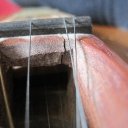
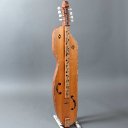
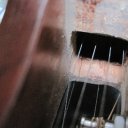
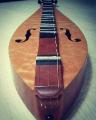
Fretboard Crack!!
Instruments- discuss specific features, luthiers, instrument problems & questions
Another shot...
Lois, once upon a time it was http://www.dulcimersessions.com/ .
Speaking as another Lois who has found Lois Hornbostel's arrangements worth seeking out, I'd like to ask if anybody has the address of the old site. As a librarian I know a few tricks for navigating back into the internet after a website goes down, but will need to know that address.
I'm happy to see this back online!
Not too light.... a bit light. But since you're playing bare finger chording and bare finger strumming, and are just getting started, the slightly reduced string tension will help your fingers. I play Noter & Drone style, and would probably use a .022, .014 and .012 strings. With experience you'll discover which strings work best for you. Strings are cheap, and finding which strings work best for your style of play is part of learning the art of the dulcimer.
That .020 should be a wound string; the others should be plain steel. The only other thing you need to know to buy or order strings is what kind of ends the existing strings have -- brass ball ends or plain loops.
Thank you, Ken! Great advice on trying different strings... I had one of those "I should have had a V-8!" moments when I read that! Of course! I'll pick several different ones and try them out. Figured out the loop or ball part too! Thank you so much!
The strings recommended could be considered light so you could go to .022/023-.013/.014-.011/012. The lighter strings are easier to press down at the expense of a little volume. It doesn't really pertain to experience, but more to how the feel to your fingers and personal preference.
Selah, you are getting good advice and the members here are very knowledgable and have help me tremendously. From a personal perspective, I don't really care for the 'twang' or ''buzzing'/'squeal' you get when using a wound string. It is a matter of personal preference.
Not too light.... a bit light. But since you're playing bare finger chording and bare finger strumming, and are just getting started, the slightly reduced string tension will help your fingers. I play Noter & Drone style, and would probably use a .022, .014 and .012 strings. With experience you'll discover which strings work best for you. Strings are cheap, and finding which strings work best for your style of play is part of learning the art of the dulcimer.
That .020 should be a wound string; the others should be plain steel. The only other thing you need to know to buy or order strings is what kind of ends the existing strings have -- brass ball ends or plain loops.
The strings recommended could be considered light so you could go to .022/023-.013/.014-.011/012. The lighter strings are easier to press down at the expense of a little volume. It doesn't really pertain to experience, but more to how the feel to your fingers and personal preference.
Thanks for the link, Ken. I was looking for this a while back and couldn't find it.
Go to www.strothers.com and enter your VSL -- the distance between nut and bridge. Then enter the basic tuning that you are using -- DAA or DAd (not DAD or you'll get the wrong string size) one at a time -- and the calculator will do all the work for you.
Brand is irrelevant -- there are a literal handful of companies in the world which make music wire of various gauges, and they sell boxcar loads of the stuff to Martin, D'Addario, D'Arco and other string "manufacturers" who put on the ends (ball or loop), cut the string to various lengths, and put them in packages. It's all the same wire, regardless of the name on the package.
Personally I buy strings from www.juststrings.com because I can buy sets of strings for under $3 per set instead of the $5 to $8 you pay for brand name strings from a music shop.
When it comes time to replace the strings, only remove and change one string at a time. If you remove them all, you stand a chance of moving the location of the bridge, which can really mess up how your dulcimer sounds...
Thank you, Ken! I did go and use the calculator... results were 0.20 / 0.13 / 0.10 for DAd Skip mentioned below that the results may be too light. Any thoughts? I appreciate all your help!
This will help. The results are a bit light so you can increase the size a couple of sizes. You should be aable to find single strings at a local music shop.
http://www.strothers.com/string_choice.html
Thank you, Skip! That helps a lot... Can you help me to understand your comment about the strings being light? Are you saying a thicker string would be better as a newbie? or just in general. (totally green here!) thanks!
David Bennet posted this on ED the other day. The archive was on-line somewhere else a few years ago, and disappeared. Now it's on ISSUU:
https://issuu.com/dulcimerplayersnewsinc/stacks
Go to www.strothers.com and enter your VSL -- the distance between nut and bridge. Then enter the basic tuning that you are using -- DAA or DAd (not DAD or you'll get the wrong string size) one at a time -- and the calculator will do all the work for you.
Brand is irrelevant -- there are a literal handful of companies in the world which make music wire of various gauges, and they sell boxcar loads of the stuff to Martin, D'Addario, D'Arco and other string "manufacturers" who put on the ends (ball or loop), cut the string to various lengths, and put them in packages. It's all the same wire, regardless of the name on the package.
Personally I buy strings from www.juststrings.com because I can buy sets of strings for under $3 per set instead of the $5 to $8 you pay for brand name strings from a music shop.
When it comes time to replace the strings, only remove and change one string at a time. If you remove them all, you stand a chance of moving the location of the bridge, which can really mess up how your dulcimer sounds...
This will help. The results are a bit light so you can increase the size a couple of sizes. You should be aable to find single strings at a local music shop.
Hello. I would like to replace the strings on my new-to-me dulcimer... I noticed a few of the strings have a small amount of rust. I am not sure how old these strings actually are so I figured best to start out with new ones. Anyway I would love to hear recommendations for strings... Brand and size would be helpful. My dulcimer has a 26.5" fret board from nut to bridge. I am learning chords and picking with just my fingers and not using a noter or pick, plus I'm a newbie player, if that matters any also. Thank you in advance for your thoughts on the subject! ~ Selah
Back in July I sent an email to Lois Hornbostel asing about this issue and suggesting that if Mel Bay was no longer willing to host the Dulcimer Sessions material we could find another site to do so. Just today I received this brief reply: "I'm working on it."
Let's hope she succeeds.
Well I have 3 of my dream dulcimers, now there is just one more which is a hogfiddle by Bobby Ratcliff.
Then a TMB by John Knopp would be nice.
I've learned over the years how helpful it is to figure out the essence of a tune, what is tune at its most basic form. The necessity of working on this skill became clear when I was honest with myself about my own limitations as a player.
Mark said if you'd like to send an mp3 of you on PAR, he'll put back-up to it. Just let me know. :)
Robin, it's a skill, isn't it, to be able to hear the essence of a melody without all the clutter? And fiddles add a lot of clutter, that's for sure. I sometimes examine several examples of sheet music for a tune I'm working on. By looking at what they all have in common, you can sometimes isolate the core of a tune. Sometimes when I hear a fiddle tune I feel like the Austrian Emperor in the film Amadeus, who tells Mozart that his music has "too many notes."
Maybe you can lend me Mark for 15 or 20 minutes. A guitar accompaniment to my flatpicking version of "Pig Ankle Rag" would help out a lot (and maybe hide some of the imprecision in my picking). If I knew how to do even basic home recordings I would record my own guitar rhythm track, but I have no idea how to do that. Poor, poor ignorant me.
Dusty, I look forward to hearing your Pig Ankle Rag! I've heard it played on hammered dulcimer but don't recall having heard it on mountain dulcimer.
I've been thinking on Cattle In the Cane this morning. First, I need to experiment with tunings to get an appriate key. Then, since I'm dealing with a real fiddle-y tune (lots of notes), I'll work on the process of subtracting notes because there's no way I'll duplicate what a fiddle is doing.
My dream dulcimer at this point ... a large body , shorter scale VSL (25"), with false bottom - want the volume!  Built in pickup and chromatic setup. Wood, I am flexible but ebony fretboard would be nice. Played a McCafferty dulcimer at Evart with a lot of these features - nice but open to suggestions....
This is a good topic for conversation, Robin. Thanks for posting. I may indeed have multiple responses.
There are lots of tunes that I would love to play but don't really "hear" yet on my dulcimer. But there are also a couple I've been working on a really long time. I've been practicing "Pig Ankle Rag" for a few years now. It took a while just to figure out all the notes for both the A and B parts. Then it took a while to figure out the syncopated rhythms. But I've been playing the tune for a long time, just working on getting it smoother and cleaner. Someday I hope to post a version that I'm happy with. But playing the song is also just a great flatpicking workout, so even if I never get the tune ready for prime time, I know my technique is improving as I keep working on it. My pinky in particular has been strengthened immensely by trying to play the tune.
I've loved the tune Cattle in the Cane for years! Betty Vornbrock of the Reed Island Rounders fiddles it beautifully. And on their cd Hell up Coal Holler, Gerry Milnes (fiddle) & Lorraine Lee Hammond (Appalachian dulcimer) play a really nice version of the tune.
Right now, the tune feels out of reach for me. . . Maybe someday I'll work up a noter/drone version.
Do any of y'all have any out-of-reach tunes now that you hope to figure-out someday?
That is quite distinctive. And I don't recall having seen the exact form on a mountain dulcimer before.
No label, hence my question...
My bad description -- it is a deep grooved circle in the scroll end of the head. Easy to make with a router and some router-experience.
No maker's label inside?
A closer view may clarify. The scroll is not a spiral but a concentric ring; it tapers dramatically from 36mm to 6mm. I will defer to your experience but I have not seen one anything like this.
https://www.banjohangout.org/photo/230369.
[I tried loading pix directly but when I tried both JPEG and PDF it said it had to be in JPEG or PDF format. IOW, it didn't recognize my formats.]
My current dream instrument is a Mike Clemmer, church dulcimer with butternut top on walnut body. Thanks for your attention
To me those scrolls aren't particularly distinctive. I've seen a lot of builders make that sort of 'grooved scroll'.
It's not square inches of sound hole per X amount of surface area... the equation uses the volume of the instrument, not the surface area, so the shape of the instrument is irrelevant -- hourglass, teardrop, box, little brown jug, bowed psaltery, violin, etc. For dulcimers I use, as a rough guide, the area of 4 American quarter coins -- not as much as 6, not as few as 3.
The shape of the soundhole(s) is irrelevant. It's the square area of holes that matters. Too little soundhole area and the instrument is muted. Too much soundhole area and the instrument sounds "brash". There's a complex formula called the Helmholtz Equation where you can calculate all this is you like partial differential equations. But most of us just say want 2-3 square inches of sound hole area for a 'good' sound.
You can certainly do leaves -- Cripple Creek was famous for their Aspen leaf holes -- and any decent luthier will know how many leaves to get the right sound...
I once built a replica Baltic Psaltery, on which the original instrument had just over 100 soundholes arranged in a spiral design, each hole was a hair less that 1/8" diameter....