How to form a local dulcimer group
General mountain dulcimer or music discussions
@dulcinina Way to go! And thanks for the update.
@dulcinina Way to go! And thanks for the update.
Here's an update on forming a dulcimer group. I have 4 people in the group so far. I had a PSA on the radio and sent emails to those who were in the group before. No one from the old group came but the 4 who did heard about it through word of mouth. They are beginners but know a little about the dulcimer and are very enthusiastic. So while I was hoping to just be the coordinator/leader, I am teaching basics. It was a lot of fun and I'm looking forward to the group growing. Thanks for your input a couple months ago. Oh, we have free space at our local Carnegie Center, a venue for music and art exhibits. We decided to meet twice a month. The group is going to work on coming up with a name. Things are looking good. Dulcinina
It eliminates most of that awful sound the bass strings makes when the finger slides up or down the string. The tuning does not change.
@annie-deeley Look for the emoticon on the second line of strip at the top of the box in which you make replies. 
Can't say enough about what FOTMD has meant to me in the last 2 1/2 years...but, um, where do we keep those smileys, so I can give y'all a hug?
No, but I've seen them; better for sittin I use a waiter's tray table
Has anyone modified a keyboard to use for the dulcimer while standing to play?
I remember seeing some comments about using a plain string for the bass rather than a wound string.
Can anyone offer some enlightenment about why and also what tuning you use when you use the plain string?
Folks, I am one of the newest members here and this forum has already been invaluable in helping me learn about both building and playing a dulcimer. Let's ALL chip in so Strumelia doesn't have to support this website out her own pocket; it's valuable to all members in so many ways. 
Caleb, I do not use a heating blanket for bending the uke sides. It was just too much for me to invest in for this project. I steam the sides and then place them in the bender. I use a heat gun to heat the sides as I bend them. I make a sandwich of galvanized steel, wet paper towel, side, wet paper towel, and galvanized steel. The first bend went well. I'll see how the rest do; especially when I change from mahogany to rosewood.
Ken
"The dulcimer sings a sweet song."
Wow Ken- looks like a great (and extensive) project! Hope you keep us posted, along with photos, as to how they are coming along!
Do you use a heating blanket for bending sides?
WOW, working on 6!! Can't wait to see them. All the best.
Work on my 00 size guitar is stalled as my friend who is helping me with it is renovating his home. The renovation is taking most of his time, so we do not find time to get together. So I looked through my shop and discovered that I have lots of scraps waiting to be used on other projects. When my son was here from California in June, I asked him if he would be interested in a soprano size ukulele for himself and one for his son. He replied in the affirmative, so I decided to go ahead with the project. I am now making six ukuleles; three from mahogany and spruce and three from rosewood, spruce, and mahogany. I spent the last few weeks thickness sanding wood, making forms, and other prep work. Today I bent the first set of mahogany sides. I have one neck roughed out. Here are a couple of photos of the bending.
Patsyannie, I have owned my Banjammer (made by Mike Clemmer at Wood 'n' Strings Dulcimer shop in Townsend, Tenn.) for 8 years. I have never mastered playing the "real" banjo playing techniques (like "claw hammer") but I really like the sound you get when you play songs like "Camptown Races". I also play slow songs on it though...it's a lot of fun to experiment!
For anyone who is interested in learning to play a Banjammer (which you can play like a dulcimer or play it clawhammer style like a banjo) the Clemmers will be hosting the 5th annual Banjammer Gathering in Townsend, TN the first weekend in October. Here's a link http://www.banjammer.com/ I went the first and second years and it was a LOT of fun!
They have classes for beginners/novice and intermediate/advanced levels.
Hearts of the Dulcimer Podcast - Episode 28
A Conversation with Judy Collins

We spoke with legendary award-winning singer-songwriter Judy Collins about her good friend Richard Fariña. We also explored the importance of Judy Collins’ Fifth Album in introducing the dulcimer in the mid-1960s. With additional commentary by Neal Hellman and readings from Richard Fariña’s cousin Omar Lugones.
Hearts of the Dulcimer Podcast can be found on most podcast apps.
Here's the link to Hearts of the Dulcimer on iTunes: http://bit.ly/hotdpodcast
Don't use a podcast app or iTunes? You can listen to all the podcast episodes directly on our website: http://dulcimuse.com/podcast
We also have a resource page for every episode, where you can find photos, videos, and song lists. Here's the resource page for this episode: http://dulcimuse.com/podcast/resource/028.html
Wow, George, that is a big critter! Enjoy!
Well, I got the 6 string Presnell all fixed up, re-strung and tuned.
Knew about the crack on the back but found some fairly serious separation on the tail in several places. But got some feedback and had all the proper clamps etc. to fix it up, can't even tell there were any issues now!!
I was surprised at how large this dulcimer is. My 1966 3 string is 34 1/2 long, VSL of 29 inches, 4 1/2 inch upper bout, 6 inch or so lower bout, 1 3/4 inch deep body.
The 1972 6 string is 42 inches long, 2 1/4 inch deep body, 5 1/4 inch upper bout, 7 inch lower bout, and a 3 1/4 inch VSL !
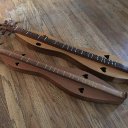
Sounds great, I've attached a couple photos to show the size contrast.
I love a success story!
Yes, for sure it has a very big Hummel like sound and tone, I have done a variety of tuning it it and seems to play well in most, great fro jam sessions, can be very well heard with accompanying instruments.
OK, so the VSL scale length is 28 1/2"... that actually the same I believe as a typical McSpadden dulcimer- that's not unusually long at all! It's apparently the other dimensions that make it 'big'- and the 6-string two inch wide fretboard is quite wide. The 3 " deep body is very tall as well. Seems like it'd have a big boomy hummel like sound with all thos strings and the big soundbox.
Thanks for the reply's! Sounds like Linda's may have been the original tuning for this dulcimer. Ken It may have been set up to play Galax because of all the small strings but hard to play because it has 6 strings the fret board is 2" wide the peg head is massive, biggest one I've ever seen it is 9" long and 2 1/2 ' wide 3 1/2 inches deep where it connects to the dulcimer. I named (Baby Hewie ) for those of you that name your dulcimers. Lisa the VSl length is 28 1/2 " nut to bridge I've always wanted a bass and thought this one may make a good one. Am I wrong in thinking that because of its size it would make a good one or does that matter?
The long size of this dulcimer means you will have to calculate what gauge strings to put on it in order to get a particular tuning you are after. You won't be able to simply tune it like a regular mountain dulcimer or a regular Galax dulcimer, without paying attention to string gauges (thicknesses).
George gave the overall length of 44", but you really need to tell us the scale length in inches: from nut to bridge.
Glenda -- your dulcimer sounds as if it were set up to be a Galax style instrument without having the double back. It would be tuned ddd (not DDD).
To change it to a bass instrument you would need to replace all of the strings (one at a time), and re-tune.
Search George's posts, because he put up a sound clip just a couple of weeks ago! I think the thread was "How Do I Tune This Thing?"
I have one of these dulcimers now too, and when I got mine the two center strings were tuned an octave apart, with strings gauged for that purpose. I've just left it because it gives a very different, rich sound!
George I have this exact same dulcimer. Iv'e had it a couple of years. I know very little about it. How did you determine it was a bass dulcimer? mine is strung all across with what looks like .09 strings I was just thinking about turning it into a bass . strange that I should see this post! What size strings does yours have on it? How does it sound? It just makes seance now that this should be a Bass . Do you have any sound clips ?
What a cool find, George!
Hearts of the Dulcimer Podcast - Episode 27
Dulcimer Week in the Wallowas
Dulcimer Week in the Wallowas is an annual adult music camp held over the July 4th week and is devoted to learning the mountain dulcimer. This episode is about our experience at the camp with interviews and music from the festival instructors and attendees. Featuring Heidi Muller, Bob Webb, Stephen Seifert, Aaron O’Rourke, Rob Brereton, and the 2017 attendees.
Listen to the episode, see photos, videos, and more: http://dulcimuse.com/podcast/resource/027.html
Such decisions. Definitely want a traditional instrument for noter drone playing.
Richard, I don't think you can go wrong with either Dan's or John's. You just might end up with both, lol 
Thanks, Patty. Beautifully done and beautiful voice of the dulcimer.
Richard, I just linked to my Old Joe Clark video. I am playing one of Dan's traditional dulcimores.
Gail... thinking of you today. What you did was so full of love and strength.
I'm afraid the closest I came to the porch thing was that I spent several hours painting our new porch doors with several coats of blue paint before they are to be hung. Had to work against the clock today, with more to paint on them tomorrow... the paint (primer plus two coats) has to all be totally dry by Monday morning early when the guy comes to put the doors on.
I played my baritone ukulele in Gail Weber's living room....that's as close as I came. Tomorrow afternoon we'll be joined by Karen Smith Gratto and we'll play whatever comes to mind.
I packed-up Mom, Dad, and a mountain dulcimer and we met my favorite guitar player about a 50-minutes drive from here at my folks'. We really wanted to participate. :)