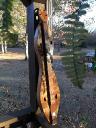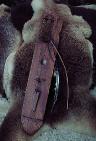
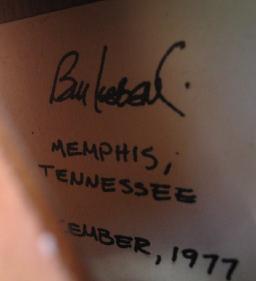
Label reading help/late revival dulcimer
Instruments- discuss specific features, luthiers, instrument problems & questions
Alas, Jim Woods at McSpadden didn't recognize these when I asked him a few years back.

Alas, Jim Woods at McSpadden didn't recognize these when I asked him a few years back.
Yes, email info@mcspaddendulcimers.com I am sure they will be happy to confirm or deny. 
Yes, it's a late 1970s kit -- I've seen many of these instruments, for which even identical stick-on "builder's label" was apparently provided. In fact there are three of them, identical in virtually every respect, in my shop.
They are very good instruments. Many (like this one) intone very accurately, which is a surprise. That precisely why I wanted to see if the assembler might still be with us.
I've never connected them to McSpadden before, though. TK-9? Do you know of some way I might substantiate this?
Here's another one, same era, pretty much identical:
http://s302.photobucket.com/user/pristine2/slideshow/78%20kit%20Keuhle
I'm with Ken. It looks like it's maybe a McSpadden TK-9 kit.
Maybe you could contact a dulcimer group in Memphis and see if they know anything.
good luck
Ken;
Thanks for adding John's website! I found John's bio on that site very informative. Military Veteran, engineer, music arranger and author -
PRETTY IMPRESSIVE.
Jim
That certainly is difficult to read Richard. Looks like it might have been made from a kit.
Ken
"The dulcimer sings a sweet song."
Jim, John does indeed produce some fine books. I am glad that you found them and like them. For those interested in learning more, here is a link to John's website: http://www.johnsackenheim.com/John_Sackenheim/Home.html
Ken
"The dulcimer sings a sweet song."
Recently I purchased some tab books from John F. Sackenheim. The book I am learning from right now contains
country and western songs from the 1930's, 1940's and 1950's. He has many other old country tune books available,
and also has Gaither music.
I think John's material is very well done and highly recommend these books.
Yep, Nimrod, there are all sorts of considerations. All things considered, if everything else was the same, wood, shape, vsl, and sound, I'd go with 4 strings. Yep, you can take one off or you can play 4 independent strings or you can have a double course. I'd rather have 4 strings than a 6 1/2 fret LOL, but I'm weird.
Some more pics here:
http://s302.photobucket.com/user/pristine2/slideshow/Dec%201977%20Kit
The first name is Bill, but I cannot make out the surname. Any guesses would be appreciated ...
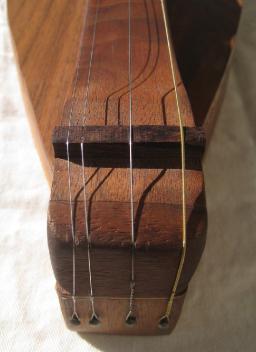
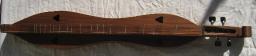
Three strings or four??? YES! Welcome Nimrod!
If I were you, I would choose the dulcimer that has the LOOK you want -- shape, woods, size, etc. And, the one that has the SOUND you want.
As you say, if you have 4 strings you can remove one; but quintessentially the dulcimer is a three-course stringed instrument -- bass course, middle drone course, and melody course. Any of those can be doubled (or even tripled) for a variety of purposes. But for ease of learning three strings is, IMHO, optimal. Whether the dulcimer you end up has 4 strings and you play only three until you get experience, or only has 3 strings to start with, doesn't really matter.
As someone who is a complete beginner who is looking to purchase a mountain dulcimer, I would like to know how many strings I should go for when looking at potential instruments. Is it easier as a complete beginner to start with the basic three strings or should I go for an instrument with four strings and simply leave one off. I use to play the electric organ but have never played a stringed instrument so at this moment in time I am completely in the dark. I have some dexterity issues in my right hand due to having mild Parkinson's so having given up the organ, I desperately feel the need to create music which I love.
Thanks Kandee! I sew, but I don't quilt. Please share a photo of yours when you are done creating. I don't have any trouble finding my stand when coming back from a break at a workshop, and I think it's fun to be different.
Looks like it's made of Meranti, enough to put me off straight away.
guy,
Both music and the dulcimer are great therapy, it is so nice you have passed your dulcimer on with it's 'big voice' - Hopefully it continues to sing.
They may have different sounds, the noter better slides sounds but with the finger you could add additional notes for sometimes a fuller sound. Both nice and nothing wrong with either or both ways at different times. As we learn we grow, as we grow we learn - a wonderful adventure.
Thanks Kathy and Marg. It's going to be an interesting experience. I am anxious to get lessons started and learn if I can play by fingering or if I will be a 'noter'. Either way is fine with me.
Loved your story dusty but was worried a 13 year old was off across the country on his own.
Kusani, your dulcimer is beautiful and wish you lots of enjoyment with it.
suzannbakkey & jan
Do you feel Warren May dulcimers sound better played with fingers or does it also sound sweet with a pick or noter? Warren uses his tick tock strum with fingers and that is the only way I have hear one of his dulcimers. Also do you tune in any tune or do you keep it in DAA?
Robin,
Surfing this site, I saw where your 'Bird Rock Dulcimers' site was mention to a new member. I wish I was passing by, would love to come in and see you, your instruments and say hi. Very Nice and well done.
I, obviously, need a pair of those glasses, too.
Bill
Strumelia has special glasses to look through when inspecting instrument photos. And I suspect they give her x-ray vision, too! 
Shoot, Lisa, if you "insulted anyone" for giving your opinion, then let 'em get over it or seethe to themselves.
Good points, actually; some of what you mentioned I hadn't noticed, so.... maybe, maybe not. Next time I'm tempted on a weird one on ebay, I may ask you to take a look at for me. 
Well, Rob, I'm glad I didn't ask. lol
Bill
Well ok since you ask , Rob, I'll be honest...
There are many elements of this instrument that I feel are not of high quality and don't suggest to me anything beyond a low 'hobby level' maker slapping stuff together- the sharp unfinished fret ends, the very weird 'tailpiece' with guitar string anchors and its dark badly varnished strumhollow (and what is happening on the very end of tailpiece there where the top soundboard ends?). The chopped up re-purposed (mandolin/guitar) tuners, the super high applied fretboard (was that added on top of the original fretboard?) which creates a bad angle on the strings at the nut, the crude blocky heart soundholes, and the high gloss 'finish' on the peghead and elsewhere. It just doesn't strike me as any kind of skilled maker or quality materials.
The case- don't get me started..lol. Putting aside the rotting crumbling foam and the 1970s yellow carpet remnants (who knows what may have happened on that rug during its sordid past..) - the handle, latches and piano hinge are all the cheapest of the cheap, crudely bolted right through the super thin plywood. They didn't even bother slapping finish on the plywood underneath the leather handle...uh, too much trouble? 
Don't get me wrong- I can really appreciate a homemade wood case put together from recycled material...but a good craftsman will create one that is a thing of beauty and carefully made to protect the instrument, last a lifetime, and be a real pleasure to touch and use. I have a 'rustic' case made from discarded plywood, a thrift store Norwegian wool sweater, an old leather belt etc... made for me by fotmd member Michael King (who makes fine strumsticks and lyres, by the way). It's beautiful and is truly a marvelous thing made with skill and love.
All that said, I'm sure whoever made and used this dulcimer and case must have enjoyed it, and that's well and good. It's just that I wouldn't buy it myself, even if the price was cheap.
Everyone's idea of value is very different. My apologies to anyone I may have unintentionally insulted with my above personal opinions ...which are worth approximately two cents. 
In any case, this auction and thread was from back in Sept 2015.
OK, I'll be the one. Why not, Lisa?
Marg the good news is that it takes a lot less tension to tune light gauge strings to pitch than heavy strings. The dulcimer in my avatar is 25" and tunes very easy with .010 strings. I use viola pegs on that model. Once the strings got settled in I only have to tune it once every few months!!!. Robert.
Thanks dan but i'm good for now, was just thinking about later when I get older & hands would hurt. That would be a problem for many things. Maybe I will end up with a great dulcimer where the wooden pegs get set and hold beautiful ;-)
Swimming against the tide here, but I myself would not buy it.
The case would be worth the price by itself.
Bill
Dusty, check out the Roland Mobile AC Acoustic (I put a link in my previous post....$129).I don't think I'd need the adjustments for keyboard, electric guitar, etc, that comes with the Mobile Cube. What do you think?
Get a Roland, as Ken, Skip, and Kristi suggest. It's on my wish list, too. I had a chance to use one for a spell this summer and was really impressed. The MicroCube sells for around $150 new and the bigger MobileCube for about $180.
I also have a Fishman Loudbox Mini that I love. I used to have one of the little Honeytone amps that Marg mentions. It was fun for creating classic rock guitar sounds and stuff, but as Kristi says, it doesn't really have enough power if you want to play a small room. I ended up selling it to someone here at FOTMD for the price of shipping.
I like the wooden case, would like to see more wooden ones.
Marg, if you suffer from a lot of hand pain or arthritis then wooden pegs are likely not for you. One of our members who is only about 40 sold his beautiful McSpadden vintage 3 string because of his arthritic hands. I'm 69 and fortunately do not suffer any hand problems (counting my blessing for that for sure). I wish this had come up earlier in this diiscussiiion.
All the best to each of you, may your year be good and thank you for all the friendly help you have so kindly given over the years.
Robert,
Well hopefully I will have my one dulcimer with wood pegs next week. I am looking forward to it but still a bit unsure as to how I will get on with the tuning of them. Seems, as I get older and my hands hurt will be harder to turn and give a firm push in to set.
There is a small mini amp - HONEYTONE - 9 volt battery or optional extra plug in. About $30.
Most music stores carry it or check it out on line.
Thanks for the replies so far. I'm really liking what I'm seeing with the Roland Mobile AC amp.
Maybe I'll take a trip to Elderly with my dulcimer in hand and see how it does. Glad to hear the Rolands are well respected. They seem to get good reviews on-line.