Hard to see text box, linksmenu- on mobile tablets
Site QUESTIONS ? How do I...?
Don't you love it when a problem solves itself? 
Don't you love it when a problem solves itself?
Boy if you had worded my post, I could have been a lot shorter. You've got it my friend. The two modes I made mention of even though I played in them both a bunch, now with the prospects of only one dulcimer I know immediately which mode will be chosen. I also have an offer to build a full size double and of course I'd be back at having both modes. Time and finances will tell. The one comes with a six month wait and I'm back to testing my patience on that decision so....... Kevin. (P.S. it really is a desease so you might as well catch it and enjoy the ride)
ken,
You say you have 4, 2 traditional and 2 modern but I read you have built 300, very impressive to have played so many fine instruments even briefly.
I like your photos of the birds, I have herons, spoonbills, pelicans, an eagle and a few other types visit the pond behind my home. Haven't seen yours but would be nice.
I love eveyones replies, sounds like 'buying the next dulcimer' is just another part of learning the dulcimer experience. We don't know what it is we like, to we try them out. Some we keep, some find a new home while we try yet another till one day, we have the ones we have been searching for. Many years can go by and what we were looking for in the beginning is not necessary what we are looking for later on, just as our playing can change over time.
Thank you all, I think as we look for our next dulcimer it is all a part of where we are going with learing the dulcimer.
Well, that was easy! 
Skip, thanks, works for me too, if I rotate my kindle to vertical position. Problem solved.
The box moves up automatically on my p900. on the nook hd+ I just drag the text box up to clear the keyboard.
Well I've been the full gammut on dulcimer collecting. At first all I knew was the hourglass vs. the more traditional teardrop. Oh and of course there are different Modes that are played so I soon after starting acquired an hourglass in DAd and a teardrop in DAA. Those were the two modes I ended up playing in. Not because of those modes particularly (wait I just said tunings and not the Mixalodian and Ionian modes respectively), but because that's the tunings/modes that all of the tab books were written in. Now far as that goes I knew standard notation backwards and forewards, but early on I decided upon tab and to not care about what notes I was playing. By not caring I didn't have to count from the open string to what the note actually was. So another mode was not going to tempt me, but how about a different dulcimer?
Yep, that did it. I saw a book that had a courting dulcimer and I had to have one. I commisioned one to be built in solid cherry. Great large instrument and was rarely played as built, but for me solo, I now could play in the two modes I knew just by flipping the instrument around and having a go at the other side. Great! Then I messed around with a slide guitar and loved the sound only to find out that a dulcimer was made with "high strings" to be played with a slide. Yep one of those too please. Then I saw a "walking dulcimer". Strung backwards and nifty as all get out, that was the next insturment in my house. All this with three courses or four strings, Melody course was a pair of course. That was until I found out about a church or six string dulcimer (after which I only buy six string dulcimers). Then I heard about an octave sized one and then a baritone octave sized one (Ron Ewing here) as well as a true baritone. With Ron Ewing I found that the hourglass and teardrop was not the only two shapes. He lists a few of his own including the Aorell, which has an hourglass double bout side next to the player and a modified teardrop (higher bout in the center rather than lower on the instrument) opposite the player. With this instrument you get a larger sound body for deeper tones but maintain a close to the body hourglass for easy play.
There are reasons for each of the above mentioned variations on a similar theme and some you realize are really important (at least to you they are), both from a sound or looks department. The last variation I obtained was a double dulcimer. Like the courting dulcimer with two fretboards, but these are aligned so that both can be played by one person. No flipping or having to get your neighbor to play a tune. Did I mention electronic pickups? Our predecessors in this venture called DD dulcimer desease, didn't really have a problem as they (if they were fortunate) had one instrument and that's it. Changing modes meant changing tunings which meant occasionally breaking a few strings. And although with my courting and with the double I tried to do it with one instrument, it would not cover all of the reasons that my collection rose to 25 pieces. Each one of those instruments was different in some manner, be it modes, pitch (most were pitched in G a fifth lower than normal and the rest in D), and then the last problem for me was woods and finishes. Yep color made me buy it (I'd tell my wife), well that never went over at all with her. Now do to expensive problems I had and that of my family I was forced into a big instrument sell off, now trying to recapture the best of the best in my (what will probably now be) last instrument of dulcimer persuation. I don't know if I'll be able to talk the builder into it, but I'm sure going to give it a try since I know if I can get it, I'll not be tempted as before into a house full of dulcimers. Most of my fellow dulcimer players have around three to half a dozen. I was most happy with that same number as I had the two modes I play in covered and an octave one to be able to play on trips I had to do to see doctors. That worked out the best.
Second to that as I was liquidating my collection was to have the double in the two different modes. Again so I could play any tab that I had in a familiar mode. Lastly and what I will be content with after all those dollars went by by, will be to get a really special dulcimer that will most likely be converted and strung in G a fifth lower than the standard D and to have six strings, but not in unison as I'd done before. Rather this six string dulcimer with have octave strings on the lower two drones while the melody string pair will indeed be in unison. I will take pictures and show all once I have what will be my very last dulcimer that I'll be perfectly content with. Unless you can see ahead and ilimenate all the fluff in the dulcimer world and settle into what you know will make you happy, you'll be destined as was I to buy a bunch of dulcimers and keep them, or as you asked in the OP, to sell one in order to buy the next. That by the way is exactly was I was doing, but only when I happened to have 25 of them sitting in the house. Best of luck to you my friend and please be sure to post whatever you decide and end up with. Kevin.
I have 7 Appalachian dulcimers here at home and two out on loan. A few are diatonic instruments and a few have the 6.5 and 13.5 frets also. I use a variety of tunings; my box dulcimer is always strung with light gauge strings and tuned to ddd. Each instrument has a unique voice-- and I like that!
Hi, I am unable to see the text box when my tablets virtual keyboard pops-up. Is there a remedy for this?
I saw a stick dulcimer at the flea market on Sunday. It was pretty old, and someone had replaced the pegs with cheap plastic ones. That didn’t stop me; I figured I could replace them. It was pretty nice otherwise, but then I found out he wanted a hundred for it. I picked it up to look at it more closely, and maybe talk him down. But then I saw some cracks in the bridge. It needed strings, bridge work, and tuners. Thought I almost had dulcimer number 2…
I just pick up quills (that look to be of the sizes I like) when out walking. though most of them have, likely, been attached to a turkey, I think not all I collect are turkey feathers. And I'm not too particular. :)
I now have five dulcimers and a strum stick. I thought the more dulcimers I have the better I would be able to play. lol Didn't work that way! lol
My first was a used Apple Creek student or kit, not sure, I bought used. My next one was a McSpadden teardrop I ordered custom made. then I got a like new McNally strum stick off of Craig'sList. I bought a like new used McSpadden hour glass all walnut. My last two I made myself, a mini dulcimer and a ginger sized dulcimer. I am now making a stick dulcimer of my own design. lol When will it stop?! lol
It cost me a buck for five, so I’ll chalk it up to an experiment, and let you know how it works out for me.
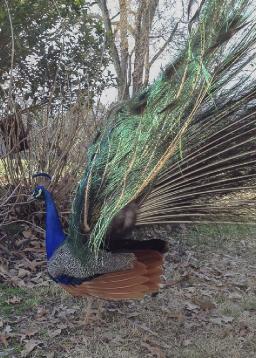
Peacock quills sure are pretty, but they aren't particularly strong, and may not last long as a plectrum. Let us know how they work.
I have two traditional dulcimers, and two "modern".
The Traditionals have narrow, thin bodies for that 'high silvery' sound I love:
a John Knopf Uncle Ed Thomas replica. 3 strings, wooden pegs, footed for playing on a possum board
a Bobby Ratliff Virginia Hogfiddle. 3 strings, autoharp tunning pegs
The two Moderns are:
Harpmaker Student, slighly customized -- higher fretboard for N&D playing, special short head with autoharp tuning pins, and 3 strings
Til Holloway -- made by my dulcimer building mentor. Doubled melody strings, 6+ fret. I have this one in memory of Til.
Would I sell any of them? I dunno -- make me an outrageous offer!
A interesting post for us beginners world be where members posted photos of their favorites. Would give us an idea of how many are around and what it is that makes the dulcimer a favorite one.
Love it' 'just one more' and yes there are more out there and beautiful.
ok so I need to look not just for another but the next one.
Oh boy, I think I will need not just a space but a room.
Thanks
I once asked my brother what he wanted for his birthday. He said "CDs and Music Scores." I replied, "you already have tons of CDs and music scores." and ye said "yes... but I don't have them all."
Well, I'm probably not the best person to answer this, but I have between 25 - 30. They range from knock about loaners for beginners to collectables. Yes, I have some of the ones I play regularly tuned differently. How many do I need? Just one more, that's all. Actually, I am looking for "just one more" to share stage duties with my Rockwell as I've been taking around one that developed a couple of small cracks. On the table beside me is a small one tuned DAd and a larger one tuned DAA in case I need to try out a tune. Space, budget and desire are all considerations.
I have 3 dulcimers, 2 I play all the time and both tuned the same. The third, I lend out if someone is trying to decide if they are instreated. I am looking for another and that would make 4 but not thinking of selling any of the ones I have. I can't decide between a nice unique one for playing and having in a different key or a knock around one for practice, grandkids, travel or friends. I can see I will be looking for yet another soon after this next one. How many is too many where one would need to find a new home - Is it based on favorites or space and budget?
What is the advage number of dulcimers members have and once we reach the number that fits, if we would want another - would we than sell one or just have yet another dulcimer and a new favorite?
Cool, Sheryl! A quill makes a really nice sound on strings.
Picked up some peacock feathers at the flea market today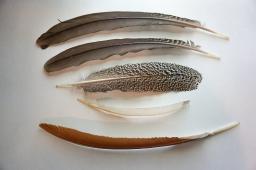
You DO know that the federal government passed a ruling last year that says airlines must allow you to take your instrument onboard as long as it fits in the overhead. I've spoken to several guitar traveling passengers in the last few months and even they are saying they're experiencing no problems -- their instruments are being stood in the corner of the flight attendant area.
It's lovely, I'm happy for you
Thanks, sounds good. if banjo pegs or right-angle guitar pegs and these dulcimer pegs all the same size shuldn't be hard to take care of. Will see what they say tomorrow.
Thanks again
Tuner replacement is a pretty easy process, usually. Especially this kind, where you're not dealing with a violin taper in the holes. New tuners are inexpensive and quite simple to install if you're handy with tools. You could go with straight banjo pegs or right-angle guitar tuning pegs.
I really like the sound of your "Dulci Friend" and it is very cool you can make the fret board to suit you.
Here is a tune called West Fork Gals played on this dulcimer. If this dulcimer had legs it would follow me around where ever I go.  ...
...
Older tuner knobs like those were sometimes made from poor grades of bakelite and other early plastics, and often fall apart if stressed. That happened to the on I owned, as well, and I was actually going to mention this to you and suggest searching for replacement knobs. Rob is right. Offer them less than the asking price to take it of their hands. All they can say is no. You can often get replacement knobs from Luthiers Merchantile or Stew Mac or similar places for a couple bucks each.
Tell 'em you'll take it for $20 less than their asking price. Those tuners shouldn't be hard to come by!
Well I didn't get to play the dulcimer or have it follow me home. When I went to the shop, they told me as they were loosening the strings to work on the action, one of the tunners broke. It may take awhile to find one like the others (tension type). So now that I was ready to get it, can't.
This might be good to post in the general forum or the Beginners Group, so people can find it in the future! :)
The link Lisa points us to looks good to me.
Let me also suggest that you can alwasy download the free trial version of Tabledit, which lets you do digital tab up to 16 or 24 measures, I think. You have to pay if you want more than that. But you can always just print out a blank page from that software.
No, my first dulcimer I purchased quickly. I was going to take a dulcimer class at the local college and didn't have one.
Asking price is ballpart $50, so no way is it much out of pocket.
I don't play noter but could bring one to try with it and if the action is high, could have it as one for noter playing.
Yes, you are right, over thinking it all
OK, will go play a tune or two and see if it follows me home.
Thank you so much, will keep you posted.
I surfed and saw recent prices from about $50 to about $150. Bottom line is that used dulcimers are worth what someone is willing to pay for them.
I play Noter & Drone and didn't really notice the action being overly high. This was 7 or 8 years ago, when I was out in the Pacific.
As far as other things to check. Unless you've got perfect pitch I would just play the DAd and DAA scales and see how they sound to your ear. The fretboard should be good in that respect, Hondo were good 'true' instruments, not like some of the First Act and other eastern European trash dulcimers that showed up here a decade ago. Play a couple tunes. Do they sound right? No it does not sound like your dulcimer. No two instruments do sound alike. But do the notes in a tune sound 'right'. Do the scales sound true, not sour.
If the price is under $150, I think you're over-thinking the whole 'get a new dulcimer' process. If there are no obvious cracks or major dings, and the scale sounds true, just buy it. Frets can be leveled, actions adjusted, other tweaks made once you've got it home.
Personally I wouldn't worry at this point about fret level, but yes, you use a steel straight edge/rule about 6" long and stand the edge along the frets and see if the straight edge rocks or not. If you sight down the fretboard, dulcimer fretboards are often in a very gently curve with the middle around teh 7th fret being slightly shallower than the ends, but that's OK as long as the notes sound true.
Lots of dulcimers (even expensive ones) get bought on a whim, and shoved in a closet for a decade or more; unfortunately. I've seen it with $50 cardboard dulcimers and several hundred dollar Warren May and Homer Ledford instruments. Many players baby their instruments and so there aren't any 'honorable scars'.
I suspect your unsureness is simply lack of experience. Did you agonize like this over your first dulcimer?
If we are thinking this dulcimer is from the 70s-80s, it couldn't have been played very much. That's 35 + years and there is no unusual wear, hardly any wear at all and no damage that I can see. Hard to believe it coud be that old. Question than, why wasn't it played?
The action does seem high but that can be address. I still need to make sure the frets are level, how? By placing something on top and see if they rock or not? I didn't hear any buzz, so frets should be ok. I didn't fall in love with the sound. Could it be from new strings and they need time to set some or the wrong strings for this instrument or I am just use to my dulcimer?
The price is lower than a few groceries, not sure why I haven't just gotten it and started making it mine. I wasn't looking for a dulcimer and if I would be, it would be something creatative. What I find interesting with this dulcimer is the age and the red stain but not sure of the dulcimer, since I didn't love the sound.
I don't like feeling so unsure, is it because I am still very new and don't know enough? It's great all of you are so helpful, I just wish there was someone here I could take with me to check it out.
Ken
You mention you had one of these for a few years than sold, the price the shop is asking seems very resonable - what should one of these dulcimers sell for - if is an unkown as far as if it's a good one or not?