
I am very flattered that you would want tab for my originals! I'm sorry, but no, I do not have any. Honestly, after I finish writing and then recording them for memory purposes, I usually go on to the next one rather quickly and do not take the time to tab them out. I'm happy that you enjoyed "Uh-oh!". I had a lot of fun with that one.  If I ever do tab it, I'll be sure to send it your way Sharon!
Forum Activity for @christine-shoemaker


So nice Christine Shoemaker has come to FOYMD and posted some of her videos, there's great members here and all interested in - all things dulcimer. In just a few days she has gotten more views than posting elsewhere and many comments alone with, quite a few WOW'S
Joy W. said:
Marg, you're right about the collection of dulciborn videos available on the YouTube link that you posted. The musician, Christine Shoemaker, is also a member of FOTMD, but I don't think she has been active on this website in a while. She and I have worked on some dulciborn duets together and, last summer, recorded some of our efforts at a practice session. Here are two of my favorites:
Southwind - https://www.youtube.com/watch?v=WaRKcaKZpkA
On her YouTube channel https://www.youtube.com/channel/UCS9PAgUI8AfFoxZFZ_XsTcQ Christine also posted some really beautiful pieces that she plays on a McSpadden 6-string baritone.
updated by @marg: 07/16/15 02:47:21AM
So nice Christine Shoemaker has come to FOYMD and posted some of her videos, there's great members here and all interested in - all things dulcimer. In just a few days she has gotten more views than posting elsewhere and many comments alone with, quite a few WOW'S
Joy W. said:
Marg, you're right about the collection of dulciborn videos available on the YouTube link that you posted. The musician, Christine Shoemaker, is also a member of FOTMD, but I don't think she has been active on this website in a while. She and I have worked on some dulciborn duets together and, last summer, recorded some of our efforts at a practice session. Here are two of my favorites:
Southwind - https://www.youtube.com/watch?v=WaRKcaKZpkA
On her YouTube channel https://www.youtube.com/channel/UCS9PAgUI8AfFoxZFZ_XsTcQ Christine also posted some really beautiful pieces that she plays on a McSpadden 6-string baritone.
Well, I'm not posting any videos either but I do enjoy listening to the ones I can fine:
Frank Ledgerwood is a member and has several videos
http://dulciborn.com/videos.html
and
"I Wonder as I Wander" A song that came out of Murphy, N. Carolina in 1933. Sung by a young Annie Morgan at a revival meeting. John Jacob Niles happened to be there and paid $.25 each time for 8 times for her to sing it for him, so he could write melody and the 3 lines. He went on to add two more versus and publish it in 1934.
there are the ones Joy W. post above and Christine Shoemaker has several
https://www.google.com/?gws_rd=ssl#q=Christine+Shoemaker%2C+dulciborn+videos
I do enjoy my dulciborn but wish the action was a bit lower so it would be easier to play the higher notes. I have had a lot of trouble trying to set it up so it would be playable.
I hope you enjoy this site, there's lots on it and many very helpful members.

thanks for the welcome, marg.
not sure what tonal differences the two designs might have - if there are any, they're probably too subtle for my ear to distinguish. and the upper register is harder to fret cleanly - not an area that the dulciborn excels.
as far as videos go, not very likely, i'm afraid. due to minimal skills i'm very reluctant to play in public. i suppose only playing in private is a bit like talking to yourself, but for now that's ok.
I see you are new to FOTMD site, Welcome and hope to see some videos soon of you playing your dulciborm.
alan kolman said:
i've been playing the dulciborn for a year and a half. it's a 'john hawk' model that i bought from john, and it has 1.5,6.5,8.5 and 13.5 frets. it sounds great, is easy to play, and i play it every day. however, after 6 months the fretboard warped badly (it's an early, scalloped model). gold tone repaired it at no cost other than shipping, tho i will say their customer support needs improvement big time. no problems at all since then.
i love my dulciborn, but it's kinda like an old british sportscar - beautiful to look at, fun to play with, but likely to spend time in the repair shop.
First glad you love your dulciborn, as I do mine but still having trouble setting the action right to make it easy to play. It gets too high up on the higher frets to where I can't make a clear sound in pressing them. But, I did get all tangs & buzzes fixed by some sanding & filing. The new dulciborns don't have the early, scalloped model and I hope the fretboard warping has been taken care of. It's too bad the early, scalloped model had this problem and now is gone because it was such a nice design. Did having the scallop fretboard help with the sound? Sorry you had problems, I hope it wont be spending time in the repair shop but in your hands making great sounds.
alan kolman said:
i've been playing the dulciborn for a year and a half. it's a 'john hawk' model that i bought from john, and it has 1.5,6.5,8.5 and 13.5 frets. it sounds great, is easy to play, and i play it every day. however, after 6 months the fretboard warped badly (it's an early, scalloped model). gold tone repaired it at no cost other than shipping, tho i will say their customer support needs improvement big time. no problems at all since then.
i love my dulciborn, but it's kinda like an old british sportscar - beautiful to look at, fun to play with, but likely to spend time in the repair shop.
i've been playing the dulciborn for a year and a half. it's a 'john hawk' model that i bought from john, and it has 1.5,6.5,8.5 and 13.5 frets. it sounds great, is easy to play, and i play it every day. however, after 6 months the fretboard warped badly (it's an early, scalloped model). gold tone repaired it at no cost other than shipping, tho i will say their customer support needs improvement big time. no problems at all since then.i love my dulciborn, but it's kinda like an old british sportscar - beautiful to look at, fun to play with, but likely to spend time in the repair shop.
Thank you for sending the links, Southwind was beautiful and J. Stinson's #2 looked like loads of fun.
Did you have any trouble getting your dulciborn set up? I thought I had mine playing very easy with a lot action until I felt I has hitting frets, weather from too low or just vibration of the strings - not sure so ended up raising it again. Not as high as when I got it but not easy to play higher up. I can't seem to get a clear note since it's hard to press. I still like the dulciborn and hope maybe my fingers will either get stronger or someone can find the right spot for the action, not so high but not so low I buzz.
Thanks again for sending your practice sessions, great fun watching.
Joy W. said:
Marg, you're right about the collection of dulciborn videos available on the YouTube link that you posted. The musician, Christine Shoemaker, is also a member of FOTMD, but I don't think she has been active on this website in a while. She and I have worked on some dulciborn duets together and, last summer, recorded some of our efforts at a practice session. Here are two of my favorites:
Southwind - https://www.youtube.com/watch?v=WaRKcaKZpkA
On her YouTube channel https://www.youtube.com/channel/UCS9PAgUI8AfFoxZFZ_XsTcQ Christine also posted some really beautiful pieces that she plays on a McSpadden 6-string baritone.

Marg, you're right about the collection of dulciborn videos available on the YouTube link that you posted. The musician, Christine Shoemaker, is also a member of FOTMD, but I don't think she has been active on this website in a while. She and I have worked on some dulciborn duets together and, last summer, recorded some of our efforts at a practice session. Here are two of my favorites:
Southwind - https://www.youtube.com/watch?v=WaRKcaKZpkA
On her YouTube channel https://www.youtube.com/channel/UCS9PAgUI8AfFoxZFZ_XsTcQ Christine also posted some really beautiful pieces that she plays on a McSpadden 6-string baritone.

(the more you strum up the fret board, the more vibration your causing, which may make the strings contact the frets.)
Someone who has helped me in the beginning & knows Goldtone said: The dulciborn "is a guitar based, rather than a dulci based instrument. Guitars and other similar instruments have a clear picking area between the bridge saddle and the end of the fingerboard, more twangy toward the bridge. The dulciborne is much larger, more resonant , and louder than standard dulcies. Therefore, buzzes and rattles will always be more pronounced."
Could this be the case, or as the guitar center said, uneven frets?
Is this as good as they get or was I sent out one that just had a bad set up from the start & no matter what I try - doesn't seem to work?
I just don't know which way I should go with it, play as is & try not to be forceful & don't play up the fret board or contact Goldtone - and what would they do? (Would they send another, would they pay to have repair work done, would they just say - send it back?) I had thought it was a high action problem, than it was a pick up problem, now I'm wondering if it's uneven frets. How many bugs am I to work out of it before I can just start playing it?
Sorry, all very confusing & just not sure on best course of action - except maybe, become a builder quick quick.
m.
Frank Ledgerwood said:
Hhmmm, I'm not sure what the issue is now. I can strum and do from the nut all the up to the 7th fret with no unwanted change in sound. You can try shimming up the saddle or even just a piece of paper under the offending strings. Also if your fretting on some of the upper frets, say from 3 fret up and still get the sound you describe, then I wouldn't blame too low of an action. If you get the "tangs" strumming open or the first 1 or 2 frets, then you probably have too low strings.. Also the more you strum up the fret board, the more vibration your causing, which may make the strings contact the frets. As your learning, setting up an instrument is an art.....
I did the dime, nickel & they lifted the strings & were very tight, so now I'm thinking the action is too low so back I go to see about adjusting that.
Not getting the sound open but starting off with first fret on up. Will keep you posted & yes, it's an art - or many years of learning.
Frank Ledgerwood said:
Hhmmm, I'm not sure what the issue is now. I can strum and do from the nut all the up to the 7th fret with no unwanted change in sound. You can try shimming up the saddle or even just a piece of paper under the offending strings. Also if your fretting on some of the upper frets, say from 3 fret up and still get the sound you describe, then I wouldn't blame too low of an action. If you get the "tangs" strumming open or the first 1 or 2 frets, then you probably have too low strings.. Also the more you strum up the fret board, the more vibration your causing, which may make the strings contact the frets. As your learning, setting up an instrument is an art.....
Watching your videos, I see you strum close to the strum hollow or right in front of it. When I am in that area I don't get the tangs but if I was to strum up the fretboard, I start getting lots of tangs. I took the string out of the slot cut into the bone & it didn't seem to make any difference. Ny other dulcimer I can play up the fret board with no problem.
Is this a problem with the dulciborn or high frets that only cause an issue when I play close to them?
Can putting a slim under the nut take care of this without raising the action much more - highup the fret board?
marg said:
Interesting, had not thought of a problem with a slot cut into the bone. The 2 melody strings are not even down the fret board,so a little notch was place in the bone to hold in place. I don't hear a tang or chimey sound if I hit each note on it's own but when I do fast sliding the strings do ring out, how much of this is a chimey/tang & how much is the tone of the dulciborn?
How did you address your string problem to make them even & not ring out?
Should I take the strings out of the grove (both or one) in the nut & just place next to it? That also would raise it just a bit. Strange, since I have gotten the dulciborn I have been trying to lower it, now I'm raising it a bit.
Frank, you have been very helpful in all my questions. I still like the dulciborn very much, just wish I was done trying to get it set up so I could just enjoy it.
PS: the pick-up that was sent out was a little different than the one that was in it to start. The new one seem to be a bit larger & fit the slot better, had numbers on it where the older one was smaller & no markings on it.
By the time I am done with getting it set up, I should know a lot about working on the dulciborn.
Thank you, I look forward to your answers since you do know a lot about the dulciborns.
Frank Ledgerwood said:
Hhmm, the term tang? If your term was buzz, then by all means, it maybe too low or a fret may be to high(or higher than the others. If you mean a bell like or chimey sound, it's more than likely an issue with string slot cut into nut or saddle. If you fret a string and still get unwanted tang(?) than it's going to be in the saddle.
Interesting, had not thought of a problem with a slot cut into the bone. The 2 melody strings are not even down the fret board,so a little notch was place in the bone to hold in place. I don't hear a tang or chimey sound if I hit each note on it's own but when I do fast sliding the strings do ring out, how much of this is a chimey/tang & how much is the tone of the dulciborn?
How did you address your string problem to make them even & not ring out?
Should I take the strings out of the grove (both or one) in the nut & just place next to it? That also would raise it just a bit. Strange, since I have gotten the dulciborn I have been trying to lower it, now I'm raising it a bit.
Frank, you have been very helpful in all my questions. I still like the dulciborn very much, just wish I was done trying to get it set up so I could just enjoy it.
PS: the pick-up that was sent out was a little different than the one that was in it to start. The new one seem to be a bit larger & fit the slot better, had numbers on it where the older one was smaller & no markings on it.
By the time I am done with getting it set up, I should know a lot about working on the dulciborn.
Thank you, I look forward to your answers since you do know a lot about the dulciborns.
Frank Ledgerwood said:
Hhmm, the term tang? If your term was buzz, then by all means, it maybe too low or a fret may be to high(or higher than the others. If you mean a bell like or chimey sound, it's more than likely an issue with string slot cut into nut or saddle. If you fret a string and still get unwanted tang(?) than it's going to be in the saddle.
New pick-up came & has been installed. Working well, problem with the older one, wire was not connected or was loose & becamedisconnected. now still dealing with the Action, it was lowered but a hair too low now, getting a tang. I hope it can be fixed without needing a new bone.
See photo:
thanks again for all of your in-put
m.
Frank Ledgerwood said:
At least your close to getting the bugs out. I have mine set up the way I like it. Biggest dilemma, is the ovalized/oversized holes for the string pins on the bridge and a small dent on side. Poor QC. I doubt at this point if I'm going to continue to promote these. Certainly can't have them dropped shipped and between time to set up/repair/deal with issues and cost increase, it's not worth the effort. I do like the sound and perform regularly with it. Thanks for your kind words about the vids. I do need to throw a few more up. If your interested, I do have a CD and they make great stocking stuffers....
Well, you got yours set up a lot faster than I did. I still have to wait for the pick up to come before I can get that in, than fingers cross - all will work & I will also be set up. The way it should have come, since I did requested a low action several times & I was told it would be low & easy to play. (The difference of the action could be the difference of the pick up - maybe they measure before the pick up than when that goes in, it's that much higher.)
I will say because of needing to address my problems, I have learned so much more about dulcimers than I knew before. You & a few of the other members have been so helpful in offering your information. Before, I didn't know about sanding the bone or how to take out a pick up or even much about a string pin. I would say GoldTone & I could call it even if after learning all of this, I was set up within 2 days, not a month.
I do hope you do continue - if not in promoting the dulciborn at lease in playing them. Yes, they do need to do a better set up otherwise they will loose any following they have with them - and they are so very different in appearance and tone. I do wish them all the best but they need to fine tune their set ups.
m.
Frank Ledgerwood said:
At least your close to getting the bugs out. I have mine set up the way I like it. Biggest dilemma, is the ovalized/oversized holes for the string pins on the bridge and a small dent on side. Poor QC.
(either works or it doesn't -a few replaced at GT )
I talked to Nathan at GT & he led me though a few checks, Yes, they work or they don't & this one isn't so they are going to send out a new pick up. I have no idea if it worked before lowering the action since I was concerned on trying to get the strings low enough to be able to play- I didn't check the pick up until afterward it was playable.
It sure would have been nice to have received the dulciborn with a lower action & pick up working - all good right out of the box. There is such a hugh difference from the height of the action when it came & now - and as you know the tone is beautiful. I love listening to your videos you have on dulciborn.com
How are you making out with yours? I'm sure you can get your action fixed a lot quicker & better than me. Sorry I don't live closer, I may have knocked on your door for some help.
Looking forward to a new video soon with this last one you received.
Thanks for all your replies with this discussion
If you sand down the bone to lower the action, have you ever run into a problem of the pick up not working? If the bone tilts a bit should the sanded end be on some sort of slant to be flat on the pickup since the bone is tilting? I have started a new discussion with the dulcimer making group - Transducer Pickup under saddle. They have given lots of good info.
marg said:
Frank,
Sorry yours wasn't as nice as the one you played. Sounds like your action is a lot like mine was. The bone has been sanded 1/16"plus a bit more than 1/32"and a bit off the sides. It fits better in the bridge - no temp with wood shim now but still no pick up. Not sure what is going on there but the action is much better, low & no buzz - the way it should have come. We did put a notch on the bone for the melody strings, they were not equal distance from nut to bridge but ended quite far apart at bridge.
On the pick up, I'm lost as to why I'm not getting anything. I will play it for a few days than e-mail Wayne an up-date.
I really wish they can get their dulciborns problems corrected, they are such an interesting instrument - the discussions should be about the tone & volume, not the problems.
Frank,
Sorry yours wasn't as nice as the one you played. Sounds like your action is a lot like mine was. The bone has been sanded 1/16"plus a bit more than 1/32"and a bit off the sides. It fits better in the bridge - no temp with wood shim now but still no pick up. Not sure what is going on there but the action is much better, low & no buzz - the way it should have come. We did put a notch on the bone for the melody strings, they were not equal distance from nut to bridge but ended quite far apart at bridge.
On the pick up, I'm lost as to why I'm not getting anything. I will play it for a few days than e-mail Wayne an up-date.
I really wish they can get their dulciborns problems corrected, they are such an interesting instrument - the discussions should be about the tone & volume, not the problems.
Glad the dulciborn did come and yes if shipped out to someone set up like it is, would be disappointing. Gold Tone has such a great instrument but they do need to fine tune it some. I am having some trouble getting mine set up.
Thank you for the info on saddle needs to be in contact with with pick up strip inside the bridge. It may not have gotten back all the way in after sanding or doesn't like the thin wooden shim that was place in the slot to raise the strings some because of buzzing
Frank Ledgerwood said:
Hi Marg,
For that type of pick-up, directly under and making full contact with saddle is were it needs to be. Even the slightest bit of dust or debris between saddle and p/u can drastically alter the tone when plugged in. The tone can be muddied also if there's any sort of space there as well. You want complete, unobstructive contact from the strings, thru the saddle/bridge/pup to the top.
(fretboard to a sloping/twisting of the fret board(sounds like the one you played),)
((for a third batch) came in that addressed the fret board issue. The probable main cause was in the scalloped fret board)
How many batches had the scalloped fret board? the third batch doesn't have it, what about the second?
If the dulciborn I have was just pulled and does not have the scalloped fret board, but could have the sloping fretboard & that's why the upper frets are so high. So, maybe they pulled a second batch & not one from the third batch, which would have addressed all of these concerns? Hmmmm...
Is there a way to tell by the # which batch it's from?
Frank Ledgerwood said:
Now to the Dulciborn.
A quick overview. Gold Tone does not build any instruments. With the Dulciborn, Wayne worked with a Weissenborn contractor to build a finger board/fretted version. Something this contractor had never done but the only builder who agreed to try this. Thru many prototypes, they came to a working version that Wayne was satisfied with and gave the nod. Now fast forward to a shipment of a hundred Dulciborns that are not quite spec'ed as the agreed upon prototype.....The first batch had somewhat rough fret boards, high action and were fixed as best as possible. My personal D'born is one. The second batch had a cleaner board, but there were inconsistencies in every instrument from strings not aligned with fretboard to a sloping/twisting of the fret board(sounds like the one you played), which required a complete removal of frets, leveling of board and re-installing of frets. This batch is the most prevalent out there. I was down there when the prototypes (for a third batch) came in that addressed the fret board issue. The probable main cause was in the scalloped fret board not having enough integrity to stay true/flat and a weissenborn body that had minimal bracing to support/maintain a flat raised and fretted board. Weissenborns are not fretted and played with a slide. Frets are just markers and a slide is used. The new batch has corrected the string height problem. I waited to see a consistency in this group, which I have so I have my first ones coming to me this week. There was talk to discontinue the Dulciborns which I'm glad didn't happen as there are many happy owners, despite the growing pains. I tried once to find the most affordable Weissenborn builder to build a body any I would finish with Fret board and bridge. He wanted $1500.
Have you received your new Dulciborn yet and does it play better?
Have you ever had a problem with the pick up - the medal part down in the bridge? Do we need to be careful when putting the bridge back in after sanding a bit to lower the action, that we don'tmess up that part of the connection to work well when hooked up to the amp? Strange that it is in the bridge, so we should make sure nothing is touching that part or would that not make any difference?
Should the bone go all the way down into the bridge or just enough to hold itself straight?
You have been very helpful Frank, I hope you can answer these concerns.
I am so new and green to anything dulcimer but enjoy the tone of the dulciborn and have listen to your videos many times.
Frank Ledgerwood said:
I think this new batch is better. 4 hrs was a good time for the older ones that needed fret board leveling and re fretted. The big dilemma for GT was the fact that after the go ahead based on a final prototype, then waiting 5-6 months for assembly and shipping, the product was not at agreed upon specs.
GT's bread and butter is in their Banjos and they set up dozens a day, so it's a loss to GT to have a tech spend most of a day on one Dulciborn. This is why I worked it out with them to go down and set up my own. No, they didn't pay me and I got a minimal price break to do it. At the time it took up to a month to order thru them and get it set up. The one I'm having sent up will tell me what to expect with the new bunch....
I like how we can have a discussion where we can ask a question and get different feel backs (without anyone thinking we own them something), as any one member would ask another member.
I am working with Wayne @ GT & have been since before my first reply within these discussions. Wayne has been very nice with all of my questions as you have been.Thank you all for your input - and you are right - the best action height is different for each of us. I am new playing the dulcimer and most anything you have said has help.
I saw some members (in a another discussion) were talking about playing chores and developing strength in their hands besides quicker moment. I many try some of their suggestions & see if that helps to strengthen my hand for playing the dulciborn before I see to having the action lowered any. I wouldn't want to alter any of the tone, it is beautiful
I had sweet help today practicing - see photo

Hi Frank,
I missed this post of yours yesterday. But I see I have said very much the same thing about contracted out building in the Far East. I have been designing, placing orders and importing resonator guitars from the Far East for about 6 years. It is a laborious and risky process  . I'm at the point where I have literally one named technician who I trust to inspect parts and undertake assembly- I do all the finishing work in my workshop which takes around 4 hours per instrument, sometimes longer. I have had around 1000 instruments across my work bench- and I'll be at it again today. The downside is it is hugely time intensive to getmy guitars right - and I couldn't live off what I earn (I don't need to, which is why no one else does what I do!!!). The upside is that I work form home when I want to and if the sun is shining I go for a bike ride and if the surf's up I go surfing I don't need to advertise,the musicians I supplydo that for me, and I always have a full order book stretching a couple of months ahead.
So Gold Tonesinconsistencies with these batches come as no surprise.
It is great to hear that you are taking the trouble to inspect and set-up the instruments you sell Frank - Good for you!!! That'ssuch an important service for musicians
Marg - The best that Gold Tone could probably manage is an inspection to check that all is well and that the instrument could be set-up for the needs of a player - there just is not the margin in this type of business for anything else at the price. Guitarists are very used to buying an instrument off the shelf and at the same time paying themusic shop's technician to set it upfor their style of playing. Even if you bought a new Martin D-28 guitar made in the USA for a retail of $2000the instrument would need a set-up!!!!!I sounds like Wayne should be able to take the action a little lower for you and show you how to change your strings.
Frank Ledgerwood said:
Now to the Dulciborn. I was fortunate in the fact that I went several times to GT and hand picked the D'borns I sold. I would select maybe 1 out of every 4-5 I looked at and then I set them up. A couple that got past me as when all mine would be sold and I would have an order where I couldn't drive 1000 miles rt to set up 1 instrument...
A quick overview. Gold Tone does not build any instruments. With the Dulciborn, Wayne worked with a Weissenborn contractor to build a finger board/fretted version. Something this contractor had never done but the only builder who agreed to try this. Thru many prototypes, they came to a working version that Wayne was satisfied with and gave the nod. Now fast forward to a shipment of a hundred Dulciborns that are not quite spec'ed as the agreed upon prototype.....The first batch had somewhat rough fret boards, high action and were fixed as best as possible. My personal D'born is one. The second batch had a cleaner board, but there were inconsistencies in every instrument from strings not aligned with fretboard to a sloping/twisting of the fret board(sounds like the one you played), which required a complete removal of frets, leveling of board and re-installing of frets. This batch is the most prevalent out there. I was down there when the prototypes (for a third batch) came in that addressed the fret board issue. The probable main cause was in the scalloped fret board not having enough integrity to stay true/flat and a weissenborn body that had minimal bracing to support/maintain a flat raised and fretted board. Weissenborns are not fretted and played with a slide. Frets are just markers and a slide is used. The new batch has corrected the string height problem. I waited to see a consistency in this group, which I have so I have my first ones coming to me this week. There was talk to discontinue the Dulciborns which I'm glad didn't happen as there are many happy owners, despite the growing pains. I tried once to find the most affordable Weissenborn builder to build a body any I would finish with Fret board and bridge. He wanted $1500.
No, not playing the last fret but that is where was noted for taking the height. Having the action high doesn't just effect the last fret but from 10 - 11 on up and I do play these frets.
Wayne set it up for me & knew I was looking for a low action, but as you said what is low or high to one may not be for another. I just received it Friday and Wayne knows the upper frets are a problem for me, while I wait for him to get back with me - saw this discussion & jump in for info. since I knew you had one & set up dulciborns for sale thought you would have some ideas. I do think that the "typical" height for the dulciborns are to high unless you have strong hands & or been playing for many years.
I have an older dulcimer with low action & plays very easy. The dulciborn (on the upper frets), I need to press so hard for the string to reach the fret, my hand shakes. I may never get the dulciborn to play as easy as my dulcimer but at least so my hand doesn't shake. It seems if sanding is the way to go, it would need to be sanded down almost 1/16" & that much may effect the lower frets. So, in a holding period over the weekend & collecting info.
Thanks Frank, love listening to your videos
m.
Frank Ledgerwood said:
You wrote "What I don't understand is if the action can be fixed by some sanding, why doesn't Gold Tone do this?"Many builders, including GT tend to set strings a little high. It's much easier to lower the action than to raise it, file or sanding to lower and new nut and saddle to raise it. This can often be resolved at point of purchase. Unless purchased online where convenience can negate service. A search in your area should find several qualified shops that can resolve your problem.
What is a "typical" height for one person may be too high (or low) for another. It may also be that the dulciborn string height at the last fret might be too high for me, I've just never found a use for the last fret. But that's just me. I didn't measure the Dulciborn but also played about 7 other Dulcimers of several different MFGers and didn't notice anything different about the D'born. 40 years of playing has probably jaded my fingers.....
(There was talk to discontinue the Dulciborns which I'm glad didn't happen as there are many happy owners, despite the growing pains.)
Yes, I am also happy they did not discontinue the Dulciborns. They already have a beautiful instrument, just a bit more adjusting on the height and they'll have something very wonderful - there now but needs easier playing.
Frank Ledgerwood said:
Now to the Dulciborn. I was fortunate in the fact that I went several times to GT and hand picked the D'borns I sold. I would select maybe 1 out of every 4-5 I looked at and then I set them up. A couple that got past me as when all mine would be sold and I would have an order where I couldn't drive 1000 miles rt to set up 1 instrument...
A quick overview. Gold Tone does not build any instruments. With the Dulciborn, Wayne worked with a Weissenborn contractor to build a finger board/fretted version. Something this contractor had never done but the only builder who agreed to try this. Thru many prototypes, they came to a working version that Wayne was satisfied with and gave the nod. Now fast forward to a shipment of a hundred Dulciborns that are not quite spec'ed as the agreed upon prototype.....The first batch had somewhat rough fret boards, high action and were fixed as best as possible. My personal D'born is one. The second batch had a cleaner board, but there were inconsistencies in every instrument from strings not aligned with fretboard to a sloping/twisting of the fret board(sounds like the one you played), which required a complete removal of frets, leveling of board and re-installing of frets. This batch is the most prevalent out there. I was down there when the prototypes (for a third batch) came in that addressed the fret board issue. The probable main cause was in the scalloped fret board not having enough integrity to stay true/flat and a weissenborn body that had minimal bracing to support/maintain a flat raised and fretted board. Weissenborns are not fretted and played with a slide. Frets are just markers and a slide is used. The new batch has corrected the string height problem. I waited to see a consistency in this group, which I have so I have my first ones coming to me this week. There was talk to discontinue the Dulciborns which I'm glad didn't happen as there are many happy owners, despite the growing pains. I tried once to find the most affordable Weissenborn builder to build a body any I would finish with Fret board and bridge. He wanted $1500.
(The action above the octave fret was about typical, but very playable. )
What does typical mean, the action is high?
Frank Ledgerwood said:
With out seeing the Dulciborn you have I couldn't say the reason for sure, the extreme height your dealing with. Lowering the saddle shouldn't be an issue and should be a cure. Today I was down at Mike Clemmers store playing one of the new ones, straight from GT, for several hours and loved it, can't wait for my new one to arrive. The action above the octave fret was about typical, but very playable. As far as a warranty issue goes after sanding down the saddle? I wouldn't know why it would be brought up in a conversation....
( It is an easy job to lift out the bone (or plastic) saddle,)
How would I do this?
First would need to move the strings, they are in pins, not even sure how to remove the pins. I have always just looped my strings around a peg -- all out in the open.
Robin Clark said:
Hi Marg,
I found this photo of a dulciborne on the internet. The saddle is sitting really high.
I know a bit about Weissenborns and a bit about dulcimers and a bit about Chinese instrument manufacture of Weissenborns - long story, but I run a small specialist guitar business and have had Weissenborns build for my businessin the past.
Original Weissenborns (1920s) have a slightly higher bridge than acoustic guitarsbut not a higher saddle (as shown in the photo of the dulciborn above). In fact, on an old Weissenborn, the break angle across the saddle is the same as a standard acoustic guitar. Here is a photo of a 1920s Weissenborn:
The high saddle on 'out-of-the-box' Dulciborns does not surprise me at all. I have seen numerous Chinese Weissenborn copies with an unnecessarily high saddle dropped into the bridge slot at the factory. It is an easy job to lift out the bone (or plastic) saddle, mark a pencil line across it about a 1/16" from the bottom, place some sandpaper on a flat surface and sand off to the line. Then re-fit the saddle and test the height of the action. Keep going as required until you get the action you want.
What does surprise about the Dulciborn is the use of a raised fretboard which requires a higher bridge? I know the raised fretboard is a significant feature of the traditional dulcimer and very useful if you are a noter drone player - but in this case it seems like over engineering as 95% of players use DAdd and chord melody playing. I think I would have tried out a lower fretboard and standard acoustic guitar bridge height rather than trying to make the instrument look like a dulcimer for no real advantage. Also I would have shaped a little relief into the fretboard and compensated the saddle. Weissenborns have no frets and a high action for Hawaiian slide guitar playing - hence the bridge is high and not compensated (no need as there are no frets). The problem with a high bridge (particularly if the saddle is then high too) is the torsional stress it places on the guitar top - you have to beef things up more thus reducing the top's ability to vibrate.There can be no 'neck set' on a Weissenborn - the top is flat from nut tobridge, so a little relief sanded in to the fretboardbefore installation of the frets would work wonders for clean playing at a lower action - perhaps this has been done by Gold Tone?
The concept is a great one - and the results seem to meet the goal of producing a louder acoustic lap dulcimer. I think I would have been a bit more radical and really thought about the instrument from a players perspective (low action, much lighter build, compensated for DAdd).
Mind you - don't take what I say as Gospel - In my opinion everything great about Appalachian dulcimer designs and playing styles had actually been perfected by 1890

Robin
I have a saddle like the one in the photo but not the fret board, mine is solid no openings. I took a photo today of the string height, tiny bit more than 3/16" from fret to string at last fret. I can see where it maybe wouldn't be 1/8" but not this much higher.
Frank, on the new ones coming & the one you played, about how high was the action?
Robin, thanks -
What I don't understand is if the action can be fixed by some sanding, why doesn't Gold Tone do this? The only concern I have hear has been the height of the strings, everyone loves the tone but a bit easier playing would make it my go to dulcimer.
I must confess I do not know enough about this to comment intelligently. I had a friend, who is also a Dulciborn owner, take mine in to a reputable shop in Lansing, Michigan. She asked them to lower the action. They did and it is much more playable. Beyond that, I couldn't really say how they did it.
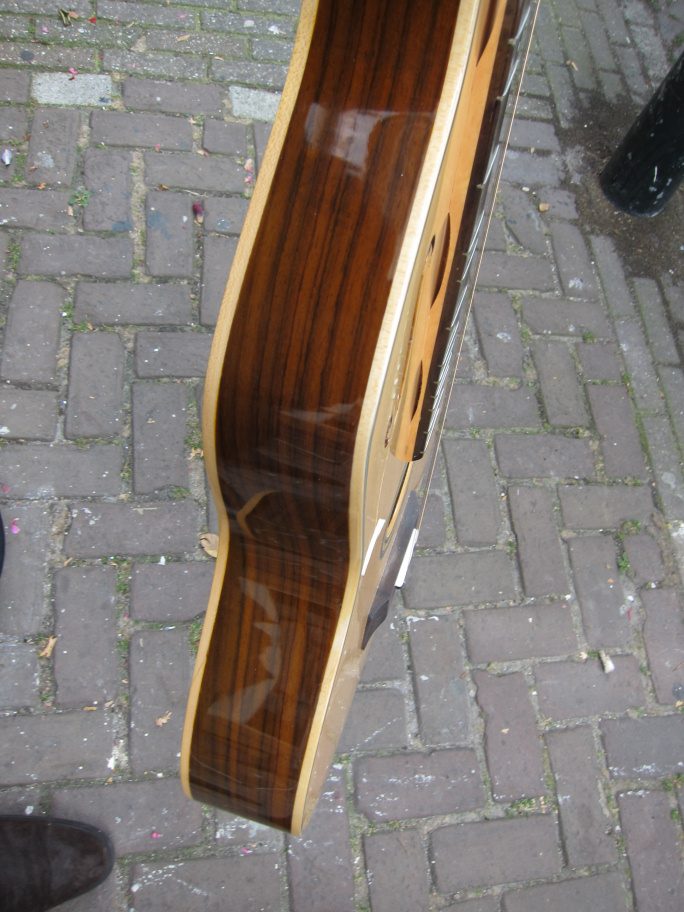 Hi Marg,
I found this photo of a dulciborne on the internet. The saddle is sitting really high.
I know a bit about Weissenborns and a bit about dulcimers and a bit about Chinese instrument manufacture of Weissenborns - long story, but I run a small specialist guitar business and have had Weissenborns build for my businessin the past.
Original Weissenborns (1920s) have a slightly higher bridge than acoustic guitarsbut not a higher saddle (as shown in the photo of the dulciborn above). In fact, on an old Weissenborn, the break angle across the saddle is the same as a standard acoustic guitar. Here is a photo of a 1920s Weissenborn:
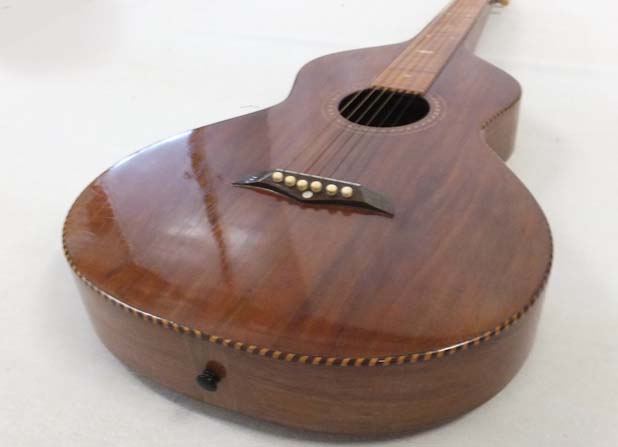 The high saddle on 'out-of-the-box' Dulciborns does not surprise me at all. I have seen numerous Chinese Weissenborn copies with an unnecessarily high saddle dropped into the bridge slot at the factory. It is an easy job to lift out the bone (or plastic) saddle, mark a pencil line across it about a 1/16" from the bottom, place some sandpaper on a flat surface and sand off to the line. Then re-fit the saddle and test the height of the action. Keep going as required until you get the action you want.
What does surprise about the Dulciborn is the use of a raised fretboard which requires a higher bridge? I know the raised fretboard is a significant feature of the traditional dulcimer and very useful if you are a noter drone player - but in this case it seems like over engineering as 95% of players use DAdd and chord melody playing. I think I would have tried out a lower fretboard and standard acoustic guitar bridge height rather than trying to make the instrument look like a dulcimer for no real advantage. Also I would have shaped a little relief into the fretboard and compensated the saddle. Weissenborns have no frets and a high action for Hawaiian slide guitar playing - hence the bridge is high and not compensated (no need as there are no frets). The problem with a high bridge (particularly if the saddle is then high too) is the torsional stress it places on the guitar top - you have to beef things up more thus reducing the top's ability to vibrate.There can be no 'neck set' on a Weissenborn - the top is flat from nut tobridge, so a little relief sanded in to the fretboardbefore installation of the frets would work wonders for clean playing at a lower action - perhaps this has been done by Gold Tone?
The concept is a great one - and the results seem to meet the goal of producing a louder acoustic lap dulcimer. I think I would have been a bit more radical and really thought about the instrument from a players perspective (low action, much lighter build, compensated for DAdd).
Mind you - don't take what I say as Gospel - In my opinion everything great about Appalachian dulcimer designs and playing styles had actually been perfected by 1890 And it has been downhill ever since then
Robin
Joy,
You said, you hadthe action lowered - how did you go about this? Did the Luthier sand the bottom of the bridge or saddle? Or something else? Was that all that was needed to make it very playable?
Joy W. said:
I've had one for a while. The string action was set very high. Much too high, in fact, for me to play it. I've taken it to a Luthier and had frets added and the action lowered. Last month I had it set up so I could play with four equidistant strings and for me, it is much better that way. My instrument is not without some issues though. When I tune it, all is fine, but once I begin using frets (particularly the middle string), it is sharp. I have to do some fancy "almost in tune" tuning so that I can play without making my ears cringe. I have several other dulcimer and none have that issue except the Dulciborn.
Wayne Rogers wrote & said he did play the dulciborn personally & he says it played perfectly. Is that the difference from a man's hand & a woman's? As Paula asked: 'You do need strong hands" Is this a gender issue?
Wayne said the saddle can easily be sanded down to lower, same as you so I guess I need to find someone who can do this. Hopefully that will work and I can enjoy this beautiful instrument.
If anyone know's anyone in the Houston area they have faith in, do let me know. Only place I can think of is a music store where someone there knows some about fixing dulcimers.
Joy, when you had your's lowered, how did they do it? Has it made it much easier to play now?
I wouldn't be worried if we were talking a slight adjustment of height but it is almost impossible to sound a tone on upper frets.When the string is difficult to push all the way to the fret board, it is too high & that's what this is.
I think some sanding could probably take care of it, just wonder why Gold Tone didn't do it to start with.
No, the fret board is not scalloped.
If I would get a luthier to lower the height by sanding, wouldn't that mess up the warranty? If I don't have a luthier near me, could a guitar shop or music store to do this?
The sound is so beautiful I want to be able to play the dulciborn. Thank you for all your replies, they do help in trying to decide net steps.
Frank Ledgerwood said:
If the fret board is scalloped, it is an older version. If it's solid with no scalloped than it's the new version. The fix for the new version is a simple lowering of the saddle. A job most luthiers wouldn't charge more that 25-30$, unless he has to chase around newly created buzzing frets. Many builders, including GT tend to set strings a little high. It's much easier to lower the action than to raise it, file or sanding to lower and new nut and saddle to raise it. For some, that little extra height is too much. You wrote... " The string height over the 17th fret should be 1/8" for low action" Is that specifically for a Dulcimer ? If sothen none of myMcSpaddens or Blue Lion qualify as low action either.
Action is a personal thing. Most professional musicians dropping thousands of $$ on a newacquisitionwill send it straight to theirpreferred Luthier to be set up to their specs. I bought my first "high end" Banjo a short time ago and first thing I did, even though action was good, was to replace the bridge to make it better for my wants.
Thanks, that's a lots of info, but this dulciborn is new, just came & action is high - so sure if they pulled an older one that's why or if it's a newer one there is still a problem.
Luthiers guidelines include:
The string height over the 17th fret should be 1/8" for low action
But on the dulciborn is a bit more than 1/16 higher than 1/8. That'sdifference, 1/16" makes a big difference. the higher frets can not be press to the fret board.
It seems Gold Tone could when setting them up either sand the bridge down some or file notches in the bridge. I'm not asking for me to try anything but when you go & set yours up would you or could you do this if need be & if so couldn't Gold Tone also do this in setting the action?
Frank Ledgerwood said:
Now to the Dulciborn. I was fortunate in the fact that I went several times to GT and hand picked the D'borns I sold. I would select maybe 1 out of every 4-5 I looked at and then I set them up. A couple that got past me as when all mine would be sold and I would have an order where I couldn't drive 1000 miles rt to set up 1 instrument...
A quick overview. Gold Tone does not build any instruments. With the Dulciborn, Wayne worked with a Weissenborn contractor to build a finger board/fretted version. Something this contractor had never done but the only builder who agreed to try this. Thru many prototypes, they came to a working version that Wayne was satisfied with and gave the nod. Now fast forward to a shipment of a hundred Dulciborns that are not quite spec'ed as the agreed upon prototype.....The first batch had somewhat rough fret boards, high action and were fixed as best as possible. My personal D'born is one. The second batch had a cleaner board, but there were inconsistencies in every instrument from strings not aligned with fretboard to a sloping/twisting of the fret board(sounds like the one you played), which required a complete removal of frets, leveling of board and re-installing of frets. This batch is the most prevalent out there. I was down there when the prototypes (for a third batch) came in that addressed the fret board issue. The probable main cause was in the scalloped fret board not having enough integrity to stay true/flat and a weissenborn body that had minimal bracing to support/maintain a flat raised and fretted board. Weissenborns are not fretted and played with a slide. Frets are just markers and a slide is used. The new batch has corrected the string height problem. I waited to see a consistency in this group, which I have so I have my first ones coming to me this week. There was talk to discontinue the Dulciborns which I'm glad didn't happen as there are many happy owners, despite the growing pains. I tried once to find the most affordable Weissenborn builder to build a body any I would finish with Fret board and bridge. He wanted $1500.