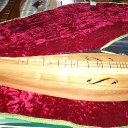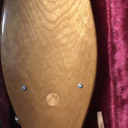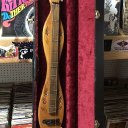
Can you tell me about a Ron Gibson Barbara Ellen 3 String
Instruments- discuss specific features, luthiers, instrument problems & questions
Downloaded it. Thanks
Ron Gibson makes very fine instruments. I've played several but don't own one.
The Barbara Allen tm model is Ron's nod to a traditional teardrop shaped 'Virginia' style dulcimer; but with a deeper than traditional body and the 6+ and 13+ frets which, as the + sign indicates, are not traditional. Check out his website.
DAd, DAA, and CGG can all be tuned from the same set of strings. DAA and CGG are the same Ionian Mode tuning but one is the key of D, the other key of C. DAd is also called Mixolydian Mode. The melody string in DAd or CGc is tuned an octave higher than the bass string note, usually indicated by the lowercase letter d or c.
Tuning up to Ggg is not particularly "Asian", but it will require different strings to prevent snapping the bass string. It is what we call a Bagpipe Tuning in the key of G. The three strings are all tuned to G but the middle and melody strings are tuned an octave higher than the bass string.
You may want to have a read of the article/booklet I wrote a number of years ago which answers many beginner questions about tuning, playing, care and feeding of the dulcimer, It's called I Just Got A Dulcimer, Now What? and can be found here:
https://fotmd.com/forums/forum/dulcimer-resourcestabs-books-websites-dvds/17129/i-just-got-a-dulcimer-now-what-article
Just bought a RG Barbara Ellen. I know woods, and sounds, structure etc. but know little about the MD and playing as yet. I will attach a piezo, one that I have always liked and use for my smaller HD. Otherwise I have been told to tune it to DAD, then DAA, then CCG, if I want to go Asian GGG. Are there requirements for different string dia. for different tunings?
I play the Hammered dulcimer EXR 4/19/21/9 for contemporary music and 16/15 "Bright" for Celtic. Having evaluated many in woods, technical, audio, it took me over a year to get my larger one.
What they said.
The wider fretboard gives more room between strings, if needed, a plus for big fingers and for 4 equidistant strings.
@lisavb, if you have to buy a dulcimer without playing it, both McSpadden and Folkcraft are solid choices. But as you can see, you have many choices to make aside from which dulcimer maker you choose.
Unless you are truly wealthy (in which case, can I get a few bucks?) you will want to develop your preferences before investing any serious money into a dulcimer. Flat head or scroll? Ebony (or micarta) overlay? What size VSL? What width fretboard? Galax back? Extra frets? Jumbo frets? Radiused fretboard? Internal pickup? What about wood choices? The list of options just grows and grows. You may want to take some time to figure that stuff out before you buy an instrument from either of these fine makers.
The action can usually be adjusted, so that is not a true variable differentiating McSpadden from Folkcraft.
Honestly, you will get a fine instrument with either of these folks. I would suggest deciding the other stuff first and then investigating which company can best meet your needs. And as @susie says, give them a call and maybe they can help you decide on all the features you're interested in.
In my case, yes, the action (set-up) is the same on the McSpadden and the Folkcraft.
Fretboard width is 1 3/8" on both the McSpadden and the Folkcraft. Not sure if you can special order the 1 1/2" fretboard with either company. I didn't pursue that, because I prefer the standard 1 3/8". VSL is something you'll have to choose. With McSpadden, their standard is 28 1/2", but you can also get the 26", which is what I got. As a chord/melody player, I love the shorter VSL. With Folkcraft, you can get a VSL from 25" to 29". I have their 27" VSL.
I agree with the flathead, all of mine are flatheads. But, some people like the scroll look. It's a personal thing.
Yes, the McSpadden is not as deep, yet it is still right up there with the deep bodied Folkcraft for sustain. Volume is pretty close. I believe McSpadden has a great design that gives such great sound and sustain. If you go Folkcraft, I'd definitely do the deeper body. I also got the galax back. Their shallower body is more of the traditional design.
Both my McSpaddens have the Micarta fretboard. I love it as a great alternative to Ebony. I like the looks, fretboard markers, and feel when playing. It is very durable. I would not get a McSpadden without either the Micarta or Ebony. But that's just a personal preference.
As a suggestion, call each company and talk to them. They are both great to work with. Richard Ash is very helpful (Folkcraft). I have talked to him on several occasions, when trying to decide on features.
Hope this helps.
Thanks, @skip and @susie--I figured if there was anywhere I could get firsthand apples-to-apples comparisons, it would be here! Couple questions:
- Is the action similar in both? Sounds like so...
- Fingerboard width. Now there's something I hadn't thought of (I was presuming standard VSL). What are the benefits to wider fingerboard, and who's wider?
- Yep, I'm thinking flat headstock this time. My walnut is scroll. I can well imagine stringing being much easier with a flat one!
- McS not as physically deep, but has good volume and sustain anyway? The D Folkcraft looked interesting b/c I want fullness and sustain and believe the deeper body would give that.
- @susie, you have some beauties on your photo page!! Is that ebony or micarta on one of those fretboards? Trying to see if micarta is worth the extra cost in playability and durability.
- I flatpick and fingerpick, both.
Again, thank you so much for taking the time to answer!
Both make excellent instruments, as do a bunch of other luthiers. I think it would serve you best to consider the mechanical features rather than 'models' or 'bling. VSL, fingerboard width and peghead styly [string replacement is generally easier on flat pegheads] will affect your intended use. I mostly fingerpick and have had standard McSpaddens and have their kit and have a Folkcraft resonator. I prefer, and really like, its short VSL and wide fingerboard. The McSpadden Ginger has a short Vsl also although I've not played one.
I currently own 1 standard size McSpadden and 1 standard size Folkcraft. I say standard, because my Ginger (McSpadden) and my Baritone (Folkcraft) are "specialty" type dulcimers, that you aren't considering. I've also owned a previous standard McSpadden and a previous standard Folkcraft. So, I have much experience with both brands.
Please note that my Folkcrafts have always been the deeper bodied models (D and Custom).
Where they are similar:
Quality
Playability and setup (ease of playing)
Sound (in terms of sustain and volume)
Where they differ:
Size (the McSpadden has less depth and is physically smaller)
Choices (there are far more choices at Folkcraft for designing your own)
Price (the Folkcraft will cost you a little more, or considerably more, depending on the Folkcraft model)
You won't be disappointed with either. Neither is better than the other. What you have to decide is what is important to you. If you are going economical, I'd suggest considering McSpadden. If you want to give yourself more choices in terms of woods, VSL, etc., I'd consider Folkcraft. If you really want to treat yourself, I'd consider a Custom Folkcraft.
I love my 2 McSpaddens and I love my 2 Folkcrafts. They all have their purpose and it's fun switching between them. If you want to see pictures, they are all in my photos on my profile.
Hello,
I began my dulcimer journey with a cardboard kit a couple of years ago, then built a Cedar Creek solid walnut kit about 1.5 years ago. Let's just say I could have done a better job with the frets (the cardboard kit came w/the frets in, but has no 6+). I've worked them over and they're much better, but they are not perfect. I don't think I can work them over much more without taking risks to the fretboard or top, so there. I have the action hiked up just a tad to accomodate. I'm considering at some point getting a dulcimer that will have properly installed, perfect frets--also considering going with a 1+/8+ as well. I tape down a guitar string to get 1+ right now. It's not ideal, but it mostly does the job.
I suspect it goes w/o saying that both McSpadden and Folkcraft build high quality instruments. Seems Folkcraft has more variety of models and is a bit more expensive than McS. I've been taking online workshops with Jessica Comeau, and she pointed out her McSpadden has a very low action. Sounds like they are known for that. I would love a very low action, very easy/fast fingering (without buzz, of course!). I love a full, rich sound. I saw an older post of Dusty Turtle's here that remarked that McSpaddens are "famously easy to play." I'm also eyeing that micarta fretboard...
So my question is, what differences are there in playability-type features btw McSpadden and Folkcraft that I should weigh? I don't live anywhere near where I could go try them out...
I like to play chords and melodies, I'm not a noter player. Primarily DAD, with CGC and some other minor tunings here and there. In case that affects the discussion...
Thanks!
Lisa
Thank you, Dusty--good information and perspective for me this morning.
Below is a short part of Skin & Bones - I did with our dulcimer group Friday -
it's on the Double Dulcimer tuned DAcc & Bass.
The sound from the GT-1 I tried to create something for Halloween
@lisa-c, it's certainly a good idea to get a ballpark idea of what a good string gauge would be for different tunings, as you've done, but you will want to experiment and find the ideal for you. We all have different preferences. On my full-size dulcimers I use a .026 on the bass, . 016 on the middle, and .013 on the melody. That might be too heavy for others, but I like the bigger sound and the extra resistance when bending strings. And my preferences also change depending on how I am playing. When I fingerpick, I like a little extra give in the strings, so I tune down to C. When I flatpick, I like really taut strings with a quick response to the pick, and I tune up to Eb or even E. In other words, I keep the string gauges the same but change the tuning to get a different feel. Of course, when I play with others, I just keep things tuned to D.
Strumelia, I appreciate your suggestion and should have known better as a retired editor! :) And while I'm fine with changing tunings, having three dulcimers and just playing alone at home led to each having a different tuning. I recently changed my DAd dulcimer to CGc, thus nice to know the set of strings is fine for either tuning. Thanks again for your sharing today and for all your care to this wonderful site!
Lisa C, just a suggestion so that we can all discuss these details without getting mixed up: it helps to list both the string letter notes and the gauges in the same order. It's been mostly accepted to list from low to high with dulcimers... thus you'd write DAd or CGG and the first letter of each of those is assumed to be the low/bass string. But to carry this through consistently, you'd then list string gauges in the same order (low bass string, middle string, melody string). So for example you would write: .022, .012, .010 for DAd... not in the opposite order that you wrote. :)
Personally, I would not bother to change string gauges if going back and forth between DAd and CGC. I do understand though that you are talking about 'ideal' gauges here.. so maybe you intend to stay in a tuning and wanting the best gauges just for that tuning. Definitely there are various reasons when one might want to do that!
Thank you all. I now also fully understand the difference between lowercase and uppercase note letters. (Had prior wondered why some tab said DAD and others DAd.) And I had assumed that the string gauges for DAd and CGc would probably be the same (both 1-5-8 tunings). For the 27.75" VSL, am now thinking the ideal gauges for DAd would be .012, .014, .022 and for CGc would be .012, .016, .024.
Lisa is correct, of course the actual tuning is DF#A, not DFA. And the F# is higher than the bass string and lower than the Melody string.
I use the Strothers String Calculator: http://www.strothers.com/string_choice.html You plug in the VSL of your instrument at the chosen open tuned notes you want. The calculator is noticeably a bit light, so you can easily go 1 or 2 gauges higher.
I belong to the "change your tuning" school, not the "one tuning per instrument" so I'm constantly changing tunings to match my mood and the moods of the songs I play.
I spent close to 30 years tuning mostly to Ionian DAA and the minor Modes Aeolian DAC and Dorian DAG. All based on one set of string gauges. These days I mostly play dulcemores set up to play Bagpipe tunings Ddd and Cgg, and plus a museum replica fretted zither set up for Unison tunings of ddd and ccc, and another "high strung" for GDD.
@lisa-c, you can check out the Strothers String Gauge Calculator . You input the vibrating string length and the specific note you want it the calculator will tell you a string gauge. It errs on the light side, so feel free to go one or two sizes heavier.
There used to be a website devoted to the 1-3-5 tuning, but I can't seem to find it now. Maybe someone will chime in.
For some reason, a lot of people who use that tuning choose to choose F-A-C. Maybe that allows you to go back and forth between D-A-d and F-A-C without changing strings. I'm not sure.
Strumelia, good information--thank you! Am wondering whether you have a favorite tuning other than 1-5-8 or 1-5-5. I began leaning toward trying 1-3-5 because Dulcimertab is generously sharing several good, nicely presented tunes.
Ken, I meant to ask whether or not you were also sharing that the ideal gauges for DAD (a 1-5-8 tuning) would be .022/.012/.010 (for the 27 3/4-inch VSL). Is that correct?
Also, is there a chart or link you could share that shows the ideal gauges for the most common tunings per the common VSLs (thinking between 25" and 28")?
Lisa C, if you are planning a 1-3-5 tuning in the key of D, then keep in mind the middle string will be an F# (not an F). Also, that middle string will be the F# that's LOWER than your melody string but higher than your bass string. If you try to tune the middle string to the F# that's in the same higher octave as the melody string, (in other words 2.5 steps higher than the high d if you are starting from DAd) then at that VSL you'll likely break the middle string if tuning it to F#4 (4 being the fourth octave on the piano). In a nutshell- use the middle string F# that's lower than the melody string for 1-3-5.
Notes such as E and F or F# are a bit tricky on the dulcimer. They can ride the fence of being in either higher or lower octave which can be confusing. With those 'cusp' notes we should double check that we're not only using the right gauge string, but also that we're not aiming for the wrong octave when we go to tune that string, since it's not always obvious.
Yes it's a cool and fascinating thing! Glad you brought this up David.
I contacted Seth years ago about his story and the illustrations. He's a very nice fellow.
I have not yet added strings to this recently acquired dulcimer. Just finished refurbishing it, via a wood craftsman, and thankfully now looks brand new. (Was made from a HERE, Inc. kit sometime in the 1980s or early 1990s in my home state of Ohio.) Because I have two other dulcimers, I thought it might be fun to try a different tuning for this 'new' dulcimer. Thank you for helping me see the ideal gauges--much appreciated.
I'm not really big on Halloween but I ran across this this morning and posted it to Steve Carney's FB page, so I figgered I'd post it here too
Old Talon by Seth Boyden
A Tennessee creature story about a mysterious monster named Old Talon terrorizing a remove Appalachian community. An Appalachian dulcimer figures prominently in the story
www.themoonlitroad.com/old-talon/
sethboyden.blogspot.com/2014/01/old-talon.html
i2.wp.com/themoonlitroad.com/wp-content/uploads/2014/01/old-talon-tennsessee-mountain-dulcimer-creature-monster-story.png
i2.wp.com/themoonlitroad.com/wp-content/uploads/2014/01/tennessee-mountain-dulcimer-creature-monster-story.png
What are you currently tuned to?? DAd? That .024 is a bit heavy -- .019 to .022 is more common. An ideal string set for DFA (1-3-5) would be .020/.016/.012.
I use a thin layer of Ebony, 1/8 to 3/16", when the fretboard material is a relatively soft wood such as cedar, or popular. It helps me feel comfortable the frets will stay embedded and does add a nice contrast to the parent woods (if you like that sort of thing).
I have a 27 3/4-inch VSL dulcimer for which I'd like to try 1-3-5 tuning. Will the .10, .12, .24 gauge combination accommodate that tuning (or would you recommend otherwise, please)?
Jill, I think Martin uses Richlite, a product very similar to micarta. Neither should expand or shrink at all, unlike ebony. They require no care whatsoever.
Interestingly, both can be colored in any way, but everyone uses black so that they look like ebony. But there's no reason you couldn't have a purple overlay or hot pink or whatever.
Thanks Dusty and Susie. I never thought about the pick marks on the fretboard. I didn't know that Martin uses micarta - and I was concerned that it would expand/shrink at a different rate than real wood. Susie, your cherry Ginger is lovely. I'd like to have Jim (he's still at McSpadden for now) make one for me that is very similar. My hand issues have been annoying and I need shorter and shorter scales as time goes on. I have a lovely koa/redwood standard McSpadden that I decided to sell - scale is just too long for me these days.
Thanks for not talking me out of the micarta LOL! Looking forward to ordering from Jim.
We discussed this a little bit over on the ED Facebook page (I'm the one that posted the picture of the cherry Ginger with a Micarta fretboard). One thing I wanted to add was that Micarta is not new for use on fretboards. It has been used on guitars for years (Martin, for example). I love it as an alternative to ebony, for playability, and it is much more economical. The other reason I like the McSpadden Micarta fretboard is the inclusion of fret markers (ebony fretboards too). I just like having them. I think it's because being a guitar player for 47 years, my eyes are used to seeing them. I know it's strictly personal as to what you like from a visual standpoint, but I love the contrast that a fretboard overlay gives a dulcimer, just like Dusty.
I just realized, I didn't do a good job talking you out of micarta.
Jill, I bought a dulcimer from Ron Ewing several years ago and he talked me out of the ebony overlay. I trusted him since he would have gotten more money out of me with it added, but I've regretted not having that overlay ever since. I am sure Ebony is not the only material that can be used, and the artificial materials like Richlite and Micarta might work even better, but personally I like the extra hard surface both for ease of fingering and also to prevent any pick damage. Sometimes I pick rather energetically, and my dulcimers without ebony overlay have little marks where my pick routinely hits the fretboard. And because ebony is so much denser than walnut or the other woods, your fingers slide over the fretboard much more easily. The Micarta and Richlite options might even be better in that regard since they are non-porous materials.
And for what it's worth, I LOVE the contrast of the ebony (or micarta) over the lighter woods, cherry being my favorite for its fine looks.
YMMV. Less aggressive players than I might have no need for a fingerboard overaly at all.
Hello friends,
I'm ordering a Ginger from McSpadden. I have a walnut/sycamore already - sold my older cherry to a friend so I'm replacing it with another cherry (different tunings between the walnut and cherry). I've always had an ebony - or at least a dark - fretboard. But on this new cherry I'm leaning toward no ebony or micarta overlay. I know ebony is a harder wood which is why luthiers like it for fingerboards. Please talk me into or out of the ebony or micarta overlay. Partially I'm not sure I like the looks of the "black" fingerboard on cherry (purely aesthetic), and partly is due to the extra cost. Thanks!
I'm glad you got to see the movie, Robin the Producer.
We bought the movie and sound track-- so cool to have them! I like it that the film focused on the musical aspect of being part of life, tying past to present to future. It was fun to see my name in the credits at the end-- I kicked in on the fundraiser for the movie. Likely, the only time I'll end up in movie credits. :)
Another option is to take it to music store and have them measure the diameter of the strings on the dulcimer using a micrometer. You can then purchase the same gauge strings.
Ken
"The dulcimer sings a sweet song."
Strothers String Calculator: http://www.strothers.com/string_choice.html
Diameters of the strings will vary depending on the VSL and the Open tuning notes you want. VSL is the distance between nut and bridge. DAA will be slightly different that DAd, CGG vs CGc the same. A given set of strings will let you tune up or down two steps before getting too floppy or starting to break.