Mountain Dulcimer Strings
General mountain dulcimer or music discussions
Hey, Dana! You're welcome! Have you tried them, yet? If so, what do you think?
Dana R. McCall said:
Hey Dewey thanks for the info on the Elixir wrapped strings.
Hey, Dana! You're welcome! Have you tried them, yet? If so, what do you think?
Dana R. McCall said:
Hey Dewey thanks for the info on the Elixir wrapped strings.
Thanks for all the info everyone. Have my first replacement strings coming from Prussia Valley.
The Elixir wrapped strings sound intriguing Dewey.
Now I just have to spend more time playing and less time on this forum! 
Ken, thank you for reminding me of that site - I had ordered from them years ago and found them fast and reliable.
Ken Hulme said:
A good online source for strings, individually or in sets, brand name or inexpensive generic is www.juststrings.com . There is little or no difference between a brand name string and a generic, as the same handful of wire-drawing companies make all of them as spools of wire which are cut, ended and packaged by a lot of companies.
Hey Dewey thanks for the info on the Elixir wrapped strings.
Welcome to the forum, and the world of dulcimers, Garland. I personally use .024, .016, and .012. on my Gallier A-frame. I have tried several different sizes and combinations, but keep coming back to these 3 sizes for my A-frame. I think my McSpadden has the same sizes as yours.
By the way, if you get tired of the scratching noise when you slide your finger on the wrapped base string (you'll really notice it on recordings), I find that the Elixir brand wrapped strings are virtually silent. They are micro-coated with something to fill in the cracks between the wraps, and also make the string slicker. They cost a little more but they last a good deal longer than the common brands as well.
Dewey
A good online source for strings, individually or in sets, brand name or inexpensive generic is www.juststrings.com . There is little or no difference between a brand name string and a generic, as the same handful of wire-drawing companies make all of them as spools of wire which are cut, ended and packaged by a lot of companies.
One careful squeeze with a small pair of well positioned pliers is all it takes ! The resulting 'loop' may be a tad smaller than expected tho ?
JohnH James Phillips said:
As well, they can pop the ball out of the guitar strings as well. I don't know about your local music shop, but I know CV Lloydd does that for free, at least for me.
As well, they can pop the ball out of the guitar strings as well. I don't know about your local music shop, but I know CV Lloydd does that for free, at least for me.
Garland, regardless of what gauge strings you use, please note Dana's original post. There is no difference between dulcimer strings and guitar strings. You can just go into any local music store and ask for acoustic guitar strings. There is no need to buy complete sets and no need to buy anything specifically labeled "dulcimer strings."
Thanks everyone,
I did find strings at Prussia Valley Dulcimers. Their shopping cart was nicely laid out and let me specify whether I wanted ball or loop ends. I ordered two more of each string I needed.
Good point about trying different guages, Garey. I was really just going with what the maker specified for now, As I get braver, I may try other ones. For now, I just wanted backup strings in case one broke.
You can by individual strings. They are guitar strings. Just order those sizes in the ball end. Most music stores carry single strings.
My first mountain dulcimer just arrived. I would like to have a backup set of strings so that if one breaks, I don't have to stop playing.
The maker, Tom Fellenbaum strung it with .012, .012, .016, .026 ball-end bronze wound strings. His instructions say I can vary them by up to .002 without affecting the sound or playability.
I had a look online for strings, but am having difficulty finding a set that comes close to this. Can someone point me in the right direction to find a source?
Thanks,
Thank you for that addition, Wout! 
This is a noter&drone version, somewhat more simplier and in DAA
That's how I play it - I just learned it from friends who sang it, so I am not sure about the melody here and there.
Here's a recording of it - but watch out: I am also trying to sing it in this video!
Beth, When tuning DAA which is a common tuning for the dulcimer, the melody strings are tuned to the same note as the middle string, not an octave higher. This puts the d at the third fret in this tuning.
When tuning DAd the melody d is tuned to an octave higher than the bass D and the d is at the open string position.
So "Are You Sleeping, Brother John" in DAA starts 3453, 3453, 567, 567, while in DAd it is 0120, 0120, 234,234.
I usually drop the DAA down one note and play CGG which I find better for singing.
Since you found Jerry Rockwell's pages, I'll mention that I almost invariably use his "relative tuning" idea. That is, I tune the bass string to the desired keynote - C, D, or G. Then fret the bass string at the 3rd fret and tune the middle drone to that note (G, A, or D). Repeat for the melody string(s) if tuning to Ionian. Or fret the bass string at the 7th fret and tune the melody to that note (c, d, or g) if you want a Mixolydian Modal tuning.
I think you've suffered a bit from Information Overload, Overthinking, and trying to relate the dulcimer to other stringed instruments you play. That's all right. We're here to help.
When you do get your dulcimer, you'll want to start with a simple finger sized piece of dowel about 4-5" long for a noter. Read my Get Noterized article and selected bits of Lisa's N&D blog for how-to hold and press with the noter.
Beth,
First, this post in my traditional playing Blog may help you tune:
http://dulcimer-noter-drone.blogspot.com/2010/12/what-notes-do-i-tu...
I will try to answer a few of your questions:
And, I understand it, the melody line is played on the string closest to one's body when held on the lap. And, that is string gives the highest notes. (Or those two strings if one has double melody strings.)
Correct.
Now, If I'm right in this, the other two strings are both lower than the melody string.
Correct.
Here is my problem. If I tune to DAaa, the aa strings are my melody strings. I have a very limited range left in my voice. a below middle c to c above middle c is the best I can stretch on a good day.
Is it possible to get strings for the melody that will tune to low A? And would it have to be a wound string?
You will actually be tuned to DAA (or DAAA), not DAa or DAaa. The melody string(a) in this tuning will be tuned to the EXACT SAME note (A) and in the SAME OCTAVE as the middle string A.
Most importantly- if tuned to DAA you will usually be playing and singing in the key of D , not in the key of A .
People normally dont put heavy low wound bass strings as melody strings.
Or should I just tune to DAaa and sing an octave lower than the notes I'm playing?
Tune to DAA (since double melody strings are usually tuned the same as a pair, we usually just give them one letter, not two, when naming the tuning) and you'll be in the key of D (the melody will be based around the THIRD fret, a D note, not based around the open melody string which an A note). Sing in the key of D, in whichever octave suits your voice. Or sing a harmony to what you are playing. Or, tune all your strings DOWN one step from DAA to CGG and you'll be playing and singing in the key of C instead of D, which might be easier on your voice. Lots of us do this.  I suggest you just start in CGG and learn to play a simple song like Hot cross Buns or Frere Jacques, rather than trying to transpose guitar or uke music right off the bat. You need to understand the very most basic simple concepts of tuning and playing the dulcimer, without worrying about what you do on other instruments ...for now.
I give a lot of this kind of advice in my noter-drone traditional playing dulcimer Blog, here: http://dulcimer-noter-drone.blogspot.com/
Hi Beth,
You're already a victim of the multple tunning notations we spoke of earlier.
DAaa is plain wrong and indicates the middle and melody strings are an octave apart. This is not the case, they are both the same and would be written DAA.
DAA usually referes to an Ionian tuning, that is your scale starts on the 3rd fret which is a 'd', an octave above the bass.
Something you may be missing - octaves run from C to B, i.e. C D E F G A B c d e ... , so A is in fact a higher note than D.
You don't have to tune to DAA, you can use CGG if it's more comfortable for your voice.
Take another look at Strel or Ken's blogs.
john
Beth. I strongly suggest you take a look at my article here called I Just Got A Dulcimer, Now What? It has an illustrated glossary of dulcimer terminology, plus answers to many beginner questions such as yours about DAD vs DAd, and others on tuning and playing, care and feeding of your dulcimer., Read the article
here: http://mountaindulcimer.ning.com/profiles/blogs/i-just-got-a-dulcimer-now-what
I also wrote an article called Uncontrite Modal Folker ,explaining modes (scales) and Modal Tunings, which you can read here:
http://mountaindulcimer.ning.com/profiles/blogs/uncontrite-modal-folker
Beth, If you go to www.robertforce.com you can download his book In Search of the Wild Dulcimer in pdf format. It's a great book and one which will help add to the explanations you have already gotten here. Keep pickin'
Rob
Hi Beth
There are multiple ways of writing tunings, and in the end it's probably easiest to just use standard guitar notation, i.e. all upper case.
First, make sure you are reading these in the right order, from bass to treble, thickest string to thinest. Some of the older books do it the other way around though.
Upper case indicates the lowest notes and lower case any notes that are in the next octave up.
DAd means D on the bass, A on the middle, and d (in the higher octave) on the melody.
DAA means D on the bass, A on the middle, and A on the melody, all in the same octave.
If you see DAD you can be pretty sure this means just the same as DAd though.
In practice, your string gauges won't let you tune to the wrong octave, they will be too slack or broken if you do.
When it comes to intervals W means a Whole tone(2 semitones) and h means a half tone(1 semitone)/
Another system goes TTSTTTS - Tone, Tone, Semitone ...
Or, as you have it, 2212221.
Here's a chart that puts the modes in order(most major to most minor), shows the intervals involved, and what the Home Frets are.
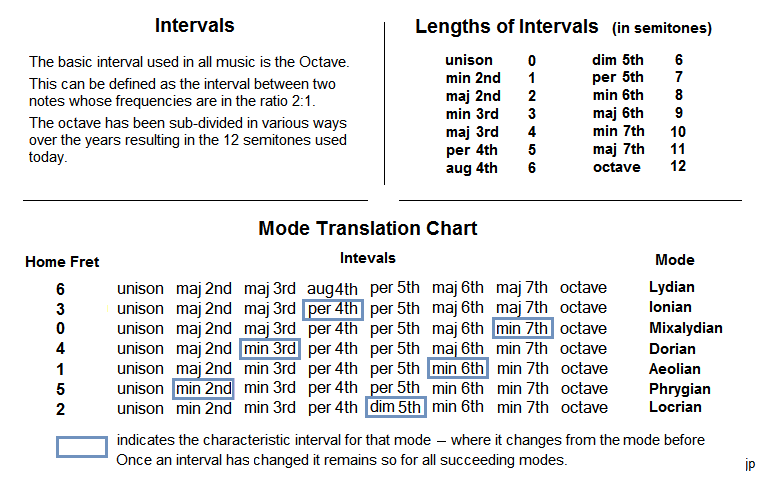
Any thing you don't understand, ask away and you'll get a dozen different answers :)
john
Beth, I don't know what the norm is on pianos, but I can say that on dulcimers and banjos, a lower case note letter is in a higher octave than an upper case letter. Thus, a standard banjo tuning of gDGBD shows the shorter "g" drone 5th string as being an octave higher than the middle string G. You should also know that these days it is customery to name/write out the dulcimer tuning starting with the low bass string first. So- for example a dulcimer tuning of DAd means the first "D" is the lowest bass string, and the last "d" is the highest melody string which is tuned an octave higher than the bass string D.
Thanks everybody! Can't wait to get it!
Thanks for the warning! It's on its way to you right now! ETA: around Sept. 29, 2155.
Dusty Turtle said:
That instrument's no good. You should send it to me.
That instrument's no good. You should send it to me.
Folkcraft (Folk Roots) are really nice dulcimers. A nice company to deal with. You shouldn't be disappointed.
I have sold a few Folkcraft hickory dulcimers through my shop. Those who purchased them have been extremely happy with them. They were all hourglass instruments, but that won't make an appreciable difference in sound. Enjoy the dulcimer when you get it. You made a good choice.
I have played a few of the Folkcraft hickory instruments and highly recommend them! I think that you will be pleased!
Hi Steven,
I have had two of that exact model pass through my shop this year. They were great sounding and great playing dulcimers - nicely set-up and well finished. They were good all-round instruments and I felt the model was particularly nice for fingerstyle playing. You have made a good choice
Robin
I just ordered a Folkcraft all hickory teardrop FSH model dulcimer (directly from Folkcraft). It'll take about a month to get it. I tooka chance, never having heard a hickory instrument. Any opinions about this type of instrument? Thanks in advance!
Here is the tab from from the Dulcimer Association of Alabama in Huntsville. http://www.hsvmda.com/sites/default/files/tabs/WayfaringStranger.pdf
It is in DAD but you will need to use a capo at the first fret.
Do any of you have dulcimer tablature for "Wayfaring Stranger?" I can't find it anywhere and want to learn it. If I knew it well enough, I could probably figure it out, but I don't remember all of the melody. If you do have it, would you be able to scan it & e-mail it to me? My e-mail address is molly@dulcimersbymolly.com. Thanks!
Barbara, if you like CGC then you may wan to try B F# B . You can even go as low as AEA. On my 3 string McSpadden I can go from DAD all the way down to AEA and the sound is still wonderful, not even close to being to loose even at AEA.
Your strings might become too loose (for lack of a better word), but give it a try anyway. You might want to order you a Snark tuner for around $10.00 plus shipping at Amazon.com.
Happy tuning!!!