Introduce Yourself!
General mountain dulcimer or music discussions
G -- GDG Good on a short VSL dulcimer
G -- GDG Good on a short VSL dulcimer
You an me gots esp er something Robin. : ) jinx!
Edited to show Ben Seymour he shows view of cantilevered fingerboard look quick!
Nate I had a Keith Young dulcimer had a cantilevered fingerboard maybe 3-4" before end block was a bitch to change strings brads were on under side between fingerboard and the top.
Beautiful tone and big bass. No conclusions here though.
Construction industry has examples of installed tension for strength and resistance.
A while ago on here I saw a dulcimer that had gap under the tail end of the fingerboard, with the string tension pulling it up from the box. The idea was that by having the tail end of the fingerboard (where the strings were mounted) detached from the box, the string tension would pull hard on the area with the string pins, lifting it so that it hovers a couple millimeters above the soundboard potentially increasing volume. Does anyone know what this feature is called, so I can look into it more?
Makes me think of Keith Young's fretboards. I think I don't have any photos of the end of the fretboard-- I used to have 2 of Keith's wonderful instruments.
I'm from Pensacola, Florida, Barb, and I have encountered several of his instruments in my musical journeys! Loran Harmon was a local mountain dulcimer builder. Here's a little background about him: https://www.legacy.com/us/obituaries/pensacolanewsjournal/name/loran-harmon-obituary?id=24325380
A while ago on here I saw a dulcimer that had gap under the tail end of the fingerboard, with the string tension pulling it up from the box. The idea was that by having the tail end of the fingerboard (where the strings were mounted) detached from the box, the string tension would pull hard on the area with the string pins, lifting it so that it hovers a couple millimeters above the soundboard potentially increasing volume. Does anyone know what this feature is called, so I can look into it more?
Quick clarification: "DAA" can refer to either a common tuning for us dulcimer players (with the bass string tuned to a low D, the tonic note played at the third fret of melody string, with the dulcimer played in the key of D) ...OR it can stand for "Dulcimer Acquisition Affliction"... a not uncommon illness whereby one succumbs to buying multiple dulcimers with little or no self control.
Sometimes the DAA illness settles down on its own after the initial raging fever. Other times, symptoms continue until friends or family stage some sort of intervention, or a storage/financial wakeup call occurs. Rehabilitation and/or therapy may be necessary for a return to 'pre-dulcimer discovery' normalcy. 🦠 🚑
John, I did build one dulcimer with a sound post. both the back and sound board were rounded, it had a floating fretboard that sat on a bridge under the saddle and fretboard. The instrument did have good volume and sound. For a variety of reason, I have move away from rounded soundboards and haven't built another instrument with a sound post. (The sound post is used to give stability to the sound board against the string tension. It also transmits vibration to the back. I tried this to increase the sound coming from the bottom of the instrument, a way of enhancing instruments with a false bottom.) Matt
Beth,
A note of encouragement. DAA is not terminal nor disabling. Nor does it respond to advanced medical treatment. I have found the best way to treat it is to get one more dulcimer.
Beth, have you contacted Robin Clark there in Wales? He's quite the knowledgeable dulcimist.
Having set up many violins & cellos etc over the years....You may want to explore using a sound post. Not really a "dulcimer" thing, but you're an outside the box kinda guy anyway. If you Google "adjustable soundposts" you will find much info good and bad about using them in so- called "real" instruments... Bottom line, is that moving the amount and location of tension to the vibrating surfaces [top and bottom] can and does change the tonal qualities. I suggest an adjustable only because there are no standard rules when it comes to dulcimers and the dimensions. Instead of having to re mount your strings, an adjustable may give you more room to play around, or just source some dowel rod and have at it..[or pencils, chopsticks,...] Changing the tensions to the body and try and find the "sweet" spot[s] if any? Then we'll have to find out if heart holes with pointy bottoms sound as good as rounded ones......
just the meanderings of a wandering mind......
While the sound post may not be "a dulcimer thing," two old time dulcimer makers, James Edward Thomas and Charles Napoleon Prichard, used sound posts. In the case of Thomas, he actually used two; one at the 3rd fret and one at the 10th fret. Prichard's was in the middle of the fret board half way between the scroll end and the tail end of the dulcimer. Both used staples rather than modern frets.
A friend of mine who was building reproductions of the Prichard dulcimer did not know that Prichard used a sound post. After I told him about the sound post and its placement he said it made a substantial difference in the volume of this instruments.
Ken
"The dulcimer sings a sweet song."
Nate, when I built my first dulcimer the end of the fret board was cantilevered. That was the what the plans I was using called for. The plans were designed by Joseph Wallo who worked in Weaver's Violin Shop in Washington, D.C. It is the shown in the bottom photo of this post.
I have added another photo of a courting dulcimer I built for a friend and both fret boards have cantilevered ends.
My first dulcimer is now fifty years old, been under string tension that entire time (tuned DAA), and has not warped. I don't know how the courting dulcimer faired, but it is only 47 years old.
Ken
"The dulcimer sings a sweet song."
That slot at the tail end of the fretboard was, IIRC, a Howie Mitchell "thing". Not sure it ever worked as advertised.
A while ago on here I saw a dulcimer that had gap under the tail end of the fingerboard, with the string tension pulling it up from the box. The idea was that by having the tail end of the fingerboard (where the strings were mounted) detached from the box, the string tension would pull hard on the area with the string pins, lifting it so that it hovers a couple millimeters above the soundboard potentially increasing volume. Does anyone know what this feature is called, so I can look into it more?
Having set up many violins & cellos etc over the years....You may want to explore using a sound post. Not really a "dulcimer" thing, but you're an outside the box kinda guy anyway. If you Google "adjustable soundposts" you will find much info good and bad about using them in so- called "real" instruments... Bottom line, is that moving the amount and location of tension to the vibrating surfaces [top and bottom] can and does change the tonal qualities. I suggest an adjustable only because there are no standard rules when it comes to dulcimers and the dimensions. Instead of having to re mount your strings, an adjustable may give you more room to play around, or just source some dowel rod and have at it..[or pencils, chopsticks,...] Changing the tensions to the body and try and find the "sweet" spot[s] if any? Then we'll have to find out if heart holes with pointy bottoms sound as good as rounded ones......
just the meanderings of a wandering mind......
Beth,
A note of encouragement. DAA is not terminal nor disabling. Nor does it respond to advanced medical treatment. I have found the best way to treat it is to get one more dulcimer.
I think if you had half of the string tension pulling up and half the string tension pushing down, the result is not increased tension but rather a neutralized/balance of tension not helping at all...
Having set up many violins & cellos etc over the years....You may want to explore using a sound post. Not really a "dulcimer" thing, but you're an outside the box kinda guy anyway. If you Google "adjustable soundposts" you will find much info good and bad about using them in so- called "real" instruments... Bottom line, is that moving the amount and location of tension to the vibrating surfaces [top and bottom] can and does change the tonal qualities. I suggest an adjustable only because there are no standard rules when it comes to dulcimers and the dimensions. Instead of having to re mount your strings, an adjustable may give you more room to play around, or just source some dowel rod and have at it..[or pencils, chopsticks,...] Changing the tensions to the body and try and find the "sweet" spot[s] if any? Then we'll have to find out if heart holes with pointy bottoms sound as good as rounded ones......
just the meanderings of a wandering mind......
Beth, have you contacted Robin Clark there in Wales? He's quite the knowledgeable dulcimist.
Hi Ken. I’m not actually in Yorkshire - I just bought my first dulcimer there when visiting old friends near Northallerton. I live in a place called Llantrisant, near Cardiff in South Wales. Hence my tendency to post Welsh folk tunes. As to having my dulcimers in different keys, I’ve already retuned my standard McSpadden to CGC as an initial experiment. What else should I try?
I think if you had half of the string tension pulling up and half the string tension pushing down, the result is not increased tension but rather a neutralized/balance of tension not helping at all...
Hi Beth! Where are you in Yorks? I have e-friends in Hawes and that part of the Dales as well as elsewhere in the UK. My partner is from Brighton originally but has been here longer than there. I play mostly the Child Ballads and Border ballads/folk music, using Noter & Drone style. Three is a good number of dulcimers (although I have more) as you can tuned in each of the main folk keys...
I’ve been a member of FOTMD for a couple of years now, and posted some audio clips of Welsh folk tunes, but I don’t think I’ve properly introduced myself. I’ve been quiet for the last few months, trying to get my head and fingers around my new toy - a lovely walnut/Engelmann spruce Folkcraft Series H dulcimer with a 1.5 fret, 25in VSL. Now that I’ve stopped stumbling over the 1.5 fret, I’ve posted some tunes that I’ve been playing on the new dulcimer - not perfect, but then I’ve never been able to play any tune right through without a mistake, especially when it’s being recorded!
I have been playing the dulcimer now for about two years. I used to play guitar, but arthritis in my fingers made it difficult for me to shape the chords. I’d been eyeing dulcimers for years, but you don’t see them in music shops around here to try them out, so I did nothing about it. But in August 2022, I bought an all walnut McSpadden dulcimer from Red Cow Music in Yorkshire while on a campervanning trip and I haven’t looked back. I so wish I’d started playing one earlier.
I play the dulcimer mainly at home, picking out folk tunes and trying to find chords for them. But I also get together with a group of people who meet to play Welsh folk tunes. This made me hanker after a quick way of changing keys, so I bought a McSpadden Ginger (walnut/redwood). Its higher pitch and brighter tone also had the advantage of being easier to hear over the other instruments. My hearing is not so good (I have two hearing aids), so I find it difficult to play by ear against accordions and fiddles.
I found myself obsessively browsing the internet looking for dulcimers with more volume, listening to videos of dulcimers made from different woods. The FOTMD site allowed me to research whether a 1.5 fret would allow me to play in more keys without having to use a capo or retune and catch up with everyone else. Eventually, as a 70th birthday present to myself, I ordered the Folkcraft dulcimer. I had a devil of a job getting it through the bureaucracy of UK customs, but thanks to Richard Ash’s co-operation and endless patience it finally arrived in January. I haven’t put it down since.
So now I have three dulcimers and a bad case of Dulcimer Acquisition Disorder. Though the Folkcraft is in many ways more versatile, I still enjoy playing the two McSpaddens. I like the mellow buzzy tone of the all-walnut dulcimer and the brightness and portability of the Ginger. The Folkcraft series H sounds to me more guitar-like in quality and has a big sound. The 25in VSL suits me better too than the 27ins of the standard McSpadden and I’m enjoying the new chord opportunities that the 1.5 fret offers me. The ebony fretboard makes a difference too as does having only 3 strings - my fingers slide better over the fretboard, though I do feel that I have to be a bit more careful in my playing on the Folkcraft.
Excuse my ramblings, but I thought perhaps my experiences might be of interest to those who can’t easily walk into a dulcimer shop and try out all the wonderful variations of dulcimer types before choosing what to buy. Thanks to you all at FOTMD for the information and warm support you provide - and also for putting me in contact with the Nonsuch Dulcimer Club here in the UK.
I am trying to ask about how to utilize the string tension to put the box under extra pressure, and if this can be good for tone or volume.
Here is a drawing that hopefully helps explain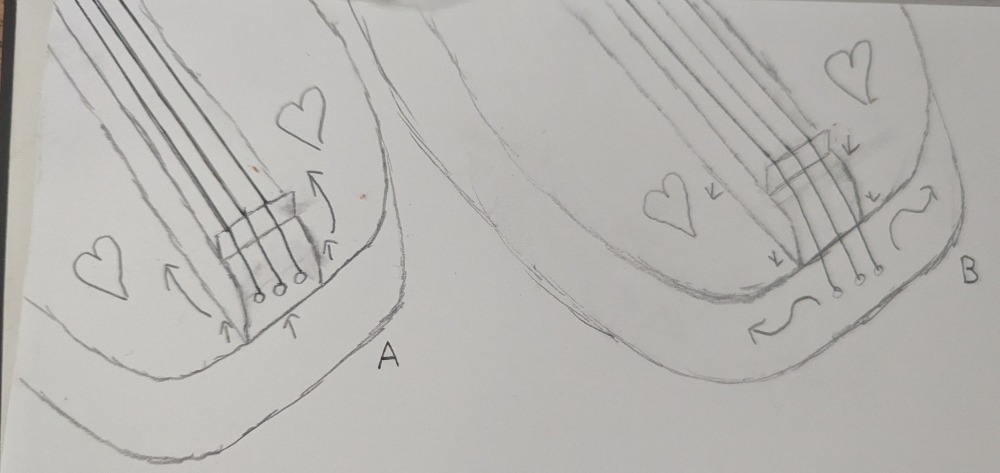
Let's assume the dulcimers have identical dimensions and the same break angle, and the only difference is whether they are mounted to the fingerboard or the box.
In figure A, when the strings are anchored to the fingerboard, the 60-100 pounds of string tension should be trying to pry the fingerboard up off the box. I am wondering if this "pulling" is adding extra stress and tension to the box, and if having the wood under more stresses makes it more rigid and stiff and allows it to transmit vibration better.
In figure B, when the strings are anchored to the side of the box, the 60-100 pounds of string tension is laying across the end of the fingerboard, pushing it down into the top of the box. I am also wondering if this improves overall responsiveness of the instrument, by distributing that 'pulling force" across the tailpiece into the side panels.
I hypothesize that if you could mount half your strings to a tailpiece and the other half to the fingerboard, the forces would be pulling the fingerboard up while also pushing it down, adding a huge amount of stress to it, possibly making it more stiff and responsive.
Hey folks, this question might be poorly asked but here goes.
Does a soundbox that is under more tension have any additional clarity or additional volume? Is this the reason that 'lighter' builds are more responsive?
When I think about a musical saw, the volume seems to directly correspond to the amount of tension out on the saw blade.
Similarly, a washtub bass seems to be quite a bit louder on its high pitched notes, when the string is pulling the hardest on the tub.
I have been thinking a lot about where the strings are anchored on my dulcimers. Anchoring them to the fingerboard should apply an upward 'pulling' force on the area of the fingerboard with the pins. Meanwhile if the pins are anchored on an actual tailpiece of the box, they are stretched across the end of the fingerboard and are 'pushing' it down into the soundboard.
Does one of these produce more resonance than the other?
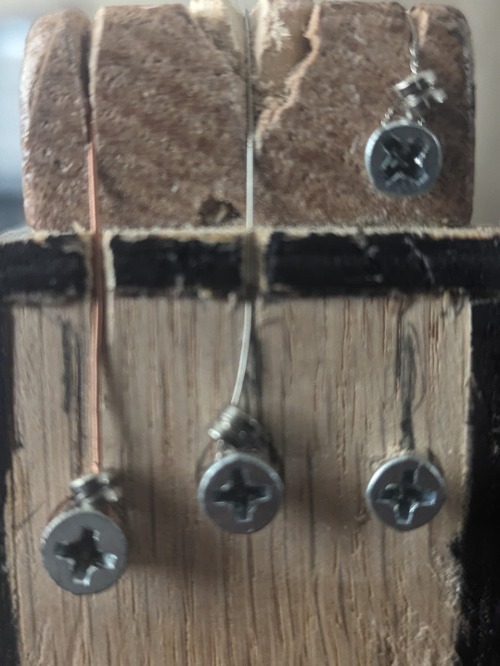
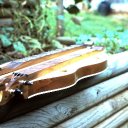
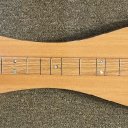
Here is a picture of a test dulcimer I built where the strings can be mounted to either the box or the fingerboard. (Sorry it's a bit ugly, form follows function) I am thinking of mounting both outer strings to the fingerboard, and the middle string to the box. My speculation is that this will put a huge amount of extra tension on the fingerboard, and the middle string will help prevent the fingerboard from being pulled off the soundboard. sadly I can't test this out until the local music shop opens back up in a few days.
Any information of how much tension matters, and how to properly harness that would be greatly appreciated
I am unclear about whether you are talking about string tension itself, the effect of string tension when mounted on the fretboard or the instrument body, or a wider question about the effects of tension on the instrument.
If you are talking about the effect of strings mounted on the fretboard, yes, it does has an effect. The effect is almost entirely lateral (depending on how high the play action is), and will be considerable if the fretboard is attached with ordinary woodworker's glue (aliphatic resin, 'yellow glue), unless it is stopped by the peghead (in which case the stress is transferred to a considerable degree to the joint of the peghead to the body (I had one dulcimer fail due to the accumulated stress on a peghead that had a hidden internal wood flaw).
The matter of string stress on the body of the instrument is a much more complex matter, as it involves construction techniques, the internal bracing and stresses within the body, and the overall design shape and geometric details.
Matt/Nate -- that 15 degree break angle is very close to the commonly-used-in-dulcimer-builds 12 degree break angle of strings from the nut to the tuners, and from the bridge to where the strings break hard over the back of the fretboard. Dulcimers with sharper break angles, especially at the tail seem, qualitatively anyway, to have more volume. I'm thinking of those which have the bridge set all the way to the rear so the strings drop almost 90 degrees to the string pins in the tailblock.
I recall others posting in the past about how increasing string tension (either by tuning higher, or simply by putting on heavier strings) on dulcimers added volume.
I do know that on banjos if you increase tension you will get more volume... but there is a point of diminishing returns, and when you reach it the sound suddenly becomes more tinny. I have seen this. And more volume does not necessarily mean more resonance or a 'better' sound.
On banjos, more string tension can be achieved by: heavier strings / higher tuning / tightening the skin head / tightening down the tailpiece that presses the strings down / putting on a higher bridge.
Supposedly, Earl Scruggs was once asked how tight to adjust the skin head tension on a bluegrass banjo banjo, and he said "Crank it down it just until the head splits, then back off a little." 
Nate,
A few years back American Lutherie had an article about someone trying a similar experiment with jazz guitars. Jazz guitars have the strings stretched over the sound board, similar to dulcimers, not attached to the soundboard like most guitars. In the article, the angle of the string from the saddle to the tailpiece was adjusted from near zero the almost 45 degrees. In this experiment, the volume (quantitative) increased as the angle decreased, but the tone (qualitative) decreased as the angle decreased. The writer settled on 15 degrees as the optimum angle. I have tried similar saddle to tailpiece angles with my floating fret board dulcimers with similar results.
Matt
Hey folks, this question might be poorly asked but here goes.
Does a soundbox that is under more tension have any additional clarity or additional volume? Is this the reason that 'lighter' builds are more responsive?
When I think about a musical saw, the volume seems to directly correspond to the amount of tension out on the saw blade.
Similarly, a washtub bass seems to be quite a bit louder on its high pitched notes, when the string is pulling the hardest on the tub.
I have been thinking a lot about where the strings are anchored on my dulcimers. Anchoring them to the fingerboard should apply an upward 'pulling' force on the area of the fingerboard with the pins. Meanwhile if the pins are anchored on an actual tailpiece of the box, they are stretched across the end of the fingerboard and are 'pushing' it down into the soundboard.
Does one of these produce more resonance than the other?
Here is a picture of a test dulcimer I built where the strings can be mounted to either the box or the fingerboard. (Sorry it's a bit ugly, form follows function) I am thinking of mounting both outer strings to the fingerboard, and the middle string to the box. My speculation is that this will put a huge amount of extra tension on the fingerboard, and the middle string will help prevent the fingerboard from being pulled off the soundboard. sadly I can't test this out until the local music shop opens back up in a few days.
Any information of how much tension matters, and how to properly harness that would be greatly appreciated
Just an FYI, I just read that the Music Go Round in Greenfield WI has a Warren May dulcimer for sale for $180.
John's given you a good start. You can also plug the VSL into the Strothers String Gauge Calculator along with the desired open note to determine reasonable gauges. Tom & Missy Strothers | String Choice
One reason that that instrument might not be so great sounding is that the square area the soundholes seems a bit less than would be common, and there are no holes in the upper bout
I have not heard of Mr Johnson, but I would go by the VSL (distance between the inside of nut and inside of bridge) to make a determination, at least to start out, anyway. My dulcimers usually have long VSLs (27"- 28"), and I use .012" plain steel for the first and second strings, and .022" wound for the drone. Nice looking dulcimer.
Hi there! Have any of you had a Geoffrey R. Johnson dulcimer? If so, what string gauges did you use? The one I recently acquired is oak and spruce, gold plated tuners, extended "foot" that I know is common in his instruments. Not a particularly great sounding dulcimer, but well crafted and pretty good looking!
I was cruising YouTube for some tab for the Dulcimer when I stumbled across this instrument called a Chapman stick played by a couple Mark White and Stefanie WOW what a beautiful sound, just thought I would share. never heard of the instrument before.
English Country Dance Tunes for Dulcimer, volume 1
Hey LP. I know Stephen Seifert has tab for it in his Join the Jam book, and I think I've seen @Mark-Gilston share tab for the tune as well.
At the website dulcibertab.com, which compiles all the tab that used to be on the old Everything Dulcimer site, you can find the tune out of DAd with a capo at 1 . I can't vouch for the quality of the arrangement, though.
"NONESUCH"
Hi kids any idea where to get the tab sheet music for a dulcimer song nonesuch?
Hello all! I just joined the group so I thought I would let you know a little about me. I bought my first mountain dulcimer, a Cedar Creek, in Branson at Silver Dollar City back in 2007. I have played it off and on (more off than on) and have recently renewed my interest in the instrument. I added to my collection last year with a McSpadden walnut body/sycamore top with a Galax back, and I am spending more time exploring the instrument. After 20+ years as a Minister of Music and another 20+ years as a public school music educator (band director) I retired in 2021. Since then I have filled my time performing in several groups on multiple instruments - baritone saxophone in a jazz big band, woodwinds and percussion in the local symphony, drums/percussion in an Americana/Folk/Country band, keyboards at my church, and pretty much anywhere when asked. I am looking forward to the discussions on here and learning more about the mountain dulcimer. Have a great day!
Welcome @rdmarble !! Hope you enjoy the community here as much as I am :-)