Tempered tuning
General mountain dulcimer or music discussions
Here is a short video about tempered tuning that may be of interest, especially to those of us in the learning mode. It was presented on another site [autoharp] and I'm 'borrowing' it.
Here is a short video about tempered tuning that may be of interest, especially to those of us in the learning mode. It was presented on another site [autoharp] and I'm 'borrowing' it.
3 7 10 are pretty common
On which frets is it customary to have markers? I've not seen enough dulcimers yet to know (ask me about banjo fret markers--THAT I can tell you!) I'm thinking of putting some temporary stickers on my frets so I'll know what the heck is what. Eventually I'll learn where my fingers are, but it would be nice not to have to stop and count all the time! Thanks!
I have always found that thicker unwound strings produce a slightly louder and more mellow tone than thinner unwound strings.Regarding the wound D string, you are clearly aware that the different materials used can produce slightly different tones (though I've never tried the string brand you mentioned), and like the unwound strings a thicker wound string will produce a slightly louder, more mellow tone, compared to a thinner wound string made of the same material.
For the 27" VSL you mentioned, tuned DAD, I'd suggest the following string gauges for a loud, yet more mellow, tone ..... 13 13 16/or17 and 26 for the D wound string. Those gauges will provide a strong, sweet, slightly more mellow tone. With those gauges, if you have a high string action then it will be marginally more difficult to press the strings down, and if you have a low string action then the dulcimer will be just as easy to play with the thicker strings.
I would take Dusty, Susies, and Strumelia's advice. To play in DAd, you should have a larger middle string like Strumelia suggests. You can easily call or email the company and ask if they are ball or loop end. Since they sell single strings to might be able to make up your own set. Reactions to Curt Managan strings on guitar forums mostly seems positive. I have no personal experience with them. If I every get to Cortez, Colorado, I may stop in for a visit. I like visiting factories.
Ken
"The dulcimer sings a sweet song."
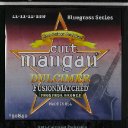
One little thing- that set you picture has all same gauge except a thicker bass wound string. That means it was generally intended for a tuning where middle string is tuned same note as melody string(s)... such as DAA.
Using these strings for a DAd tuning is certainly do-able and should work ok, but for 'optimal' results in DAd you would want a middle string that is slightly thicker than the melody strings. For example 11-11-14-22w instead of 11-11-11-22w.
Maybe contact them directly with your questions. I've found most places to be very responsive and informative.
Unless it specifically says "loop end," the strings will be ball end since that is the standard for guitars. (Notice their mandolin sets specify "loop end.") But they sell single loop-end strings, so it seems that would be the way to go. A single phosphor bronze loop-end string only costs a couple of bucks. Why not buy one and check it out?
Hi Mountain Dulcimer Friends 
I'm hoping to have a question answered and would also be interested to know what anyone who has used the Curt Mangan FusionMatched (#90840) strings thinks of them.
First the question. I'm guessing these strings probably have loop ends but I don't want to assume they do. I've looked high and low but haven't been able to find a description that mentions the end type. Are they loop end strings?
Second, what is your opinion about them? I'm hoping to achieve what could typically be described as a sweet, mellow tone as opposed to a bright tone. I'll be putting them on an hourglass dulcimer with a 27" VSL.(1.75" deep, upper bout 5.75", lower bout 7", waist 4.5") I use DAD tuning. I've calculated the string tension and it seems suitable to me. If you've used these, did you notice the tone to be noticeably more sweet and mellow and less bright than, say for instance, what you might hear using a set with the low D made of materials such as round wound nickel, stainless steel, or 80/20 bronze? How do they stack up in terms of quality? Do you have any other tips or might you suggest any other strings available that would achieve what I want to do?
Thanks so much for any advice you can give me on this. 
Yes, thank you for the photos @slssld! Enjoy your Black Rose!
Hi Robin,
I posted the pictures of my Black Rose at the beginning of the thread. Cool that you live so close!
Thank you to all that commented!
I'd like to see a Black Rose mountain dulcimer-- I only live about 20 miles from Nelsonville OH.
Great info. interesting story of how the name came about
I have been trying out Dgd. I watched a couple YouTube videos on approaching it, which were helpful. I think that will really work for what I want to do.
Two obvious reasons why I can't just play a tune out of D, since that's what I'm tuned in. Number one is my fiddle player. If a tune is in G, then, well, it's in G. And some of those awkward tunes that obviously were written in a different key because they are either too high or too low for the middle voice of the instrument.
This will be really quick to tune to G when needed (my brain won't be so quick, so the first after re-tuning is always a throwaway, easy tune).
I will try to be content with this new challenge (on top of still being challenged with the standard tuning) for a little while before I start chasing the next tempting thing.
Good ideas. I'm less willing to capo because I remove a few inches of dulcimer from the potential. I know when I go to another tuning on my banjo, I really have to pay attention during the first tune because my "muscle memory" has to shift to a different one. I guess that is what will happen when I re-tune the middle string.
I guess I'll try that, see what happens, and if I'm not ready, then I'll makeshift a capo and see how that feels.
Hey @carolynf,
The easiest way to play in G might be to tune the middle string to G so you would be in DGd. Then the drones would be "right" but "reversed," meaning the root or key tone would be on the middle string and the 5th would be on the bass string. Your home base on the melody string would no longer be the open D, but the G on the third fret.
If you don't want to retune, you could put a capo at the third fret. If you are tuned DAd and capo at 3, your notes would now be GDg, so you could play in G exactly the same way you were playing in D before.
You can play in G without using either of those methods, but as you have discovered, you can't rely on the open strings as much. You would also likely have to move up the fretboard to get the C natural that falls on the 6th fret of the bass and middle strings. (In fact, I've been working on a series of intermediate-level arrangements of tunes played first in D and then in G, all out of the DAd tuning. The challenge for the G parts though, is that we move up the fretboard where we are often less comfortable and have to use more fingers to play chords.)
EDIT: Woops! I see @ken-longfield is a faster typist than I am and offered the same advice already.
Probably the simplest way to play in G is to drop the middle string from A to G. Another easy way, which you say you don't want to do, is to capo at the 3rd fret. In the first method you will be playing in what is called "reverse ionian." The scale begins on the 3rd fret, not on the open as in DAd. Any DAA tab will work for playing in DGD.
Ken
"The dulcimer sings a sweet song."
I have a dulcimer tuned DAD that I have been learning on. I like to do notes and strumming with a thin pick and using chords. I am especially interested right now in playing some tunes in G. What is the usual way to do that? I know I can pick out the tune, but the drones aren't right then. (don't want to finger chords all the way through!)
Do people retune the drones for G? Do people just get a second dulcimer, like people have harmonicas in different keys? I know there are some keys one can capo up for, like A, but not ready to do that yet.
Thanks so much Trail Dad. Hope to have it soon. Robert Schuler instruments are unique & lovely. :)
Gail..mentioned small hand issue to Rick so hope he did the 1 3/8 but, like you said, not a huge diff. Found video on tuners & how to use Accutune module on Joe Collins web link off NHD page. Learned so much! Had no idea what types of tuners were even available or what/how/why to use Accutune Module. Rick & Joe each discussed & now I understand. What a great enhancement & design. Hope NHD adds lots of info/materials about the design, etc. as they redo the webpage....great selling points most like me who aren't in the mainstream dulcimer community would never even know existed.
I like the 1 3/8 because I have small hands. Might not matter for you - really not much difference.
Congratulations on ordering your new dulcimer. I also think they have a wonderful sound. I came very close to getting one but it just didn’t work out. I ended up getting a large body dulcimer from Robert Schuler here on the site. Enjoy your new love.
Hearts of the Dulcimer Podcast - Episode 52
Grant Olson Dulcimer Explorer
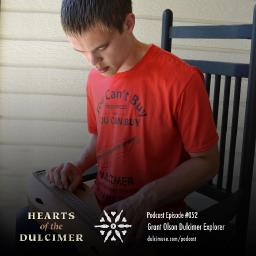
We spoke with the talented young dulcimer player Grant Olson from Minnesota. In 2019 at the age of 17, Grant won the coveted first place in the Mountain Dulcimer National Championship at the Walnut Valley Music Festival in Winfield, Kansas. In addition to playing the dulcimer, Grant also composes his own music.
You can listen to all the Hearts of the Dulcimer Podcast episodes directly on our website: https://dulcimuse.com/podcast or in most podcast apps.
Every episode has its own resource page with photos, videos, and song lists. Here's the resource page for this episode: https://dulcimuse.com/podcast/resource/052.html
Thanks for listening!
Fretboard width not brought up. Assumed Rick had a standard width. Honestly don't know why a player might prefer one over another. Maybe I'll send an email to ask...good to know about Ewing capo. Tks. Barb
Cue Ray Charles and the singers....
"I can't stop loving you...!"
My fretboards are 1 3/8. They also make 1 1/2, so it depends on which you requested. My Ron Ewing capo fits either one. I know you are excited about getting yours.
@dusty-turtle I have a feeling she never stopped (loving you). 
Gail...can you tell me the width of your New Harmony fretboard so I know what size capo to buy....thanks ahead of time. Don't have the dulcimer yet but should be any day now.
Barb
I put new strings on my dulcimer today, and she loves me again. 
Lori, I can help you. I have dozens of wonderful illustrations. I emailed you some last night. Here are a few. email me at laury@dancinghelix.com Laury
Hello, I have built dulcimers from 21" to 30" VSL and in my experience playing a shorter VSL dulcimer isnt much different at all than just playing further up the fretboard on a high VSL dulcimer. If you like chording there are definitely long stretches that can be made much easier on a shorter VSL dulcimer, but if youre anything like me, you may prefer a little extra space between the frets in the second octave. The difference of an extra 1/8th of an inch can make a really big difference for my fat fingers lol.
Having several dulcimers of the same VSL is definitely a bit more convenient than having them of different VSLs, but I think it's worth it to get your hands well experienced with adapting to different dulcimers.
One more added advantage to choosing a specific VSL and sticking with it is that you'll be able to use the same string packs for all of them, rather than needing different gauges or tunings for each one.
-Nate
Lots of different VLS, Don -- from 18" to 28". Play one, put it down, pick up another. Only takes a minute or so to adjust.
I have dulcimers with VSL's that range from 23" to 27". My fingers/hands (and mind) tend(s) to adjust very quickly.
I only have one dulcimer but I've got a lot of ukuleles, scales ranged from 7.5" to 20-ish inches. I gave the 7.5" one away (I had made it more as a dare than to be playable, but the person I gave it to was great with it.) I can play anything from 11.6" to 20", as long as I keep at it. If I put the shortest ones away for a while I lose my skill with them and have to regain it. Same with the longest one.
I often play dulcimers with radically different VSLs, ranging from a tiny octave dulcimer to standard dulcimers of 25" and 27" and a baritone of 28". I suppose I have to look more regularly at the fretboard until I get situated, but only once that I remember was I playing a tune I had arranged on one dulcimer and ran into difficulty playing it on a different one. The fingering had to change slightly and I was caught off guard.
I used to switch between guitar and mandolin, too. We humans are adaptable creatures.
Do you always play dulcimers with the same VSL? When you change dulcimers with varying VSL do you have difficulty adjusting?
This is as healthy as I get. Made it to 70 and still going.
LOVE Green Salsa and Enchilada Sauces. Nice to grow your own!
We've finished Mango season on our tree.
Have been "foraging" at a large local park/arboreteum this spring and summer when I go with a friend to do t'ai-chi, also around the neighborhood. Malay Apples and Rose Apples from the park, also now the Chocolate Sapote trees are coming into fruit, and I picked enough wild coffee that is drying that I'll be able to grind a few cups worth after roasting. Plenty of Starfruit around the neighborhood, plus wild lemon and grapefruit. .
That's a lot of tomatillos!
John i had never even tasted tomatillos until about 4 yrs ago. At first i thought Hmmm....odd. Then got seriously hooked. LOL Now i grow both tomatoes and tomatillos as my 'most important' Summer veggies.