Forum Activity for @jill-geary

Jill Geary
@jill-geary
05/01/18 11:54:14AM
33 posts


Thanks Greg! I have a standard BL (also custom) that is an amazing instrument - love it. But I would like the longer scale, slimmer body, for my noter/drone. Yes, it's hard to find a used BL :-)

Banjimer
@greg-gunner
05/01/18 07:29:00AM
143 posts


Jill, good luck in your search for a Jean Ritchie model Blue Lion.  I presently own two Blue Lion dulcimers, a Jean Ritchie model and an Acoustic Jam Baritone model, both were customized to have a single melody string and only three strings total.  I had to wait several months until my name came up on the build list, but they are exceptional instruments and well-worth the wait.  Blue Lion dulcimers are greatly valued by their owners and are seldom available as used instruments.  If you find one available used, don't hesitate in purchasing it.  It won't be for sale for long.

Jim Hedman
@jim-hedman
05/01/18 03:46:25AM
25 posts

4 equidistant strings/McCarty tulip dulcimer


Instruments- discuss specific features, luthiers, instrument problems & questions


Bridge, I was in a similar fix with my Carstanjen courting dulcimer.  An invaluable tool for doping out the intonation problems was this fret position calculator:  http://www.liutaiomottola.com/formulae/fret.htm#mozTocId169477.  There are a number of calculators on that web page.  The one you want is titled "Calculating Fret Spacing for All Frets".

The calculator is set up for a chromatic fret board so the fret numbers are actually semi-tones and you'll have to adjust to accommodate the diatonic scaling of your fret board (e.g. the first fret is 2 semi-tones, the second is 4 semi-tones, the third is 5 semi-tones etc.).  The equivalents for the first octave are as follows: 1~2, 2~4, 3~5, 4~7, 5~9, 6~10, and 7~12.

The StewMac web site has a similar fret position calculator ( http://www.stewmac.com/FretCalculator) that additionally provides fret to fret measurements. With this calculator you can specify "dulcimer" as a parameter input and doing so will restrict the output to the diatonic scale of your instrument - well, except it includes the 6+ fret which it labels fret #7 and calls the octave fret #8.  An advantage of this calculator is that it is easy to cut and paste your data output into a spreadsheet or print out.

For the "scale length" (i.e. VSL) measure the distance from the zero-fret to the seventh fret and multiply by two, which will give you the uncompensated VSL for the instrument.  Adjusting the bridge position by finding a true octave at the seventh fret gives you a compensated VSL that factors in the effect of the string tension increase caused by the act of depressing the string to the fret.  A compensated VSL will be slightly larger than an uncompensated VSL and it is the latter that we want to work with - at least for now.

Once you've entered the VSL measure the distance from the nut (or zero-fret) to each of the seven frets and compare them with the calculated values and look for discrepancies (i.e. errors).  The seventh fret VSL will of course be spot on automatically because that measure was the parameter used to determine our scale length input. What we want to look for is a pattern in the errors for frets 1 through 6.  For example, do all errors in frets 1 to 6 come up short?  I suspect they would if frets 1 to 6 play flat as you described.

Where we go from here is dependent upon the error findings and to cover all possible outcomes and remedies would make this reply overly long (if it is not already).  So if I've tweaked your interest, provide feedback on what you find and I'll try to dope out a solution - if there is one.

If you use Excel or another spreadsheet program, that would be a good vehicle for keeping your notes and for doing some later data manipulation, hopefully leading to a solution of the intonation issue(s).


updated by @jim-hedman: 05/01/18 06:22:42AM
Ken Hulme
@ken-hulme
04/30/18 09:35:05PM
2,157 posts

4 equidistant strings/McCarty tulip dulcimer


Instruments- discuss specific features, luthiers, instrument problems & questions

Could it had had the frets set by ear, rather than tuner -- say Just Intonated?  I've seen several "tulip" dulcimers from that era.  I think Wilfred in Germany has one, and there's one pictured in one of the early books -- Michael Murphy's Dulcimer Book perhaps or the early edition of the Mel Bay Learn To Play (I don't have them handy)

Strumelia
@strumelia
04/30/18 09:19:00PM
2,402 posts

4 equidistant strings/McCarty tulip dulcimer


Instruments- discuss specific features, luthiers, instrument problems & questions

This is cool.

I did however, move this thread to the "Instruments- luthiers/instruments Forum because it's about a specific maker and the issues effecting the instrument's playability.  howdy

Bridge
@bridge
04/30/18 07:51:09PM
18 posts

4 equidistant strings/McCarty tulip dulcimer


Instruments- discuss specific features, luthiers, instrument problems & questions

@rob-n-lackey

@ken-longfield

I just pulled it out and experimented. I have been positioning the bridge so that when you play the octave fret the note sounded is one octave higher using a digital tuner (and my ear). When I have that satisfied and play notes up the fret board, they are flat until I reach the octave fret I used to position the bridge. It would seem that the frets are not the proper distance from the zero fret, but I'm finding that hard to believe give the general quality of the instrument. The strings are all properly seated and are vibrating between the zero fret and the fret serving as the bridge.

I wondered if string gauge and tension might have an effect, but I don't think so. The bass string is a .023, and it acts the same as the unwound strings. The action is properly set and not so high as to affect the note sounded (and it would also be sharp, not flat). At the first fret, I have to bend the string about 1/8" to bring it up to the proper pitch. I've recently read an online article about different tuning "modes" and some of it went over my head. The writer was talking about some notes being flat or sharp when "in tune." Couldn't quite wrap my head around that one, but it seemed authoritative!  ;-)


updated by @bridge: 04/30/18 08:14:38PM
Ken Longfield
@ken-longfield
04/30/18 07:39:10PM
1,315 posts

4 equidistant strings/McCarty tulip dulcimer


Instruments- discuss specific features, luthiers, instrument problems & questions

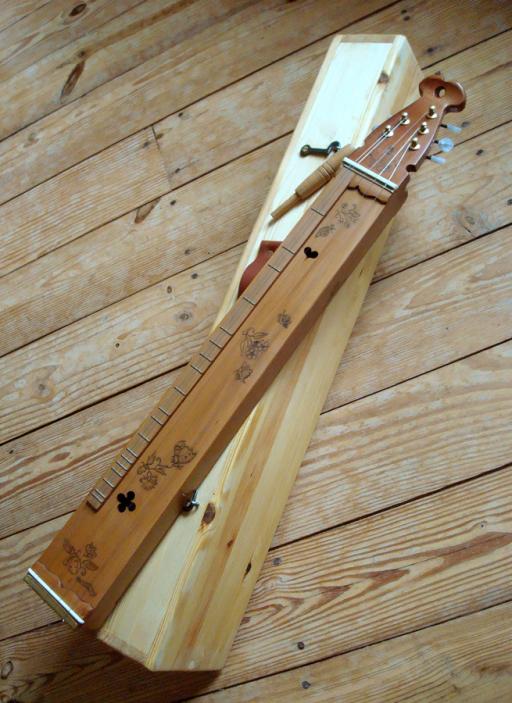
From what I can tel from the photos, the first piece of metal after the peg head is a Zero fret. The next is one and so on. Measure the distance from the middle of the zero fret to the middle of the seventh fret, double it and you have the place where the bridge (in this case another fret) should be. It is difficult to see, but do the strings pass along the slots in the tail piece? It was also constructed before the 6 1/2 fret became popular, so I would place it nearer to 1963 than, say, 1975.

Ken

"The dulcimer sings a sweet song."

Rob N Lackey
@rob-n-lackey
04/30/18 07:37:11PM
420 posts

4 equidistant strings/McCarty tulip dulcimer


Instruments- discuss specific features, luthiers, instrument problems & questions

Interesting instrument.  I don't know either if it's a tulip or lyre, but my money's on tulip.  I know where Volga is, but don't know anyone who lives there.  In fact, it's not far from here in Barbour County.  I have an hourglass made in the county seat of Barbour Co. and it's 4 independent strings as well.  Have you started with the bridge set the same distance from the 7th fret as from the nut to the 7th and see how close the intonation is.


Bridge
@bridge
04/30/18 06:51:12PM
18 posts

4 equidistant strings/McCarty tulip dulcimer


Instruments- discuss specific features, luthiers, instrument problems & questions

@rob-n-lackey

This might be better posted in another forum, but this topic line fits it perfectly. These are photos of a West Virginia 4-equidistant-string dulcimer I recently bought in Cleveland, OH for $75 while visiting my son. I'm not sure if it is supposed to represent a lyre of a tulip! I cleaned it up and put some standard strings on it. Sounds nice, and "shimmering" seems to fit it. The label inside it reads as follows:

No. #33

Russell W. McCarty

Volga, W. Va.

I've done some light investigation on the web, and I believe I have located some members of Mr. McCarty's family, but I have not yet tried to contact them.

Based upon my limited experience, this seems to be a pretty unusual instrument. I don't know how old it is, but it must have been constructed after 1963 and before people started printing labels on computers since the address contains a zip code and the label was done on a typewriter.

Since restringing the instrument, I have not been able to get it to play properly. The bridge is adjustable fore and aft, and I can get it to sound the right notes at the octave or middle fret, but it is as if the frets are not spaced properly when you play up and down the fretboard. As I go up the fretboard, the notes are flat until I hit the octave fret. I do NOT believe the instrument is improperly constructed, but I have yet to figure out why it seems to be so far off. I haven't really spent much time on it, and I might even be using the wrong fret for positioning the bridge if it doesn't have half frets. There are some very small pin holes that seem to hint at where the bridge should be placed; they are obviously there for that reason.

Anyway, that's a project I am working on.

I've posted below a link to some photos at the Google Photo site. I've made them accessible to all, but I may remove that link if I find that it compromises my my security there. First time I have done this...

https://photos.app.goo.gl/YtZR1fFgw4fSkJ9R6


t4.jpg t4.jpg - 132KB

updated by @bridge: 04/30/18 07:27:03PM
Bridge
@bridge
04/30/18 05:55:42PM
18 posts


@cheryl-johnson Those are two really lovely instruments!

Terry Wilson
@terry-wilson
04/30/18 05:16:16PM
297 posts

NDD - McSpadden 26 vsl (thumbs up)


Instruments- discuss specific features, luthiers, instrument problems & questions

I've owned dulcimers over the last 6 years, built by different builders. In the end, I sold them all, except my McSpadden. It was the only one that was just perfect, in a higher octave, beginning at 7. Perfection.
Jill Geary
@jill-geary
04/30/18 04:52:32PM
33 posts


I'm looking for a Jean Ritchie BL dulcimer to purchase. Maybe someone on this thread knows of one for sale?  (needs to be a non-smoker, please. I bought a dulcimer years ago from a smoker and the fingerboard was horrendous - could never get the odor out of it :-(

Thank you!

Bridge
@bridge
04/30/18 04:47:50PM
18 posts

NDD - McSpadden 26 vsl (thumbs up)


Instruments- discuss specific features, luthiers, instrument problems & questions


Susie: I also have been playing guitar for quite some time (finger pickin' for 45 years). I know the importance of spot on intonation. It really bugs me when builders fall short on intonation. McSpadden gets it right.

Essentially through dumb luck and what came up for sale on the local CL, I ended up with a pristine McSpadden M12W that had been in a case in a closet for 27 years. The intonation is dead on up the frets and from string to string. I don't really know why because there's no sign of any extra compensation tweaks. It's textbook. I returned a dulcimer made by someone you would all know that just was not right. I had bought it used from Guitar Center with the 45-day return option, so it wasn't a case where the original luthier could set things right, perhaps with a different instrument. It's a current model that sells for about $300 with soft case, and it just was not right. Why the McSpadden is so spot on, I just don't know, but I had read that their build quality is extremely consistent from instrument to instrument. I'm on a budget, and I feel very fortunate that this M12W fell into my lap at a good price. It's a pleasure to play.


updated by @bridge: 04/30/18 04:50:19PM
Susie
@susie
04/30/18 04:21:09PM
515 posts

NDD - McSpadden 26 vsl (thumbs up)


Instruments- discuss specific features, luthiers, instrument problems & questions

I also have been playing guitar for quite some time (finger pickin' for 45 years). I know the importance of spot on intonation. It really bugs me when builders fall short on intonation. McSpadden gets it right.
Lisa Golladay
@lisa-golladay
04/30/18 01:42:08PM
109 posts

Group sync


Playing and jamming difficulties...HELP ME!

Somebody leads.  Different people can lead different songs if you like, but figure it out before the gig.  There's nothing worse than a bunch of musicians looking at each other like deer in the headlights, waiting for somebody, anybody to count them in.  Do not ask me how I know this!  I got so fed up with one group that I made buttons saying:

I'M THE ONE WHO CAN COUNT TO 4

and handed one out before every gig.  The leader must be fearless, ready to jump in and count the beats and name the chords like Dusty says.  "Back to the A part, three, four, here we go..."  Leading a group is a skill that takes practice, like any other skill.  Following a leader is also a skill to practice.  This could be a goal for club meetings.

One option is to get a bass player... or a drummer (one drummer)... to keep the tempo.  You need an instrument with a sound that stands out from the rest of the group so everyone can hear it.  A banjo (or a dulci-banjo) might do the trick.  If all else fails, sit someone down in the middle of the group with a 5-gallon plastic bucket and pound the beat.  Then the problem is to find the right bass/drum/banjo player.  I've been stuck with bassists who can't keep a steady rhythm and bassists who play the wrong rhythm (this is a waltz, you idiot).  If the bass has the wrong tempo there's nothing anyone else can do to save the tune because in a group with 3 dulcimers and one bass, the bass wins. 

Once you get more than 6 MD players, as Bill describes, I think you've reached the point where somebody has to conduct.  If one side is getting ahead of the other, that means they can't all hear each other.  Which means they need a visual indication -- tapping foot, waving hand.  I think pulling out a conductor's baton would be a funny bit of shtick for the audience. 

I have played gigs where we had to watch each others' strumming hands because nobody could hear the beat.  That doesn't work so well for beginners who still need to look at their fretboards, and it's hard to manage if people are using tab.  At least be sure you're sitting close together and in a semi-circle so you can all see each other.

Bridge
@bridge
04/30/18 11:44:39AM
18 posts

NDD - McSpadden 26 vsl (thumbs up)


Instruments- discuss specific features, luthiers, instrument problems & questions

Just an added note regarding short VSL instruments. In general, intonation is harder to get spot on as you shorten the string length because anything that's "off" about the instrument (perhaps the accuracy of fret positions) represents a large percentage of the whole and gets magnified. For example, it's much easier to have perfect intonation on a baritone ukulele than it is on a soprano uke. You can definitely get intonation spot on if you are willing to do what needs to be done. On some saddles (at the bridge) you will see them shaped so that each string has a slightly different VSL. On electric guitars, there are small sliding string carriers that can be minutely adjusted. Often, you can just angle the bridge/saddle. On my McSpadden M12-W, the bridge is basically perpendicular to the strings. On the McSpadden 26" VSL, the bridge is at a distinct angle on the 4FH26WR pictured at their website. See pic below.


dul.png dul.png - 320KB
Bridge
@bridge
04/30/18 11:22:38AM
18 posts

NDD - McSpadden 26 vsl (thumbs up)


Instruments- discuss specific features, luthiers, instrument problems & questions

I'm new to dulcimers, but I have quite a bit of experience with short-scale guitars and alternate tunings. On guitars, when you go to a shorter scale, you end up increasing the string gauge to maintain proper intonation. When you go down in VSL, less string tension is required to maintain the same pitch. At some point, the string becomes floppy, sounds bad, and doesn't intonate well. If you keep the same VSL and go up in pitch, your string tension obviously goes up. If you want to go up in pitch and maintain the same string tension, you need to go to a lower string gauge. Just some examples.

Go to this string tension calculator provided by D'Addario and experiment. You can select a standard setup and then vary one or more factors and see the calculated results.

D'Addario      http://stringtensionpro.com


tens.png tens.png - 119KB
nigelbleddfa
@nigelbleddfa
04/30/18 03:50:57AM
33 posts

bagpipe drone.


General mountain dulcimer or music discussions


Changing strings is fine, Dusty, but having them snap is very, very dangerous. I have managed to convince my wife that this is so and she loves me so much that she would rather I bought another dulcimer than risk getting hurt. 

This works for me and I am sticking with it.giggle


updated by @nigelbleddfa: 04/30/18 03:53:52AM
Dusty Turtle
@dusty
04/30/18 03:33:30AM
1,846 posts

Group sync


Playing and jamming difficulties...HELP ME!

I actually like all the suggestions here.  I've found in jams that it's important to have a clear leader for each tune.  That person counts out the first measure and determines the tempo.  Everyone else should follow that person.  It also helps if that person or a surrogate taps their feet loudly and plays the role of conductor.  

If there is a real disconnect, it may be that someone has to take a more active approach. In my monthly dulcimer group, I will sometimes start counting beats out loud and giving cues to where we are: "2-3-4- third line" or "3-4 A chord" or  whatever to get people in sync.

And sometimes a private conversation may be necessary.  I have a tendency to speed up as I play. One person in my local group always plays too fast.  But one day I spoke with her privately, explaining that we both had the same bad tendency and asking for her help in slowing down and following the tempo of the rest of the group.  That conversation made her a better player with out my having to insult her in any way.

But as a general rule, every orchestra needs a conductor. Whether that's the rhythm guitar as Randy suggests, someone taping their foot, or another leader of some sort.

Dusty Turtle
@dusty
04/30/18 03:16:03AM
1,846 posts

bagpipe drone.


General mountain dulcimer or music discussions

@jp, I regularly use a .014 on my melody string and almost always tune to d. I've never had a string break on my dulcimer when I was tuning it.  But perhaps on longer VSLs .012 or even lighter would work better.  I say go for it and see what happens, perhaps putting on some goggles just in case. blinders  Jeepers, creepers, you gotta protect your peepers!

@nigelbleddfa, it is surely the case that the more you change a string's tuning the more likely the string is to snap, but so what?  It's a good idea to change strings every 3-6 months anyway, so I don't see what the big deal is.  A string costs a buck.  A dulcimer costs a lot more than that.  There are better reasons to justify a new dulcimer.dulcimer

Maybe I'm spoiled.  My thoughtful wife inlove got me a $100 gift card to Just Strings for my last birthday. I was able to buy several years worth of strings with that.

nigelbleddfa
@nigelbleddfa
04/30/18 02:59:13AM
33 posts

bagpipe drone.


General mountain dulcimer or music discussions

My first dulcimer was tuned DAD. I told my wife that it was dangerous to keep changing the tuning to DAA and over a period of time strings would snap and replacements would be needed. She accepted this and I bought a second dulcimer which is permanently tuned DAA. 

Do you think she will accept the "strings snapping" argument as a good reason for buying a third ? I quite fancy a nice solid walnut one.whistle

jp
@jp
04/29/18 09:45:27PM
42 posts

bagpipe drone.


General mountain dulcimer or music discussions

ok the good news is yes you can tune it up. it is tight but it is there.... changing strings is not an issue for me ... i wanted to be able to go back and forth DAD and DDD...on the same machine... with out surprises.

thanks to ken for the counsel.....he got closest to a yes or no answer.

Strumelia
@strumelia
04/29/18 06:27:05PM
2,402 posts

Group sync


Playing and jamming difficulties...HELP ME!

I like Randy's suggestion- so the main rhythm leaders can better keep all together!

Ken Hulme
@ken-hulme
04/29/18 03:26:36PM
2,157 posts

Group sync


Playing and jamming difficulties...HELP ME!

Someone whom all can see, blatantly tapping a foot to follow!


Randy Adams
@randy-adams
04/29/18 11:30:49AM
125 posts

Group sync


Playing and jamming difficulties...HELP ME!

Bill
Try keeping the guitars and any other rhthym instruments near each other so they can hear one another.
Bill Robison
@bill-robison
04/29/18 11:03:29AM
36 posts

Group sync


Playing and jamming difficulties...HELP ME!


 I belong to 3 central Indiana dulcimer groups and we often play together at local events. 

The problem arises when we have more than  6 or 8 players. Some players are advanced others relative beginners.

Usually we have at least 1 or 2 guitar players but still have problems with group sync in the larger group. Do you pick some one to lead and everyone follow them? One side of the group will end  up a note or two behind or ahead of the other side . We don't use electronics so it is difficult, especially outside to keep everyone together. Other that very frequent practice, does anyone have suggestions?  We play together weekly with portions of each group involved 

Bill Robison


updated by @bill-robison: 10/27/19 12:02:25PM
Ken Hulme
@ken-hulme
04/28/18 03:33:50PM
2,157 posts


There's another Too Young To Marry  a.k.a. My Love Is But A Lassie Yet, which predates Robert Burns, but for which he wrote lyrics under that title...

ABC:


|:d/c/ | dD FA | dD Dd/c/ | dD FA | eE Ed/c/ |
dD FA | Bg fe | d/c/B/A/ Bc | dD D : |
|: f/g/ | a>f g>e | fd df/g/ | af g/f/g/a/ | be ef/g/ |
af ge | fd fe | d/c/B/A/ B/c/d/e/ | fd d : |


Rob N Lackey
@rob-n-lackey
04/28/18 02:31:32PM
420 posts


It's "other" name is "Sweet Sixteen" and like Lisa, I can't recall hearing any words to it.  Yep, Lisa, that's the basic tune.


Strumelia
@strumelia
04/28/18 01:34:13PM
2,402 posts


If it's this tune:

http://abcnotation.com/tunePage?a=nlfiddlers.org/ABCtunes/Reels/0011

then it's a very old fiddle tune (Scottish maybe?).  A tune , not a song .  Not sure if anyone's written words to it in more modern times, but I've only ever heard it played as a fiddle tune in oldtime festivals.

majajog
@majajog
04/28/18 09:43:25AM
21 posts

Pick paranoia!


Instruments- discuss specific features, luthiers, instrument problems & questions

Perfectly willing to try the PykMax EXCEPT I play left handed and they don’t seem to make one yet.  I guess we are too small a market. The trials and tribulations of us southpaws.

Kusani
@kusani
04/28/18 09:16:05AM
134 posts

bagpipe drone.


General mountain dulcimer or music discussions

I am finding that 10ga, 12ga, and 20ga are working best on the dulcimers I build, but occasionally a 22ga is better. But as most know, a lot of it is simply personal preference. 

Banjimer
@greg-gunner
04/28/18 06:39:39AM
143 posts

bagpipe drone.


General mountain dulcimer or music discussions

I'm with Skip on this one.  Strings are inexpensive and easily replaced.  Replace the .014 gauge with a .012 gauge.   

Elvensong
@elvensong
04/28/18 05:53:52AM
9 posts

Pick paranoia!


Instruments- discuss specific features, luthiers, instrument problems & questions

majajog:

I have arthritis in my picking thumb it is hard to hold a plain, thin pick comfortably for very long...


Have you tried the PykMax? I would think this would be perfect for you! It allows you to loosen your grip completely without dropping the pick. 


Within a minute of playing with mine the first time I ordered 3 more. It's a super comfortable picking system.


Pykmax03.jpg Pykmax01.jpg

Skip
@skip
04/28/18 01:43:54AM
389 posts

bagpipe drone.


General mountain dulcimer or music discussions

jp,

You will be increase the tension from ~ 20 lbs [calculated] to ~27 lb according to d'addario string tension chart pdf. Their chart shows the .014 going up to ~38 lbs for an 'f' on a 26 1/4 banjo vsl. You could also replace the A with one of the melody strings or install a new, additional, .012 string.

Robin Thompson
@robin-thompson
04/27/18 10:31:31PM
1,548 posts

bagpipe drone.


General mountain dulcimer or music discussions

Maybe it's just me yet I would not try to take a .014 string up to D from an A. 

jp
@jp
04/27/18 10:19:57PM
42 posts

bagpipe drone.


General mountain dulcimer or music discussions

Dddd.... Hey that’s the dragnet theme!🎶

my concern is the “A” string going up to the same D as the melody strings will pop. i am just trying to find out if it will be to tight... has anyone had any experience doing this with the specs i gave in the original post???
my strings are 12 12 14 22
Ken Hulme
@ken-hulme
04/27/18 10:11:58PM
2,157 posts

bagpipe drone.


General mountain dulcimer or music discussions

Aye, well, I didn't understand that from your first post, it's true.  As Skip says, tune the Middle Drone A string UP to the same d as your melody string(s).  A 14 ga string on 26"-27" VSL should be able to tune to d, because you can play that same d on the 10th fret.  Then your tuning will be Bagpipe D -- that is Ddd

Skip
@skip
04/27/18 08:42:25PM
389 posts

bagpipe drone.


General mountain dulcimer or music discussions

Tune the 'A' to the same as the melody, dd [middle 'A' to 'd']. You're tuning then will be spelled as Ddd [or Dddd], bass to melody, in MD speak. If you loosen the 'A' to 'D' it will be pretty 'floppy'. The .014 will feel tighter than the 2 melody strings though if those are smaller.

jp
@jp
04/27/18 06:19:42PM
42 posts

bagpipe drone.


General mountain dulcimer or music discussions

well maybe i was not clear.

my dulcimer is tuned to ddAD

i want it in bag pipe all D's across the board

the middle string presently is at A.... a .14 gage will it go up to D with out breaking

OR should i tune it down to D.

  333