DAA or DAD as primary tuning ?
General mountain dulcimer or music discussions
When do people use the 1 1/2 , 8 1/2 and 13 1/2 frets?
To clarify, all MD's have the ionian scale, it starts on the 3rd fret. The scale name [key] is defined by the note on that fret. DAA is used to play songs in the key of D [D is on the 3rd fret]. MD's having a 6+ fret have 2 ionian scales, one starts on the open using the 6+ and one starts on the 3rd fret using the 6. So, in DAd, you have the notes for the key of G [starting on fret 3] and D [starting open] on the melody string.
"the vast majority of those Mixolydian tune book songs are not Mixolydian modal songs. They are Ionian Mode songs being played in Mixolydian DAd using the 6+ fret."
This is correct - or you could play across the strings and use the 2nd fret of the middle string.
This shows the confusion created by calling tunings by mode/scale names. Think of the modes as scales and scale variations. Ionian mode is a fancy name for the major scale, the old do re mi... Myxolydian is a fancy name for the major scale with the 7th note flatted. (Aeolian and Dorian are fancy names for two kinds of minor scales.)
On most modern dulcimers (w a 6.5 fret):
When tuned DAD you play an ionian/major scale from 0 (open) to the 7th fret using the 6.5 fret and skipping the 6th fret.
When tuned DAD you play a myxolydian/flat-7 scale from 0 to 7th fret using the 6th fret and skipping the 6.5 fret.
DAD tuning was called "myxolydian" because on the original dulcimers - with NO 6.5 fret - it is the only scale you could get going from open to the 7th. Also, that's how you MUST tune the dulcimer to play a song like Old Joe Clark that uses a flat 7th (on 'Clark': 4 - 5 - 6 - 5 - 4 - 3 - 2...)
To play an ionian/major scale on a trad dulcimer - with no extra frets - you MUST tune to DAA, and the scale starts with the D that's now at the 3rd fret, and you play 3 - 10 on the frets. If you tune DAA on a modern dulcimer, you still play 3 - 10 for the major scale, but you have to make sure to skip the 6.5.
That's why DAA tuning became called "Ionian" - b/c that's the way you have to tune to get a major/ionian scale on a traditionally fretted dulcimer.
With the 6.5 fret (or playing across the strings) you can find the pure major scale songs even if you're in DAD tuning.
Bottom line: It's NOT really the tuning that is "myxolydian" - it's that that tuning allows you to play the myxolydian scale, in particular on a dulcimer with no extra frets. Same with all the other Greek names.
I tend to stay in DAD because I can play either mode with no retuning. However, you can't play a D-myxolydian scale on a dulcimer tuned DAA - unless you use the bass string.
I think of the DAD tuning as 'containing' the DAA within it - on that middle, A, string - but not vice versa.
Hope that makes sense. It can be a little confusing!
Thx, what a fun history lesson. U are quite knowledgeable re: jazz & ragtime-I love 1940's swing stuff-Andrews sisters, gene krupa, benny goodman, but also earlier Stephane Grapelli & Django Reinhardt-if i could just translate it to dulcimer. U can call me jonesie (or RayJay for that matter) if you wanna:), but my name is Luann.
BTW, it just occurred to me that we know each other. We met at one of Don Pedi's retreats at Wildacres, what, a year or so ago-or 2?-that was a fun one-Randall McKinnon was there too, remember?
DulcimerJones (or can I just call you "Jonesie"?),
It holds a lot of memories for me, too. My mom used to sing it to me when I was but a little shaver. I forgot about it completely until recently when I started playing it again with a ragtime pianist of my acquaintance. He plays the original 3-part tune "Iola" from 1904.
Then in 1940, a fella named Saxie Dowell stole the middle part for his song, "Playmates". Johnson sued over the plagarism and won. However, at the time "Playmates" became popular. Kay Kyser had a hit with it with Sully Mason and His Playmates on vocals, as did a few other people.
In 1955, Which is probably the version that you and I are familiar with, the record was a hit for The Fontane Sisters.
Even more recently, it was used in The Addams Family movie with vocals by The Kipper Kids.
And there you have more than you ever needed to know about "Iola: A Ragtime Intermezzo".
Don, you are using tunings on your short scale dulcimers which mean you will be playing in the key of G (not D, so don't get confused by anyone talking about D). It's simple: both the guitar and the uke should be able to play in the key of G along with you without anyone having to use capos.
For simple common folk tunes there are usually only three essential chords the guitar and uke will need to know when playing along with you in the key of G: G, C, and D chords. They should already know how to play those very basic standard chords. They won't need to use a capo or learn new chords or fingerings to play in G.... they just have to know when the chords change in the tune. Most players can sense that and will catch on when doing simple chord accompaniment. You will most likely be playing the simple melody and they most likely will be playing accompaniment chords... at least as you get started playing together.
The guitar can play in any key, especially if he has a capo.
Ukulele players seldom use capos and (almost) never above the 2nd fret.
If she's strumming chords, in the key of D, simple D-2220 or 2225, A-2100 or A7-0100 or 2130, and G-0232 will accommodate most dulcimer folk songs.
Somewhere in my Getting Reacquainted prowling yesterday I found the comment (by Dusty Turtle?) that could be the maxim for this site and all our musical questions: The dulcimer takes 5 minutes to learn and a lifetime to master.
As for "Mixolydian tune book songs are not Mixolydian modal songs. They are Ionian Mode songs being played in Mixolydian DAd using the 6+ fret" , that's because I guess we could take another saying and turn it into a call for da da da dum: Music Theory! Accidentals happen.
Just did a print out of the chart, to keep with my music. Think I'll do a download on my tablet, too.
Since they have 'chromatic' instruments [all notes/keys available], they play with you or play in the 'keys' [note ranges] you have available. Otherwise you could be retuning for some tunes or adlibbing some notes.
Don;
Tunings are a physical thing, they are nothing more than the 'open' notes of the strings. The different tunings are used to facilitate physical access to various ranges/arrangements of notes. Most all the rest is music theory, which you can find on the net, in libraries or via classes and will pickup over time.
Don, I have the sense that you don't want to delve too far into music theory (i don't blame you!)- that you really only want to know enough to not be confused when playing simple tunes at home. Because you have instruments with shorter-than-usual lengths of scale, you can't get around the fact that your tunings will need to be higher than the usual D-based dulcimer tunings...in this case you go up the alphabet from D tuning to a higher G tuning. But because you play alone, you can use your G tunings that are almost just like the usual D tunings and you'll be able to 'pretend' you are in D and use the tabs written for the D tuning equivilent of your G tuning. (i hope you're not lost here)
There is no definition page here on FOTMD, but there are plenty of those on other sites if you google. I have written a guide to the four most common dulcimer modes and tunings -written for beginners and in plain language with videos, charts, and simple explanations. My posts on modes/tunings are intended for people who just want a simple basic understanding so they can play and tune more easily. Most of what I've written on my Noter Blog is geared towards the key of D tunings, but you can just 'translate' that for your G tunings by substituting G for D (use GDd when you see DAA). Or in the case of your new dulcimer, GDGg ...which you should know is also similar to an ionian DAA.
I understand you don't want to get far into theory, but since you ask for definitions, I'm going to give you a link to my blog post that tries to explain modes and tunings to beginners who only want to get a quick and practical understanding :
https://dulcimer-noter-drone.blogspot.com/2010/09/few-of-my-posts-about-modes.html
Anytime someone asks for a 'definition' of modes and tunings, they should understand that reading one or two sentences in a 'definition' is never going to give instant understanding. But if you go through and explore the post I've linked to above, it might take an hour or two but you will then have a basic grasp that will get you feeling a little less frustrated than you are now. That feeling will be very reassuring as you go forward in your home enjoyment playing.
Lois -- remember that the vast majority of those Mixolydian tune book songs are not Mixolydian modal songs. They are Ionian Mode songs being played in Mixolydian DAd using the 6+ fret.
I was going to say that!
Ken's right Don- Just think of your GDDd tuning as a higher version of DAA. It needs to be higher because of the short scale/length of your Wren dulcimer. BUT you can follow all TAB written for DAA on your GDDd dulcimer. (you will be playing in the key of G)
As to your coming GDGg dulcimer- when it comes you can either retune it to GDDd and see if it feels right, OR you can stay in GDGd and think of it as similar to DAdd (DAd) tuning... and then if you are playing noter style you can follow all TABS written for DAd. (again, you will be playing in the key of G)
If strings feel too 'heavy' or tight when playing, you can buy strings one number smaller and often it will feel better for your fingers. However, keep in mind that the shorter the instrument (and the Wren is quite short) the stiffer the strings will feel by default. My epinettes tend to be stiffer feeling than my (longer) dulcimers.
Don't worry too much- you can find your fave one or two tunings and stick with them if you like! Some folks like to experiment, others not so much.
Lois -- remember that the vast majority of those Mixolydian tune book songs are not Mixolydian modal songs. They are Ionian Mode songs being played in Mixolydian DAd using the 6+ fret.
Don -- Play what works for you, GDD, GDg, QRS, TUV, WXYZ.... Nothing wrong with the key of G, especially on those smaller instruments. Just remember that your GDD dulcimer can play DAA tabulature, and your GDg dulcimer can play DAd tabulature, as written. No need to change to the key of D.
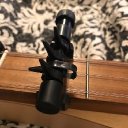
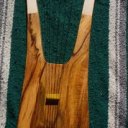
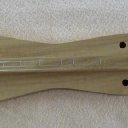
Marg, that little dulcimer was made by FOTMD member Peter W . You might contact him if you have any questions. Notice that in addition to the swivel possum board, he has a small box situated directly under the fretboard. The purposes of a box are to 1) amplify the sound, and 2) improve the tone. To achieve the second, cardboard won't do, which is why I suggested cedar cigar boxes.
I have a really nice patio out back overlooking a small lake but sometimes it is very sunny in the afternoons so I put in a small paved sitting area at my entrance up front for a shady afternoon. Now I can play outside anytime, just sometimes in the back & sometimes in the front.
What a great eclipse site-loved the animations, thx.
Thx, we love our deck! Jan, come on down!! Some of us here in Morehead just spent an intense, but very fun 3 days with Sarah Morgan & Stephen Seifert at Ky Center for Trad Music w/jamming on Bill & Patty Mains' porch 1 nite & jamming at Sarah's camp the next-the final nite concert included Raymond McLain on fiddle-it was awesome!
Don: Tune your dulcimer to DAd. Use music that's tabbed out for DAd tuning. Find other people who enjoy playing with this tuning. Enjoy!
I believe this answers your original question.
Lovely deck--thanks for the photo! Let me know if you need jamming company someday!
Type your zip code into the box here and it will give you lots of info on what the eclipse will look like from your location. This is a really cool site. https://www.vox.com/science-and-health/2017/7/25/16019892/solar-eclipse-2017-interactive-map
DulcimerJones, that's a beautiful place to sit!
Thanks, Ken! That's so quick! I am on my tablet now, but am eager to print it out when back on my desktop. Similarly I have found YouTube recommendations about strumming I am looking forward to trying. It's good to be back here.
Lois, here is a link to chord chart in DAA from EverythingDulcimer.com: http://everythingdulcimer.com/files/tab/chord_chart_daa_major.pdf
Ken
"The dulcimer sings a sweet song."
Lots of different cigar box dulcimers, 2 & 3 boxes - great.
This one was interesting also, no box just the possum board that also acts as a cover.
CGG seems to fit my voice better, although I am definitely not wedded to it. I have found so many books in Mixolydian that I have found myself playing it more and more. I would really like to find chords in Ionian.
Care to share, Jim? I am not worried about transposing. As long as I allow for the 6 1/2 fret that is not a problem.
I will try to do this also. We just built deck vol.2 this year & its a pleasure to sit looking out over paradise in E. Ky. Too bad this does not coincide w/the eclipse-that would be cool! Attaching pic, hope this works!
The solar eclipse starts at 11:54 a.m. CDT and totality begins at 1:22 p.m. CDT, lasting for a little over two minutes.
Sean, Wow, that song is dredging up memories from the long, long ago of my aging brain. Was this recorded by the Andrews Sisters or Shirley Temple? The lyrics are so familiar, but I'm having trouble placing the tune, even w/youtube...
Yes, you want at least one sound hole. Since your fretboard is already made and the dulcimer fretboard sits on top of the box (instead of recessed into it like a guitar), your project is much easier than most.
Check out FOTMD Randy Adams playing a fretless cigar box dulcimer . You can see how he set up the soundholes and how he arranged the two boxes underneath his fretboard. Randy used two cigar boxes, but check out this Tiny Guitars version with three (and frets, too, along with a pickup).
(Any cigar boxes will do, but those made of cedar will sound much better.)
dusty,
do I need to put some type of sound hole in the box?
Leo, the issue you are dealing with now is simply a question of where to post a comment or question on a given topic. I wish more people here would think about that instead of just posting in whatever forum or group they find first.
Each of the last few years someone sent out email notifications about the Kindred Gathering, and I think there were announcements here and at ED. For some reason none of that communication happened this year.
If you want to post somewhere that you are going and wondering who else may attend, I would suggest either the General Mountain Music Forum or the Group pages for the California Group and the Northwest Players Group. However, I will warn you that the Groups have been a little inactive over the last few months. Maybe everyone's off at festivals.
Leo, you're very welcome.
I agree it's best to let organizers post about their own event. They may not have remembered it- in past years they have posted it here in Events. Maybe they assume everyone is on FacePlant. lol
BUT, you could create a General Forum thread mentioning that you are going...no harm in that I'd say. Just click on the top of page LINK to Forums, and post a new thread in the General Mountain Dulcimer Or Music Discussions category.
I type pretty fast.
------------
Lois, you posted your Single Instructor Event just fine. If you stop trying to post in activity feeds you won't see that error message.
Thanks to all who have answered. I appreciate the information and encouragement. As to the info, I have to digest it all! Gosh, Strumelia, I hope all that was boiler plate from somewhere you cut and pasted OR that you're a very fast typist!
But without having read the responses in detail, what I had been looking to do was along the lines of, say, when I first got on the site and some people posted a hello. A general place or message board to say, 'gee I see the Kindred Gathering isn't listed here, but I was going to be there next week and thought some FOTMD members in Nor-Cal and Oregon may be interested...' And a link. Or not, if it's problematic.
See, though I want to mention the KG and that I'm going, it's not my place to post a festival listing as others organize it and I don't know why they choose to not use FOTMD OR ED! So posting that gathering IS something I'm "not authorized" to do - by them! I will ask them about it when there. Maybe on that basis, I should not post anything about it (??? This seems counter-intuitive to me!), but in any case it has raised the general issue of messaging to people and the group.
I'll read and plod.
Thanks again and ciao for now, Leo
From your page, select Events/Single Instructor Events. Up comes a new page with the banner
Discussions » Single-Instructor Workshops, Band & House Concerts, Club Activities, Monthly Jams
and at the right side of the banner, click the + When you do a new page appears titled
|
||
with a text edit box below it where you type your information