Dulcimer shops near Asheville NC?
General mountain dulcimer or music discussions
Ah! I wondered why there were two addesses I found for Native Ground. Thanx Steve. Did I miss anyone?
Ah! I wondered why there were two addesses I found for Native Ground. Thanx Steve. Did I miss anyone?
I've played D-A-d-d 99% of the time for the last 35 years, but I also like D-A-c#-d for some of the interesting chords it offers as well as the chromatics.
Tom Fellenbaum builds some great instruments, too. If you like Celtic music, he alternates Sundays with Richard Beard, another great dulcimer builder, as a host of Celtic Roots on WNCW from Noon-3pm Eastern. Richard was on today, so Tom ought to be the host next week. (Available online.)
That's just Wayne Erbsen's house - there isn't a store there, and he doesn't sell dulcimers, anyway. But the others are good. Have fun, Annie!
What John said. Most pickups will use a 1/4" in jack with a female end. The cord will have two mail jacks. One plugs in to the dulcimer and the in to the amp.
Ken
"The dulcimer sings a sweet song."
Thanks, Ken. You are always so quick to help! I know for sure we are passing through Black Mountain, so that's good. A.
Hearts Of The Dulcimer Podcast - Episodes 11 and 12
Judy Klinkhammer: A Dulcimer Life


A two part celebration of Judy Klinkhammer's life. She was a well-loved dulcimer player and teacher who lived in the Ozark Mountains in Arkansas. Many people credit Judy for introducing the dulcimer to that part of Arkansas in the early 60s. She truly lived with the dulcimer in the center of her life.
For episode resources: http://dulcimuse.com/podcast/resource/011-12.html
Here's the shops I know of in that general area.
Native Ground Music -- 109 Bell Road, Asheville, NC 28805-1521 - 828-299-7031
Song of the Wood -- 203 W State St Black Mountain, NC 28711 - 828-669-7675
Fellenbaum Stringed Instruments at Acoustic Corner - 105-F Montreat Road - Black Mountain, NC 28711 - 828-669-5162
High Country Dulcimers -- 8830 NC Hwy 105 South Boone, NC 28607 - 828-963-TUNE (8863)
Going to visit NC next week. Please suggest shops/builders I could visit in this dulcimer heartland?Thanks!
Ken. I sometimes play regional variations. There's a lot of them when it comes to old tunes.
When Sandy and I get together weekly, our first tune is Boonie Doon. She plays harmony and I melody. Then Softly and Tenderly followed by 5 Tull Glazner Gospel songs we play w/o tab. We are working it.
What do the 2 jacks look like? A 1/4" phone jack is pretty much the standard for guitars, amps, mikes, etc.
Sometimes you run across a 1/8" phone jack, in which case you can get a little adapter to go from one to the other.
I got a super fun little amp from Mike Clemmer and while I hope to use it playing at the nursing home, right now I like to use it to better hear my finger picking. I got a Gallier and it has a pick up but I don't know what type of cord I would use to put the two together. Any advice? Thanks!
For some reason, if I pick up a dulcimer to just "noodle around", I seem to fall right into "Twinkle Twinkle Little Star". That morphs into "Smiling", "Acres of Clams" (aka "Rosin the Beau") and always has some variations of "Cabbage" thrown into the mix. To change it up, "Spotted Pony" and/or "John Stinson #2"!
I always encourage dulcimer players to keep a list of every song they can play "on the spot" without looking it up, rehearsing, or asking someone, "How does that start?" There might be only one or two songs on the list at the beginning, but it will grow with some effort. And it's great to have some songs to pull out at any time.
As a 'beginner' I like your perspective Ken. 
Right on, what K n said. LOL
There are no missed notes... there are improvizations, or 'making the tune my own'.
Dusty, that's a brilliant goal to give beginners. I think a lot of us shortchange ourselves, thinking it'll take forever until we're good enough to have a song ready to play in front of others. It's a great confidence-booster to know you've got something ready to go.
Simple Gifts was the first song I played on MD. It's still my pocket song for drone-style. That or The Cherry Tree Carol depending on the season.
Southwind is my pocket tune for chord/melody, but when I'm feeling competent I play Si Beag Si Mor (just don't ask me to spell it).
Beulah Land Mississippi John Hurt style is my pocket tune for singing. Except when it's Slip Sliding Away. Oh, and April, Come She Will. I've been playing that one so long, I forget to mention it.
If I need to fill time and have nothing in particular in mind, I can improvise all day in Dorian mode. I'll noodle around on 12-bar blues until somebody distracts me by offering food... or threatening to kick me out. The great thing about improv is, there are no wrong notes!
Susie, Rosin the Beau is my pocket tune on recorder!
And I have to say, a little whiskey before breakfast is a sure guarantee I'll be missing notes ;-) Not like I needed the help.
Just last night I gave a private lesson to a brand new player, and towards the end I explained what a "pocket tune" is. I then gave her some tablature for a version of Beech Spring that I worked up for my dulcimer group. I explained that it stresses certain left-hand techniques such as hammer-ons, but otherwise is pretty accessible, and sounds better the slower it is played. I played it for her and she got really excited. So we have our first goal: to learn Beech Spring as her first pocket tune.
For me, the tune I play most/first when I pull out the dulcimer is either "Old Dubuque" or "West Fork Girls". They're both a lot of fun to play.
Thanks for sharing that information Ken. I didn't check it as the book came as a gift. I think when I come to the point of replacing my Kindle, I'll get one that is in color. It will certainly help with the pictures. I have not used mine much lately. The few books I have that contain photos seem to have all the photos at the end of the books. Is that usual for e-books? Just wondering.
Ken
"The dulcimer sings a sweet song."
Nook and Kindle versions are available for $19.95. I think the CD comes as an MP3 or similar media. I have it on Interlibrary Loan request, but I'm tempted just to pop for the e-book.
I think we overcome a major hurdle and reach a new, more proficient place in our abilities as a musician when we can make a mistake and keep playing. I know I saw something similar with my daughter, who used to just stop playing the piano when she made a mistake. But now she has learned how to keep playing--even making something up--until she gets back on course. It can be a great confidence boost to know we can make a mistake and not fall flat on our face but keep the music moving along. I was recently asked to play something on the dulcimer at the end of a ukulele workshop that I attended, and afterwards a woman commented that it was nice to see someone really enjoy playing. What she was referring to was the fact that I smiled and even chuckled at one point. But I did that in reaction to a mistake I had made! Happily, she misinterpreted my amusement entirely, so a liability became an asset.
I now have a list of about 30 "backpack" tunes. I consider these the tunes from which I would choose to put together a set of music. I am going to make an effort to play through the whole list on a regular basis to keep rust from accumulating.
My pocket tune is Rosin the Beau. Love the song, and it's a great tune for playing the melody on the bass string, chord/melody style. So, you can switch it up.
Old Joe Clark is my pocket tune and in the backpack are Mississippi Sawyer, Hangedman's Reel, Grey Cat on a Tennessee Farm, Bile Dem Cabbage (of course) and when I feel adventurous I slap on the capo for Huntin' for the Buffalo. The 'wanna learn' list, still written on stone tablets, is Mes Parents, Going to Boston, June Apple and Ragtime Annie.
Dry and Dusty, and Elk River Blues seem to be on the top of the list right now. My pocket song seems to shift around some. In fact, about a week ago I was playing for a friend, and for the life of me I could not remember where I was going in the middle of a song I play nearly every day. Right now I can't even remember which song it was. I just remember the feeling of having a total brain cramp.
Even after many years, I still cling to Shady Grove. It just gets me.....plus it's easy enough that it's hard to become rusty.
I definitely should be better about keeping a rep going, but my problem is there are only so many hours in the day! I try to keep about 3 or 4 tunes "performance ready" if I can unless I'm too busy working on something new.
I usually do Cripple Creek for finger dancing, Skip to My Lou for noter/drone, and Going Fishin' for flat picking. I mess up the latter sometimes. I like to do Old Joe Clark, but often mess up when switching to a harmony accompaniment. Still working on that transition. I do mess up less when I'm truly concentrating on my playing
Ken
"The dulcimer sing a sweet song."
[quote="Dusty Turtle"]
... I seem to concentrate on a few at any given time and play those pretty often, but not playing the others just means I get a bit rusty when I do play them. I've already forgotten songs that I once played well and want to avoid that in the future. /quote]
Mine is Harvest Home, but I completely agree with Dusty, I have to remember to play it or I get rusty. I think I know it, then I get in the middle of it and forget something, and add lib. I know, that's okay, that's Folk, but I'm not where I can do that smoothly yet.
Glad to know you experienced players mess up. I thought it was just me. 
A simplified version of Pretty Betty Martin, finger dance and thumb strummed. (Messing up only adds to the folk experience!)
I also neglected to mention what you mentioned, Randy. F'real.
I tell a friend of mine who is learning dulcimer that I mess-up and it's good she hears me mess-up! I also tell her the difference between her and me is I have more experience.
I mess up on every tune at some point Robin!
I neglected to mention I always mess-up on WBB at some point. :)
My list of tunes is still fairly small, but I always start my playing sessions with a Scottish bagpipe lament that I don't know the name of (I heard it on an LP of bagpipe music many years ago). I know the tune well, but I still tend to goof it up!
Whiskey Before Breakfast has been the tune in my hip pocket for some years now. Due to life circumstances, I don't practice it nor play it regularly. It's always been a good jam tune when I've been in multi-instrument jams. :)
My pocket tune changes pretty regularly -- several times a year at least.
I also keep a backpack list -- about two hundred tunes with melody line tab for the opening (or memorable) measure(s). Six point type in two columns on a single sheet of paper. I haul out the list on those 'dark and stormy nights' at the boat when I'm entertaining myself because the wifi link is snafu.
I've also got an open mic book of around 40 or so songs that I play regularly at the Monday night open mic at a restaurant near the marina. New tunes added when I work them up.
How many of you have a "pocket" tune? You known, the one song you know well that you can pull out whenever someone says, "Oh, you play the dulcimer? Well let's hear a song!"
When I was a kid playing guitar, my uncle asked me to play him something, and when he saw that I only had pieces of tunes he taught me the four chords to "Rocky Raccoon," which is something you can sing even if you can't sing, if you know what I mean. That was my pocket tune for years until I was a bit older and more proficient and that tune got replaced with a Cat Stevens tune.
On the dulcimer, the first song I learned was "Rosin the Bow." Even before I laid my hands on my first dulcimer I had watched Bing Futch's video demo of that song so much that I pretty much knew how to play the song already. For a long time that was my "pocket song," the song I would play when someone asked for something and eventually the first song I would play if I had to play several, since I knew it well and it put me at ease.
Do any of you have a pocket tune? What is it?
As my dulcimer repertoire has grown, I now have not only a pocket tune, but a long list of tunes that I supposedly know. I am calling these my backpack tunes, songs that I supposedly know and should be able to perform at any given moment. However, I seem to concentrate on a few at any given time and play those pretty often, but not playing the others just means I get a bit rusty when I do play them. I've already forgotten songs that I once played well and want to avoid that in the future.
Do any of you keep lists of songs that you know? Do you practice them regularly? How do you keep up-to-speed on all of them?
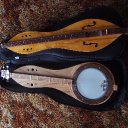
I have built 4 "banjammers" or as I call mine, banjo-dulcimer. A practice drum head in 6 or 8" diameter either set on a dulcimer shaped 1/2" thick board or suspended in a round based dulcimer body. Yes they are loud and alone they are fine. In a group sometimes I put a 1" wide piece of sponge rubber under the head before putting tension on it. then usually rest pinkie and ring fingers on the head to further mute it. The dulcimer group s that I jam with seem to welcome the addition. The only complaint I have is that above the 11th fret it loses a little ring and clarity
Bill Robison
Bing Futch used one of these for small gigs. Actually sounded pretty good, I thought. Now, it's not a Fender Acoustisonic, but it don't cost as much either LOL.
http://www.amazon.com/Audio2000S-AWP6040-Portable-Rechargeable-System/dp/B001DN6REG
I, also, have one of Maxwell's dulcimers also made in 1976 and had never been played prior to a few weeks ago. Mine only has one base string, middle string, and two melody strings; see the photo in my profile on the left. I am starting to learn..... slowly.... 
Sidenote: the Upper CumberlandCraft Center in Cookeville and the Tennessee Tech's Appalachian Center for Crafts are not the same. Maxwell's Craft center was privately owned and preceded the Appalachian Center for Crafts.