
I have one from 2002 that is plywood, if that helps narrow it down.
Forum Activity for @john-p
Hi Shiela,
There are a few candidates for Erin's Green Shore that come to mind.
Most likely it's a tune often known as Paddy's Green Shamrock Shore.
Or There's Lough Erne's Shore, a great slip jig.
Or maybe The Wee Weaver -that mentions Lough Erin's shore.
I can do you a fret order and sound clip for any of them if that's any help.
updated by @john-p: 07/05/15 03:57:29PM



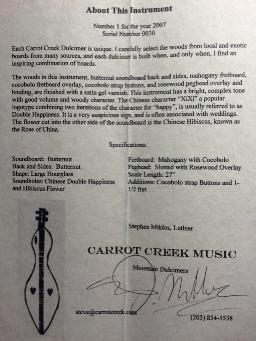
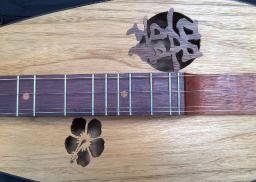
Carrot Creek Dulcimer, 2007, Made by Steve Miklos
Instruments- discuss specific features, luthiers, instrument problems & questions
This Carrot Creek dulcimer was built by Steve Miklos, who sadly, passed away earlier this year. He named it "Double Happiness."
updated by @jerry-posner: 06/08/16 09:24:05PM
Arkansas Traveler 1916
OFF TOPIC discussions
Here's another neat site for early recordings.
http://cylinders.library.ucsb.edu/
Lot of old minstrel tunes, the pop music of the day, was recorded on cylinders.

i used to buy scraps of the plywood from lynn to make door harps and various craft items. this plywood was a very high quality veneer core
product about 3/32 inches thick. lynn told me it was specially made to his specs. i still have quite a stack of the material in the shop. the backs were a big time saver as they needed little or no sanding....or braceing.
I call them by their makers name mostly, ie the Yocky,or my Berg. I do have 2 McSpaddens so I call the walnut one "Stripe" because of the light stripe on the back.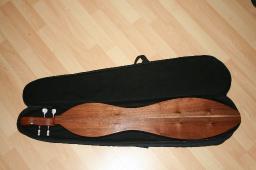
updated by @charles-thomas: 07/06/15 07:30:31PM
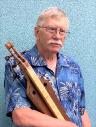

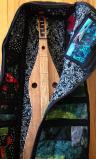
Arkansas Traveler 1916
OFF TOPIC discussions
Thanks Rob! I couldn't remember where I found it on the Web.
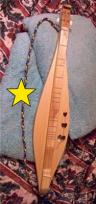

Here you are Dusty. During the time that Lynn McSpadden owned the company some of the dulcimers were made from solid wood. These were the higher priced models. From my converstations with Lynn, the reason he gave for using plywood for back and sides was to insure a consistent quality of sound and construction as the plywood would be more stable than solid wood. This also accounted for there being only two types of wood offered; cherry and walnut. When Jim Woods acquired McSpadden all solid wood became the standard. I do not know the reason for this, but it may be due to discontinued production of the plywood used to make the dulcimers. I understand that the David Schnauffer model was discontinued because McSpadden could no longer get the cherry plywood that David specified for his signature model. Maybe this is more than you wanted to know. Now back to our regularly scheduled discussion.
Ken
"The dulcimer sings a sweet song."
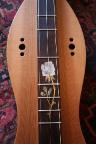


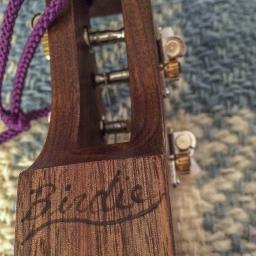

I think Stephen made the important points, eli. McSpaddens are consistently good instruments and hold their value well.
At some point in the past--perhaps Ken could tell us when--they stopped using plywood for the backs and started making all solid wood dulcimers.
They also sell kits, and I would not suggest buying one made from a kit unless you could hold it and play it first. Just ask what the label inside the dulcimer says; it will indicate if it were made in the shop or was a kit that someone bought and made for themselves.


Lots of folks name their dulcimers. I never named any of my guitars or mandolins, but most of my dulcimers have names. The first one I ever bought has rosebud soundholes and I named her Rosita. Later I obtained a baritone teardrop with rose soundholes and named that one Tia Rosa. I got my Blue Lion from FOTMD member Jeannie in Paradise and named it Queenie, partly in honor of Jeannie and partly because my daughter insisted that since female lions do the hunting they should be considered the queens of the jungle. I have another named Lucinda and my daughter named her octave dulcimer with dolphin soundholes Splash. But oddly, the the dulcimer I play most often is just my dulcimer. No name.
And I mean no offense, but dulcimers have such beautiful curves, they have to have female names. I guess Lexie and I just don't agree on that. Maybe a Tennessee music box could be called Fred or Barney, but an hourglass has to be female, especially if its voice is as alluring as the sirens' song.
updated by @dusty: 07/04/15 02:48:22PM

Barbra, What are your names for you dulcimers?
Yes, I name my dulcimers, my first is "Ho-Hum", my favorites and new this year is "Lil' ButterNut", made by Robert Schuler modaled after A. J. Jefferies.
And the one I just purchased not long ago is, "Thommy", made by Kevin Messanger copied after Edward Thomas. I play N & D style and my 2 new ones are very sweet to play and have that old time silvery sound....Love It!
Probably the one thing you should know about McSpadden instruments is that they are high quality instruments that hold up well. The usual cautions about used instruments certainly apply. You want to make sure that there is no damage or bad repairs. Check to make sure the frets are smooth and level. If you can not see the instrument in person, make sure you can return it if not satisfied. McSpadden dulcimers hold up very well.
Ken
"The dulcimer sings a sweet song."


I've played old ones, I have two newer ones (DAD and AEA). Jim Woods is a great owner - I prefer the new all solid ones to the older ones with a plywood back. The acoustic spectrum they produce (I have a PhD in acoustics and have measured many of them) is remarkably consistent over time. Just make sure that you are getting a McSpadden built one - there are kit built ones as well - some are as good as the shop built ones - most aren't. The best way to tell the difference is by the label. You can find a good account of the company here .
I would look for the normal things applying to any used item, unusual wear and damage, primarily. The company did change hands some years ago but that was ownership only as far as I'm concerned, same employees, etc. There have been some changes over the years just like in any other business, but I don't think it affected their instruments to any significant degree. I've had 2 of them, still have 1, but make my own now.
Arkansas Traveler 1916
OFF TOPIC discussions
Here it is from archive.com
https://archive.org/details/DonRichardson-ArkansasTraveler1916
Do You Have A 'Go To' or Favorite Dulcimer
General mountain dulcimer or music discussions
My Blue Lion rosewood hour glass. Beautiful sound and action.

Your music area
General mountain dulcimer or music discussions
Thanks monica, i tried it out tonight and it is really a great chair for playing. I can't imagin what the chair was really made for since it is so low but it is great for my prupose. My dulcibon is a large instrument, especially with the case so it's on the other side of the room to fetch when i need. Other than that, yes i think I'm good for awhile on my set up.
If ever you are down i the Houston area, stop by and try it out ;-)
Arkansas Traveler 1916
OFF TOPIC discussions
You might be able to embed an mp3 into a post here...in the texbox, click on the video-y looking icon on the right (right before the smiley icon) and explore that.
Arkansas Traveler 1916
OFF TOPIC discussions
I understand Lisa, I'm so sorry ,I was trying to share that recording from my "archives" and I wasn't sure how.
Arkansas Traveler 1916
OFF TOPIC discussions
Hi Charles, you can link to that recording here in a discussion if it resides someplace else online, but you can't upload the recording to your member audio clips- because all audio/video clips uploaded to the music and video site sections have to feature yourself playing or performing...see the site rules. Had to remove the recording. Very sorry!
Your music area
General mountain dulcimer or music discussions
That's a great chair Marg, Your set up looks very nice.
Your music area
General mountain dulcimer or music discussions
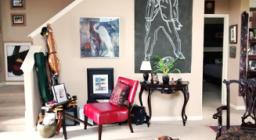
I did find a chair today that is the best one for playing I have seen at any of the stores. Low, wide (to hole a few grandkids) no arms but a back. Problem was, how to make it fit in my space, design wise. But than some of my dulcimers are hanging on an art easel, so shouldn't be too hard to fit a new design. The price was so good, I got it. Turns out it is a design they used in one of the Maxtrix's scenes. So now, I have a great chair for playing and a conversation piece. The rest of the room may still need some rearranging but I think this will work.
Thanks
Arkansas Traveler 1916
OFF TOPIC discussions
updated by @charles-thomas: 01/13/19 05:09:18PM