
The little Craigslist dulcimer that I bought over the weekend was made in the early 1970s in Texas. So naturally, I'm calling her "Tex". Haven't named the other two I have yet though... Will have to wait until something strikes me. Tex sounds better than "that Craigslist dulcimer".
Forum Activity for @colleen-hailey

I assume dulcimers to be female -- especially the hourglass dulcimers, for obvious reasons.
Mr. B. B. King named his guitar "Lucille", so why not name our dulcimers girl's names?
Anyway, there doesn't seem to be any hard and fast rule about it.
One could argue the case for Galax dulcimers being male by observing their pot-bellied appearance.


I have a habit of naming inanimate objects myself. For example, my two-tooth partial plate is called "Chip and Dale"
My android device is called "Rufus". But I have never named any instrument I have owned - funny. My "Uncle Eddie" is just called the Thomas, and imagine my new ones will be called The Homer (Ledford)and The Warren (May).
Kitty,
I've been naming my dulcimers for a couple years now. I think I first read of the idea from Clare Chu.
My dulcimers have names derived from the Bible (KJV), and are usually from the Psalms. I think of an appropriate word to use from a verse, then I cite the entire verse on an inside label. For example, my wormy chestnut dulcimer is named "Heritage" from the verse in Psalm 16:6: "The lines are fallen unto me in pleasant places, yea, I have a goodly heritage." And I wanted the name to have a historic sound, since the chestnut wood I used to make it was over 100 years old, and the dulcimer design was, too.


You're ready to testify, for real! :)
John Keane said:
I have no recollection of any of this.
Robin Thompson said:Hey, Carrie, I'm glad you got back to Ol' Pal! If you ran into a certain J.K. there, I trust you made every effort to avoid that troublemaker. LOL! I've heard wonderful things about the Wright's fest and might just make my way to TX some spring to attend.

I have no recollection of any of this. 
Robin Thompson said:
Hey, Carrie, I'm glad you got back to Ol' Pal! If you ran into a certain J.K. there, I trust you made every effort to avoid that troublemaker. LOL! I've heard wonderful things about the Wright's fest and might just make my way to TX some spring to attend.



My New Dulcimer
Instruments- discuss specific features, luthiers, instrument problems & questions
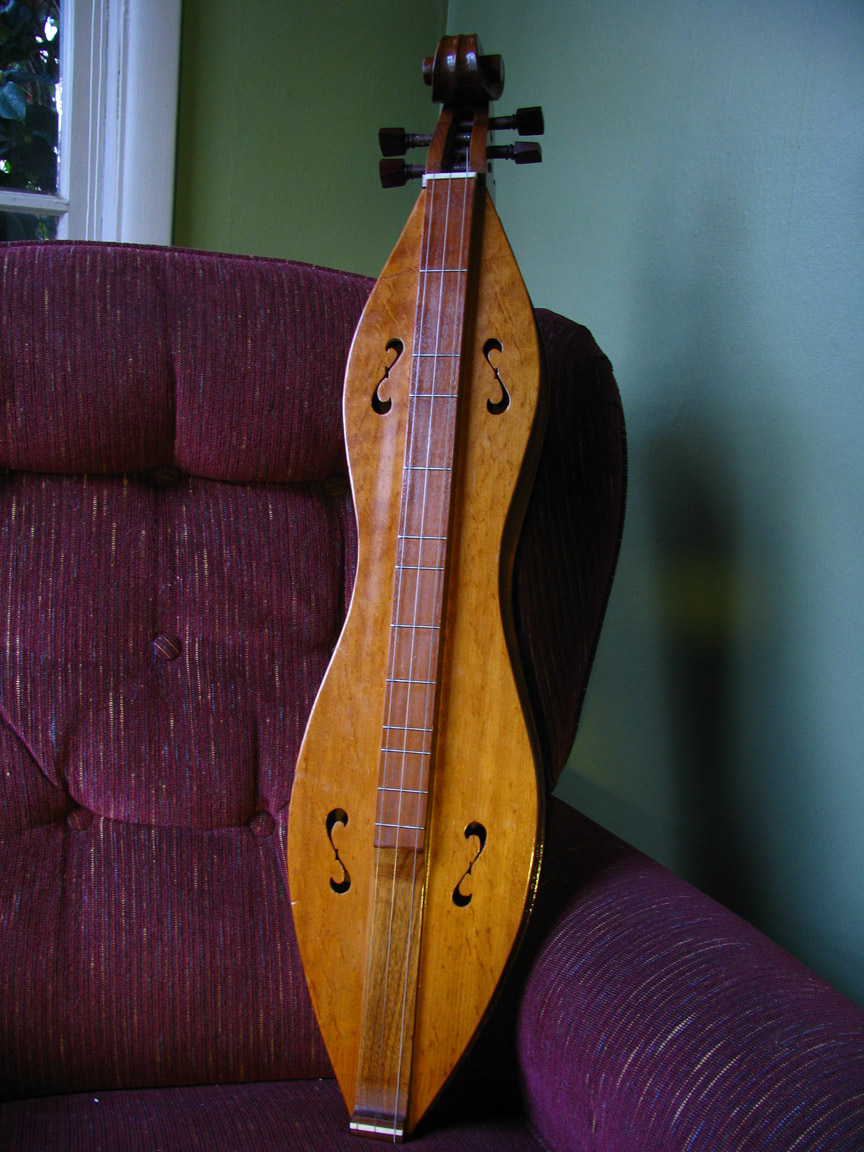
To answer your question about possible woods used, I"d say mostly walnut, with some pretty figured (burl or crotch figure) bookmatched walnut on the back, and an unknown wood --possibly spruce or similar softwood--on the top. The tuning pegs look like Brazilian rosewood to me. It looks like the original fret spacing on the fretboardwas cut inaccurately, and an overlay was glued on and new fret slots cut in it. The nut and bridgelook to berecent replacements for what was originally a paired melody string setup. Note the grooves worn in the tailblock.
What surprises me is the different levels of finish and craftsmanship evident in this dulcimer. Somebody who takes the time and effort to carve a scroll, fit friction pegs to the holes and bookmatch beautiful figured wood on the back should show similar care in doing the tailpiece joinery. Maybe some of a fine dulcimer was rebuilt by an amateur?

My New Dulcimer
Instruments- discuss specific features, luthiers, instrument problems & questions
Thanks Randy! My other dulcimer also has fiddle edges...now I know what to call it. I prefer them!
Randy Adams said:
The top and bottom plates extend past the sides 1/8 of an inch or so.....it's old school.....I like it....

My New Dulcimer
Instruments- discuss specific features, luthiers, instrument problems & questions
The top and bottom plates extend past the sides 1/8 of an inch or so.....it's old school.....I like it....
Jennifer Wren said:
Randy, what are fiddle edges?
Randy Adams said:No matter how it got to where it is now it's a nice dulcimer Jennifer. I like the scroll, the bridge placement, the fiddle edges. All the other stuff gives it character! I bet it does sound good. Back looks like walnut.
My New Dulcimer
Instruments- discuss specific features, luthiers, instrument problems & questions
Randy, what are fiddle edges?
Randy Adams said:
No matter how it got to where it is now it's a nice dulcimer Jennifer. I like the scroll, the bridge placement, the fiddle edges. All the other stuff gives it character! I bet it does sound good. Back looks like walnut.
My New Dulcimer
Instruments- discuss specific features, luthiers, instrument problems & questions
Thanks for your comments everyone. It was sitting next to a used McSpadden and a Folkcraft, and they were very nice, but after playing them side by side, the sound of this one just had "it" for me. I left without it twice, partly because I was a bit fearful of the wooden tuning pegs. They are finicky, but I've come to like them. I wish I know the story behind it, but I enjoy imagining the possibilities.
Also, I added a photo to show more of the frets from the side to clear up that confusion.
My New Dulcimer
Instruments- discuss specific features, luthiers, instrument problems & questions
Kenneth, I'm not sure which piece you are referring to, so I took a picture from another angle, which may clear up any confusion.

Kenneth W. Longfield said:
That's a nice find Jennifer. I am having trouble figuring out the second picture. Do the strings go under the round metal piece or over it? Under the metal piece it looks to be a walnut bridge with slots for four strings. Or maybe that is where strings cut in to the end of the fret board. The nut definitely looks like a replacement.
Ken
"The dulcimer sings a sweet song."
My New Dulcimer
Instruments- discuss specific features, luthiers, instrument problems & questions
As I wrote before, I think the skills of the original builder were decent-- and "decent" is likely an understatement-- it's got some very nice touches. For me, sound is everything and looks a bonus. You've got both here!
My New Dulcimer
Instruments- discuss specific features, luthiers, instrument problems & questions
I should have made it clear that all the frets had been moved. I will post another picture later today.
My New Dulcimer
Instruments- discuss specific features, luthiers, instrument problems & questions
That's a nice find Jennifer. I am having trouble figuring out the second picture. Do the strings go under the round metal piece or over it? Under the metal piece it looks to be a walnut bridge with slots for four strings. Or maybe that is where strings cut in to the end of the fret board. The nut definitely looks like a replacement.
Ken
"The dulcimer sings a sweet song."

My New Dulcimer
Instruments- discuss specific features, luthiers, instrument problems & questions
Do we know that it was only a couple frets that were moved? Based on what I saw I thought it likely they all were moved. Can't tell for sure from the pictures though.
Oh and it looks like there were two melody strings at one time before the nut and bridge were replaced. The groove on the bridge is evidence of that. It looks like you could add one back pretty easily if you wanted to.
Ken Hulme said:
If the bridge was moved, John, all the frets would have re-cuts, not just a couple.

My New Dulcimer
Instruments- discuss specific features, luthiers, instrument problems & questions
Only 4 frets shown and it looks like a veneer overlay was applied, so not enough info.
The workmanship looks good and the sound is good = good deal.
Wood may be walnut with a spruce top?
My New Dulcimer
Instruments- discuss specific features, luthiers, instrument problems & questions
No matter how it got to where it is now it's a nice dulcimer Jennifer. I like the scroll, the bridge placement, the fiddle edges. All the other stuff gives it character! I bet it does sound good. Back looks like walnut.
My New Dulcimer
Instruments- discuss specific features, luthiers, instrument problems & questions
If the bridge was moved, John, all the frets would have re-cuts, not just a couple. I suspect the builder didn't have his/er table of numbers right next to the cutting, and mis-remembered a couple numbers in transferring from the table to the wood.
Yes, lots of players play above the 10th fret -- especially chord-melody stylists working on variations into the second octave
My New Dulcimer
Instruments- discuss specific features, luthiers, instrument problems & questions
It looks to me like originally the bridge was further up the fretboard and someone has decided to move it backwards right to the end, then having to move all the fret positions to match. I can't imagine why anyone would go to all that trouble but if it sounds good now, maybe it wasn't so good before?
Does anyone actually ever use those frets way up above the tenth fret anyway? Most of us strum there anyway - well I do, you can tell by the wear on the fretboard surface - as the sound is less tinny than when you strum over the `strum hollow'.
That's a nicely worked scroll so the original builder can't have been lacking in skill...
My New Dulcimer
Instruments- discuss specific features, luthiers, instrument problems & questions
That hadn't really occurred to me Robin, but that is possible.
My New Dulcimer
Instruments- discuss specific features, luthiers, instrument problems & questions
I could well be mistaken. . . It seems the original builder may have had decent skills yet those who made changes to the instrument later were not expert.
Happy strumming!
My New Dulcimer
Instruments- discuss specific features, luthiers, instrument problems & questions
Oh, I meant to mention that. I don't see any name.
My New Dulcimer
Instruments- discuss specific features, luthiers, instrument problems & questions
nice find. I am glade that it has found a new home and will be once again singing happily. have you tried looking in the sound holes to see if there writing on who made it?
My New Dulcimer
Instruments- discuss specific features, luthiers, instrument problems & questions
Hello! I found this dulcimer in a shop the other day and after playing it for awhile kind of fell in love with it. It's been banged around a bit and is inexpertly made, but that is what endears it to me. Most importantly though, it has a lovely sound.
I wonder if anyone has any guesses as to the type of wood. I'm also curious about the fact that the tuning pegs and the pins are set up for 4 strings, but the bridge and the nut for 3. An indecisive maker? A later change? It's also interesting that is only goes to the twelfth fret...luckily I rarely play higher than that. It's got a 28 inch VSL, and the strum hollow is really long! I've not seen one that looks quite like this...but then I haven't seen as many dulcimers as many of you. Here's some photos.
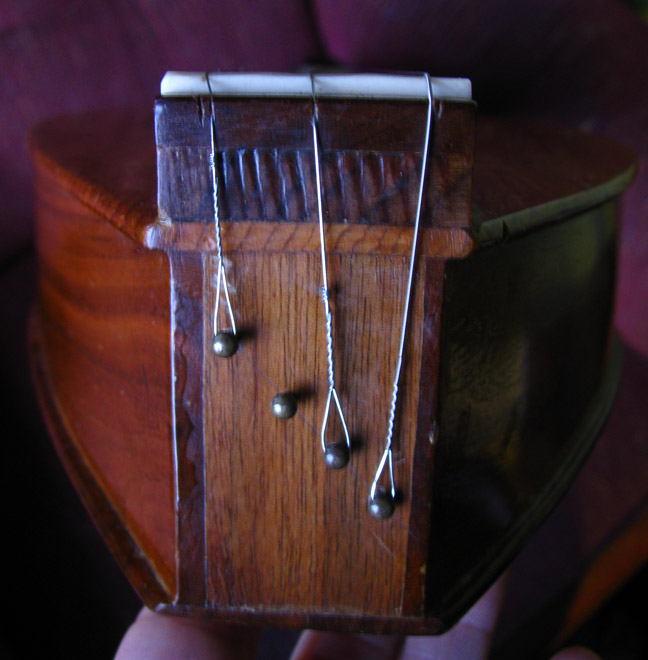
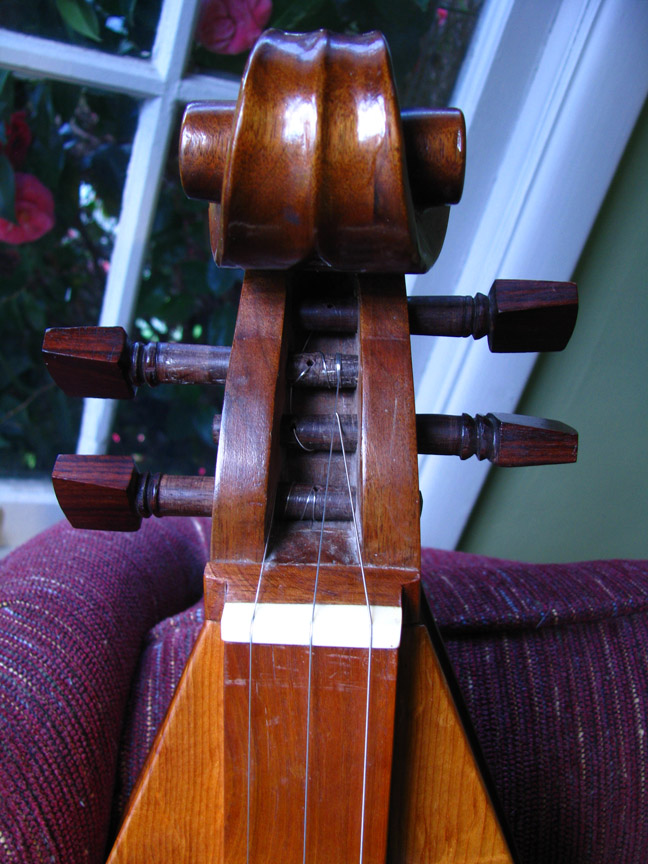

 Oops, looks like some missteps with the frets!
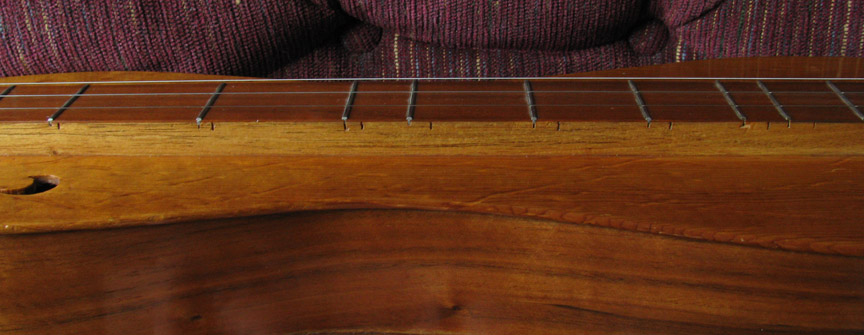
updated by @jennifer-wren: 06/08/16 09:24:05PM

Check my response to your question in the thread Jennifer started:
http://mountaindulcimer.ning.com/group/beginnerplayers/forum/topics/worthwhile-to-buy-from-craigslist-as-a-brand-new-dulcimer-fan?commentId=3745489%3AComment%3A592478&xg_source=activity&groupId=3745489%3AGroup%3A36
Hi Sheryl, welcome to our little corner of the world!
If you join our Beginner Players Group on this site, you will find several discussions with good suggestions about buying a first dulcimer that is good quality but not too costly for a beginner. Check out our Groups section for special interests you may wish to learn more about, too.
The good news is that there are several various beginner dulcimers that would be reputable and excellent choices for you to get started with! Check out those discussions in the Beginner's Group.
-I know you are just learning your way around the site, and it may be a bit confusing at first... I deleted about eight other identical discussions to this one that you probably didn't mean to post in duplicate. -But rest assured, no harm done at all!
Sheryl, welcome to FOTMD. Sounding pretty is subjective to everyone's ears. So we all could help guide you, what style of playing are you looking into? Chording, noter/drone? That could help us help you.
updated by @james-phillips: 01/22/16 11:34:41AM