
Very interesting video! I loved seeing your instruments and hearing you play. I hope a lot of people see this!
Forum Activity for @jan-potts



I would put money down that the song is in the key of C. The only chord that doesn't quite fit is C#. Regardless of the key you play the song in, that C# chord is likely to cause some difficulty on a diatonic instrument. If you tune CGc or CGG you will be able to get the other chords with little difficulty. But that C# might be something you have to fake by just playing a note or two rather than a full chord.
Glenda, if you are really a beginner, I would suggest beginningwith easier songs that only have three or four chords. You might want to put this one on the "to learn" list for next month or whenever you get more comfortable playing a variety of chords. But if you already have experience chording on the dulcimer or other instruments, then by all means, forge ahead!

Hi Glenda, can't you ask the woman who wrote it what key it is in? That would help us a lot. 
The guitar player might know the key as well, if they've been playing the song already.
updated by @strumelia: 01/27/16 01:21:53PM
The Onion Flute - mother of the kazoo
Adventures with 'other' instruments...
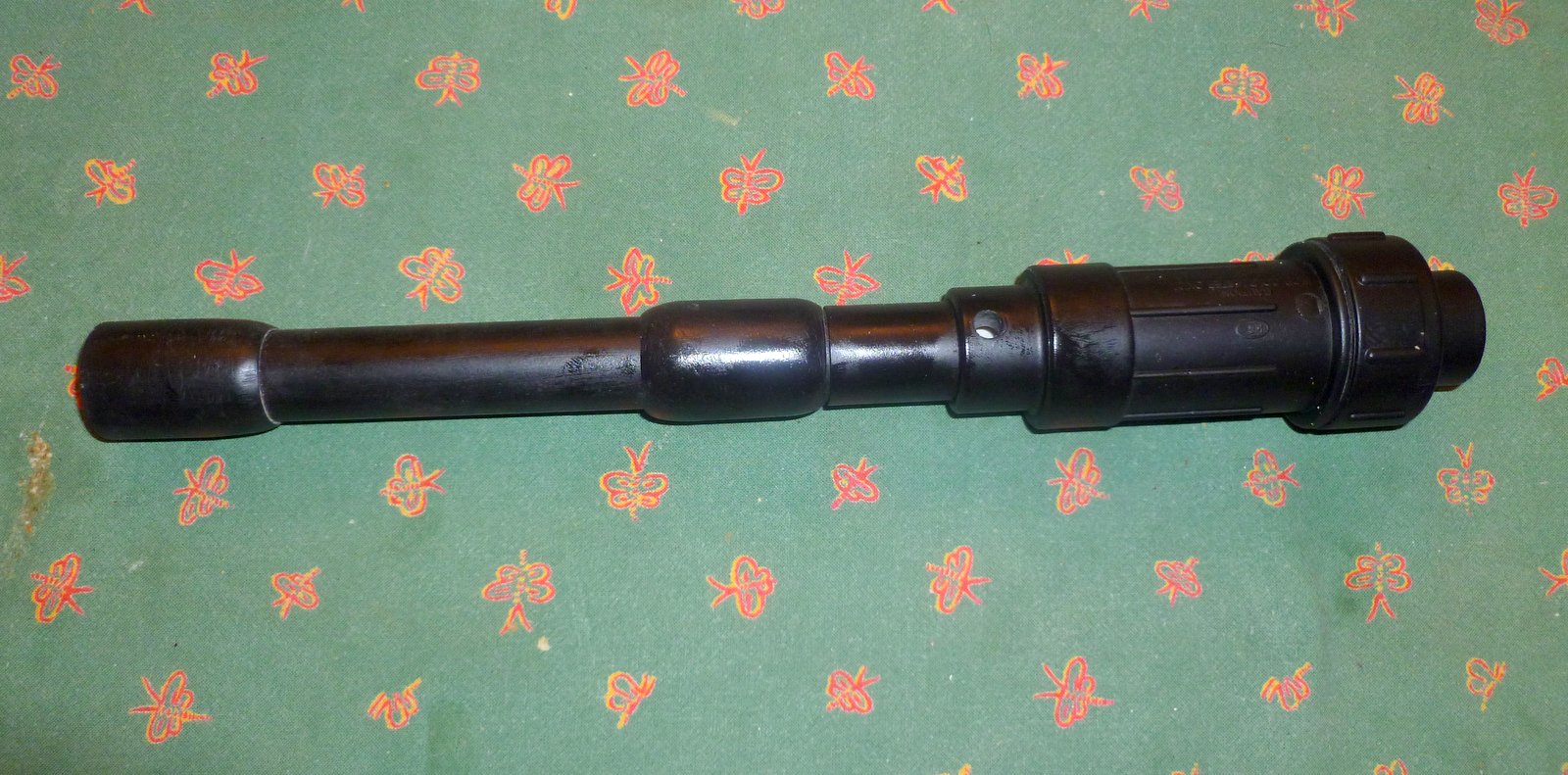
Here's my Mirliton, made from $5 worth of 1/2" PVC fitting and pipe.
On the right is a Compression Slide-Repair Coupling, then a plain 1/2" coupling rounded on both ends, a 4-5" length of 1/2 pipe and last, a second coupling sanded into a mouthpiece. A 1/4" hole is drilled below the end. A membrane of plastic bag is held in place under the screw cap on the right end.
Sounds pretty good, actually.
The Onion Flute - mother of the kazoo
Adventures with 'other' instruments...
Maybe I'm just not as funny as I think I am...

The Onion Flute - mother of the kazoo
Adventures with 'other' instruments...
Ah - sorry I didn't get that, John... blame it on the fact that English is a foreign language to me. 
Thanks for the additional info on the crumhorn.
The Onion Flute - mother of the kazoo
Adventures with 'other' instruments...
I was making an attempt at humour, Peter. But your onion flute does indeed sound very similar to a crumhorn. They had a brief (50 years or so I believe) period of popularity in the late 1500s I think. They are a fairly simple reed pipe - double oboe type reed in a wooden pipe with a windcap over the reed to protect it, the lower end of the pipe bent up presumably imitating a horn. Limited to a 9 note scale they have a deep for their size buzzing tone.
The Onion Flute - mother of the kazoo
Adventures with 'other' instruments...
Thanks for the reply, John!
Actually, I am not familiar with the background of medieval instruments, so I can't answer your crumhorn question (in German: Krummhorn"). To play the onion flute (or kazoo) at least half-decent, you should have some singing skills - otherwise an instrument would still be the better alternative. I think the onion flute has never been an instrument that has been taken too seriously.
Yes, I have played MD and kazoo together (by using a harmonica holder and one of my selfmade wooden kazoos):
http://mountaindulcimer.ning.com/photo/kazoonica-harmonikazoo
Here's something with kazoo and MD I recorded a few months ago...
http://mountaindulcimer.ning.com/video/st-louis-blues-kazoo-and-box...
The Onion Flute - mother of the kazoo
Adventures with 'other' instruments...
Just watched the video you put up - it sounds great, and also when you strum along on the dulcimer. You can hardly tell that you're not playing melody on the dulcimer as well. Is this why the crumhorn had such a short existence, because the onion flute could reproduce the sound with such little effort?
Presumably you could make up a wire `harmonica holder' type thing to have both hand free so you could play and kazoo at the same time?
The Onion Flute - mother of the kazoo
Adventures with 'other' instruments...
Thank you, Phil.
for you and all others who are interested: here is a sound sample, a solo in the first part and accompanied by mountain dulcimer in the second part. Enjoy.
The Onion Flute - mother of the kazoo
Adventures with 'other' instruments...
wow never realized that the kazoo was that old? can't wait to hear it played. Might have to get one of my own.
The Onion Flute - mother of the kazoo
Adventures with 'other' instruments...
Thank you, Frank.
Yes, it is beautiful - and it's a joy to hold it in one's hands...
Maybe I can make a recording this weekend.

The Onion Flute - mother of the kazoo
Adventures with 'other' instruments...
Very interesting, Peter, and well researched. I had no idea that the kazoo had such a background. Your onion flute is easily the most beautiful kazoo I've ever seen.
The Onion Flute - mother of the kazoo
Adventures with 'other' instruments...
I always liked the kazoo as a "melody instrument" that allows you to have your hands free for playing guitar, ukulele - or MD or Kantele at the same time. As I did some research during the last time I found some information about the history of the instrument.
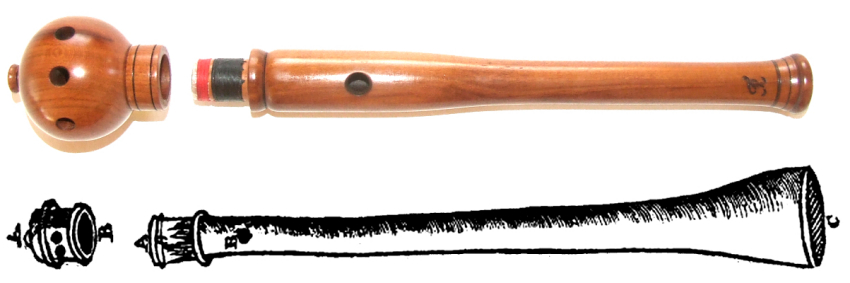
(One of) the oldest printed descriptions seems to be on p. 229f of the book "L'Harmonie universelle" by Marin Mersenne from 1637. In a row of 5 "chalumeaus" the 4th instrument is an "onion flute". It is mentioned and described on the next page:
Source: http://gallica.bnf.fr/ark:/12148/bpt6k54710466/f432.image
There also appears the name Eunuque (Eunuch flute), but it seems that "Eunuch flute" has up to then never been the name for the instrument. It is more likely that this was a misinterpretation of a word Mersenne wasn't able to read in a hand written description of the instrument he had received in a letter about 1633.
The principle of the instrument is described correctly by Mersenne - it is really a kazoo. At that time the membrane must have been of organic material, e.g. onion skin (is that word right in English?).
In the 18th century the name "Mirliton" was used for the instrument, that was often just made of a tube, like bamboo kazoo is still today.
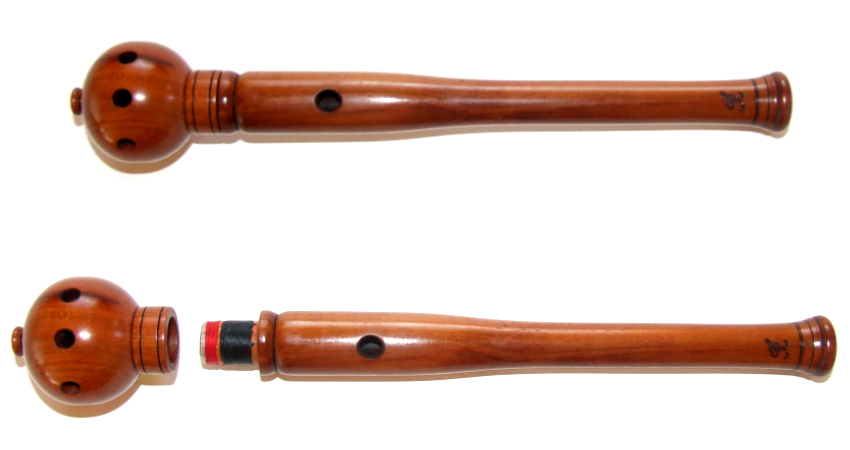
And then I found that there are still makers who build that "mother of the kazoo"! Mine is mady by Thomas Rezanka, a teacher and bagpipe builder from Austria. I just like to share some photos with you. I don't have a sound sample yet - it sounds like you expect to sound a kazoo. Rezanka uses Bamboo skin as a membran (so that's very close to onion skin) - but of course if it breaks you can also use a piece of a (PE) sandwich bag etc.
Ah - one thing: you need one hand to hold the onion flute. But you could still strum your MD as a drone instrument with the right hand and hold the onion flute with the other and play both instruments together.
Just a joke: "onion flute" - literally...
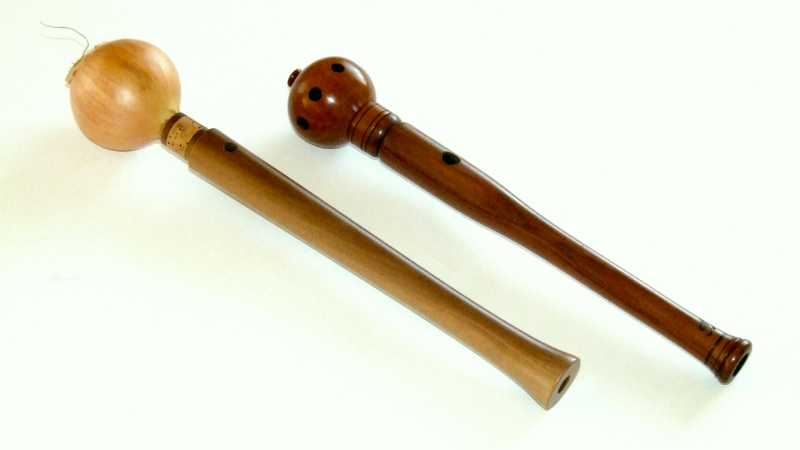
Onion flute - removed membrane cover:
 t Onion flute by Thomas Rezanka and Mersenne's illustration:
updated by @peter-w: 06/11/15 07:40:28AM

5,000! What I'm most grateful for. . .
OFF TOPIC discussions
I don't know whether I would've stuck with playing if not for FOTMD. Though I have fun with the lap dulcimer, learning new things and sharing music here helps keep things fresh.Oh, and the number of luthiers who are either building replicas of old instruments and/or drawing heavily from old ways of building is great to see. I don't own any that are new yet look old. . . Not yet, anyway. ;) I've gotten to see and hear some of these beauties here at FOTMD and I'm grateful for that, too!
5,000! What I'm most grateful for. . .
OFF TOPIC discussions
Wow, Geekling, what a wonderful tribute to FOTMD, thank you so much. Thank you all so much. 
I do feel like we all have sooo many great dulcimer friends here, and the nature of the site is such that it really encourages everyone to share equally, learn from each other, and get to know each other as well.
5,000! What I'm most grateful for. . .
OFF TOPIC discussions
I'd more or less abandoned the Mountain Dulcimer until I found FOTMD which brought me back into the fold enough to make me start making them again - a TMB and a Swedish Humle so far.
I have to say that FOTMD is the best `social media' site I've ever come across to do with music, so well done Strumelia for starting it off, and of course everyone else who's kept it going by contributing to the site.
5,000! What I'm most grateful for. . .
OFF TOPIC discussions
Well Robin - while I haven't tried N/D yet, I sure have to be totally and whole-heartedly in agreement with you! Everyone here understands the passion and love for the dulcimer - in all its wonderful forms and varieties! I know for sure that FOTMD has certainly helped me and helped keep that passion alive!
5,000! What I'm most grateful for. . .
OFF TOPIC discussions
John, how glad I am you've been favoring us with your wonderful instruments and play! Your instruments are family heirlooms, treasures.Ken, our in- person meeting was far too brief. I hope our paths cross again and that we can share some tunes!

5,000! What I'm most grateful for. . .
OFF TOPIC discussions
Amen to that Robin.
Ken
"The dulcimer sings a sweet song."

5,000! What I'm most grateful for. . .
OFF TOPIC discussions
Well said Robin ! If I had'nt 'joined' I doubt very much if I would be making or playing now, I knew of some outstanding MD players, none of whom played N/D, or used a quill ect ! Different now
John!
5,000! What I'm most grateful for. . .
OFF TOPIC discussions
It's a given, I think, for many of us that the "Friends" part of FOTMD is the "thing" for which we are most grateful. . .At this 5,000 milestone, though, it also occurs to me how grateful I am that this site has been instrumental (haha) in the re- surgance of the noter and drone style of play. I had seen precious little to help me with learning ND style before FOTMD popped onto the scene. The available recordings in the style were few and video demonstrations were scarce not oh-so-long-ago.So, thanks to Strumelia for her noter and drone blog-- it's how I stumbled onto FOTMD in its earliest days-- and for starting "Friends"! And a big thanks to you all for making this neighborhood a nice place to learn-- I've learned lots-- and spend some time.Happy strumming, y'all!
updated by @robin-thompson: 08/02/23 03:15:05PM

Loop vs. ball end strings
Instruments- discuss specific features, luthiers, instrument problems & questions
Dusty;
The ball can be carefully crushed if necessary, been there, done it.
Loop vs. ball end strings
Instruments- discuss specific features, luthiers, instrument problems & questions
You are right, Jean. The only difference between the two is the way the string connects to the instrument. There is no difference in tone or functionality. In general ball end strings are easier to find because they fit guitars that use end pins. If ball end strings fit over the little brad nails on your dulcimer, or if you have a dulcimer with end pins, then go ahead and use them. If not, loop end strings are the only option.

Loop vs. ball end strings
Instruments- discuss specific features, luthiers, instrument problems & questions
From the comments so far, it appears thatthere really is no functional difference for tone or playability. I'm using ball end strings on instruments that have very slim metal pins to anchor the string. It always looks as though the pin is so slim that the ball (really a brass circle inserted in the loop) will save some stress that would occurif I were to put the "naked" loop on the pin. And I save the old brass circles, too, and re-use themon a plain loop if that is possible. About where strings break, most of the time mine break at the tuning peg, but the last time a string broke, it was at the pin below the bridge. Really. And I was able to save the brass circle since it was still on the pin.
Thanks to everyone who answered, and of course more input is welcome. I've played for about 20 years and never have had a good explanation of loop vs. ball end.

Loop vs. ball end strings
Instruments- discuss specific features, luthiers, instrument problems & questions
Robert,
Please explain how you use them for bushings on loop end strings.
robert schuler said:
Whenever I change strings I save the ball ends. I always find uses for them. Keep some and use them as bushings when using loopend strings... Bob.
Loop vs. ball end strings
Instruments- discuss specific features, luthiers, instrument problems & questions
I've saved lots of ball ends!
robert schuler said:
Whenever I change strings I save the ball ends. I always find uses for them. Keep some and use them as bushings when using loopend strings... Bob.

Loop vs. ball end strings
Instruments- discuss specific features, luthiers, instrument problems & questions
Whenever I change strings I save the ball ends. I always find uses for them. Keep some and use them as bushings when using loopend strings... Bob.
Loop vs. ball end strings
Instruments- discuss specific features, luthiers, instrument problems & questions
Jean,On my instruments that will accommodate both types, I prefer to use ball end. However, I'll use whatever I have on hand when I need a string change. (I also re- tune a lot.)
Loop vs. ball end strings
Instruments- discuss specific features, luthiers, instrument problems & questions
No difference as far as I'm concerned. Strings break near the tuner whenever they break on me, that's the area that the metal is worked the most.
Loop vs. ball end strings
Instruments- discuss specific features, luthiers, instrument problems & questions
I never had a ballend string break at the ball. Loop end strings need a larger pin to support them. I use 1/8" brass as loop string anchors which has the same support as a ball. You should be able to tune to any of the common pitches without string breakage. Check for string pinching and binding... Bob
Loop vs. ball end strings
Instruments- discuss specific features, luthiers, instrument problems & questions
This may have some discussion threads already and if so I apologize for not finding it. My question concerns using loop or ball end strings. The two types seem to be interchangeable on my instruments, in that the little nails that hold the strings will anchor both types easily. Is there some preference based on performance, or functionality, or some other characteristic that would guide me? I like the look of ball ends better, go figure what that is all about. I'm not on good theoretical ground with this idea, but it seems to me that the ball end puts less strain on the string, thus lessening (delaying is more the case) the likelihood of a break. I find myself replacing just the melody string on my Folkcraft fairly often, but I retune that top string a lot to accommodate different tunings. Thanks for all the (anticipated) helpful comments.
updated by @jean-van-erem: 08/04/23 05:48:01AM