Seeking the Imelda Marcos of dulcimers
General mountain dulcimer or music discussions
LOL RN just call me Imelda!
HAHA I know there are several out there with a lot more than my 25+ Jan for one.
LOL RN just call me Imelda!
HAHA I know there are several out there with a lot more than my 25+ Jan for one.
http://mountaindulcimer.ning.com/photo/dulcimer-wall?context=user
One of the best collections, of which this is just a portion.
Wayne,
Thanks for the laugh and the link. Wow, there are some serious instrument collectors among the mix!
Wayne Anderson said:
Laughing "Imelda Marcos of Dulcimers" have to break into song "Don't Cry for Me McSpadden" lol. There are a number of us who have the DAD - Dulcimer Acquisition Disease and to keep everyone happy should write it DAd. There are more than a few of us that have two or more - there is an on going discussion on FOTMD How Many Dulcimers you may want to take a look at that discussion, Ellen.
But as many have said, you cannot have just one...lol
![]()
I first laid eyes on a dulcimer in August 2013. I now own two. I now look at wall space in the house differently. Instead of visualizing a picture moving into a blank space, I wonder how a dulcimer would look hanging there.
Where is this leading me? I have seen a few pictures here of proud players who have a line up of dulcimers -- which leads me to ask, "Who is the Imelda Marcos of dulcimers?"
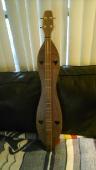
Please humor me by posting photos or links to your collections. We might as well see the what lies further down the path.
Dusty--Thanks for mentioning scale positions. Since I am most comfortable playing by ear, I think in terms of scale positions and then transpose to the correct fret positions based on how my instrument is tuned (and possibly by what mode I'm playing in, but I don't actually think about modes!).
I also usually do a "tuning check" in addition to tuning individual strings with a Snark or Korg tuner. Since I'm using a 1-5-8 tuning, Icompare the open bass and melody strings with the middle string at the 3rd fret. I thencompare the open middle string with the bass and melody strings fretted on the 4th fret.
Tuned DAd, that means I first listen to eachstring playing a D, followed by each string playing an A.
If I'm playing alone, though, and don't have a tuner handy, this is a good way to tune the dulcimer to itself.
It's also a quick way to check the tuning after apiece using a vigorous strum or periodically during a long jam session.
Heavens Wayne- that would make too much sense for me! (down the road, I just might cave and get a tuner..)
I love my snark... great for the dulcimer, and the harp!!!
Cool- thanks Guy- as always you are a big help.
I think I am getting/remembering it now: 7 frets; hence the first open is C, then D; E; F; G; A; B ?
( Crazy question from a dormant dulcimer builder and knock-about-player huh!?)
Start out with C in the bass and then tune the middle to the 4th fret of the bass string, and the melody to the 3rd fret of the middle string. Or just use an electronic tuner.
How would I tune my dulcimer to C-G-C ? (using this tuning-to-itself style) It is the tuning for a song I love. She did capo on 1st fret to play "Rights of Man", and I MUST learn that tune!
Now this I can do! Thanks!!
Another way of envisioning the relationships among strings is by scale positions.
Ionian tuning (DAA or CGG, for example) is also referred to as 1-5-5, meaning the middle and melody strings are tuned to the fifth scale position starting with the bass string. Then all you need to know to tune your dulcimer is how to count to 5.
open = 1
1st fret = 2
2nd fret = 3
3rd fret = 4
4th fret = 5
Since the middle and melody strings are tuned to the fifth, you tune them to the bass string at the 4th fret.
Mixolydian tuning (DAd or CGc, for example) can also be referred to as 1-5-8, meaning the middle string is tuned to the fifth and the melody string is tuned to the octave (the 8th). Again, all you have to do is count.
open = 1
1st fret = 2
2nd fret = 3
3rd fret = 4
4th fret = 5
5th fret = 6
6th fret = 7
7th fret = 8
So for a 1-5-8 tuning, tune your middle string to the bass string at the 4th fret and your melody string to bass string at the 7th fret.
[You can also tune the melody string to middle string. Since the open string is the 5th, the first fret is the 6th, the second fret is the 7th, and the third fret is the 8th or octave. So once you tune the middle string to the fifth tone of the bass string (the bass string at the fourth fret), you can tune the melody string to the middle string on the third fret. Now you can double check it all, since the bass string at the 7th fret, the middle string at the 3rd fret, and the open melody string should all be the same note in any 1-5-8 tuning.]
I won't bother going through this for other tunings such as the 1-5-7 tuning, but hopefully you can see the advantage to thinking in terms of scale positions. The scale positions themselves tell you how to tune your dulcimer. The counting you learned from Sesame Street is all you need to know.
Thanks- I am just playing notes on the melody sting, with the others as drones.
It really depends on whether you are using drones or not. If you are using drones on the middle and bass strings, then you need to retune to get the proper mode, or use a capo. If you are using chords then there are more possibilities of playing in various modes within each tuning.
For Aeolian tuning... for Dorian tuning it's tuned to the base string at the 3rd fret.
In Mixolydian tuning, you can play in the Dorian mode starting at the 1st fret if you use the 6.5 fret... it's an easy way to play in that mode...
oh--- the melody string is at the 6th fret of the Base String? I will try that one! Thanks :)
It's good to remember that the names of the tunings and the modes use the same words but don't always mean the same things. You can play in different modes in different tunings... I have an arrangement of Greensleeves that uses the Mixolydian tuning, and also one that uses the Aeolian tuning. First two strings are the same as the Mixolydian tuning, but for the melody string you fret the base string at 6 and tune the melody string to it.
For Dorian tuning you can tune the melody string to the 3rd fret of the base string.... Then your Dorian mode starts on the melody string at fret number 4 and skip your 6.5 fret.
Guy
Hi friends,
It has been ages since I have played my dulcimer, and I have since forgotten how I used to tune it to itself! I had learned some modes from a Jean Richie book I read years ago, and forgot almost everything!
The common tuning I use now is:
Press Bass String (4th) behind the 4th fret = 1st & 2nd strings open
Treble (thinnest) String (next to bass string)= 1 octave above open 4th String
-What is this mode called(Mixolydian?) is it CcG?
There was another fun tuning I used, which was great for playing "Greensleves" because it was in minor tuning (Dorian?). Does anyone know how to tune the dulcimer for that (tuning to itself?)
Hopefully this question is not too confusing!
Thanks for any help :)
Katie, since we are both upi the Hudson Valley from NYC, I wouldn't be surprised if you and I haven't attended the same contra dance at some point.
Babs,
Have never heard of Strip the Willow, but the movement looks familiar. Loving bagpipes, I'd love to see our annual Highland Games start this. Here in the Detroit metro area we've the oldest U.S. Highland Games, but all dancing is left to the young lassies and occasional lads in competition. When I get to the next Contra dance I'll have to ask about Strip the Willow. Dare I presume it's the name of the tune?
Of course just saying "We do a lot of Strip the Willow here, though I'm not sure if it's contra-dancing but it is fun" could be subject to misinterpretation if folks just see "strip" and "fun."
Our folklore society joins with a contra group to produce an annual dance. Have gone to the past 2 years. This past year I was all set to join the contra group when health problems got in the way. It will come up again this February. I'll have the insanity of being in Sweet Charity in March, but hope this is the year I finally start being a contra dancer and not just a contra newbie visitor. Dance is definitely my favorite exercise and mainly it's been belly dancing in recent years, so this looks like a fun way to add more dance.
Great old movie scenes, Patty. That 'Grand March' seems a bit stiff and formal!
I know this can't be contra dancing but was always interested in this and the purpose of it when I saw it, http://www.youtube.com/watch?v=BX99GBCtysI , Fort Apache starring John Wayne and Henry Fonda. Then Lt. Col. Thursday danced with Sgt. O'Rourke's wife, . Henry Fonda sure could cut a rug
I think I understand. I hope to have an opportunity to participate in these dances. Nothing like learning by doing. Thanks for the information. It sure looks like fun
Patty, in a square dance, four couples form a square and dance with each other through the entire dance. In a contra dance, couples generally form double lines that stretch the entire length of the hall. A large hall with lots of dancers may have as many as 3 to 5 full lines, a smaller dance may have only 1 long line of couples.
Every other couple moves in one direction while dancing with people along the way, and the other half move in the other direction while dancing with couples they encounter along the way. The end result is that each couple winds up dancing with every other couple in the line. When you and your partner eventually get to one end of the line, you turn and start back again, dancing in turn with each couple you meet in the line.
You and your partner mostly stay together as you work your way down the line dancing, but you wind up also dancing with just about everyone else in the line too. I think that makes it particularly fun. You also cover more ground, from one end of the hall to the other, as opposed to staying in one spot like the 4 couples in a square dance do. Both contra dancing and square dancing do incorporate some steps in common, such as do-si-do and swing your partner...
This contra dance video shows how people keep dancing with different other people as they work their way up or down the line:
Here is a very lively and crowded contra dance: It looks like chaos to a non-dancer, but you can see the well organized double line of couples go 'forward and back' right on time at the 0:42 mark. they know exactly what they are doing! lol
Again, another crowded lively dance: At the 0:56 time mark in this one, again at 2:00, you can again see those organized long lines of couples go forward and back. The caller stops calling the moves after a while, as the dancers get the hang of the sequence of moves. Each dance is different. I have danced in that Greenfield MA hall, and I've danced with half the folks in that video at one time or another. That particular band is terrific- they are only two young men and they play everything you hear- electronically looping each part on top of the next as they play on different instruments- live. The tension builds as they add more parts and loop them on top of what they just played a minute before. lots of energy! I do square dances occasionally, but I find contra dances to have a different feel. Hope this adds some info...or maybe just confuses it more for you!
Contra dance incorporates round dances, square dances and other partnered folk dances where couples face each other in lines similar to Scottish Country Dancing.
This is probably a dumb question but here goes. What is the difference between contra dancing and square dancing? I remember doing square dancing in school. From the video it seems to be square dancing. Did I miss something along the way?
I bet there are some other contra dancers here...!
Tomorrow night I'm going as usual to a double-long holiday contra dance in Lenox Mass, with a potluck in the middle between two whole long dances. I usually go to a couple of contra dances per month, and have been doing so for about 4 years now I think.I love the exercise, and I always laugh a great deal- so good for the spirit.
I just now came upon this video someone took from a year ago of the dec 2012 Lenox dance- hadn't seen it before and was surprised to see myself dancing in it!:
I'm wearing a black top, flowered skirt, and am in the right half of the screen. At the very start of the video, I'm dancing with the fellow in the red shirt, but of course partners keep switching throughout the dance.
Anyone else here like to contra dance?
Oh, yeah! Thanks for the link. Some of us need all the help we can get . . .
Wait, we switched from cassettes to CDs? When?
CDs are already obsolete now since everything is just 1s and 0s.
If you want to see a demonstration of how to use a capo, check out this Bing Futch video: . He teaches the fiddle tune "Hangman's Reel" and then shows how you can play it in the key of G with a capo at the third fret or A with a capo at the 4th fret. And if you listen to the music playing over the closing credits, you will hear a "spooky" minor version of the song which he gets by playing it in Em with the capo at the first fret.
I have to confess that I now own a capo -- but have been a bit terrified to open the bag and actually use it. I felt the same way when we switched from cassette tapes to CD's. Those silvery discs looked so . . . alien.
Fog or no Fog, sounds like you have figure somethings out and crossed a few bridges. Nice going.
I'm posting to boost this up for Beth S.
Glad to share a giggle - Doesn't "Mixolydian" sound like an expert bartender?
This is great! Even with the little knowledge of the dulcimer that my husband has, he laughed and laughed as I read this to him. You've got those speeds defined just right!
Oh my! Thanks for the big chuckle in the middle of the night! I could relate to so much of this!
Hope you continue to enjoy your dulcimer over the holidays and on into 2014!