RIP Pete Seeger
General mountain dulcimer or music discussions
Well, thanks for posting that, Steph, even tho' it brought a tear to my eye.
Well, thanks for posting that, Steph, even tho' it brought a tear to my eye.
I heard a funny story in an interview Pete did onFresh Air with Terry Gross that was re-broadcast today. He was describing when he first met Woody Guthrie, who taught him how to hop trains and play in taverns. Woody basically told him which songs would get him a nickel or two when he played. And Woody explained how to wait on the outskirts of town where the trains would just start to pick up speed and then jump on. But he never explained at first how to get off. So the first time Petetried to get off, he fell, rolled down a hill, skinned both knees and both elbows and, more importantly, broke his banjo. He was traveling with a camera at the time, which he hocked to get enough money to buy a cheap guitar. He only knew a few chords at first, but played well enough to earn some nickels in the taverns until he could afford another banjo.
You can hear Pete tell the story yourself here .
We know most of those riding the rails were not doing it for fun, but it must have been quite an experience, just jumping railroad cars and traveling to wherever the trains went. What else would you expect from a guy who dropped out of Harvard to ride a bicycle across the country?
I not only remember them, but I have a couple. I also remember the LP pictured above.
Ken
"The dulcimer sings a sweet song."
Here is the NPR Obituary . It includes links to stories on Pete and some of his music.
Here is the album I refer to in the introductory comments above.
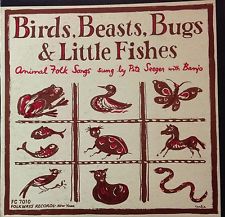
I had forgotten, but it was a 10" LP. Does anyone remember those?
Thanks DT, I appreciated your musical tribute to Pete.
Here is one way I will remember him: It's a song I enjoy playing on my dulcimer.
Ken
"The dulcimer sings a sweet song."
In the post war 50's I was halfway thro' my apprenticeship and senior 'boy' in the building firm I worked for. In charge of three or four other 'prentice's, (and 20 oz claw hammer and a sack of cut nails), we spent a lot of time on our knees laying floors in new build council houses! We used to sing a lot, helped the boredom of driving nails, and being the owner of a cheapo record deck (anybody else remember having one?) and a few pennies to spend , I was into what my family called 'rubbish music', some of which I introduced to my mates . One of the songs from my 'collection???' cropped up often !! Yep! you guessed it, 'If I had a Hammer' I guess it could be seen as our way of protesting about sore knees and blue thumbs ? (and I later married a girl named Irene ???)
rest in peace Pete
and thank you
JohnH
In 2001, after the terrorist attacks on September 11, I wrote a piece as a skit that served as a healing point for many of the parishioners at my church. In that I wrote about the lives of people and how it affected the rescuers and the ones who consoled those people. I also used a few songs to help give meaning and voice to the words that i wrote. It opened with Billy Joel's Miami 2007--I've seen the lights go out; sandwiched with Simon and Garfunkel's take on Silent Night with the evening news; and closed with a recitation of Pete Seeger''s If I had a Hammer (some of those who were helping in that part wouldn't sing, so we said the words...just as powerful).
A touching tribute indeed, and most assuredly, heartfelt. I never had the privilege of meeting Pete, but he certainly had a peaceful, down home appeal and approach.
I posted on my facebook page when I found out this morning.
May his song live on in all of us.
A personal musical tribute:
If you listen carefully, you can hear my voice breaking up.
Pete was such a powerful force for good. We can all learn from his example.
Pete was my hero back in the sixty's. He was the one that really got me singing and playing. My second banjo was a long-necked Vega because "it was what Pete played". I feel sad, but I am sure he and Woody are now making music again in the next world.
Pete on music and participation:
"I've never sung anywhere without giving the people listening a change to join in . . . I guess it's kind of a religion with me. Participation. That's what's going to save the human race."
Once upon a time, wasnt singing a part of everyday life as much as talking, physical exercise, and religion? Our distant ancestors, wherever they were in this world, sang while pounding grain, paddling canoes, or walking long journeys. Can we begin to make our lives once more all of a piece? Finding the right songs and singing them over and over is a way to start. And when one person taps out a beat, while another leads into the melody, or when three people discover a harmony they never knew existed, or a crowd joins in on a chorus as though to raise the ceiling a few feet higher, then they also know there is hope for the world.
Pete influenced a couple of generations of folk musicians. While he will be missed his influence will be felt for many years to come. RIP Pete. I'm glad to have known you.
Ken
"The dulcimer sings a new song."
One of the greats. We'll miss you Pete!
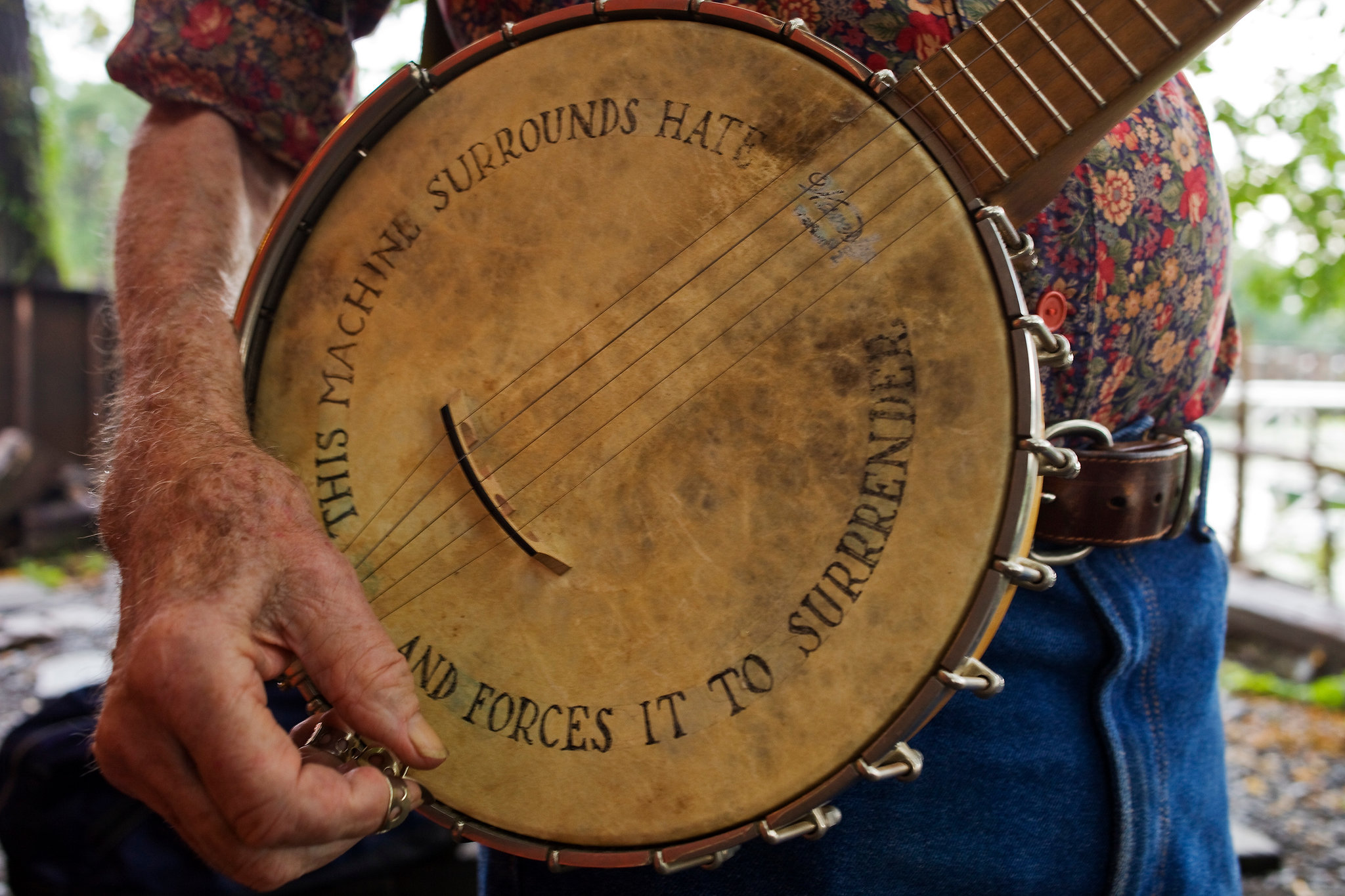
A great man lived a great life. His music lives on in all of us. Thank you for sharing the banjo photo. We must continue his work of destroying hate.
http://www.motherearthnews.com/nature-and-environment/pete-seeger-i...
A great interview with Pete! He was a gracious man.
Very well put together Dusty, Rest in peace Pete.
Pete Seeger just died. He was 94. Maybe when my emotions are easier to put aside I'll post some comments about his place in American folk music history, but how can you sum up the importance of someone who sang with the Weavers, led protest marches, and sang children's songs? He lived the assertion that music was a joyful tool intended tobring people together. (And it was on his TV show that Jean Ritchie and her dulcimer were introduced to the television audience.)
You can read the New York Times obituary here .
There is no way to choose a representative song to post here, but perhaps this one will do. He is playing with others and singingfor peace.
Thefirst record albumsI remember, from when I was just a few years' old, were Woody Guthrie's Songs for a Mother and Child to GrowOn andPete Seeger's Birds, Beasts, Bugs, and Little Fishes . I am sure I know every one of those songs by heart, and I have since I was able to talk. When I get depressed, I put on a Beatles album. But if that doesn't work, I go right to Pete Seeger. His voice is as comforting to me as my own mother's, and is indistinguishable in some ways since my earliest memories in life are sitting on my mother's lap listening to that album.
I used to wonder why I am drawn to acoustic music. I grew up in suburbia in the northeast, after all. And I spent many years listening to rock, blues, and jazz. But I've always felt at home with someone singing a simple song while plucking some strings, and I'm sure that is because of the early influence of Pete Seegerin my life.
I only met Pete Seeger once--at an anti-nuke rally in New York about 30 years ago--so I never really knew him. But I feel as though I've lost an uncle, a best friend, a mentor, and a security blanket all rolled into one. I honestly can't imagine who I would be today had Pete Seeger's music not been a part of my life.
Thank you, Mr. Seeger, for sharing the joys of music and modeling a life devoted to the improvement of one's community. Rest in peace.
Haven't been able to catch all of this by any means after seeing the discussion late, but just have to get in my 3 cents worth (inflation should up it to worth at least that much).
Storytelling is also mainly a folk art, just as most dulcimer players are "folk-y." I remember someone once saying something like "How should I say this? You should look sort of like a hippie gone to seed." Well I don't think we want to look "seedy", but we should have a look that says we're folk artists. Sitting with a dulcimer also probably says either a long skirt or pants. Jeans would probably not be something I'd ever feel respected a performance for anything other than a meeting with fellow performers, but I'd not rule out a jeans skirt.
Because for years I had a 12-letter last name that hardly anybody could pronounce, I took up using LoiS as my logo and play games with it when signing emails, such as LoiS(pringtime can't come soon enough!). In fact a storytelling friend once introduced me to other storytellers who see me on storytelling sites as "LoiS with the big S" to which I looked over my shoulder at my backside and said in a proper mock offended tone, "I beg your pardon!" (My husband swears I married him for his short last name.) All of this to show how I consider a t-shirt or turtleneck with my logo a form of "shameless self-promotion."
It's not appropriate for all of my programs, especially the historical reenactments. I'm looking forward to using my dulcimer as an example of ways one-room schoolteachers could bring music to their classes. For that program I have long turn-of-the-previous-century outfits.
I'm not all that well-endowed in the chest and doubt my approach to performing would lead many to wonder, "when is the bingo game gonna start?", but the main thing is it needs to help my program, not hinder it.
Thanks for quoting that picture here, Lisa! :)
This is just a traditional felt hat (like any European farmer in the last centuries could have had one), a simple linnen shirt and linen trousers from an online shop specialized on clothes for Medieval reenactment and a pair of wooden clogs (like any European farmer in the last centuries could have had some). The clogs are made and sold by a family here in Germany, and many people actuallylike to wear them as garden shoes. They are a bit smaller than the typical "Klompen" of the Netherlands.
That's all, the outfit is very comfortable, my feet were warm even without socks - and it is "authentic" andsuits almost all events / eras from the medieval until the early 20th century.
EDIT: Just noticed that the original question was about outfit for women, so I guess, this is a little "off topic". Anyway - I think a simple outfit is always perfect with the dulcimer! :)
Peter W just posted a great outfit he put together for a gig:
http://mountaindulcimer.ning.com/photo/dulcimer-music-at-book-launch

marymacgowan said:
Ken, okay, so where does a gal get a simple old fashioned country dress?
Women, any advice on that?
Mary, go to the Salvation Army or the Good Will Store. You would be amazed atwhat interesting stuff they have that you can dress yourself up in.. seriously.

And yeah, we're performing, not just getting up and doing a song. For me that's tricky, because I want my performances to be about the songs and yet I do acknowledge to myself that it is a performance. I just don't want to be insincere.
Ken Backer said:Hi Mary
I may be old fashioned but I think one should dress for the music they are doing. For me, jeans, hiking boots, and at-shirt for guys doesn't work. You want to stand out a bit more, and remember you are performing not just getting up and doing a song. For gals, look at what Jean Ritchie wore most of the time. A simple country dress. I think a long, colorful old fashiond dress goes very will with the old songs played on a dulcimer.Cheers Ken
Well, melady, I hadn't thought of it...but, now that I 'av a kilt, ah might be inclined to wear it on occasion whilst performing onstage. That might present some new circumstances that I 'adn't thought of such as standing as opposed to sitting. Well, there ye 'ave it...'cepting I might 'ave ta get some new accessories...hmmm....
Cheerio
No, I wasn't endanger of losing my head at the Highland Games, but I did one performance after falling in a parking lot. Caught my toe in the hoop and fell flat on my face. Hoop went over my head, but no one was about for that show. Did spend the day holding ice to my split lip to keep the swelling down. Fortunately it was an inside split so I could do the walking Kodak moment with the kids and not horrify them.
John Henry said:
ff, I do so hope that you did not hide a puppy dog up your skirts, and subseqently lose your head ..............?
John
Too bad ! I'd have paid good money to have seen you in that 'ensemble' Dusty ..............
John
Dusty Turtle said:
So I guess I won't be wearing my red stilettos at Thursday's open mic! Too bad. They go so well with that new cocktail dress I just got for Christmas.
Rob N Lackey said:Just be yourself and wear comfortable shoes.
So I guess I won't be wearing my red stilettos at Thursday's open mic! Too bad. They go so well with that new cocktail dress I just got.
Rob N Lackey said:Just be yourself and wear comfortable shoes.
Well, last night I had about 4 paragraphs written on this subject before falling asleep. A cat on the keyboard (thank you Mousie!) killed the window with about 24 open tabs in it. So much I had written has now been said, so I'll just reiterate: comfort and appropriateness. Oh and at those open mikes with the young folks, If they like your music they won't care what you wear. I had quite a following at one when I lived in MD a few years ago, particularly among the other musicians. Just be yourself and wear comfortable shoes.
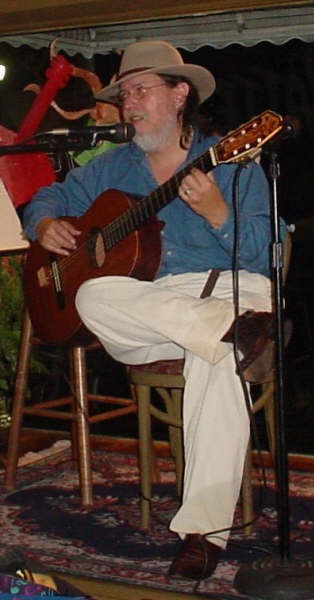
Me.... a few years ago at an open mike
Something you've worn before that is neat, clean, comfortable, a good color on you, and won't pop, pull, or show too much if you have to bend over, sit down, or fall on your face. You don't want to have to worry about wardrobe malfunctions during a performance.
Someday, I'll have to tell you about my performances as Mary Queen of Scots.
Somehow, I think Aubrey Atwater would be very amused to know we're discussing her wardrobe! I've seen her in quite a few performances and I think she always wears a skirt or a dress....something she can clog in.
If I were performing regularly, I would also keep track of what I wore, so I didn't end up wearing the exact same thing every time (unless I was deliberately going for a "uniform" look). I sang in a group where we DID have to wear the same thing at every performance...back in the 60's...but expressing yourself as an individual is a good thing, I think.
I am reminded of a little girl I taught who was puzzled by what I wore, but didn't say anything until the end of the year. My school had me on a very rigid schedule to see particular students,and this student only saw me once a week. At the close of the school year, as she was leaving, she pulled me down so she could ask quietly--and privately--"Mrs. Potts, why don't you have any other clothes? All you wear are those green pants." I then realized that since our school was so big (spread out over several buildings) she probably HAD only seen me on TUESDAYS--the day I had meetings with my troop of Girl Scoutsafter school!
I am not at all surprised that Guy is most comfortable in nice slacks and a collared shirt, well-pressed--and you look GREAT in your profile photo!
I personally think that dressing in all black can sometimes be like a black hole. Or the place where all the energy drains away to nothingness. Or, like the Japanese puppeteers, you're "not really there" at all. If you see folks looking at you with worried expressions and a furrowed brow, they may be wondering who died. And I KNOW that there are a lot of folks who dress in all black every day....we all just gotta do our own thing, I guess.
When people come to a performance, they come toSEE you and experience being there with you, not just listen to you--they can do that (the listening) with all kinds of modern technology. They want to connect with you, and some of that is about your wonderfully expressive face andhow your body interacts with the dulcimer, and some of that is about forming this image of you that they're going to keep in their head.
I ALWAYS notice what female performers are wearing on stage. It's part of the performance package, unless your audience is visually challenged. There are some outfits that just don't work. The skirt is too narrow to easily navigate the higher-than-average steps up to the stage, or the material ends up being nearly transparent (oops!)with the positioning of the stage lighting, or there's not enough give or stretch in the material and construction to move around and/or adjust stands, instruments, stools, mikes, chairs, etc. The fringed jacket--which looked so great in the mirror--ends up getting caught in your strings. You pick up your dropped music and inadvertently flash the audience. Well, you're a performer, so you know all these pitfalls. MOSTLY, folks just want you to be comfortable and communicate a sense of your personality. Comfy shoes, a flowy skirt--or slacks that fit well--and a top with maybe a simple necklace that doesn't reflect the lights into folks' eyes.....if you're a hat person, go for it, just not one that keeps your face in shadow the whole time. Mary, I can't imagine you in work boots, ripped jeans, hunting shirt and ball cap on backwards, but maybe that IS you and I just lack imagination!!!
For most casual gigs, such as coffee shops and such, dress in the image you wish to convey to the audience. You are who you are. I was born and raised in a large, Northern city, to dress as a Southern Farm Boy isn't me. And may be seen as an insult by some audiences or sponsors. For formal gigs such as weddings, you need to dress for the occasion. When you get invited to play at an art museum fund raiser, consider it a formal occasion, and dress with class. For a Christmas performance, wear seasonal clothing. Try not to be a caricature of anything, you need not dress as Uncle Sam for an Independence Day performance. Tasteful in all cases, no matter what the pro's do. When radio stations all over the world play your recordings, you can wear a dress made of meat, and still get gigs.
Absolutely!! if you have a particular image you are desiring to present that will definitely influence your choices in attire. Even an "unkempt" sort of look. I just think it's nice to consider how you are presenting yourself to your audience, rather than some guys I see who obviously put no thought whatsoever into what they are wearing. It's another part of the whole experience in addition to the music, and something that doesn't have to cost a great deal of money to consider.
I am with DustyT in saying "Dress in whatever makes you most comfortable." Usually for indoor events I dress in slacks with an Oxford cloth shirt (short or long sleeve depending upon the time of year and temperature). For most outdoor events I wear jeans unless it is very hot. Then I wear shorts and a t-shirt. Outdoors I always wear a hat with a brim to cover my ears. I do this for medical reasons. Most of the time it is a straw Panama hat. I have worn a variety of footwear from my New Balance walking shoes to work books.
Ken
"The dulcimer sings a sweet song."