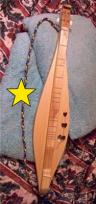
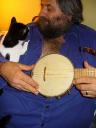
You might be a dulcimer redneck if . . .
OFF TOPIC discussions
Yikes, I don't! Maybe my diatonics got broken! 

Dan Goad said:
I didn't know that you had a chromatic dulci, Robin.
Yikes, I don't! Maybe my diatonics got broken!
Dan Goad said:
I didn't know that you had a chromatic dulci, Robin.
Nope. Hb.
Dan Goad said:
Oh, ya found G# did ya, Robin?
Well, I know the alphabet further than G. Guess that disqualifies me. 
Your idea of adopting an orphan is someone's unwanted dulcimer.
If your "Mac" is a McSpadden rather than an Apple product.
Your Bumpah stickah says, "I brake for Dulcimer Jams".
Your tattoo of your Dadd is a three-string dulcimer on your forearm.
I was looking for some new jokes and found this.DT;
The new one I received in the mail yesterday is the only snark I've had any experience with. I have a feeling that the 'accuracy' claim is pure advertising. My Korg CA-1 seems just as good. The key feature for me though WAS the new display. I can see it while it's clipped on to the headstock of my dulcimer without using my glasses. I do question the durability of the snark. The Korg is very robust (except for cement floors). I won't use the swivel on it much, I think it would wear quickly. The clamp does seem adequate.
I had trouble on occasion with background noise (tv etc.) registering on the Korg. The snark 'reading' vibes through the head stock may be a real advantage. Still new, I'll have a more objective opinion once I've used it a while.
Sam, I have a Snark SN2 (the red one)and was wondering how the SN8 is any different. Is it just the display or is the tuner actually more accurate?
Got my new Snark SN8 in the mail yesterday. The display bars are bigger and easier to read than on earlier models. I have a Korg CA-1 and I like it but I really do like the 'clip on' feature of the snark. With preliminary testing it does not appear to be anymore accurate than the Korg. It comes with a default setting of 440, I'm not sure if I need to change that, but my dulcimer tunes nicely at that setting and it seems to agree favorably with the Korg.
$12.69 FREE shipping ebay.
That's it Kristi - the Seiko was the one I saw. I see it on Ebay foor $19.95 with free shipping. Heading my way soon! Thanks.
I need to add a disclaimer: I went back an looked at the TU-80C listing on Amazon and although the picture clearly shows a "C4" on the screen, the model number shown on the pictured tuner is TU-80. So I can't be sure that the TU-80C is the same model or has the same features or not. Given the inaccuracy of listings I've seen on Amazon, I wouldn't be too sure that the listed tuner has all the same functions. OTOH, I can't find any reference at the Boss site for the TU-80C, so I don't know what the deal is.
The Boss TU-80, $29.99 at Elderly, shows the octave. Its range is E0 to C8. The TU-80C, available at Amazon for $19.41 also shows the octave, but I couldn't find its range anywhere, although it's described as having an "ultra wide" tuning range.
John - I looked at that one, and several others similar. That's not displaying the octave, 5G is the 5th string G note...
iphone? I barely have a cell phone!! Thanks for the note Christian.
if you have an iphone you can take the apply : cleartune !
it cost less than one dollar (in europe it's 0,79 euro !!!).
it does all of that and is realy good.
Yeah - this is beyond a battery job - one too many drops onto hard floors I think. You can get the Snark from Amazon for under $15, my local store sells them for darn near full price - over $25...
Ken, first, are you sure you don't just need a new battery? My tuners get a little hinky when the battery gets low.
I have a Shark and love it. I have the red SN2, but I think there is a newer model out that is supposed to be even more accurate. The metronome feature is pretty useless, but I like that it can work either through the vibration of the instrument as a clip on or through a microphone if your instrument has no convenient place to clip the device. Search the web and you can find some for less than $15.
Oh yeah. I don't need an octave display, but it would be nice if it were $20 or less. I'm looking at the Snark clip on and the new Korg small clip-on too. Both are under $10 if you shop the 'net.
It's my only guess. Maybe it wasn't what you were thinking of. Yes, $69 is a bit steep. I bet there's a better option out there somewhere for you Ken.
That could have been the beast, but I don't remember that big triskele dial. Price little sucker at $69 Amazon price, isn't it!
OK, so my third Korg CA-30 tuner is biting the dust after 4 or 5 years - displaying B# when I know I'm near D...
What I want is a tuner that displays the octave that you're in, not just the note -- D3, C4, A4 etc, not just D, C, A.
I've seen and used one, but can't remember where or who it belonged to (Senior moment?) Any ideas who makes such a critter and how much it costs?
The reason it sounds off to our ears is because the drones are in D, while the melody is played in C ionian as Ken has it. You can tune to the "dorian" mode, but if you finger the ionian scale that's what you get. A point to remember is this: every mode is available in any tuning, by starting your scale on a different fret. But the drones must be tuned correctly to give you the harmony for that key.
If we start our scale on the open string, we get the mixolydian mode. Always. If that string is tuned to C, we have C mixolydian. To harmonize this, we tune the drones to C and G. If we leave that melody string tuned to C, but begin our scale on the 1st fret, we have the aeolian mode of the key of D. We must now tune our drones to D and A to harmonize this new key and mode. Leaving the melody string at C, and starting our scale at the 2nd fret, we now have the locrian mode of E, and we need to tune our drones to E and B. This continues all the way up the fret board, with each mode in a new key. Drone and chord players alike are bound by this. The mode not only gives us the notes we need for that modal melody, it also gives us the notes used by chord players to harmonize that melody. This is also true for drone players, just not as readily visible. But as we learn to hear, and to trust our ears, we recognize when the harmony is right for the key and mode of the melody. Playing alone, this is dissonant, but try adding a chord player to the mix. If you play this song tuned to DAG, what key do you tell your guitarist buddy to play it? In C or D? If he plays it in C, his chords will sound good against the melody, but will clash terribly with the key of D drones. If he plays it in D, his harmony and yours will work, but the melody will clash with both harmonies. The key of the melody string must match the key of the drones.
Paul
OK, Ken, so you're saying that by tuning the melody string one note lower you're tuning into Dorian mode, which I understand. But playing a tune in an Ionian mode against the drones doesn't make it a Dorian sound. As you said in your first post, the Dorian scale begins on the 4th fret. Thus if a tune is to truly sound Dorian with the melody string tuned down it must (usually, there are exceptions to every rule) resolve to the 4th fret, not the third. Our western ears are accustomed to music using certain chord progressions and resolutions and, like folkfan, I find the sounds as you've given the melody weird. But if I raise everything one fret (melody string still tuned down), then it sounds Dorian.
Ivan, Ken previously wrote that "All Through The Night" was in Ionian. The reason I asked about his fretting was to see if he was working with a different variation of the tune than I was. If so, then how it sounded in Dorian would be different than the version I'm playing. I'd tried my version in Dorian, but I'm so used to playing and singing it in Ionian that I couldn't get it to sound right to me.
A lot of people experiment with different tunings on modal music and come up with interesting sounding tunes. Lisa just did a video of "Go Tell Aunt Roadie" or "The Old Grey Goose" in Dorian. It sounded "Medieval" and not like "The Old Grey Goose" at all. Spooky.
Ken mentions doing the Wreck of the Edmund Fitzgerald in Dorian, my version is in Mixolydian, but I don't use a 1-5-8 tuning for it. My tuning is DGG with the G being played at the open string on the melody. This has a different sound than the more traditional GDg tuning for Mix, but it works for me.
Yes, Ivan, I'm well aware that the melody line and the tune is Ionian. In both Ionian and Dorian Modes the drones are tuned to the same notes - D and A. It's the G tuned melody string which gives the effect Folkfan has noticed. I've never said that this tune is anything but Ionian. I am simply saying that - right, wrong, or indifferent - it can be played with a Dorian Modal tuning. Many Ionian tunes can be played from a Dorian modal tuning to give them a unique and different mood.
Ken, the melody line you give above is for a tune in the Ionian mode. No matter what you tune the melody string to, any scale that begins on the third fret without using the 6+ fret is Ionian. Tuning the drone strings to something else may make for some strange harmonies and may even make the song sound Dorian, but the truth is that the melody you give denotes an Ionian tune.
 You play the same fretting positions that I do, but our tunings are different. Going from Ionian to Dorian really hits my ear as wrong and leaves my mind in a muddle
 . My ears are going "what the heck??? that's all.
Here's the melody line that I worked out.
3..2..1..3 - 4..3..2..0 - 1...2...33 (repeat)
sleep my child - and peace attend thee - all through the night
Guardian angels He will send thee - all through the night
6...5.6.7.8..7..6..5
While the drowsy hours are keeping
6..5..4...3-5..4..3..2
Hill and vale to-gether sleeping
3..3..2..1-3..4..3..2..0 - 1...2...33
I my lo-ving watch am keeping - all through the night.
What fingering are you using for say "All Through The Night". Mine in Ionian goes All/1 Through/2 the/2 night/3. Tuning to Dorian (1-5-3) and using that sounds wrong so how are you transposing it?
All Through the Night may not technically be a Dorian Mode tune, but it sounds pretty neat that way....