What's in a NAME???
General mountain dulcimer or music discussions
I hope it doesn't get so cold you're forced to burn a mountain dulcimer! If you have a hammered dulcimer, it will burn longer. ;)
I hope it doesn't get so cold you're forced to burn a mountain dulcimer! If you have a hammered dulcimer, it will burn longer. ;)
According to an old time cowboy I know, the reason they didn't name their horses was "You never name something you may have to eat". This is a very cold winter so I do not name anything I may have to burn.
Hearts of the Dulcimer Podcast - Episode 32
The Legendary Howie Mitchell
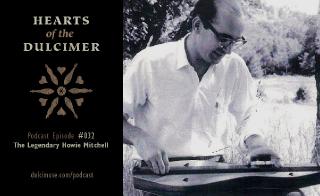
In this episode, we present the stories and music of Howie Mitchell. An innovator of dulcimer building and playing in the 1950s and 60s, Howie is credited with spreading the idea of the 6 and half fret, the DAD Mixolydian tuning, and the chord melody style of playing dulcimer starting in the late 1950s. All three of these ideas caught on in the dulcimer world and for many players is the standard way of playing dulcimer.
Hearts of the Dulcimer Podcast can be found on most podcast apps.
Here's the link to Hearts of the Dulcimer on iTunes: http://bit.ly/hotdpodcast
Don't use a podcast app or iTunes? You can listen to all the podcast episodes directly on our website: http://dulcimuse.com/podcast
We also have a resource page for every episode, where you can find photos, videos, and song lists. Here's the resource page for this episode: http://dulcimuse.com/podcast/resource/032.html
Move the string back again to the other set of notches. It may be that you just didn't have the string seated properly the first time.
Thanks everyone for the responses! The bobbin is a bit longer than my usual noter, so it took a little getting used to especially on the higher frets. All in all a successful experiment!
Dave, check the slot depth on the nut first and then the bridge..........you might try a slightly heavier string or do what I have done when the string is just twanging on a fret........put a small piece of a flat tooth pick under the nut, right under the the edge closest to the twanging string.........then try it........do you have and adjustable or moveable bridge? Sounds like the string is vibrating in the slot a bit too much to me.
Hi Dave, you posted this thread in the For Sale forum, so I moved it here instead.
I hope someone will help you with your buzz issue!
Help please. I play with three strings, leaving the outermost double melody string off. I just put new strings on it. When I start tuning the inside melody string, and once I reach the note C just below D, I get a twang/buzz sound from there right on up to the correct D note. Sounds so sour. When I move the same string to the outside notches the sound isn’t there, and rings true. Any ideas?
You're welcome, Robin. I remember you being there. This will be my fourth. Haven't missed one yet.
Ken
"The dulcimer sings a sweet song."
Thanks, Ken! When I got to the Hindman fest in '15, I loved it!
Thanks. Lisa. I found a few minutes to sit, so I worked on it. 
Ken
"The dulcimer sings a sweet song."
I created an event notice for the Homecoming. Once Lisa approves it, it will appear in the Events listings. I supplied the date, place, and link to the Homecoming website. Let me know if you think there should be more there.
Ken
"The dulcimer sings a sweet song."
To whoever submits the notice in our site's "Events/Festivals" list....some info bits you should know:
1) it's free
2) you can add an image to the listing, which makes it way more eye catching interesting to look at.
3) It won't actually show up for the general membership until I approve it- but I'll be watching for it and will approve it right away once it's submitted by someone.
4) make sure just 'one' person is going to submit it to the fotmd calendar, so there are not 'dueling submissions'. ;)
5) to create the calendar listing, you need to do it from your own profile page.
Ken L's got it, John K. There's something in the works for getting word out here in near future, though.
That's a good question John. My guess is that none of the organizers are members here. If I had time I would do it, but I'm really busy tomorrow and heading out of town for a few days and will have spotty internet connections. Maybe I'll do it when I get home, if someone doesn't do it before me.
Ken
"The dulcimer sings a sweet song."
Why hasn't this weekend been listed with the upcoming events and festivals yet?
At least post the dates for folks to set aside on their calendars. Time's a-wastin'!
Richard, you said, "Hoefully that [noter/drone] influence will be felt."
Have no worries!
I know the class sessions haven't been announced, yet, but there are many fine noter/drone players-performers-instructors-enthusiasts on the staff, so there's no doubt that you will have a fine offering of classes in this playing style. Also, as Ken H. points out, outside the class times there will, additionally, be a lot of great music sharing among the participants and you can join whichever group draws your interest...many of these will be noter/drone.
I've been to Hindman many times for a variety of events and am sorry I will miss this since I'll be out of state at another dulcimer gathering the same weekend. I know most of the people on staff and they will provide what you're looking for! I hope you do get to go and if you do get there, I hope you have a grand time! Tell us all about it when it's over!
Thanks Ken and Ken. I would like to go. Wanted to see what sessions might be offered. Glad to hear there was good input via facebook (I don't do facebook). Hopefully that influence will be felt.
I'm reasonably sure there will be a good bit of N&D things. There was a pretty vociferous chain of posts on FB concerning that very subject. Some of us are planning getting together for just such activities not matter how much 'official' N&D there is...
Richard, as fas I know, the workshop offerings have not been posted yet. I know a couple of people made the suggestion to Lorinda Jones that she offer such a workshop. There will be a few noter drone players there.
Ken
"The dulcimer sings a sweet song."
Hi @kb9jlo
i just now saw your question today so I'm a bit late for the Christmas songs. However I wanted to tell you something that may help in playing for your grand darlings to sing along. You already know that you will find most songs tabbed for the DAD tuning. If you need to sing in a bit lower key, which is often needed, then you can tune to CGC and play the exact same tab as you do for DAD.
That would mean you lower each string by one.
Does anyone know if some of the sessions will have noter drone emphasis?
Wood Quills or Quill Bobbins are readily available on places like Ebay.......and they are dirt cheap. When I worked for a textile company during the summers during undergraduate school we threw thousands of them away because the company had changed over to paper quills. Those wooden quills screw/or slide into the the right side center gap of the wooden shuttle with the thread/yarn wound around them. Most I saw were made of oak or some other type hard wood. I'll bet they would indeed make excellent noters, especially if one side was sanded flat..........great idea Charles.......Bravo!
yep, I'm also a weaver, and yep, that a bobbin and it looks cool to use as a noter. aloha, irene
Yes, that is a bobbin. A spool of thread would have been put on that and then then run through the loom.
Ken
"The dulcimer sings a sweet song."
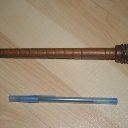
Whatever it is, it works great! It's made from some very hard wood and the weight at the end helps.
Should be a great noter, that's for sure!
I'm trying this out as a noter. I know it's old (100+ years) and I think it may be part of an old loom, maybe a bobbin. Anyone have any other guesses?
Just to clarify the original question- Red78445 has an instrument that (presumably) already has a finish on it and wants to enhance the finish.
Some finishes cant be applied over another type (i.e., applying boiled linseed oil over a cured shellac finish). If it was a specific type of finish, I would go with a newer application of the same on the prepared surface.
If its just a 'spit shine', I think some furniture or paste wax might be the best option. There are tons of suggestions available in various woodworking/luthier forums.
On the website, entitled "Luthiers Mercantile International", I did find the following info:
As far as the tung oil is concerned, I do use Formby's low gloss tung oil finish; which is not 100% pure. I take the surfaces of the dulcimer to 320 grit. I then use a cloth pad to apply 3 to 5 coats, depending on how it is working with the particular wood I am using at the time. I lightly scuff the surface with 320 between coats. Final is with #0000 steel wool and a wax polish.
I would like to do that experiment sometime, but not sure my ear is attuned sufficiently to tell a difference. Nice instruments you are making.... :)
No, actually, I have done it with other features, but not comparing oil to lacquer. The times I have used oil, I was just not happy with the results.
That is a good suggestion Matt. That would be the only way to know for sure, of course both the top, bottom, and sides would have to be out of the same piece of wood, on both dulcimers. Have you already done sibling dulcimers; one with tung oil and one with another type of finish? Is that how you know oil finishes dampen the sound?