What are you reading right now?
OFF TOPIC discussions
I am still reading _Younger Next Year_ and loving it! Also trying to finish _The Four Agreements_, which I started first....
I'm reading a knitting pattern for knitting a pink hat. Haven't picked up my needles in about 10 years(!) and I got inspired. I'm really enjoying taking it up again for a few minutes of relaxation here and there. Love the act of carefully making something with my hands again. I'm finding it's like riding a bike- I need to review the instructions for certain things, but it's coming back to me very quickly.
I'm realizing they now have a million online youtube videos for knitters. The internet didn't even exist when i first learned to knit almost 30 yrs ago. (!) Yay!
Hi D- if you don't use the 1.5 fret, then you'd not likely use its 'mate' that's one octave higher (the 8.5 fret).
The reason we don't often see such extra frets mentioned in tab is this- the reason for adding them is to enable you to play in a different mode and key without re-tuning. 90% of tabs seem to be written for DAd or DAA tuning... both of which can be played without using the 1.5 or 8.5 frets. Bluesy tunes might use them more often though.
I find the 1.5 and 8.5 frets are handy for me when playing in fiddle tune sessions. One example of where I find it useful is if fiddlers switch to a modal-y sounding tune in the same key and then switch back to a major-y sounding tune in the same key, without much of a pause. Since I don't use capos either, those two extra frets give me more options in weird fiddle session situations. But for folks who play typical pop and/or traditional folk tunes mostly from tab, they might rarely run into instances that call for a 1.5/8.5 fret.
I was wondering what sorts of experiences yall had had when selling dulcimers on ebay. I think I understand the fees are 9 or 10% then you add paypal to that.
Have you mainly had good experiences? Did you add sound files? Did you find yourself sitting with a bag of popcorn watching the last hour?
Is there a software program that allows someone to 'cheat' the system and outbid the last bid? If so, how does that make you feel?
I know, I know...lots of questions, haha!
"Exploring Genesis" by John Phillips. Wonderful insight into Genesis.
Singing was important in my primary school. In kindergarten I learned a song about "going to a hooki Lau" and I'm probably mangling the Hawaiian word. But we had to do movements as we sang and our mothers made us hula skirts out of crepe paper. Mine was orange and purple. It was for an end of year concert. I can still remember the words and movements.
Oh we're going to a hooki Lau. Hooki hooki hooki hooki hooki Lau.
Everybody loves a hooki lau, where the bow-wow meets the cau-cau at the big luau.
We'll throw our nets right into the sea, and all the tumerumas come a swimmin to me.
Oh we're going to a hooki Lau. Hooki hooki hooki hooki hooki Lau.
Something like that!
Also I remember singing Kookaburra sits in the old gum tree, Its a Small World After All, Getting to Know You, The Water Is Wide, Jamaican Farewell, Oh Island In the Sun. There was a teacher who played guitar and taught us these. Being a Catholic school we sang hymns at Mass. We also sang in an annual eisteddford and the music teacher nun would drill us rigorously in the songs. It was a big deal to have to travel to the regional city where the competition was held. We never won but would get third place. I can't remember any of those songs though. Sorry Sr. Jan!
Kookaburra Sits in the Old Gum Tree!
I have a folkcraft with a 22" VSL which has the 1+, 6+,8+, and 13+. and have had no problem with the fret spacing at the high end. You just get used to it like any other spacing. I suggest you get the higher one if you are getting the 1+ and 6+, you may grow into playing at the higher frets over time. Keep in mind the music you play now and any future changes in your play lists and style of playing.
Don Pedi says he'd rather have an 8 1/2 than any other 1/2 fret. In fact he says the 1 1/2 gets In his way a lot for making smooth sounding slides. That being said, I agree with Ken. Look at all the great players who didn't or don't use extra frets: Roger Nicholson; Robert Force; Michael Rugg, Dan Evans and many others. I've declared this my year of no extra frets. I'm really finding there is little necessity for a 6 1/2 even. Now I just need a great diatonic instrument. Anyone got one they'd like to donate?
Someone has to be the con here!
The voice of reason crying out in the wilderness!
I never recommend any additional frets, not even the 6+ . I think people should learn to re-tune to a proper tuning to get the so-called "missing" notes for a particular song . After all we're only talking one string, in most cases, and everyone should be intimately familiar enough with their instrument to re-tun one string in something less than a minute -- I can, why can't you? That's my humble opinion, and I'm stickin' with it!
I"m a little tea pot
The ants come marching, one by one,
I'm a juvenile delinquent....that's just what I wana be...la la la la...
I was JUST thinking about this very thing the other day and realizing this generation of kidnicks aren't singing things like 'Ring around the rosie' and 'I've been working on the Railroad'. Sad to think these would pass away!
I'd recommend getting the 8 1/2 fret, too. When you go to play tunes higher on the fretboard, it will be confusing if you have a different fret pattern than you have in the first octave, and you may not be able to play the same notes and chords that you've played lower on the fretboard.
I hadn't planned on having an 8 1/2 fret put on my main dulcimer with a 1 1/2 fret, but the person building the dulcimer convinced me that it was a good idea. I am very glad now that I listened and had the extra fret put on. My main dulcimer has a VSL that's slightly over 26 inches, and there's plenty of room for the 8 1/2 fret.
Hot Cross Buns
Hot Cross Buns
One a penny, two a penny,
Hot Cross Buns
Our music teacher would also use the numbers One, Two, Three to the same tune while using a hand to demonstrate ascensending and descending notes.
First thing that came to mind for me was Eensy Weensy Spider (or Itsy Bitsy spider, if you're my wife).
Then I remembered a tune that my dad used to sing to us. One he learned from his mother.
Did you ever go down to an Irishman's shanty
Where money was scarce and whisky was plenty
A three leg-ed stool and a table to match
An old broken door and an old broken latch
Sung to the tune of the Irish Washerwoman. I've known this tune as long as I can remember. My grandmother's name was Susanna McGranahan, btw. She knew something about being Irish. :-)
A couple of lines from a song we sung in primary school (probably about 8 years old) were "Hey rig-a-jig in a jaunting car" and "Clear the track, let the bullgine run". These stuck with me, probably because they didn't make a lot of sense (to an 8-year-old).
It was only recently, with the magic of the search engines on the internet, did I manage to track down The Margaret Evans and add it to my repertoire ... really ought to figure it out for the dulcimer :)
I remember in 8th grade our music teacher taught us "Band on the Run" I still hear 2,3, band on the run.... She also taught us some Beatle tunes.
I seem to remember "I've Been Working On The Railroad", "This Old Man"...probably more...it's been a very long time ago (3 years!).
Steven
The first songs I remember learning were in Sunday school. They came with choreography! I may never march in the infantry, ride in the cavalry, shoot the artillery... even as a preschooler I wondered why we're pretending to fire a rifle in church when Jesus says to love one another. But I loved "This Little Light of Mine." Then and now, forever.
In 1st Grade they taught us "The Star Spangled Banner." In 3rd Grade Mrs. Coolidge had us sing "There's a Great Big Beautiful Tomorrow" every morning. We learned "If You Dance Then You Must Have Boots of Shining Leather" in music class and it was not an easy song to sing. But the songs that really counted were the songs we sang on the school bus. I lived outside North Canton, Ohio (not Canton, not even North Canton...) and Grades 1-12 rode the same bus to the same huge consolidated school. Given the range in ages, the playlist was, um, interesting:
B.I.N.G.O.
There she was, just a walkin' down the street, singing doo-wa-diddy, diddy-dum diddy-doo
I Wanna Hold Your Hand
Rat Fink (to the tune of Rag Mop)
The Name Game
It's My Party and I'll Cry if I Want To
There was an ongoing argument among the older girls about whether The Beatles or The Dave Clark Five was a better band.
4th Grade is somewhat too old for this discussion, but I must share the following, which I remember almost verbatim from our long-suffering music teacher (this was Cumberland, MD by now): "The words are 'her green beret has met his FATE.' That's FATE, not FACE. He didn't meet his FACE, that doesn't make any sense. How could somebody meet his own FACE? He met his FATE which means he DIED. Now let's try it again."
I'm now reading Thomas Jefferson The Art of Power by John Meacham. Also reading the latest issue of Martin - The Journal of Acoustic Guitars.
Ken
"The dulcimer sings a sweet song."
Bill Bryson should be considered a national treasure.
Here and elsewhere!!!
Bill Bryson should be considered a national treasure.
You're not sure of the exact gauge -- ie 22 or 24 or 26? With either solid steel or wound strings that can be quite a difference. Depending on the VSL, of course. Not many of us use solid steel strings above about 14 gauge, although I personally do -- on my traditional setup instruments -- use a 20 or 22 plain steel as it gives a crisper sound than a wound string of the same gauge.
A wound string will be "softer" than a plain steel string of the same diameter, thus your "moves more towards the side" if you aren't nailing the fingering straight down. A plain steel string is solid metal -- much firmer than a piece of thin nylon or very thin steel spiral wrapped with even thinner steel or bronze wire. The consensus is that a wound string is easier to play (takes less energy to move) than a solid steel string of the same gauge -- gauge being the external diameter of the string, wound or not.
Just to clarify, this is not a bass dulcimer... I am just talking about the bass string or lower string...
On a three string DAD set up... The lower D string - Just wondered about gauge and sound differences. I have a 2
Phosphorous Bronze wrap - 22 to 26 gauge
Steel no wrap - 22 to 26 gauge
On one of my dulcimers I have the steel and it's nice and smooth and blends well. On the other identical dulcimer I have the wrapped phosphorous wrap...
I think the wrapped bronze it a little harder to play... It moves more towards the side of the fretboard, which I don't like, but it is deep sounding. Not sure it blends as well..
Just wondered what you all have experienced on this...
We loved "Little Dribbling", especially since my Lady Sally is Brit, and we love the small out-of-the-way places there. You should see the trip we're planning for September into the Borders of Scotland where her clan and mine hung out 'back in the day'. We've read all of Bryson's other books as well, and vistited many of those places.
I remember we sang Happy Birthday if any of our classmates had one on a school day. Songs that I recall are Skip to My Lou; Twinkle, Twinkle Little Star, Sweet Betsy from Pike and I Ride An Old Paint (Cowboy day in first grade), and as we moved on we used at song book entitled Twice 55 which had 110 songs in it. Here is a link to it on Amazon: Twice 55 .
Ken
"The dulcimer sings a sweet song."
I grew up in Ohio, and the songs I remember from early school are (in nor particular order) things like Twinkle Twinkle, Frere Jacques, Today Is Monday (foods for each day), John Jacob Jingleheimer Schmidt, Happy Birthday, etc.
At home my folks had a bunch of old wax 78s and I learned one of my Mom's favorite tunes Across the Alley From The Alamo
What a great idea for a thread! I may post multiple times; please excuse my enthusiasm.
I grew up listening to the Pete Seeger and Woody Guthrie albums for kids, and my mom would also sing those songs accompanying herself on a ukulele, but that was at home. In school?
I grew up on the east coast, in Connecticut and then Massachusetts. However, I spent 3rd grade in Santa Barbara, CA, and one song I remember learning in school there was "Tinglayo, Come Little Donkey Come." I loved the rhythm of the song and the silly lyrics in which "my donkey eats with a knife and fork." However, we moved back to the east coast after that year and no one asked me to sing that song again.
Decades and a few lifetimes later, I found myself raising a daughter back in California. And lo and behold, in her Montessori preschool, everyone sang Tingalayo! I was so excited to hear that song once again. And on those occasions when I brought my guitar or ukulele to that preschool, we all sang that song together.
Here is the Canadian folk/children's music group Sharon, Lois, and Bram, singing the song on one of their albums . In the interests of wonderfully full disclosure, I must add that the middle name in that trio (Lois Lilienstein, RIP) is the mother of one my best friends from college. She was an absolute encyclopedia of kids music. If you ever started to sing a song, she would have a ready-made harmony part, or some hand gestures, or a rhythmic chant, or something fun that accompanied the song. She and I did not connect musically until a few years before she passed, but she was an absolute delight.
I thought it would be interesting to hear about the songs we were taught when we were very little, in kindergarten through the first few years of grade school, like up to the age of around 10.
Did certain songs 'stick' with you through your life in meaningful ways?
What were YOUR early impressions and experience in learning songs as a small child in school?
It makes sense to include FOTMD so it can be searched. I don't know whether I'll remember to do it or not. ;)
I play this on the melody string in Ddd, Gdd and DAA; either Fingerdancing or Noter & Drone.
One I Love -- Jean Ritchie
All of my friends fell out with me
-5--5--5-----5----3--23---2---1
Because I kept your company
--75-----8--7-----5----345--5
But let them say whatever they will
-7---8---8-----7---5-3-4-----5----5
I love my love with a free good will
1--1---5----5----3--3-23----2----1
Chorus
One I love, two she loves
3---2---1----3---2-----1
Three she's true to me
0-------0-----01--2--1
I had an idea that I was thinking of earlier . Not sure if this is the right forum or not, but here goes : To make it easier to find fellow members videos on YouTube , could I suggest using Fotmd in the searth terms people use when posting a clip? It is a suggestion for whatever it is worth, and one I will be adding onto my videos when I get home from work on Monday .
My guess is that the dulcimer could be a more recent Ledford rather than an early one. He was often asked for his 'old style' 3 strings with staple frets even at a time when most players wanted 4 string dulcimers with guitar frets. I have no idea why there's no label? Is it possible the number is scratched or pencilled on the inside somewhere?
I've just wound up a guitar business. We would badge and number all our guitars. But sometimes we got the numbers and letters out of sequence when we stamped them (it is easy to do if you are a bit dyslexic !); sometimes I'd allocated batches of numbers to an assistant but then they didn't use them all; sometimes customers wanted a special number; sometimes customers didn't want the badge on the outside so we hid it internally or didn't fit one at all; sometimes we wrote the number in pencil internally rather than stamping the headstock; sometimes folks wanted no markings on the guitar. In years to come anyone trying to trace the lineage one of the 1200 or so guitars I produced could well find anomalies in about 5% of cases. So I'm not too surprised that a Ledford without a label has turned up - musical instrument workshops are a little more 'organic' than say an aircraft parts factory!!!
Good Day,
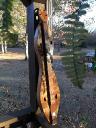
I recently obtained a Homer Ledford dulcimer and it is unmarked completley on the inside without a date,name and/or number. The back of the tailpiece has his signature carved dogwood flower along with his initial "L." Its made out of walnut and poplar, I will post pics. My question is to anyone who may know or know someone that may know any further details about this dulcimer and its build date or the number and why it is unmarked inside.
It is possible the label was lost, I'm not aware of Homer "not" labeling any of his pieces. The staple frets dates it back a little ways, if you study the registry you may be able to guesstimate a date line of the latter part of the use of them. I say latter part because we know about when he started using "hearts", and about when he started "full" fret.
http://www.backroombluegrassband.com/hlccbweb/instruments/instruments.htm