The Positive Thread...
OFF TOPIC discussions
Looks great, Robin!
P.S. Someone should copyright the name "grassroots celebration" before some corporation does.
Looks great, Robin!
P.S. Someone should copyright the name "grassroots celebration" before some corporation does.
In the way of many who have gone before us, I used what I had on-hand to make a little sign.
I'm wanting thoughts on going ahead and putting this picture on my Facebook page.
My apologies for the big photo-- I've tried to re-size it yet don't really know what I'm doing (obviously)!
I'm wanting thoughts on going ahead and putting this picture on my Facebook page.
Thank you so much for posting this. I was lucky to see Steeleye Span a couple of times "back in the day" when they were in their prime, when I lived in Boston, Massachusetts. Fantastic video.
We aren't an off-shoot of worldwide Play Music on the Porch Day. It's a totally different thing.
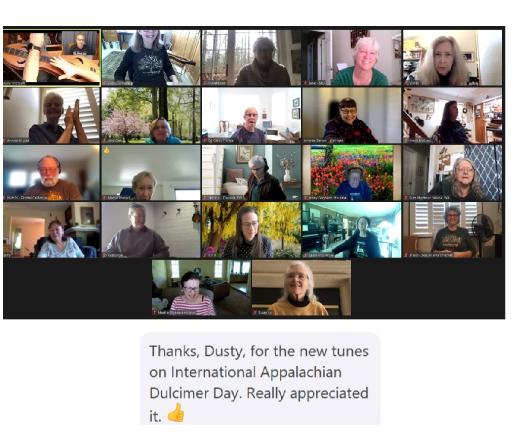
International Appalachian Dulcimer Day is its own thing-- just a day set aside to celebrate however you choose and in some small (or large) way, our favorite instrument. (I live in an old coal mine village and everything we do here is on a small scale.
)
I'm fine with it (assuming we are celebrating indoors--it will be cold where I live). Good to have an easy to remember date!
Being that the date will change yearly it will make it possible for others to celebrate if not this year then next. It will not be a fixed day.
@marg I didn't check the date here or internationally. My thinking was it is not a day which would interfere with anything (unless one were on silent retreat or some similar event) yet, rather, a day to celebrate what many of us do every day-- play mountain dulcimer.
That's fine, just checking if that date was good Internationally.
'Block or street gathering [party] day' for dulcimers on an annual basis.
@marg I was advocating for using "International" because the spread of the fretted dulcimer is across the globe and the membership here at FOTMD reflects this.
This is to be a grassroots celebration on only one day. (This is how I understand it. No committee with officers, a budget, etc. More like a flash mob, maybe? If I'm on the wrong track, somebody can jump in and point the way.) Even if a person just wished to post a special still photo for the day or make an elaborate video or a piece of artwork or anything in-between, assigning a day is a simple way to celebrate the boxes with strings we all love.
(International - last Saturday in March)
Did anyone check if this date is ok for different countries - That their country doesn't have that as a special date? Did anyone discuss just (Appalachian Dulcimer Day)
@dan
Or 'MD Day".
OK for me although 'Appalachian' sounds a bit 'puffed up'. Reason, I'm used to referring to it as a mountain dulcimer .
Baaaaaa
{No need for a poll.}
Sounds good to me for International Appalachian Dulcimer Day on the last Saturday in March.
Go for it.
Not exactly good for outdoor activities in my part of the world, but I have no objections.
Ken
"The dulcimer sings a sweet song."
How many do we need for a consensus, can we just stop and agree at the conspiracy level?
P.S. You'ins do know the Black Sheep will refer to this as "Dulcimore Day"...just sayin'
No real need for a poll if everyone thinks that's a good plan, Dusty.
Does anyone have other options they'd like to see considered?
@dusty-turtle, I like it!
OK, folks. I think this conversation has wound down. Perhaps it's time for a vote. Before we go there, how 'bout this:
International Appalachian Dulcimer Day: the last Saturday in March
What think ye? If there are serious objections, we can isolate some variables and have Strumelia set up a poll. But I wonder if we might reach a consensus.
Thank you so much for posting this. I was lucky to see Steeleye Span a couple of times "back in the day" when they were in their prime, when I lived in Boston, Massachusetts. Fantastic video.
Jim, John, Ken, thanks for the info. Richlite looks like a good source and I am already talking with them.
The TV show Rockpalast is still running today. It was started in Germanys public radio/tv WDR (Westgerman Broadcasting Westdeutscher Rundfunk) in the 1970s. Every episode features another show from a band/single artist. Most of the times they were actual live shows other times (like this Steeleye Span show) they were recorded "live" in the studio.
For real live shows they often recorded them in the Dortmund Westphalenhalle since the WDR is located in Cologne. Both cities (Dortmund and Cologne) are large citys in the state North Rhine-Westphalia.
The Westphalenhalle used to be quite popular as venue for big names of show buisness.
Youtube has a lot of these shows although mainly all kinds of Rock music.
So looking for Rockpalast episodes will often lead to live material with good audio/video quality :)
I have Richlite fretboards on two of my Martin guitars. You can't see a difference between it and ebony and I think the Richlite lets you slide better than ebony.
Ken
"The dulcimer sings a sweet song."
Etsy and eBay are good sources for micarta. Luthier's Mercantile sells Richlite fingerboards, which looks similar to micarta.
Matt,
I have not made a fretboard from micarta, but I use it for nuts & saddles. I buy that stock from "Texas Knifemakers", but I think maybe they would not handle pieces long enough for a fretboard.
A good place online would be:
https://www.professionalplastics.com
They have many types and colors of micarta - listed under "Phenolics". You would probably want the "linen" grade - itis a very fine weave.
A couple of months ago, I found some blocks of micarta on Ebay that I used for a guitar repair job (internal insert) - so you can check on Ebay. It was very nice material.
Good luck,
Jim Phillips
Wondering if any of you build using Micarta fretboards and if so, where to you source the material?
Interesting dulcimore for sure. I wasn't aware of the fact the Glenns may have helped Stanley Hicks fill orders for dulcimers.
The Glenns apparently made several dulcimer models:
1. A Teardrop Model (1950s)
2. Their Standard North Carolina Model (Based on a dulcimer made by Leonard Glenn's grandfather, Eli Taylor Presnell, in the 1880s.)
3. Their Standard Kentucky Model ( Based on one of Homer Ledford's or Jethro Amburgey's dulcimers.)
4. A Nathan Hicks Model (Based on a Nathan Hicks dulcimer taken to Leonard Glenn by Nathan's son, Lewis Hicks, with a request for two copies for Hicks family members.) This pattern was used to make dulcimers for Frank Proffitt.
The dulcimer in the picture appears to be made in pattern 3, the Standard Kentucky model. It would be interesting to know the explanation for the Stanley Hicks label in the interior. If I had to guess I would say Stanley saw an economic opportunity at a time when he was not yet building the instruments commercially. Stanley was known as an entertainer and often had to be talked into building an instrument.
Incidentally, Paul Dolce ("Slingerland") purchased all of the Glenn dulcimer patterns from Clifford Glenn after he retired from actively making the instruments.
Unfortunately, Hicks dulcimers can also be Glenns! This 1969 dulcimer is a case in point. Doesn't look like a Glenn dulcimer shape - much more Kentucky style - though it has their headstock. Look inside and there's a Leonard Glenn label with a Hicks one rather crudely stuck on top of it! I understand that the Glenns used to 'help out' when the Hicks order book got too long....
Wonderful ! Thank you for posting this. I am long time fan of Steeleye Span, but did not hear this show before. Very enjoyable.
Richard, I'm still looking for a Stanley Hicks dulcimer at a reasonable price.
Regarding the traditional dulcimer builders on TTAD, the list begins with Bobby Ratliff, Dan Cox, and John Knopf.
Bobby builds traditional Virginia style dulcimers and a replica of the McKinley Craft hourglass.
Dan can build just about anything you want. His reproduction dulcimers include the Praetorius scheitholt, the 1608 hommel, a Ben Hicks dulcimer, a Frank Linney Glenn dulcimer, a dulcimer based upon a picture contained in the L. Allen Smith book, and a traditional style dulcimer of his own design based on historic dulcimers.
John Knopf builds excellent reproductions of the Uncle Ed Thomas dulcimer, the Will Singleton dulcimer, various Russell and Melton dulcimers, and the 19th century Tennessee Music boxes.
If you've got a traditional dulcimer in mind, one of the three builders above can probably make your dream a reality.
In addition, TTAD members Ken Hulme and Ken Longfield have been known to build traditional instruments if asked.
Well said greg-gunner. Just depends on the sound each likes in the dulcimer.
Would be nice to have one of the old ones, like a Presnell. So what about those builders on TTAD?
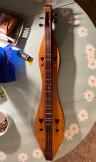
Wondering if anyone knows this luthier. The dulcimer I play is their basic model (I'll attach an image below); I found it online from a private seller and took a chance on it despite being unable to find any info. Got lucky with the quality, considering it's a 20 yr old instrument- it sounds just fine to my ears. I fell for it on account of the handsome fretboard and how I love the simple rectangular shape but hadn't been able to find a mountain dulcimer in that shape that wasn't made of cardboard.
There was a pamphlet in the case with it with some basic info about the luthier and their options, and a phone number (that I'd rather not call if I can help it- dislike being on the phone and I can't find so much as a mention of the Landreys or their dulcimers online so I'd feel weird calling the number). I'll attach a picture of the pamphlet too.
Tdlr; I just wanted to know if anyone had heard of the Landreys or Log Cabin Dulcimers since I own one of their instruments and I've been curious.
Most of the dulcimer builders who grew up in the tradition tuned their instruments for just intonation to sweeten the blending of the melody and drones. Modern dulcimer makers use a different intonation (equal temperament) which blends more readily into triads (3-note chords) to facilitate modern chord melody styles.
The older, traditional "just intonation" gives the most traditional dulcimer sound with the bass and middle drone strings ringing out a constant 1-5 drone against the changing melody. Leonard and Clifford Genn, Edd Presnell, Homer Ledford, A.W. Jeffreys, and a few others continued to use the just tempered scale, and their instruments were made with the drones in mind.
To get one of those sweet sounding "just intonation" instruments like the Glenns made, you need to find one of their instruments in the used marketplace or purchase an instrument from one of a handful of traditional builders. You will find them in the The Traditional Appalachian Dulcimer (TTAD) forum. They build beautiful traditional dulcimers based on the tried and true techniques of the Glenns and others.
Hi everybody,
I already posted about it in the "Dulcimer ancestors group" last summer . I now manged to record a little demo so I will repost here now:
When I visited my parents (they live in East Frisia near the town of Norden) some weeks ago I bought an eight-stringed frisian hummel from fellow FOTMD member Wilfried Ulrich. He is an outstanding artisan and showed me also his other instruments (including several hummels, epinettes, monochords, dulcimers and bowed dulcimers (one even with sympathetic strings!). If you ever visit Northern Germany try to arrange a visit and shopping at his place, you will not be disappointed:
http://www.ulrich-instrumente.de/
I also purchased Wilfrieds book about the history of the hummel, his instruction book and several collections of hummel tabulature. According to him the tabs should also work on a dulcimer.
Since then I try to play the hummel. It's big fun but also quite challenging in it's own.
The fretboard is much wider than on my dulcimer and covers four strings. So I could even use it for learning dulcimer chord playing. That's the nice part.
Wilfried recommends in his instruction book to learn a kind of fingerdancing style. The benefit is, of course, that you can play notes on the other strings. I will need some time for it though since I play my MD only with the noter. So finger dancing is a challenge, but a welcome one!
The other challenge is to get the right strumming pattern to play all strings (including the four drones without fret board) without sounding bad or eleminating the melody strings. On my dulcimer I use the thumb for strumming from the melody strings to the drones and the HEDIM pick for playing from the drones to the melody strings. On the hummel you start always with the melody strings and play the drones just when they fit in (usually at the beginning of a bar). So this is a change as well.
Hello everybody,
some weeks ago I saw an interesting ad in Facebook: A gentleman offered to sale his fender 12 string guitar for 50% of the original price. Since this sounded to good to be true I googled the model.
It turned out to be a "signature model" of some punk musician (thus kind of silly "evil" "Hellcat" and "Skull" inlays). Although the inlays are debatable the reviewers agreed that the sound has much value for money.
And it has a pickup included.
So I wrote the owner a message I would be interesting to try it.
From the first sound I was hooked. He explained to me that he had a kind of serios "Guitar acquisition syndrome" (I feel with him) and needs to downsize his collection.
Good for me, I ended with a great sounding fender twelve strings guitar:
Better quality pictures on my profile page.
And a demo recording so you might get an idea of the sound: