John Tignor dulcimer rework
Instruments- discuss specific features, luthiers, instrument problems & questions
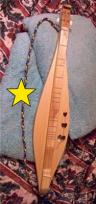
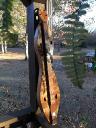
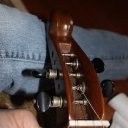
Here are before and after photos of the Tignor pegs:
Thank you very much for your quick answers! I was very sad and I feel much better now. I showed your advices to my luthier friend and he'll do as you say.
Volha, you have been given excellent advice!
I have a cherry dulcimer made by Rodney Hensley that looks just like yours and it, too, sounds wonderful.
Hot hide glue and fiddle clamps, let sit over night. Clean it up the next morning with a warm wet cloth and go back to playin'!
DAN
www.dulcimore.com
I agree with John, and might even do a 'pre-clamp' for practice. That would help you also be sure you have a sufficient number of clamps; keeping your clamps as close as possible to avoid 'unclamped' areas.
Volha, that's a very beautiful dulcimer! And a very big crack, too!
If the wood is still all there, it can be glued with Franklin Titebond wood glue (or a similar woodworking glue) and clamped well. It shouldn't be a difficult repair to accomplish, even though it looks very bad right now.
Hope it goes well with you and you once again have a wonderful instrument! Happy Easter.
Hi guys,
I have one great sounding dulcimer of Rodney Hensley made of cherrywood and it got some cracks on the side. As I see, this one was construted without kerfing.
I have a friend who is guitar luthier, he has no experience of dulcimer repairment but has the tools and experience of woodworking and electric guitars making.
Extremely need your advise - what operations he has to do to fix the cracks and which glue to use better for this operation not to loose this great sound.
Side is little bit going out of the body shape in the crack place.
Mr. Hensley's site is down and I can't ask him directly for advice.
Thanks in advance, Volha
John and Jim, I'm glad to hear that both of these fixes worked.
Ken
"The dulcimer sings a sweet song."
Great story, Jim. There are several ongoing mysteries about dulcimers and their builders.
I called the owner of the Tignor, and he said it would be OK for me to deepen the existing string slots, so I did, and it was a big improvement. That dulcimer sings sweetly now with a normal playing touch. He has yet to pick it up from me, but I'm sure he'll love it now. I'm sure the late John Tignor would approve as well.
BOTH of you really need to show up for the second-First Berea Traditional Dulcimer Gathering, that several of us here are hosting May 16-19, 2019 (yes, that's next year) The ONLY dulcimer event dedicated to traditional instruments and traditional playing styles.
See the articles about Hindman in Exile and the Event listing here by David Bennett, KenWL and myself.
Is there any provenance for this dulcimer? A maker's label or name inside? What IS that dark blob around the off-side upper soundhole??? If it is old -- pre-1970 -- you might want to think carefully about restoration.
1. That crack isn't going anywhere. I would carefully fill it with superglue after putting painters tape close around. That will stabilize it just fine.
2. As mentioned check the location of the Bridge if it is a floating bridge (not set in a tight-fitting slot). The crest of the Bridge should be the same distance away from the 7th fret as the 7th fret is from the Nut. That being correct, then
3. Lower the action down to what we call the Nickel & Dime position. Set a dime alongside the 1st fret and lower the nut until the strings just touch it. Set a nickel on top of the 7th fret and lower the bridge until the strings just touch the coin.
4. Finish -- Many of the J.E. "Uncle Ed" Thomas replicas are painted black, and look quite nice (I own and play one). The thought is that he did exactly what you indicate -- painted the instrument to hide bland wood. I've also recently seen several old traditional dulcimers that appear to have been stained or painted a reddish-black that is quite attractive.
Thanks Matt and Jim! I think I will take a fine bristled, little paint brush and maybe put a small, light coating on the inside of the crack. Like I said, it doesn't push out when I apply pressure. But the action is off the fretboard by, at least, 1/2 to 5/8 by the bridge/tailpiece. Pictured below is open A and fretted A. Kind of shows how sharply it progresses. I have just tuned it slightly, flat so I can do some noter drone playing till I can get to Menards for supplies...
Given the age, the crack probably didn't happen yesterday. If there's no body buzz, it's probably stable (especially if the sidewall/bottom junctions have inner linings) and I'd opt to do as little as possible except perhaps use glue to add stabilization and dress any sharp edges. I don't pretend to be a repairman so don't take this as the final word.
Intonation issues due to high action due to a high bridge are characterized by increasingly sharpness as you move up to higher registers because, upon fretting, the distance the string is depressed (and is consequently stretched) increases accordingly. If the nut is also high (not the usual case) the pitch changes are moderated to some extent. Your side view photo does give the appearance of lousy action.
It looks like you may have a floating bridge. If so, it could be too close to the nut. Your seventh fret (one octave above an open string) should be located at one-half your VSL. If your bridge is too close to the nut, the bridge to nut seventh fret VSL is shorter than the open string VSL, thus too sharp. A quarter interval correction would be rather large however. Assuming you have a tuner, check again and give us the sharpness error in cents (1/100ths of an interval). There are many sources detailing how to determine correct bridge placement but if you are stumped let me know and I can go into it here.
Bridge height and placement are the most common problems resulting in intonation issues, and remember, both can be in play at the same time. Other possibilities are nut placement and height or poorly laid out fret placement.
I'm sure not gonna throw any advice your way about painting a dulcimer... except YUCK!
Update: Corrected VSL statement as shown.
Is the action high because the nut or the bridge is too high? Sounds like the bridge position needs adjustment.
The crack looks old, if you agree, just let it be. Adds character to the instrument. If it truly bothers you, GENTLY, try pressing it back into shape. If it goes back into place, you can try putting a very thin layer of glue in the crack and GENTLY clamp it back into shape. Use a clamp with rubber protectors to avoid flattening the final product. (Even better, cut out a caul the shape of the instrument where you plan to clamp.) Immediately take the clamps off once or twice to wipe up excess glue (if any) then clamp and let sit for a couple days. Not my first thought, but you asked.
No comment on the finish.
Awhile back I bought this thin sided walnut teardrop. A pretty little piece but basically unplayable due to intonation issues (namely it got progressively sharper as you fretted higher up a string) and the string pressure required to fret was outrageous. Clearly, the fixed bridge was way too tall. The fit of the bridge in the fretboard was so exact and tight I elected not to try to remove it, but cut it down where it sat. To do so I removed all but the middle string, then loosened the middle string such that I could pull it to the side of the bridge, moving it up and down to gauge how much material had to be removed (which was conservatively about a third of its height). I removed the last string, then fashioned a hardwood shim to the height of where I wanted the bridge to be. Laying the shim alongside the bridge I used it as a guide to carefully cut down the bridge with a fine hacksaw blade. I followed up with files and sandpaper to dress the new top of the bridge, then using the piece of bridge I cut off as a template, I cut new string slots.
I could hardly believe the result; the intonation is right up there with the best of my current crop of 8 dulcimers. What baffles me is how the builder could have released a dulcimer, that overall was a really nice piece of work, with that crippling bridge.
One might argue my approach would reduce the collector value of a piece, but I consider it simple "set-up" that transformed a "wall hanger" into a quite playable instrument.
The photos below show the dulcimer "as received".
After moving cattle panels and discing all day, I came home to find my pawn shop treasure on the porch! :D
I realize that the bottom gap was not actually damage, like the guy claimed, but was a cut soundhole. But several things need to be addressed...
1. There is a crack in the side, probably happened while the builder was bending the sides. The date inside says 71', which was a good year... Because Led Zeppelin. I pushed against it with my finger but it didn't move. Should I shore it with glue or thin piece of spruce, like on a violin?
2. The super high action is causing intonation problems. If tuned DAA, the melody string is sharp by a quarter note all the way up the scale. Since it is always about a quarter, does that mean the frets are ok?
3. It has a thin wax finish that has several drops of walnut varnish spotting here and there. The pine or poplar is not eyecatching by any means. And the side crack damage. Maybe a black milk paint job is in order? Help?
I moved this thread to our forum on specific luthiers' instruments, questions, and instrument issues.
Jennifer, had I not known the maker's name I would have had a hard time deciphering the signature scrawl up to the "L" in Fleming. I just assumed an abbreviation "Wm" for William but looking at it again I can see the first letter could taken as an "H", but bear in mind the grain of the wood might contort the signing to some extent.
Maybe I was not clear about that "open square". The fingerboard is fashioned from a single piece of wood with a sound hollow routed out from the bottom. The inverse square cornered "U" profile of the fingerboard continues right into the peg box - thus if you look into the peg box towards the nut there should be an opening under the nut. He may have omitted that feature on some of his dulcimers but I would think not as I recall him discussing it with some pride. Of the eight dulcimers I own, only one other has an open ended peg box, which coincidentally (?) is my only other violin-sided 5-string dulcimer.
I agree with your statement about your dulcimer's f-holes being exactly like mine. Small point maybe, but there's a certain distinctive elegance about his pattern that immediately grabbed me when I saw your first photo, telling me "hey, another Fleming!" Everything else you have shown or said amplifies that first impression - well, except for the open peg box (but the jury is still out on that). The signature is the final nail it would seem.
As mentioned in my prior post I have made efforts to garner more information on Bill Fleming, including searches on this site, Everything Dulcimer, checking Dulcimer Players New archives etc. but had not posted a query such as yours. Thus, I am grateful you did post. At least I know Bill was still building in 1972.
As for the buzzing I'd need more information. I know Bill was into floating bridges and his were made of hardwood and triangular in cross section (see my side view photo). My action is on the high side and I intend to make a duplicate bridge with a lower profile (rather than mess with the original which I want to keep intact). I'd guess your bone (or plastic) bridge is a replacement and may have an overly low profile which could, as Ken Hulme suggests set the action too low. Use a nickle as a gauge at seventh fret; it should pass under without putting pressure on the string. If it buzzes on open strings there are other possibilities, like improperly cut string slots in the bridge (or less likely the nut) or a broken glue bond in a brace or lining inside the body of the dulcimer. If you get buzzing only when depressing a string or strings a certain frets the problem is a fret that is too high or too low or (less likely) a warped fingerboard. Most of these issues can be addressed by someone versed in dulcimer "set-up". Warps and un-bonded bracing (or lining) requires someone skilled in repair.
As for tuning a four course, five string set up like ours start with D-A-d-dd. I use D'Addario 5-string banjo stiring sets (23bw-16-12-10,10 gauge, where bw=bronze wound and gauge = x/1,000") you may wish to replace the 12 gauge with another 10 gauge but the slightly heavier gauge does not seem to affect much and makes an alternate D-A-A-dd tuning possible that can be fun to experiment with. Or the 16 gauge A can be dropped one step to a G (i.e. D-G-d-dd) which yields a "New Ionian" (aka Reverse Ionian) in G. I guess some may use a "1-3-5" tunings which are also reachable with that string set, though perhaps not optimal. For example D-F#-A-dd which is 1-3-5 in D or D-G-b-dd which I guess you could call a New Ionian 1-3-5 in G. But again, start with D-A-d-dd as this is the closest thing there is to a standard tuning for your 5-string layout, which makes finding chords and tabs a heck of a lot easier.
Got a little long winded here.
Hope it helps.
UPDATE: This post has been revised to correct and or clarify information pertaining to tunings.
It may not be the frets causing the buzzing; could be a combination of the wrong string size(s) and an action set too low.
I hear you, Strumelia! :)
Robin... it's tempting, but no way!
For exotic bowed instruments, I have my jouhikko(tagelharpa), have a little cheap rebec, have my Cretan Lyra, and have a Langspil being currently made. Spreading myself too thin just results in my being a crappy player on all of them! I'm having fun ...but I really don't need to add yet another learning curve instrument to the mix.
That's a pretty cool discussion. I hadn't started playing the dulcimer again when it took place in 2010. Oh to know several years ago what I know today about older dulcimers and players, etc. I'm ordering my copy of Anne Grimes book today!
Strumelia, go for the erhu! :)
Lynn, probably not good form to jump in on an old thread, but from your description of the deep body and the photos of the peg head and strings, it is pretty apparent you have a five-string, four-course, baritone dulcimer. If the VSL is 28", give or take an inch, a common Mixolydian tuning would be A-E-a-aa (bass to melody-doublet) with corresponding string gauges of 34bw-22bw-14-14,14 (where "bw" = bronze wound and gauge means x/1,000"). With this tuning you can change to a "New Ionian" (aka Reverse Ionian) tuning by lowering that wound middle string from E to D (A-D-a-aa). In doing so you've gone from Mixolydian in A to New Ionian in D.
If the unwound middle string next to the melody-doublet look a tad thicker than the melody strings my guess would be a "1-3-5" tuning, i.e. A-C-E-aa with maybe 16 to 18 gauge for the E. Lots of luck with that unless you've dabbled with 1-3-5 before. I'd stick with the baritone mixolydian described previously and experiment with the quick change to New Ionian.
If you play with someone who is in DAd tuning you can do simple back and forth rounds in keys of A and D while you are in A Mixolydian mode or duets while in D New Ionian mode.
Oh, and Jeff's dulcimer is an old Dennis Dorogi that was given to him. Note that there are no 1/2 frets on it. Also, Jeff told me he never plays in DAd. He uses a lot of tunings, but for some reason that's not one of them.
I build most of my dulcimers with 26" scale. I find it more practical in many ways. Easier fingering and chording are the two best advantages, especially for people with smaller hands. Also your much less likely to break strings.
Many of us play guitar and almost all guitars are universality between 24.75" to 25.5" so transition is easy. Longer scales like 28 to 30" are great for ND but string tension is much greater.
Greater string tension limits a strings ability to vibrant, so a longer scale can actually sound poorer when tuned in D4.
I built a lot of dulcimers and there are many factors affecting tone and volume. First thing a builder learns is what they are and how to build them into a dulcimer. That's the fun part... Robert
Erhu.... another wonderful and exotic instrument that I idly dream of being able to play...
I agree with you Dusty. I think the shorter vsl must have some effect on the volume and tone. That is why I talked to Jim Woods about it. He even said that, but it would be very slight and probably not even noticable to the player. I'm happy with the end product. I guess my point was that if someone was considering going with the 26, they shouldn't be concerned with sound. It is still the nice, sweet, beautiful sound of a McSpadden.
I have one of their cd's and want to get the other one. The music is captivating.
Dusty, I, too, like Jeff's percussive sounds.
Rob, I wish I could've gone to Jerry's fest in '16 and heard 2/3 of the group.
Wow! This stuff's really good and really interesting. I like Jeff's percussive style of playing the dulcimer.
I don't want to start a big debate here, but how could shortening the VSL not affect the volume? Pluck an open string. Now fret it at the octave. You will clearly see that the longer string has a lot more volume than the shorter one. Or if you think your finger (or noter) on the fretboard is what dampened the sound, fret a string at the first fret and pluck it. Then fret it at the 12th fret. Which is louder?
And even more than volume, shorter strings have less sustain. On a well-made dulcimer such as the McSpadden you might not notice that if you play down near the nut and use a lot of open strings, but in the second octave it will be much more noticeable.
I am not saying any of this to dissuade people from getting dulcimers with shorter scale length, for my current go-to dulcimer has a mere 25" scale length. It is a beautiful sounding instrument, and I made that choice for the same reason Susie did: the ease of playing chords. But there seems to me no doubt that you sacrifice some volume and sustain as you move to shorter VSLs.
They are really good, aren't they? And Jeff (dulcimer) and Susan (banjo) are such nice folks, too. Anyone who gets the opportunity to see them live shouldn't miss it.
I listened to Appalasia's music on my car's cd player this evening. Listening reminded me how much I like their unique blend of instruments and evocative compositions.
Glad you're happy with your new acquisition. FWIW, changing just the VSL on a given size box will never affect the volume.
Enjoy your "new" to you dulcimer. Keep us up-to-date on your progress and don't hesitate to ask for help if you need it.
Ken
"The dulcimer sings a sweet song."
NDD = new dulcimer day
Thumbs up to McSpadden for offering their full sized dulcimer in a shorter 26 vsl. I spoke with Jim Woods about the 26. I was interested to hear if the shorter vsl resulted in a noticable loss of volume and if the tone changed, from their standard vsl. He said I wouldn't notice a difference in volume and there might be a very slight tone difference. I got my new McSpadden and am very happy with it. It is so close to the McSpadden I had a few years ago, but I love the shorter vsl for my chord/melody. I wanted it to be comparable to my Doug Berch and Folkcraft Custom vsl's.
I just wanted to say, if you're considering one, I give it five stars. You probably won't be disappointed.
(I added a pic of it in my photos.)
Richard: "I have found that certain instruments sound better on some tunes than others":
Being an amateur builder I thought it was just me. I have noticed the same thing. Thank you.
Jennifer, this appears to have been made by Bill Fleming who had a shop in Gatlinburg, TN. I visited his shop in 1970 and had one custom built from a list of several options which included body style (hour-glass and "fiddle-backed" for sure - can't remember if he offered tear-drop or not), tuning keys could be set up as friction keys (like yours), violin pegs or "traditional" hand turned pegs - in hickory as I recall. He had several options to chose from for sound holes, with upper and lower bouts mix or match. There was quite a variety of woods to choose from too.
I opted for a fiddle-back (aka fiddle-sided) in walnut with the "traditional" hand turned pegs. It has f-holes in the lower bout and dogwood flowers in the upper bout (his favorite was the dogwood but he usually recommended against it because of the delicate carving - I went with it anyway). The back is book-matched but not the top (it appears your top is book-matched but not the bottom).
A couple things to look for to confirm the maker: The top and bottom should be "fiddle-edged", i.e. overlapping the sides by about 3/32". The ends of the side pieces making up the waist of the body should abut the sides rather than the other way around. The simple, yet elegant, scroll head is one-piece and not carved through the bottom. Inside the scroll head should be an open square where it attaches to the body - sort of a hidden sound hole. I believe all of Bill's dulcimers had floating bridges (I think they were generally of the hardwood used in the instrument so your bone bridge may be a replacement). Lastly look through the near lower bout sound hole with a pen light - you should see a signature and a date in pencil.
I've searched for information on Bill Fleming from time to time but until I came across you post I've come up empty. Bill Fleming was a contemporary of Bill Davis and there may have been some cross influence one way or the other. Their "fiddle-backs" are similar but with distinctive differences. For example, Davis scribed his name on the back of his dulcimers, the overlap on his "fiddle-edges" was greater (about 5/32"), the key pegs were of a slightly different style and the scroll head was flat sided with carving. Also, the waist side pieces cover the ends of the side pieces (opposite of Fleming's set up).
I'll take some pictures so you can compare the two, but there's little doubt in my mind that you have a Bill Fleming Dulcimer.
UPDATE: The signature on my dulcimer appears to read "Wm Fleming", i.e. he abbreviated his first name William. Under the signature is the date "11-5-1970". I've attached some snapshots for the sake of comparison with what you have.
Looking forward to hearing from you and anyone who has some information on Bill Fleming.