Forum Activity for @strumelia

Strumelia
@strumelia
03/11/17 09:08:53AM
2,420 posts

Tunes in the key of A major


General mountain dulcimer or music discussions

Great posts, Dusty and Brian!!  This helps to explain a whole lot.

I find it fascinating that for dulcimers, any discussion about playing in a different key really sort of has to go into tunings/capos and available fret intervals/notes.

Susie
@susie
03/11/17 08:47:51AM
513 posts

Native American Flutes


Adventures with 'other' instruments...

Beautiful collection of flutes, Monica. I do think I'm all set though. I've got the variety I want and now I'm just going to keep working on techniques, and voices, and learning to play cleaner and faster. I'm playing a lot of written music, which is fun. I've actually transposed quite a few of my written music pieces into keys of A and E, so I can play them. Plus, I'm playing with my sister. Thanks for sharing your picture of your flutes, they are beautiful.

Monica
@monica
03/11/17 08:11:39AM
64 posts

Native American Flutes


Adventures with 'other' instruments...

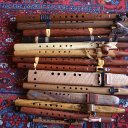
Susie: Ok, I'm done. Got the bases covered, and I'm having fun. Plus, all the spaces are filled.

I have been playing less than a year, and not everyday at that..I have also traded a couple of flutes with other people.

Susie I thought after 2 I was done..never say never!!!! You have to try other flute makers.


ffflute.jpg ffflute.jpg - 193KB
Sam
@sam
03/11/17 06:45:33AM
169 posts

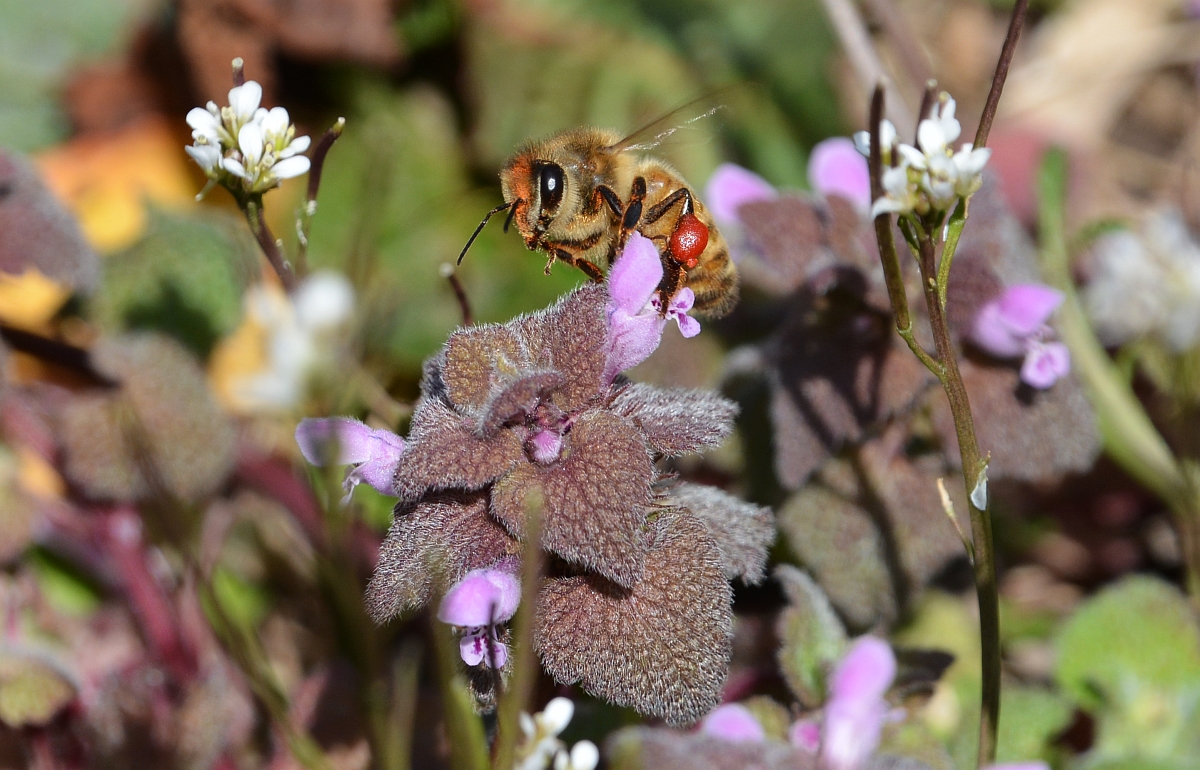
Sweet Little Red Head


OFF TOPIC discussions

Thanks for the kind comment and the link Strumelia. Bees are such fascinating little buggers! My garden project is coming along. I have some stone terraces and beds built, some seeded already. I have my buckwheat seed ready to sow. The project will focus on honeybees, Monarchs and hummer. Many, many flowers, herbs and shrubs to go!

Shawn, we're getting a sever cold blast here which is forecast to last over the next several days at least. I hope your stand can 'buzz up' enough heat to keep from freezing. 

Brian G.
@brian-g
03/11/17 06:11:50AM
94 posts

Tunes in the key of A major


General mountain dulcimer or music discussions


I'm also going to plug EAA tuning here.  I tend to be lazy and either play an A tune out of DAD if I can, or capo to 4, but the truth is, I hate capos at fret 4 for a number of reasons (two big ones - you lose about a third of your instrument, and the vsl becomes so short that the instruments generally don't sound very good to me) and much prefer EAA as it has a number of advantages:

  • built in A major and A mixolydian scales
  • plays an octave under fiddle, mandolin and capo'd dulcimers
  • the lower A sounds better to me for many tunes
  • it avoids the heavy boominess and reverbing bass drone string on baritone dulcimers and is much better balanced to my ears

I also want to respond specifically to Dusy's comment about it being better for drone players since chord players will need to learn all new fingerings - there is a "secret" (not really) that makes this very easy.

EAA tuning can be thought of as a kind of "reverse DAD" tuning in which you reverse what you would do on the middle and bass strings.  For example - in DAD, if a note falls below the pitch of the melody string, you can normally get it on the middle string. In EAA, if the note falls below the pitch of the melody string, you play it on the bass string.  So if the IV chord in DAD is played 0-1-3 (bass to melody string), in EAA it would be played 1-0-3 (bass to melody string).

UPDATED to give credit to Rich Carty, who was the first person to have the above discussion with me and made me aware of the possibilities of EAA tuning.  I don't play in it very often, but when I do, I absolutely love it.


updated by @brian-g: 03/11/17 09:28:59AM
Susie
@susie
03/11/17 05:59:45AM
513 posts

Native American Flutes


Adventures with 'other' instruments...

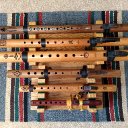
Ok, I'm done. Got the bases covered, and I'm having fun. Plus, all the spaces are filled.
IMG_20170310_130855299.jpg IMG_20170310_130855299.jpg - 249KB

updated by @susie: 03/11/17 05:59:47AM
Strumelia
@strumelia
03/10/17 07:08:18PM
2,420 posts

Most inspiring live workshop/lesson you've ever had?


General mountain dulcimer or music discussions

Paula can you tell us about a  particular workshop moment of inspiration  that opened a door in your personal musical life? That's really what I was after in this thread.  nod

" Tell us about the single LIVE workshop or music lesson that was the most musically inspiring to you in your music life.  Could be on any instrument- but tell us about how that teacher's in-person lesson or workshop made a big impression, opened a door to your progress, or inspired your music playing in some profound way."

Paula Brawdy
@paula-brawdy
03/10/17 06:58:24PM
54 posts

Most inspiring live workshop/lesson you've ever had?


General mountain dulcimer or music discussions

Stephen Seiferts 3 day workshops are the best.   He gets down to basics, rhythm, strumming, chords and covers the landscape very well.   Not everyone is a good teacher and a good player.   Stephen Seifert is excellent at both, and a very nice guy on top of that! 

shawn wright
@shawn-wright
03/10/17 05:40:43PM
7 posts

Sweet Little Red Head


OFF TOPIC discussions

My hive made it through, but this weekend will be a challenge.  Queen is laying heavy and we have lows forecast for upper teens.  I hope they have enough bees to cover the brood.

Dusty Turtle
@dusty
03/10/17 01:54:24PM
1,870 posts

Tunes in the key of A major


General mountain dulcimer or music discussions

Technically, the fingering does change, in the sense that an A in DAd at the nut would be 1-2-4 or the lazy version I use: 101, and an A with a capo at the fourth fret is 0-0-6+, with those open strings really being the fourth fret where the capo is.

However, if you think of your chords as I, IV, and V rather than D, G, and A or A, D, and E, then your fingering doesn't change at all.

I just improvised a video showing how I use a capo in a DAd tuning to play in D, G, and A without changing any fingering.

Jan Potts
@jan-potts
03/10/17 11:44:12AM
403 posts

Tunes in the key of A major


General mountain dulcimer or music discussions

No...Dusty is correct...the capo then becomes the nut and you use the same positions for your chords as you do without the capo.

Or am I missing something?  confusey

Strumelia
@strumelia
03/10/17 11:37:15AM
2,420 posts

Tunes in the key of A major


General mountain dulcimer or music discussions

Dusty Turtle:

The advantage of a capo is that you can use all the chords you've already learned.

But with the capo on fret 4, you won't have the same pattern of whole/half steps to use as you have in DAd...so how can you use the same chord fingerings as you do in DAd?  Won't you have to learn new chord fingerings anyway?


Bob
@bob
03/10/17 11:24:57AM
87 posts

Just intonation and limitations


General mountain dulcimer or music discussions

Thanks Robert and Ken. Very helpful ! smiler

Dusty Turtle
@dusty
03/10/17 11:22:47AM
1,870 posts

Tunes in the key of A major


General mountain dulcimer or music discussions

A big question that we haven't addressed is the style of play. An EAA tuning might be easier for a drone player, but if you play with chords you have to learn a whole new set of fingerings. It would be like learning a new instrument.  The advantage of a capo is that you can use all the chords you've already learned. And the limitation of not playing below the capo is less of a problem if you play across all the strings.

But look at how many options we've explored for playing in A!

Ken Hulme
@ken-hulme
03/10/17 11:03:09AM
2,157 posts

Just intonation and limitations


General mountain dulcimer or music discussions

True dat, Robert!  He probably would end up with ET, since a tuner is usually set for A=440.

Strumelia
@strumelia
03/10/17 10:27:52AM
2,420 posts

Sweet Little Red Head


OFF TOPIC discussions


Great photo, Sam!

I think our bees are still about a week away from bringing in pollen of any kind yet...we have temps in the 30s this week and inches of snow predicted still!

Here's a cool website that shows pollen color charts by season:

http://eversweetapiaries.com/pollencharts.htm

I've lost 3 of my 5 hives this winter.  Sadly, that's not terribly unusual for folks these days.  It's hard for the bees (and other beneficial pollinators) to survive and stay strong.  I'm just hoping my remaining 2 hives make it through til Spring because it's a whole lot easier to recover my hive numbers starting from 2 than from 1.


updated by @strumelia: 03/10/17 10:33:56AM
Strumelia
@strumelia
03/10/17 10:20:47AM
2,420 posts

Tunes in the key of A major


General mountain dulcimer or music discussions

I tend to agree with Rob- tuning to EAA would make it much easier to play in A.  Cross-tuned fiddlers do the same kind of thing.


updated by @strumelia: 03/10/17 10:20:59AM
Susie
@susie
03/10/17 09:05:53AM
513 posts

Native American Flutes


Adventures with 'other' instruments...

Monica:

The next step after condor bass are the Drones. Though I recommend starting with the smaller holes as blowing into 2 chambers is quite the challenge and takes practice, the smaller one is a B minor made by a Canadian (Templewindflutes)and the large on Is a G# . It arrived 2 days ago all the way from Australia (MagicWoodworks)

Wow, those are beautiful Monica! 

Actually, I have a double flute that my friend gave me that is the V type, in the key of F#. It was made by a fellow in Michigan and has wonderful intonation, tone and craftsmanship. She wasn't using it, so she generously gave it to me. It's been fun to mess around with. 

robert schuler
@robert-schuler
03/10/17 08:47:36AM
258 posts

Just intonation and limitations


General mountain dulcimer or music discussions

Bob... JI scale was determined by ear. Its the sound the fretted note has when played against the drones. There is a sweet harmony that you can hear and feel,that doesn't exist with fretting the ET scale. I'm not sure what will happen using electronic tuner, you might end up with ET instead.
I've sold a few JI dulcimers but most folks reject them because they don't include the 6.5 fret...Robert.
Monica
@monica
03/10/17 08:12:44AM
64 posts

Native American Flutes


Adventures with 'other' instruments...

The next step after condor bass are the Drones. Though I recommend starting with the smaller holes as blowing into 2 chambers is quite the challenge and takes practice, the smaller one is a B minor made by a Canadian (Templewindflutes)and the large on Is a G# . It arrived 2 days ago all the way from Australia (MagicWoodworks)


Drones.jpeg Drones.jpeg - 132KB
Ken Hulme
@ken-hulme
03/10/17 07:15:46AM
2,157 posts

Just intonation and limitations


General mountain dulcimer or music discussions

Yes, a string and a tuner will work well to set the fret positions.

If you advertise a JI scale dulcimer as "may not play well with others" and an explanation of what JI is, then it should sell readily to folks who appreciate the JI scale but may not be able to build, or who play only for themselves without other instruments around.

If you build Equal Temp, then it will sell to any tom, Dick or Jane who likes the look of your work.

Ken Hulme
@ken-hulme
03/10/17 07:00:38AM
2,157 posts

Fine Tuner Beads -- a Primer Needed!


Instruments- discuss specific features, luthiers, instrument problems & questions


Laurel -- when I google "dulcimer tuning beads", your avatar photo here shows up!!

marg:  between the Bridge and end of the dulcimer, the strings slope downwards. If you have a bead on that string, and push it towards the end, it will slightly tighten the string.


Tuning Beads_edited.jpg Tuning Beads_edited.jpg - 22KB

updated by @ken-hulme: 03/10/17 07:02:38AM
Rob N Lackey
@rob-n-lackey
03/10/17 06:57:33AM
420 posts

Tunes in the key of A major


General mountain dulcimer or music discussions

Well, you do have a G$ on the melody string IF you are tuned to DAA and have a 6 1/2 fret.  For my work with a band, however, I'd rather re-tune.  EAA is my choice for playing in A; indeed, I have a book of tunes for EAA [shameless self-promotion there.]  For some tunes, however, I don't retune from DAd.  June Apple is one of those tunes, You'll Never Leave Harlan Alive is another.  Also, if you're tuned to DAd then you can tune the bass string up to E and have a great Am/A dorian tuning.  I don't like a capo because it cuts off lower frets.  I know, dulcimerroo, this hasn't really answered your question.  But do y'all re-tune or just play in one tuning?


Sam
@sam
03/10/17 05:29:53AM
169 posts

Sweet Little Red Head


OFF TOPIC discussions


OK, I'm guessing by the red nectar and the red 'hair' on this little honey bee that Dead Nettle pollen is red.

img


updated by @sam: 01/13/19 05:09:18PM
Jan Potts
@jan-potts
03/10/17 01:52:12AM
403 posts

Tunes in the key of A major


General mountain dulcimer or music discussions

 Yeah...sometimes I'm switching between several keys and hate the bother of a capo.   grin

Since I use three fingers to barre, my fingers don't mind having something to do.  happydance

That's true about starting on the bass string.  So, yeah, you can start at the 4th fret on the bass string and go up a whole octave before getting to Do on the melody string.

We're probably driving some people crazy, Dusty!  krazy It was probably a short trip for 'em, anyway.....

Dusty Turtle
@dusty
03/10/17 01:31:52AM
1,870 posts

Tunes in the key of A major


General mountain dulcimer or music discussions

What Jan is showing here is that you can play in A even without using a capo.  If you use a capo, though, it  can be even easier. All the 4s in her chords would essentially be open strings requiring no fingering at all.


Additionally, if you think of the Do as residing on the bass string, and you play across the strings rather than staying on that one string, you can go up an octave and a half without moving out of 1st position.

Jan Potts
@jan-potts
03/10/17 01:15:26AM
403 posts

Tunes in the key of A major


General mountain dulcimer or music discussions


This is really long (and boring to a lot of people), but you might find it helpful.

Coming from a background of playing by ear on the piano, I like to just move my hands to a new starting place on the fretboard--as much as possible--rather than retuning or using a capo.  The folks I play with in Tucson always play "Boil 'Em Cabbage Down" first through in D, then G, then A and then back to D again with nary a measure or a rest in between.  Of course, that's a pretty simple tune, but it got me familiar with all 3 keys.  Now I often play in A when I'm at a jam with a bunch of fiddlers or other people that want a tune played in a particular key.

If you're just playing 3 chords,  the I chord (A) is  barred at 444 or else played 44 6+  (I start with the bass string when I write the numbers and 6+ is 6 1/2.).  You can play it higher up as 6+78.   The octave is barred at 11.

The IV chord  (D) is 457 or 757.  Higher up, play it with 779.

The V chord (E) is 545 or 86+8, or barre it at 888.   There's no G# when you barre at the 8th fret, but you can let your brain fill in "what's missing" here....the brain actually does that very well!

A scale of the I, IV, and V chords  plays them in this order:  I   V    I    IV    I    IV    V     I .   Try playing the three chords and singing up the scale...you'll see it harmonizes very nicely.  (also try it in keys of D and in G)

To play a scale in the key of A going all the way up from Do to Do (an octave), you'd play:

444     545     446+     457     6+78       779     86+8     11 11 11

  I         V           I            IV        I             IV         V           I

Do       Re       Mi           Fa      Sol          La         Ti           Do


Notice that except for "Ti" the melody string plays do re mi  right up the scale when you play the chords this way.  "Ti" is played on the middle string.

Does this help?  I mostly play by ear, so I'm not "classically trained" in any instrument, but this sounds pretty good to me.

My apologies if I wasn't supposed to capitalize Do Re Mi...

If the order of the I, IV, and V chords seems impossible to remember, it's a little easier when you realize that Do, Mi, Sol, Do  are all I chords.  Or, in scale degrees, that would be 1  5  8  1  or the interval a singer always seems to sing when they're warming up (at least in cartoons!).

The next thing that I think really stands out is that the V chords are played Before and After Do--at both ends of the octave.  So you'd use a V chord if you're going up FROM Do, or up TO Do (the octave).  And likewise, if you're going down FROM Do or down TO Do.   If it's next to Do, play a V chord!!!

The others are IV chords.  In my mind I think of the scale in three sections:

I     V            I    IV    I    IV            V   I          The I and V chords look kind of like bookends holding up 2 pairs of alternating books. 

Hey!  I'm a very visual person, too!   I hope this hasn't all been lost in formatting glitches.  If you want this sent as an email, just let me know!

Hope it helps!     Jan Potts


updated by @jan-potts: 03/10/17 01:32:15AM
Strumelia
@strumelia
03/10/17 12:43:29AM
2,420 posts

Tunes in the key of A major


General mountain dulcimer or music discussions

Good info Dusty, thanks!

So, I guess a capo at 4th enables one to play some tunes in A but not others, while needing to get the G# on the middle string. I think chords would be a bit of a bear to work around, and the lack of G# on the melody string would really bum me out.  krazyhair

Dusty Turtle
@dusty
03/10/17 12:18:05AM
1,870 posts

Tunes in the key of A major


General mountain dulcimer or music discussions


Strumelia:

Dusty, if you capo on the 4th, you also won't have the G# available on the melody and bass strings- you'll only have a G natural on those outer strings- it'd be like not having the 6.5 fret.

That's true, but if you need it, you can get the note on the middle string.

Quote: (Kitchen Girl and Road to L. both sound more like minor, not major tunes to me?- with no sharps?)

Kitchen Girl has a minor part and a major part.  And Road to Lisdoonvarna is indeed in a minor key.  But with the capo at 4, the 6+ fret functions as a 1+ fret, giving you the minor third note of the scale.

Quote: Dulcimers have certain whole/half fret placements that mean you can't just move a capo up and down to get any key you want- unless it's a chromatically fretted instrument like a guitar, banjo, or a chromatic dulcimer.

Definitely true, which is why it is so difficult to play in other keys out of a standard dulcimer tuning.  I generally retune to get other keys.   But the capo can help for G and A.  The very first tune I ever saw played on the dulcimer is Stephen Seifert's Whiskey Before Breakfast video on YouTube.  He plays the song with the capo at the 4th fret, putting him in A major. I regularly play Indian on a Stump and Booth Shot Lincoln in A using the capo at 4.  It may not work for every tune, but it works for a lot of them.


updated by @dusty: 03/10/17 12:22:24AM
marg
@marg
03/10/17 12:08:08AM
624 posts

Fine Tuner Beads -- a Primer Needed!


Instruments- discuss specific features, luthiers, instrument problems & questions

dshombert is selling a dulcimer here on FOTMD & his photos listed looks like it has something like beads you have discussed here. Is that what they are?

dulcimerroo
@dulcimerroo
03/09/17 11:38:40PM
15 posts

Tunes in the key of A major


General mountain dulcimer or music discussions

Sorry Strumelia, just reread your post. We usually only use the capo if we need to play in a minor key but also for one or two tunes in G. As you point out it does not work for A tunes well.

marg
@marg
03/09/17 11:37:45PM
624 posts

Fine Tuner Beads -- a Primer Needed!


Instruments- discuss specific features, luthiers, instrument problems & questions

Does anyone have a photo of how these beads work, I'm not sure I understand where or how or why.

thanks

dulcimerroo
@dulcimerroo
03/09/17 11:32:07PM
15 posts

Tunes in the key of A major


General mountain dulcimer or music discussions

Thanks again for the comments Strumelia and Dusty.

Trying tunes in A is more of an exercise in finger dexterity in reaching for the G# and also seeing what can and can't be done, we play melody and drone for the most part and play melody only if with other instruments. But endless tunes in D with the occasional G gets boring and retuning in the middle of a session out of the question. 

I play with an Old Time String band and we often play A tunes, as Dusty pointed out, for the most part I play melody and chords only when the melody is too fast or too difficult, but I play by ear and could not honestly tell others what I do it just comes natural and if what I do sound bad I change it. When pitted against a room full of guitars and banjos mistakes on the Dulcimer go pretty much unnoticed.

marg
@marg
03/09/17 11:30:59PM
624 posts

Single or Double Melody Strings?


Instruments- discuss specific features, luthiers, instrument problems & questions

I have a few dulcimers & some have 3 strings & some have 4 & one has 5 & one has 6.

    The ones with only 3, I took one of the melody strings off because I finger pick with one of the dulcimers & the other just sounded better with 3.

    The ones with 4, sound good that way & I don't have any trouble with pull offs, hammer on's is still a problem no matter if it's 3 or 4 strings. Still working on the force & position to the string, also which finger works best & depending on where my fingers need to go afterwards.

   As everyone is saying 'personal preference ' but also the dulcimer may have a say in what works best for it. If I was building a dulcimer I would go with 4 strings, that way the player can decide what they think works best for them.

marg
@marg
03/09/17 11:14:20PM
624 posts

Recommendations for new strings and new a bridge?


Instruments- discuss specific features, luthiers, instrument problems & questions

Cripple Creek's store has been closed since a flood when through the area but the have a FB & I read they said they would still answer questions


Strumelia
@strumelia
03/09/17 11:06:57PM
2,420 posts

Tunes in the key of A major


General mountain dulcimer or music discussions


Dusty, if you capo on the 4th, you also won't have the G# available on the melody and bass strings- you'll only have a G natural on those outer strings- it'd be like not having the 6.5 fret.

(Kitchen Girl and Road to L. both sound more like minor, not major tunes to me?- with no sharps?)

You can capo on 3 to get the key of G successfully IF you have the 6.5 fret because that gives you your needed C#.  But unless I've missed something obvious, capoing to 4 won't give you the right whole/half steps to play in A major.

Dulcimers have certain whole/half fret placements that mean you can't just move a capo up and down to get any key you want- unless it's a chromatically fretted instrument like a guitar, banjo, or a chromatic dulcimer.


updated by @strumelia: 03/09/17 11:22:39PM
Dusty Turtle
@dusty
03/09/17 11:01:59PM
1,870 posts

Tunes in the key of A major


General mountain dulcimer or music discussions

So the easy answer here is indeed to capo at the fourth fret and play everything you know for the key of D. You'll be playing in A.  Folks do that sometimes to match the keys of standard tunes at old timey or bluegrass jams.  Kitchen Girl, for example, is usually played in A, as is Salt Creek. Sally Goodin', Sourwood Mountain, and more.

What I don't get is the motivation here. Are there songs you want to play in A or do you just feel like playing in A for the fun of it?

Gary Gallier has arranged a few tunes in A out of a standard DAd tuning. But those are some pretty fancy tunes with very careful picking.  Since the D note is found in both the D and G chord, that low string sounds OK when you play in D and G, but it will be out-of-place in A, so you have to be really careful and only hit that bass string when you are playing a D chord. When you are playing an A or E chord you cannot hit that open bass string at all.

See Gary's arrangements of Kitchen Girl and Road to Lisdoonvarna from the tablature page of his website .

Personally, when I want to play in A I use a baritone dulcimer tuned AEa.  Simple, huh?

Strumelia
@strumelia
03/09/17 10:33:27PM
2,420 posts

Tunes in the key of A major


General mountain dulcimer or music discussions

I'm not understanding how that's going to work on DAd tuning.  Are you planning to make chords on all your strings, or just pick out the melody on one string?  
How do you plan to make the needed I,IV,V chords in A major on a DAd tuned dulcimer?
And if you capo on 4 to get to the key of A, you won't have the needed G# on the melody and bass strings.


updated by @strumelia: 03/09/17 10:34:26PM
dulcimerroo
@dulcimerroo
03/09/17 10:09:33PM
15 posts

Tunes in the key of A major


General mountain dulcimer or music discussions

Thanks for the responses all! nod

To explain we tune DAD and have 6 1/2 frets that gives us a G sharp on the middle string, so we have just short of two octaves starting on the open middle string to the 2nd fret and then working up the melody string. I am fortunate in that I play by ear and can pretty well play any tune I can hum or whistle, but some of our group need tabs to play. Not wishing to make work for myself I hoped to find tunes in A major already written out saving me the chore.

Bob
@bob
03/09/17 10:08:08PM
87 posts

Just intonation and limitations


General mountain dulcimer or music discussions

Yes, this is really interesting! 

I was thinking of designing, for a JI fingerboard, a sound box to set a blank fret-board on top. I would rig a dulcimer string to stretch over it to mark off the notes using an electronic tuner, and then cut in the fret slots... I wonder if it would work.

So... if I was going to build a dulcimer with the idea that I would offer it for sale,  would it be better to have the scale in Equal Temperament or Just Intonation?

  390