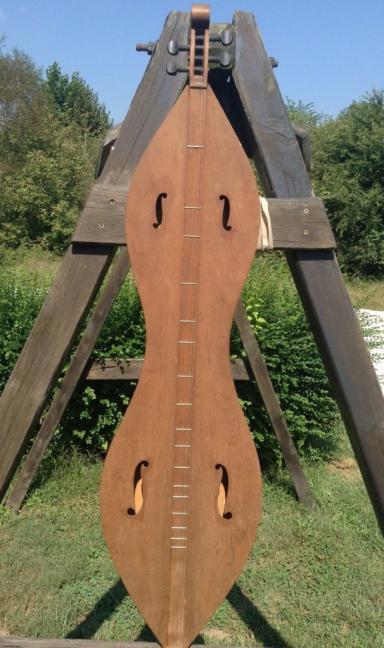
Changing tuners on a Warren May dulcimer.
Instruments- discuss specific features, luthiers, instrument problems & questions
I would not recommend the Grover pegs. I just took very similar pegs off an older instrument I bought used and replaced them with Pegheds. I'm very happy with the Pegheds. They work really well and look like traditional violin pegs. But it was a tricky installation. It took me several evenings to do the job properly. A violin repairperson should do it if you're not experienced working with tapered reamers, small files, super glue, and following directions very carefully.
Your wooden pegs are actually superior to the Grover "patent heads." Both hold their tension with friction. Wooden pegs need to be properly seated in their holes and sometimes need a little rosin, chalk, or peg dope to seat properly. Patent heads use a tension screw which often shakes loose or comes loose while tuning.
Aside from slipping, friction pegs of any sort are not as easy to tune as are geared heads. Getting the strings just right takes some practice and patience.
Geared pegs are easier to use. There are two types, planetary and guitar-type. Planetary gears (or "heads" or "pegs") are used on most banjos and some dulcimers. People like them because they are straight, like friction pegs but have a 4:1 gear ratio. That is, it takes four complete rotations of the knob for the shaft to rotate once. This makes fine tuning much easier. They don't require any screws. But they often require a spline notch or small hole for an anchor post, hidden under the gear housing. The disadvantages to planetary heads are cost (my Pegheds were $100), not as fine a gear ratio as guitar pegs, and the tension needs to be tightened occasionally, just like the patent heads.
Guitar-type heads have gears at a right angle. That's why the buttons on a steel-stringed guitar stick out to the sides, while the buttons on a banjo don't. They can be mounted on the back of a solid peghead or on the side of a slotted peghead.
There are two types, "open" or exposed-gear, and sealed-gear, in which the gears are sealed inside a casing with a lubricant. (Planetary tuners are also sealed with a lubricant.) Guitar-type tuners are made individually, like planetary pegs, or several mounted to a common plate. The two big advantages of guitar tuners are cost and a higher gear ratio. A typical gear ratio is 12:1, twelve rotations of the knob to a singe rotation of the shaft. While this means changing strings may take longer, fine-tuning a string is much, much easier. Ratios have ranged from 8:1 to as high as 18:1.
A complete set of serviceable import tuners can be had for as little as $10.00! Of course, prices go up from there.
Guitar tuners don't require much attention. A drop of oil on exposed gears every few years is about all the service they'll ever need. They are held in place with small screws. Sometimes the screws will loosen slightly and need to be snugged down. Sealed units (both guitar and planetary banjo types) also have threaded bushings which circle the string posts and screw into the housing from above. These help keep the unit in place and may need to be tightened slightly once in a while.
I think the main objection people have to guitar tuners is aesthetic. They don’t like the look. But my new Warren May came with gold-plated Grover Rotomatics, sealed guitar tuners. They work wonderfully and the gold against the walnut looks great. Mr. May does retrofit geared tuners to his dulcimers. He also keeps all the old wooden pegs he replaces. I suspect he plans to build some more traditional-style instruments and he plans to recycle the old pegs.
Two of my dulcimers have wooden pegs and one of my fretless banjos has patent pegs. Everything else has gears or zither pins. The only one I had real problems with recently was the dulcimer with the Grover patent pegs. The Pegheds fixed that.
updated by @john-gribble: 09/07/16 02:48:09AM