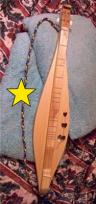
Do You Have A 'Go To' or Favorite Dulcimer
General mountain dulcimer or music discussions
... siiiiiiiigh ... yeah ... I know ... still sometimes think abortion should be an option into the 27th tri-mester ..............
... siiiiiiiigh ... yeah ... I know ... still sometimes think abortion should be an option into the 27th tri-mester ..............
Oh, I've been tempted.
... maybe ... except th' hang 'em on th' wall part .........................
Isn’t that a bit like having a favorite child?
Many of us have more than one. If you do, do you enjoy playing one more than the others? It seems that I take this one down off the wall more often than any of the others.
Do you have particular reasons for your favored dulcimer?
A 1.5" wide fingerboard set up with three equaldistant strings should be more than enough. You don't need four strings. When I got my fiddle I was shocked because the 4 strings are only 9/16" appart at the nut and .75 at the octave. Where there is a will there is a way... Robert
Here's the article I wrote back in 2006 about getting started playing in the Noter & Drone style -- techniques, types of noters, and much more...
The width of a fretboard is not a critical dimension for 99.99% of players, where VSL and body dimensions are of major importance to the sound of an instrument.
Most commercial (McSpadden, Folkcraft, Blue Lion) fretboards these days are 1.5" wide or 1.25" wide. That's pretty standard for most custom builder too, unless you ask.
If you have a custom dulcimer built by someone like Harpmaker Dave Lynch or any of the other custom builders here, you can specify how wide you want the fretboard.
The fretboards on my traditional dulcimers are considerably narrower than 1.25"; but then, I play Noter & Drone style and don't need huge spaces between strings.
I recently purchased a McSpadden M8 and was surprised at how narrow the fretboard was. I wear men’s 2XL gloves.
Except for Blue Lion, I found no dimensions listed for width of fingerboards. Most were centered around the VSL and body dimensions.
Can anyone suggest models/makes with more “roomy” fretboards?
Like Travis, I learned melody first on MD and chords on uke and guitar. True story: some years ago when I had just figured out how to chord on MD, I was jaming with a uke-playing friend. I was frantically grasping at the chords (would have helped if I knew the song better). We finished singing the first verse and chorus and I thought thank goodness, now I can take the instrumental break and I started playing melody which was so much easier. And my friend said, "oh that's right, unlike me you really know how to play!" The easy beginner stuff for me was the hard stuff for him, and vice versa.
I take this as proof that we're all meant to play together.
I don't necessarily have an opinion about whether one should learn melody or chords first, but I can corroborate Travis's assumption that most guitar teachers start with chords. I think the reason is simply that with a few chords one can quickly accompany one's singing. It is also the case that most single note work on the guitar is built out of left-hand chord positions (I am not joking that it took me 15-20 years of playing to figure that out, but I am almost entirely self-taught).
I certainly wish you the best, but I do agree that a guitar player who is not familiar with the dulcimer may not be the best teacher. You might consider Skype lessons from a dulcimer teacher. Just the fact that you are asking about rare chords makes me think your teacher may not really "get" a diatonic fretboard.
Yep -- that listing says Actual Weight = 10 pounds, Shipping Weight = 70 pounds!
Thanks Robert and Ken - I am checking out my options now to see if I should make or buy one!
Melody, melody, melody. If you don't have the melody correct there is no need to add chords. Were I to teach a beginner on either guitar or dulcimer scales would be the 1st thing I'd cover. I know a fellow here in WV who carries 7 Jim Good dulcimers in a cabinet tuned in 7 different keys. I agree with Travis, you have to approach them differently.
Angela-- No dulcimer tuning really has a wide range. That's part of it being a dulcimer, not a guitar -- it is not chromatic. If you want to play a lot of minor chord music, you might be best off having two dulcimers -- one tuned in a minor tuning like DAG or DAC; the other tuned in a major tuning like DAA or DAd. Otherwise re-tuning is your best option. Usually you only have to re-tune the melody string....
This is a lovely possum board indeed, and really suits Robert's dulcimers. It did not fit any others I have, so guess you'd have to send him the right measurements.
Thanks everyone for your comments. I build and sell mountain dulcimers and thought it would be nice to offer a possum board to fit my instruments. I mostly play off a table top and use the possum board to keep the dulcimer off the table. Makes a fancy way to display them as well. I used to use scrap wood sticks to support the dulcimer but a possum board looks and sounds much better.
It generally does not slip around on my lap. On my newer models I added two holes to attach a strap. I play up to the last fret so I need a board that can be shifted left and right real fast. Gale, I would be happy to make one for you, I charge $35.00 plus shipping. But Kens point about building your own is a good idea if you got the time... Robert.
Sitting a lot may cause poor circulation and weight gain. Hence the standing or treadmill desk craze. I sit at my desk all day at work, so I find I just need to stand sometimes.
Why is standing better for your health?
Last night while playing on the screened porch table and competing with the cicadas for sound, I discovered that two coasters turned upside down (cork up) worked pretty well as a way to increase the volume, and protect the back of my dulcimer. That is if you like to play while standing, which is better for your health. You can stack several coasters to see if you like the sound better. They don’t slide because of the cork backing. If you still want to make a possum board, this will help you decide how high you want your dulcimer to rest on the board. That said, that’s a beautiful board Robert, and I wouldn’t turn it down. You can only stand for so long.
How do you keep it from sliding off your lap?
Gale -- A few dulcimer builders here are making and sellin possum boards, and I'm sure they'll chime in soon. You can actually make one really easily by buying a "craft wood" plank of poplar from Home Depot or Lowe's that's 3 ft long and 6" or so wide. You also need a piece of dowel (square is best) to glue across the board a litle closer together than Robert has his 'bridges'. A couple rubber bands will hold the dulcimer in place...
That is beautiful! Where is the best place to purchase one? Not sure if I have time to make one.
Thanks for bringing that up Dusty. I didn't think to mention that, I was on a tablet and a bit pressed for time.
I've also tried DF#A and DF#AA [4 equidistant]. It may be better to describe these tunings with numbers in order for them to be translated to other keys [135 or 1355, etc]. Bing Futch teaches some interesting things in his book 'Blues method for MD 101' that uses 'boxes'.
I've used a variation on Janita's tuning: D-A-d-A#. Also D-A-d-c#. I can mute the near string with the heel of my hand. That means I'm playing D-A-d (that's easy and I can strum!) with an extra string I can play only when I need it.
Another chromatic tuning is D-F#-A. See this site: http://www.mountaindulcimer-1-3-5.com/
With 4 equidistant strings, try D-F#-A-D.
You can substitute a "power chord" when you can't get a major or minor chord. A power chord contains only the root and 5th notes. It's the 3rd note that determines whether the chord is major or minor. When you play an open DAd you're playing a D power chord, which can substitute for either D-major or D-minor as needed. Not the same sound, but it works in a pinch, especially when playing with other instruments that will supply the missing 3rd.
When dulcimer tab shows a barred 1st fret as an "E-minor" chord, it's actually an E power chord. It's the kind of workaround that dulcimer players use all the time, but a guitarist won't know about.
I think it's great that you've found a guitar teacher who's willing to explore dulcimer with you. However, he may need an occasional gentle reminder that a dulcimer is not a guitar. The typical lesson plan for beginning guitarists is not well suited for dulcimer. The dulcimer is NOT designed to play in multiple keys from the same tuning. Nor to play chromatic runs. That doesn't mean it's impossible -- but it ain't easy and it's very uncommon for anyone to attempt it. The addition of a 1-1/2 fret doesn't really change things -- it makes a few more chords and scales possible, but it does not mean you can take the normal scale boxes and movable chords that you'd learn on guitar and translate them directly to the dulcimer.
If you're hunting for a Gb, G and G# in the same song, then you're playing a song -- or an arrangement -- that might be easy on guitar, but on dulcimer it's crazy advanced. If your heart's set on that style of music, your life will be much easier with a full-chromatic fretboard.
This past weekend at The Dutchland Dulcimer Festival, I had the pleasure of meeting three FOTMD members.
Oliver Odgen, Maryann Lang and Jeff Hamilton. If I missed anyone Let me know. Had a wonderful time in Lancaster.
Just a quick note on Janita Baker's use of the DAA#d tuning: you can't strum. She fingerpicks, and that A# string allows her to get all the chromatic notes, which is why she can play jazz and ragtime and stuff. But if you follow her tablature and try to strum across all the strings, it will sound terrible. The tuning only works for her style of fingerpicking.
You can join our Public Domain...or Not? Group here and ask every time you have a question about a certain song:
http://fotmd.com/strumelia/group/40/public-domain-or-not
But often it's just faster to google "(song title) copyright" and go to the resulting Wiki page...where it usually tells the composers or traditional info. It will also give versions and talk about any copyrighted lyrics someone may have added later, etc. Most songs first published before 1926 are now in the public domain, by the way.
Yay! Thank you, thank you, thank you, and thank you! You've been very helpful. I had come across a couple of these but couldn't remember the names or how to relocate, particularly oldtown. My google searches for old time fiddle tunes missed most of these.
Janet
Old time fiddle tunes by the hundred, thousands even :
Larry Warren's Sippery-Hill Web Site
Find your tune > right click > Save link as ...
Try this one: https://www.oldtownschool.org/classes/adults/fiddle/tunes/ . I think those are all MP3 files.
Click on your name which will take you to you page. Above your profile photo you will see:
Latest Activity-Audio-Video-Events-MyFollowers
Click on MyFollowers TAB and it will show you the ones you need to approve.
Maybe I'm missing something, but I can't find the list of people following me, in order to approve them unless I go back to the original email and click that link.
Is there a direct way from the FOTMD website?
Steve Eulberg
Janet, I am no expert on Apple products, but my understanding is that older versions of Quick Time can play midi files. Try to install QT 7 and see if that works.
Another (more time consuming) solution would be to use one of the many free online audio converters to convert the midi files to mp3 files. If you put "Free online audio coverter) in the Google search bar, you'll find plenty of options. Don't use any that ask you to register or demand payment.


 Get Noterized.pdf - 82KB