No capo here, either, Babs. It's not hard to re-tune quickly.
Thanx for the explanation, john p.
Hi Babs,
No, I don't capo - I re-tune my drones. Have a look at this:
http://mountaindulcimer.ning.com/group/oldstyledronenoterplayers/page/tunings-for-noter-drone-beginner-intermediate
The principle of tuning, which John also mentioned above, is that the drones are there to support the melody whatever key and mode that melody is in.
The thing to get hold of is that the drones don't define the keynote, rather the keynote defines the drones.
The basis for n/d tunings is the Home fret, this is invariably the fret that the tune ends on. and is where you tune your keynote.
IOW, if you tune the melody string to D and then play an Ionian tune, you will be ending on a G, what your guitarist hears.
It's after that you tune the drones. The idea here is to provide a constant reference to this keynote whilst playing, something that can be used to gauge the intervals being used and firmly establish the mode. The octave and the fourth/fifth give the best grounding for this and are usually chosen for the drones.
This is what makes DGD an Ionian tuning, the 'reverse' of the more conventional, and not easilly tuned, GDD
Some tunes you may want to use a cross tuning, where the drones are not where you would conventionally put them. depends on the feel you're aiming at. Regardless, the keynote is always at your Home fret.
[edit] I've recently put up a piece called 'The Curra Road'. Convention would say this is one of the minor modes, but none of the ones I tried really suited the words. I ended up using a simple Ionian tuning, but playing out of the Locrian position (Home = 2nd fret).
john
Hi Ken,
Yep - most of the time I'm playing with the bass string being the 'keynote', but not always. And for the type of playing I do - playing a lot at sessions - I need to know the key I'm playing in and the mode within that key. So I've had to work out a system for understanding tunings that suits my playing - but the system I use for working out tuningsmay notsuit the way others play - and it is not the way that tunings and modes were explained by the likes of Bonnie Carol or Jean Ritchie.
My guitarist friend keeps saying I'm in the key of G when I'm tuned Ddd or DAd. I think there may be two "keynotes" here.
I learned "keynote" as a word in reference to the instrument, not the scale being played on that instrument. "That dulcimer is in the key of D" (and as Bonnie Carol taught decades ago, with dulcimers that refers to the note to which the bass string is tuned); not "I'm playing this song in the key of G".
Hi Ken and Babs,
In some tunings the keynote does not appear in the drones at all. D,d,d may have the keynote of D in the drones or that tuning could be played as the key of G, with the keynote being on the 3rd fret of the melody string and not appear in the drones at all.At least half of the traditionalGalax tunes are in the key of G from d,d,d,d tuning!
Personally, I would not use the term 'keynote' in relation to the drones at all but instead find it on the melody string. For example, for the key of D ionian the keynote is at the 3rd fret on the melody string. The drones will be either the root or the 5th of the D ionian scale - and they will work in any combination. You could have D,A,A or D,d,A or A,d,A or A,A,A - all of those tunings would be key of D ionian tunings and A,A,A would also be key of A mixolidian. They would each have a slightly differnt feel to them but they would all work.
When I'm learning a new tune I always start with the melody string and place the keynote on the correct fret first. So if I was playing in A dorian then I would place an 'a' at the 4th fret (so my string would be tuned to d). My drones would need to be either A or E in any combination A,A or A,E, or E,A or E,E. Depending on the feel I wanted from the tune and the ability of the bass and middle string gauges to reach certasin notes I would decide which drone combination to select.
Robin
The traditional Modal Tunings all have the bass string as the Keynote:
Ionian........DAA
Locrian.......DAB
Aeolian.......DAC
Mixolydian...DAD
Lydian........DAE
Phrygian.....DAF
Dorian........DAG
Bagpipe Tuning.... Ddd and Galax Tuning........ddd, also have the bass string as the Keynote.
There is some Circle of Fifths apparently sound Musical Theory reason why the so-called Reverse tunings (like Reverse Ionian...DGd) can have the keynote on another string. Someoine will surely come along and confuse me again with the reasoning, I'm sure.
Reverse Ionian is the most common middle string keynote tuning, but there are a couple others. But I personally don't use those tunings and have never bothered to absorb the theory.
Randy, I had that dulcimer at Dulcimerville. I don't know if you remember seeing it on the table. It was the one from the Joseph Wallo pattern.
Ken
Randy Adams said:
Not so long Ken...but interesting! I had mentioned International Violin in the past and you replied at that time with the 'short' version. Good to hear the longer story.
Not my first dulcimer, but an interesting story nonetheless. About 3 years ago, just after I retired, I thought to go into the Peace Corps. Mercenary reason, not humanitarian - I could bank my monthly Social Insecurity payments for 2+ years while living at the government's expense and get a $5000 buy out at the end of the tour. That would give me a big nest-egg to purchase a newer retirement boat to liveaboard when I returned. The PC wanted me to go to Africa and teach forestry (my degrees). I planned to take my 'worldly goods' in two footlockers, but all my dulcimers were too long to fit therein. Harpmaker said he could make me a slightly customized version of his Student Model that would fit in one of the cases -- no extended tuning head, autoharp tuning pins and a taller fretboard for noter & drone play. So I said, "Why not", and commissioned him to build it.
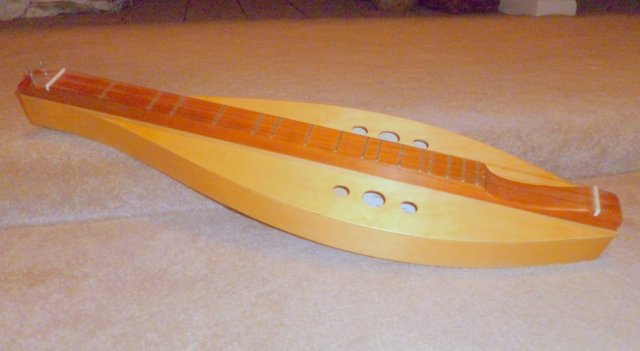
Long story short: just after Harpmaker sends me the new dulcimer, and a month after meeting a wonderful lady, the Peace Corps tells me they won't take me without a bunch of periodontal dental work I couldn't afford at the time.
So... I never did go to Africa, and thus avoided the Arab Spring uprisings which seriously impacted the area to which I would have been sent. The dulcimer still sounds wonderful, and Lady Sally and I have been together for about 2-1/2 years now. Oh... and I finally have been able to get half the periodontal work done that they wanted me to have -- for a mere $3000! By the time I'm 80 I'll have perfect teeth (or a complete set of falsies) paid for.
The story of my first dulcimer is rather long so bear with me. I wanted a dulcimer, but being a student, getting married, and with graduate school I could just not afford it. In 1973 I met a young man at the Iguana Coffeehouse in Washington, DC. We became friends and in 1974 he told me he was going to build a dulcimer. A man he knew who was retired from the Atomic Energy Commission where he worked was going to teach him how to make it. He told me they were going to Baltimore to buy some wood at International Violin Company. I asked if I could go along. He checked with the man and I was able to go with them. At International Violin Company I picked out six rosewood guitar sides (2 sides make the back and one side is split for the dulcimer sides) and two pieces of sitka spruce for the tops. I had enough wood to build two mountain dulcimers. I also purchased some rosewood tuning pegs and strings. On my day off I would travel from the inner city to Bethesda, Maryland to the man's workshop and work on the dulcimer. After about eight weeks I had a dulcimer.
Now there is more to the story. I was assistant pastor at Luther Place Memorial Church in Washington, DC. The coffeehouse was part of our church's ministry to the young adults of DC area. It turns out the man my friend knew was a member of the church. I had not met him because he always attended the early service which the senior pastor always led. Since I was up late with the coffeehouse folks on Saturday night, I didn't usually arrive at the church until 9:30 a.m. on Sunday mornings. The man, whose name is George, and I became good friends. I built five dulcimers in his workshop during my time at that church. George was worried about taking his pastor to International Violin Company in Baltimore as it was located on "The Block" which is where all the strip clubs were at the time. IVC was located above the theatre where Blaze Starr was performing. George's hobby after retiring from the AEC was building violins although he had also made a dulcimer and a guitar.
Oh, and by the way, to the best of my knowledge, the young man who said he was going to build a dulcimer never did. We lost track of each other after we both left Washington so maybe has by now, but not back then.
My first dulcimer arrived by Reindeer-powered sleigh, on Christmas Day, 1990. Mrs. Wanda decided I should play dulcimer, and so it was written. The box contained a lot of sassafras wood pieces, none of which were shaped like the pictures in Foxfire, but with glue, varnish, and some tools, it eventually acquired an hourglass shape. Working with sassafras has a small problem, every day after work I spent a little time working on it, and nearly every evening the fragrance sent me looking for a glass of Root Beer. It was not enough to buy a 12 pack and be done, Mrs. Wanda decreed that root beer without ice cream floating in it just was not to be accepted. My next dulcimer was walnut & spruce, I weigh enough without a daily dose of root beer float! The fragrance faded over several years, but a certain amount of humidity tends to boost it somwhat.
Paul
Ah, Sharna, I've a song my husband & I are working on for Paint Creek Folklore Society's monthly Song Swap about Elderly. Unfortunately it's to the tune of two songs that are under copyright so we can't send them here .
.
Like you, I've told about my 1st dulcimer here already. Mine was what some call a Junker. I'll just say it was an Orphan. I was prowling an antique mall that was a bit of a flea market in the section where I saw it hanging off the end of some bookshelves. (Books are a magnet for this Bibliomaniac.) The poor baby was made locally here in Michigan, but I'll protect the name of the maker as it was of the thinnest plywood, probably to make it affordable. Whoever sold and bought it didn't know to take the strings off tension, so its body and fingerboard suffered. I thought the fingerboard looked straight, but my demanding teacher disagreed. He had my husband file down the Bridge and Nut (no, not me!) and do all he could to glue and clamp the body as tightly as possible. The body wants to pull apart, especially right under the Fingerboard, so I kept it in DAA for the least tension possible.
It's funny, but I took my acoustic bass guitar the spring before finding my Orphan to a day-long folk music gathering that turned out to be offered by area dulcimer folks, both hammered and mountain. At that time a year-long loan of a mountain dulcimer was offered and I foolishly didn't expect to want such a thing since I already have quite a menagerie of instruments. Never say never!
I don't regret adopting my Orphan. It convinced me this was a good instrument for me. Now if I just stay off the computer long enough, I'll improve on my new Folk Craft dulcimer bought where else? . . . Elderly!
Oh, Lord, lead me not into temptation for I can find it myself!!!
Sharna, you are fortunate to be near Elderly instruments. They do excellent work. I had them sell a banjo for me and had them recondition it before selling it. I was impressed with what they did. It was better than new. That is a wonderful story about how you acquired your Blue Lion. I purchased mine with money that was left over from settling my father's estate. Every time I pick it up I think of him.
Fret leveling is very common on stringed instruments. I have had a couple guitars need it over time, and one dulcimer is getting close. It's about 22 years old. When the strings wear grooves into the frets, and buzzing starts to occur, they need leveling. This is done with a file, and then they are crowned to bring back the correct shape. After this they are polished and you are back in business. After having them leveled 2 or 3 times, they may have to be replaced when they become grooved again. This can be many years down the line, or not so many, depending how much you play, how hard your strings are, etc. Stainless strings are harder than the fret wire, and the frets wear faster. Brass fret wire is even softer, and should only be used with gut/nylon strings. If brass is even available any more. If you aren't hearing buzzing, you probably don't need to do anything at this time. Seems unfair to bad mouth a luthier who isn't available to defend himself, particularly if we haven't seen the dulcimer in question. We don't know how much fret wear is visible.
Paul
Shana what you need to look for is fret wear. This is usually a groove in the top of the fret worn there from pressing down on the strings. My ten year old Blue is showing some fret wear on the third through fifth frets. It is not enough to replace them yet. The only reason to re-level the frets would be if some were worn down and others were not. In leveling the frets you file down the crown and the crown needs to be put back which is rounding them. Sighting down the fret board should allow you to see if the there are any high frets.
Blue Lion! I met Janita at Mount Dora last weekend. Unless you are moving your dulcimer from -50F to +120F daily, you shouldn't have to re-level your frets either. If it sounds good, leave well enough alone.
I don't want to say anything really negative about your "luthier", but IMHO he's looking to make easy money off you for something that doesn't need doing. If I had a Blue Lion, no one but Janita or Robert would touch it -- I simply wouldn't let some local "luthier" touch it. You've got the creme de la creme of dulcimers, don't let some 'shade tree mechanic' mes with it.
It depends on the quality of the frets used in the initial construction. You hardly ever hear of a complete fret job; just the occasional single fret replacement. I have a vintage dulcimer which is over 50 years old and it doesn't need a fret job. If there are grooves in the frets where the strings run, you might consider it. IMHO it sounds like your luthier is trying to drum up some extra business...
Hi Kendra,
I'm a lefty but I play right handed. I also play other instruments; guitar, whistle, smallpipes; in every case I learned right handed. My son is also a lefty and plays violin and mandolin right handed.
The one problem I can see if your students learn a special lefty method like reversing strings, they will always have to reverse everything from what the majority is doing; such as when they learn new songs or follow tabs/videos from other players.
I like playing the regular right handed way so I can share...."here, sit down, try my dulcimer..." My vote would be to have your students play right handed and not worry about it. Lefties will automatically reverse if they need to, and for most tasks we don't need to! I will admit I needlepoint upside down and I used to depend on lefty scissors.
I will also be teaching some kids this spring, can't wait!
Hope this helps
Sue
I always felt that what we refer to as "Right Handed" playing is backwards. We need the dexterity more on the fret board than for strumming. But the reality is, both hands have a job to do, and both have to learn that job first. I don't think either hand is incapable of learning both jobs, but few people would bother learning to play both ways. If the students are playing guitar or another stringed instrument, let them continue to fret with the hand they have been using. If they are new to stringed instruments, it really shouldn't matter. It's all a matter of training each hand to do it's job. Some years back, when I had Carpal Tunnel Syndrome in my left hand, I tried a lefty guitar to see if I might need to switch. The 35 or so years I had been playing was all right handed, and neither hand had paid any attention to it's counterpart. It was just like Deja Vous, all over again.I gave up the lefty guitar idea & had surgery instead.
Paul
I think most Corry-handed folks play right handed. That way their dominant hand is doing the delicate work of fingering/notering while their less skilled hand is doing the 'grunt work' of strumming out a rhythm. I suppose if they want to learn finger- or flat-pick style, then reversing the strings would be the better choice.
I've only taught one class of seniors, and 2 of the 10 were lefties. One was brand new to playing any instrument, he just learned right handed and said it didn't bother him. The other is a long time guitar player, he plays leftie but kept the strings as is for a right handed player. It doesn't help much but may lead to letting them try what works for them.
Hi Nancy here is a Sound sample of my Clemmer Sweetie
I love the Sound and the Sweetie. And it is really good Play on it
Hi Susie, I would love to visit his shop, but from New York ist too far away. But maybe one time I will go there. So for me a good thing is to let him sent the Dulcimer to my Hotel. I will for sure make pictures and post it .... ahh can't wait.
Yes I asked him for a lot of specials :-) so we will see if he could do them all. I wrote him that if he has a better idea than I did or thinking that it did not work or sound well he could do it his way, no problem for me. So Im excited by now.
Yes, he offered the initials to me too, but I wanted to make it special, tying it to the maple syrup. I thought about maple leaf soundholes, but when I've seen them on dulcimers, they really didn't move me. So I opted to have the maple leaf on the headstock. That way, I had him keep the whole vine motif on the instrument. I'm really happy with my decisions. Your lizard soundholes are nicely done. You're coming to the US and then picking up the dulcimer then is a great idea. When we make an RV trip to his area, we'll stop by his store. That might be bad for me, because I need another dulcimer/instrument, like I need a hole in the head. I would love to see your dulcimer when you get it in June. Is he personalizing that one?
Yes, Mike is really nice. I asked him if he can do the Lizards for me and he said yes. I did'nt know how this worked out untill i got the parcle. I'll be in New York in June, so that's why I ordered it now to save the unfortunately high postage to Germany :-) Have you seen, I have my Initiales at the place wher you got your Marple Leave. ;-)
Hi Susie,
enjoy your Sweetie. I also have one, and it is my favoritte dulcimer at the moment. But I ordered a reg. Style Dulcimer from Mike last weekend which I will get in June this year :-)
But here is my Sweetie and the other one on the left Side is a Noteworthy Woodworking:
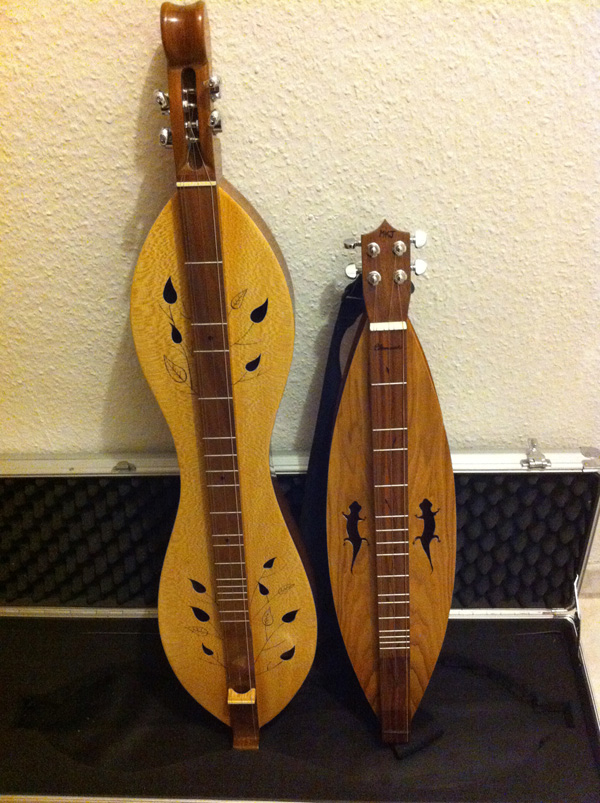
Very pretty, Susie. Though I don't own any of his instruments, he does make some nice ones!
Here's the Maple Leaf on the headstock. The pic still doesn't capture the full "depth" of the leaf.
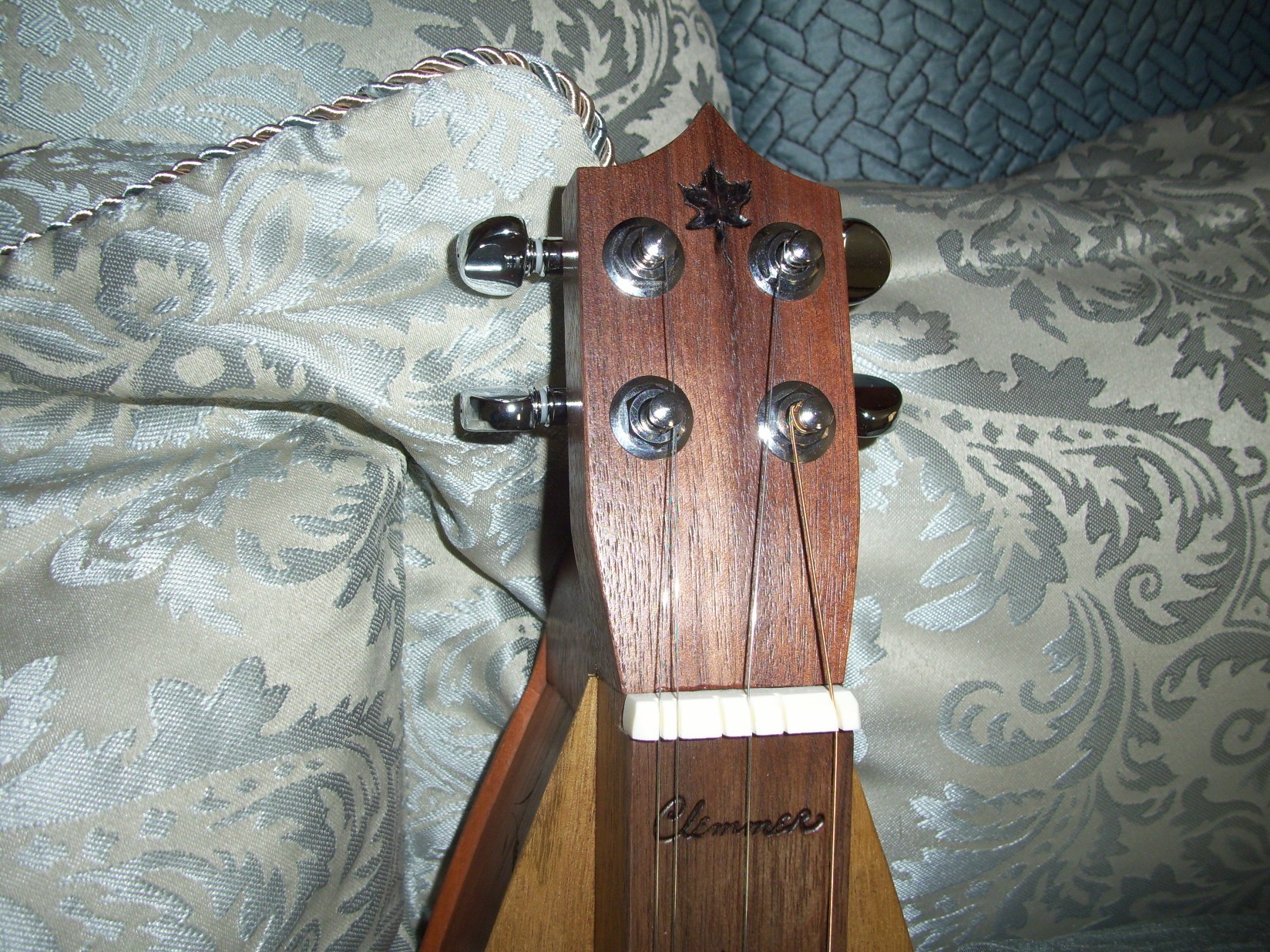
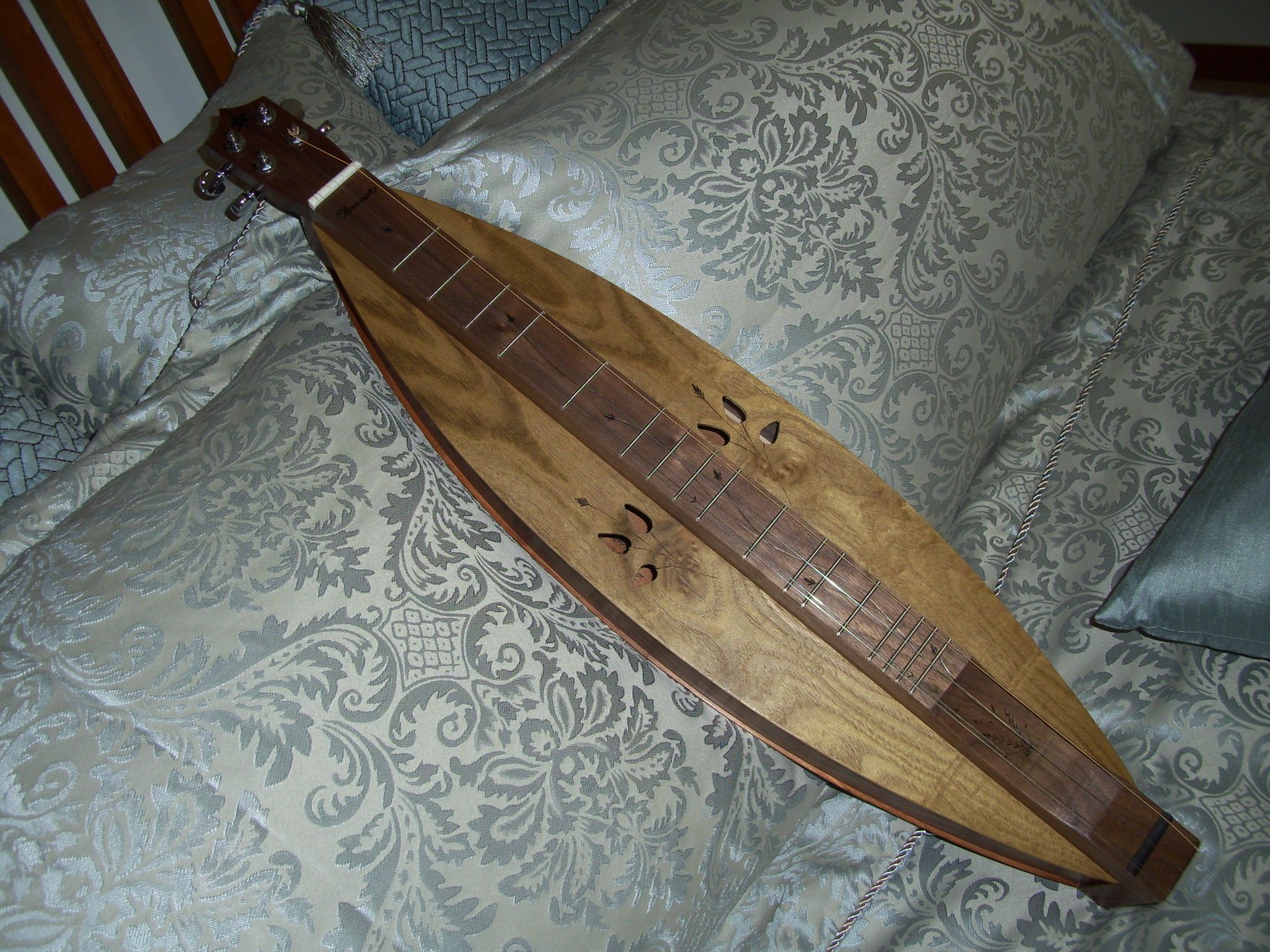
I got my Clemmer Tennessee Sweetie (Church) yesterday. It is really beautiful. I can't get over how "big" it sounds. It has a wonderful voice, for a little dulcimer. The intonation is great all the way up the fretboard. It has a sassafras top and walnut everything else. I had Mike engrave (or however he does it) a maple leaf on the headstock, since my husband and I are maple syrup producers. It's so nicely done...you can actually see the veins of the leaf. He does such a beautiful job and I just love the vine running up the fretboard (which also serves as position markers). I'm really happy with my new dulcimer, I just had to share pictures of it.

Looks great!! You will like a suitcase handle better you can get them at Ace Hardware for under $5.00. I made two wood cases out of 1/4" luan will post pictures.
Thanks ken. John P I ordered a suitcase like handle ,but. it has yet to arrive, I will see if I can make it work once it gets here.