Help how to post a video
Site QUESTIONS ? How do I...?
I have had same issue same message for month or so. Something changed.
I have had same issue same message for month or so. Something changed.
Hi Macy Jayne, good to see you here again!
Can you please look through this thread and tell us if it solves your issue?:
Haven’t been on in awhile. Just tried to post a new YouTube video but got this message. Help please. “ Unable to extract the YouTube ID from the URL - please try again or enter the ID”.
https://youtu.be/qmRQbQZTC7c?si=zdFG_4Prtlnf7p5S
[quote="shanonmilan"]
[/quote] Does it also make it sound better that you use a specially coated string?
[/quote]
Shanon, each material sounds slightly different, but I don't personally think any sound better than any others.Some are magnetic, which is useful for a dulcimer with electric pickups. Some use fancier metals under the premise that they sound better, but I personally like the different sounds of all string types. Maybe a more refined ear would hear more of a difference.
Nate
I often use mandolin strings on my dulcimer, which are phosphor bronze. At my local music shop, they are only a dollar more than the pack of dulcimer strings but come with 2 of each gauge. They are basically the same gauge as dulcimer strings, and the extra 2 thickest strings can be tuned a fifth lower than the root note, so with one pack you could string up a 4 string dulcimer Dadd and a 3 string dulcimer AEa, or whatever tunings suit your VSL.
Nate
I often use mandolin strings on my dulcimer, which are phosphor bronze. At my local music shop, they are only a dollar more than the pack of dulcimer strings but come with 2 of each gauge. They are basically the same gauge as dulcimer strings, and the extra 2 thickest strings can be tuned a fifth lower than the root note, so with one pack you could string up a 4 string dulcimer Dadd and a 3 string dulcimer AEa, or whatever tunings suit your VSL.
Nate
@john-c-knopf I'm grateful for the music she left behind-- it continues to enrich my life!
Jean Ruth Ritchie was born 101 years ago today in Viper KY.
Jean Ruth Ritchie was born 101 years ago today in Viper KY.
Hi, My main instrument is the 5-string banjo. I recent did a book for Hal Leonard called Do-It-Yourself Banjo. Written during Covid, it's sort-of intended as a self teaching guide, complete with audio and video files to demonstrate what's being presented in the book. Been teaching since the mid-1970s, so feel free to hit me up with any questions. Naturally, I recommend the book, but I have been getting good feedback about it.
My uncle just gave me one of his banjos! It's something I've always wanted to learn.
@austinpmckenzie, that's an interesting piece on functional ear training. Having just skimmed it once, I don't know for sure that I fully understand it, but I do think that the way my ear hears music is similar. I know what a I chord sounds like or means in a song. I know what a V chord means. So I can hear in a piece of music when that chord is being played by the function it plays in the song. The V chord creates tension that wants to resolve to the I chord, for example. The same can be said of a melody. Certain notes of the scale function as resting places, other notes as passing tones, and some create tension that needs to be resolved. There are only 12 notes in a chromatic octave and 7 in a diatonic octave, so it isn't too difficult to get to know the notes from which you can choose to play a melody.
Put on some music and grab an instrument. Try to play along. Your first task will be to determine the key. Then you will pay attention to the structure of the music. Then you either start figuring out the chord progression or you start working on key melodic phrases. Eventually, you get the whole song.
Lather, rinse, repeat.
I played guitar (not very well) for years. I started at family sing-a-longs, and I learned pretty quickly how to hear chord changes in a song. I also used to watch a lot of sports, and I would do so with a guitar on my lap. When the commercials came on, I would try to play along with the jingles. That forced me to work through those steps above (determine the key, identify the melodic hook, etc.) super fast because each commercial might only last 30 seconds. But by the third or so time a given commercial aired, I could usually play along.
If you want to train your ear, I strongly suggest not looking at tab while you play. Look at your dulcimer and think. Think about the relationships between the frets and the notes they represent. Think about the relationships between the strings in the same way. And I would advise not thinking about absolute tones, but about intervals. For example, the distance from an open string and the second fret is a third. From the open string to the fourth fret is a fifth. To the seventh is an octave. And so forth.
Eventually, you'll be able to hum a song in your head and imagine how to play it on the dulcimer. And that's a pretty cool skill to have.
Thanks! I encountered an article on functional ear training while navigating the ToneScholar app. Do you think this method is as effective as the one you suggested? You can read the article here: https://tonescholar.com/blog/functional-ear-training-explained
I have no evidence for this, but I suspect that many things we might consider 'traditional' now were done out of necessity at the time. This has always been a bit of a paradox for me. I assume the original developers of dulcimers were very innovative folks who were applying the concepts of older zithers to the materials they had in the Appalachians. This makes it hard for me to tell the difference between deliberate choices made by the 'masters of old' and choices made purely out of necessity. It's hard for me to imagine that they would have used staple frets if they had access to fretwire. Similarly, I have a personal hypothesis that noters were invented to allow a player to keep playing on super old grimy strings.
In both cases, the choices they made then shape what we consider to be the "dulcimer sound" and the "role of the dulcimer." I imagine that over 100 years ago, people may have made themselves all sorts of improvised zithers based on concepts they learned from European instruments. Probably what we consider 'traditional' are the ones that lasted long enough to be documented, but I suspect that with a time machine, we could go back and see all sorts of different 'dulcimers' with different features and roles. Mostly I think it's human nature to evolve and adapt, and I suspect that if you could bring those innovative inventors to the modern day, they would probably be ecstatic to hear how much the instrument has developed and grown.
Good point!The mountain dulcimer is a folk instrument and as such,capable of growth and innovation.Nevertheless my curiousity about its traditional role is well-founded.As a traditional singer/ fiddler I'm interested in where things come from,the history,the stories.Were I a cajon player I would research that as well....I'm not a folk purist,but old is often better than new.Not always,laugh.
It seems to me that the inquiry of "what the mountain dulcimer's role was in the area it came from a hundred odd years ago" is attaching undo importance to the instrument. It is a FOLK INSTRUMENT, something which can be made at home and used to create music.
We might ask the same question about the bones, spoons, shipping crate drums, cigar box fiddles, the washtub base, the monkey stick/Stumph Fiddle, cigar box uke/guitar, and many other musical devices. All of these have enthusiastic contemporary users and builders with forums, etc. and are used in public performances. I think all of them are also commercially produced and sold to a widespread market.
As a parallel to the current interest in the lap dulcimer, look at the cajón (Ca-HOne). It is a wooden box on which you sit and pound. In its modern version it is a Peruvian folk instrument, and you can easily pay $400 for a top grade one through Walmart's on-line shopping. You can find YouTube instruction on how to play it, ensembles, and get lessons at many music schools.
Enjoy your dulcimer, I enjoy my assortment along with other instruments. By all means, study its history. But we shouldn't make it into something of great world-wide importance.
John and Ken gave you the advice I was going to offer. You don't say where you are located in British Columbia but if you are near a shop that works on fretted instruments (guitar, banjo, mandolin, dulcimer, etc.) you should be able to have the proper frets installed. Good luck.
Ken
"The dulcimer sings a sweet song."
I think it is better to have frets installed by a professional than to DIY it.
Yes, those are excellent books and must reads for folks who want to learn about mountain dulcimer history and context. One part of your question we have not addressed is the use of European predecessors of the mountain dulcimer. Wilfried Ulrich addresses some of this in his book The Story of the Hommel. There are many such instruments in museums in Germany, Belgium, Denmark, Norway, etc.Unfortunately I am not aware of English translations of literature that describes how folks used these instruments. What is clear is that they were "folk" instruments and not considered to be of great value musically. Again, they were mostly played by folks in their own homes for their own enjoyment.
I do what to respond to Kenh's comment about amplification. The zitters used in Pennsylvania Dutch communities had feet on the bottom and were often played by placing them on tables when played. This increased the volume of the instrument. Some dulcimers builders in the late 19th century (J.E. Thomas, C.N. Prichard) made dulcimers with feet on the bottom which allowed them to be played on tables as well. It may have helped when dulcimers were used to accompany dances.
Ken
"The dulcimer sings a sweet song."
I agree with Lisa (Strumelia) that those 2 books are enjoyable and informative reading.
It's not easy to give quick answers to such questions. Some good info has already been posted to your question, but really I'd suggest doing some reading of books and articles written by both Ralph Lee Smith (such as "Appalachian Dulcimer Traditions") and Jean Ritchie ("Singing Family of the Cumberlands"). Those two books in particular are enjoyable reading and filled with descriptions of how mtn dulcimers were played and built before the 1960s 'revival'. Reading books and articles on mtn dulcimer history, and on early American folk music history in general are a wonderfully enriching way to learn all that is currently known, without trying to limit it to a few sentences. I remember almost 25 years ago, curling up in a big chair to read Jean's story of her childhood and her musical Kentucky mountain family, loving how every page swept me into another place and time.
Thanks so much for all of your replies.I was looking for context(what was the dulcimer's role in the Appalachians?Non-existent in Canada,so I wonder).A work in progress it seems,like all things that grow.
Both Kenh and Dusty offer good points. Dusty's offering of Lucy Long's comments reminded me to mention that role of the dulcimer was different in different communities. Dr. Long specifically researched the role of the dulcimer at Beech Mountain, North Carolina. Things may have been different in various communities in Kentucky, southwestern Virginia, West Virginia, and North Carolina. Of course we shouldn't forget southeastern Ohio and perhaps southwestern Pennsylvania (the area the borders WV and OH) and some areas of Tennessee. I'm not sure when the dulcimer tradition began in Arkansas, but let's not forget that as well.
Ken
"The dulcimer sings a sweet song."
In my opinion, the best (meaning accurate and short) history of the dulcimer is the piece written by Dr. Lucy Long and available at the Bear Meadow website: https://www.bearmeadow.com/smi/histof.htm . Most of us know this story by now. Dr. Long explains what @robin-thompson notes, the variety of playing styles that characterized the dulcimer from its origins:
The traditional repertoire of the dulcimer included the full range of repertoires found in the mountains, including traditional British balladry and hymnody, dance tunes, and play/party songs [ . . .] Because of its soft volume, the dulcimer is thought to have been used either as accompaniment to singing or for instrumental solos, but it was also used in string bands and instrumental duets where it functioned as a melody instrument and also provided harmony and a rhythmic background through the slapping of the pick against the strings.
And @nate's point about innovation characterizing the dulcimer from its very origin is spot on. Both the construction of the instrument and its use was still evolving in the early 20th century when, as @ken-longfield explains, it emerged from isolated Appalachian communities and gained some degree of commercial exposure. At that time, interestingly, it was already being romanticized as an "old" instrument associated with an imagined Anglo-American past, even though the instrument was very new and was still evolving.
The role of the dulcimer, and probably its predecessors as well, was to play what I call "personal" music or in small (3-4) person music group, for listening enjoyment within say 20 feet -- porch or small room in a home. It never was intended as a 'performance' instrument with the player standing/sitting in front of an audience. It never was intended to be used with any electric/electronic amplification -- at best a 'possum board' or double-back amplification.
The dulcimer played instrumentals or accompanied the singer/player in the religious and secular music of the local community (folk music) -- not a part in orchestral compositions. Here in the States that was what we today call "Appalachian" music (the precursor to Bluegrass, the repertoire varying from region to region, with some songs common across all regions, with variations. Much of that music was based on English, Scottish and Irish tunes and lyrics which came to America with settlers from those countries -- although there never was an Anglo-Celtic predecessor instrument.
A hundred years ago (1923) the mountain dulcimer was beginning to emerge from isolated communities in the southern Appalachian mountains. With the beginning of the settlement schools northern teachers began sending dulcimers north. At this time the dulcimer was pretty much an instrument played at home for one's own enjoyment. It may have been played at dances but was not a concert instrument. In other words people usually would not have played as a solo performer in a public forum. In 1935 the Galaxy Fiddlers' Convention began. I can't recall if a dulcimer contest took place that year or started later, but we can probably mark that contest as the beginning of dulcimer concerts.
You can find a good bit of information in the discussions Nate cited.
Ken
"The dulcimer sings a sweet song."
How I see it is the mountain dulcimer has several traditions depending on where you are on the planet.  Here in the U.S., Jean Ritchie is one person whose family story and travels spread awareness there was such a thing as a mountain dulcimer in the central/southern Appalachians. On Jean's album The Most Dulcimer , several different styles of music are represented and it is, perhaps, my favorite record of all the music we have in the house. To me, this album offers a great point of departure for exploring various traditions related to the Appalachian dulcimer.
P.S.- As I understand it, Jean Ritchie is the person who introduced the mountain dulcimer to Ireland. We have an excellent player and singer from there right here on FOTMD, @macaodha .
Thanks a lot for the mandolin advice. I never thought about easing into it with one string per course, but it makes a lot of sense. I'll definitely keep that in mind as I continue practicing.
It is interesting to think that at a time when European antecedents were 'traditional,' at one point the dulcimer was probably considered an innovative new thing. I wonder if there were once epinette players who saw new fancy zitters shaped like violins with heart shaped soundholes and looked down on them for not being traditional.
Your real question is too big for me to answer, but I'm sure some folks on here definitely could. If you havent already I recommend joining the Dulcimer History group
https://fotmd.com/ken-longfield/group/38/mountain-dulcimer-history-traditions
and the Dulcimer Ancestors group
https://fotmd.com/strumelia/group/14/dulcimer-ancestors
Hi,I'm very curious about what the mountain dulcimer's role was in the area it came from a hundred odd years ago.Likewise its European antecedents...any folklorists,historians,traditional family dulcimer players out there?...who could enlighten me,perhaps give a direction to my playing?
Our Christmas will be quiet as well…well as quiet as my granddaughters can be. We will attend Christmas Eve services and Christmas Day. I’ll dress for my grandchildren as St. Nicholas, (the one that really lived and still lives with Jesus), this Weds. on the feast day of St. Nicholas and tell his story.
This will be a quiet Christmas at home. I played at our local historical society's museum for our annual Festival of Ice the first weekend of this month. I played Thanksgiving and Christmas holiday music. We will visit our daughter's family after Christmas and help them pack up the first floor of their home which will be renovated in January and February. We will attend our usual service of worship on December 24th in the morning and the evening Christmas Eve service. For the most part I'm avoiding crowds until after mid-January as I will have cataract surgery on December 14 and January 4.I don't want to catch a cold or the flue and have to reschedule. I'll be at home most of the time playing dulcimer.
Ken
"The dulcimer sings a sweet song."
Thanks for the suggestion Strumelia. My family and I will celebrate Christmas from the perspective of the Biblical record, with praise and thanksgiving. We look forward to the Christmas fellowship at church and then the Christmas Eve candlelight service. It will be different this year as we lost my wife's dear sister passed due to cancer in September, so time will be spent to remember her. We will share Christmas dinner with close family. Our daughter and her family will be with us for a day or two. There will be visits with family and neighbors. I will be making a homemade gift for my brother in law. As of now I need to get started baking about 30 dozen cookies to share with many friends and some local businesses in the small town where I am. My list is growing so it may be more. I will play Christmas music most every day on the dulcimore.
Then as the Christmas Season passes into the New Year, we will continue to enjoy the birds which visit our 6 feeding stations daily. We also feed the wild deer, Canada geese, squirrels, an opossum we call Polly, a racoon we call Rocky, and a few ducks that have taken up over the years. Some nights we listen to the call of the wild coyotes across the way.
In the Positive Thread... I'm just wondering what some of you are doing for the holiday season! Whether you celebrate Christmas, Hanukka, Winter Solstice, Kwanzaa, or you just 'do cozy things'... tell me what plans you have to make winter meaningful or enjoyable.
Are you looking forward to a family gathering or cooking a special meal? Do you have a musical event planned or going to a cool concert? Are you getting a new instrument to play? Adopting a pet? Reaching out to an estranged relative? Traveling to a place far away? Knitting some festive socks or making some other homemade gift? Working a double shift so others can enjoy the holiday? Having the neighbors over? Honoring the memory of a loved one? Setting up bird feeders for wildlife to enjoy?
Tell us how you add something positive to your December/January. ☃️ 🕯
It's fascinating how Zupfgeigenhansel drew inspiration from Breuer's collection and put their unique spin on folk tunes. Adapting songs to suit your own style is a common practice in the folk tradition, and it's great that you've carried on that tradition with the mandolin.
Hi folks, I joined some weeks ago, and don’t remember if I ever introduced myself. I was kind of waiting until I got a dulcimer before getting too involved. Well, I finally ordered one from McSpadden. After talking with Duane Porterfield, I have a 26” walnut/walnut hourglass that should be ready sometime in Jan. So, let the new adventure begin!!
Thank you for sharing your interviews, Steve!
:: Hi! I’m in Deep Creek (Port Charlotte) and would be thrilled to have a year round dulcimer group! Let me know. granningk@hotmail.com. 🙃
Thanks, Redmando, I always enjoy your interviews!
In the latest of my "Conversations with Mountain Dulcimer Players" I chat with Geoffrey Reeve-Black about his UK dulcimer dealership and he tells me about some of his interesting instruments.....
https://mdconversations.blogspot.com/2023/11/11-geoff-black-from-herefordshire-uk.html
I hear you Wally  . I had an aunt who had perfect pitch (and a Steinway piano worth about as much as my house!). When my uncle was learning a right-hand picking pattern for the banjo, she didn't mind the repetition of the picking, but she couldn't stand that he was always practicing in the same key. So he used a capo and would just change keys every few minutes.
Using capo to change key on the fly seems to be a good idea.
I finally (OK, I'm slow and not the brightest light on a Christmas Tree), figured out how to avoid the aggravation. 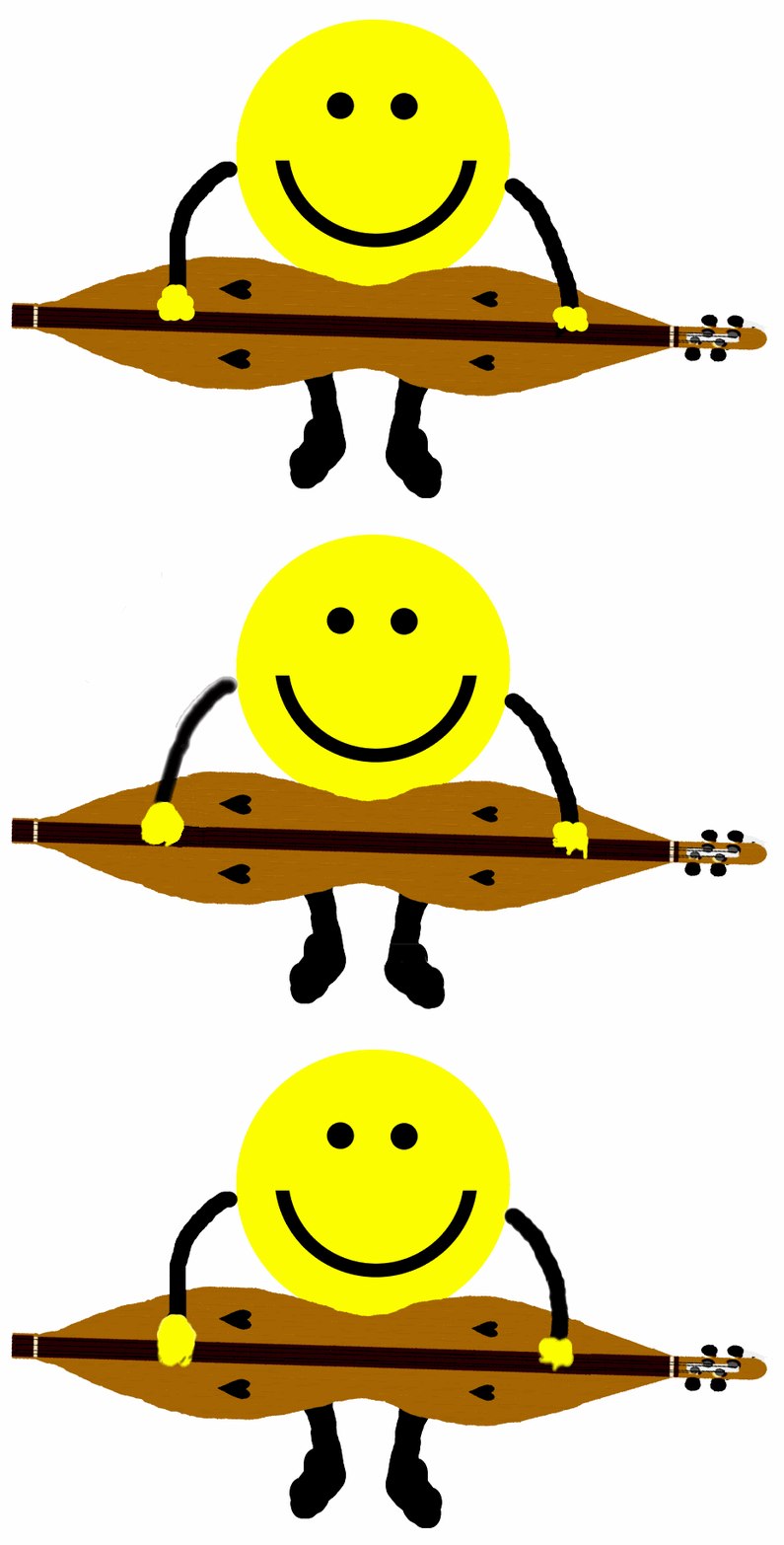 Since I have some issues with my right hand, (think lousy Rugby player 50+ years ago) being used to strum so I used to always string up for left handed play. A bit frustrating and all that goes with it, such as chord charts etc. So............I learned to play Galax style.......4 d strings and a noter........makes no difference how you hold that critter, works just fine. So I recommend you give that a whirl and if it doesn't suit 'ya you can return to that "bac'ards ciphering." You can also finger pick a unison Galax stringed instrument and finger dance too. Listen to Phyllis Gaskins and you'll be amazed what that style of play can do.