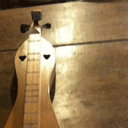
W. Martin Dulcimer History
General mountain dulcimer or music discussions
You're welcome.
Ken
"The dulcimer sings a sweet song."
You're welcome.
Ken
"The dulcimer sings a sweet song."
Ken,
I want to thank you for the Sunhearth brochures and information on Walter Martin.
ErthLing, I built a chromatic dulcimer for a customer and was quite excited about the project because it gave me a chance to explore the possibilities before I shipped it. But after playing diatonic for 50 years I found the extra frets a distraction. But give it a try. A lot depends on the type of music you want to play... Robert.
And, Robert, you may have noticed your fretwire supply dwindling twice as fast as usual! I've built just 2 chromatics and started getting anxious about having enough fretwire to finish the projects!
ErthLing, I built a chromatic dulcimer for a customer and was quite excited about the project because it gave me a chance to explore the possibilities before I shipped it. But after playing diatonic for 50 years I found the extra frets a distraction. But give it a try. A lot depends on the type of music you want to play... Robert.
Hearts of the Dulcimer Podcast - Episode 59
Dulcimer Originals
In this episode we’re playing originals composed and performed on the mountain dulcimer by the artists themselves. You’ll be hearing music from dulcimer players Gary Gallier, Leo Kretzner, Mary Giger, Aubrey Atwater, Neal Walters, Christine Shoemaker, Holly Tannen, and Ken Bloom.
You can listen to all of the Hearts of the Dulcimer Podcast episodes directly on our website: https://dulcimuse.com/podcast or anywhere you listen to podcasts.
Here's the resource page for this episode: https://dulcimuse.com/podcast/resource/059.html
Thanks for listening!
Patricia Delich & Wayne Jiang
Yikes! What year was that?
Hi everyone
People send me things
and I thought you might like to take a peek and see whom you can find!
If I get a Chromatic Dulcimer can I play it the same as a diatonic by just ignoring the extra frets?"
Bing Futch has a great book on Chromatic Dulcimer. Be aware he does include a lot of music theory information and counts frets chromatically versus referring to the diatonic numbering. Erin Mae has a lot of good chromatic references and usually provides sheet music with diatonic fret numbering as well as chromatic fret numbering in chromatic workshops
. Sam Edelston does this also - thanks, Sam!
Method for Chromatic Mountain Dulcimer (Book by Bing Futch) – Folkcraft Instruments
Private Music Teacher | Erin Mae Music
If I get a Chromatic Dulcimer can I play it the same as a diatonic by just ignoring the extra frets?"
Yes.
Regarding getting a chromatic dulcimer, what Sam said. You will not regret getting a chromatic in my humble opinion. When I purchased my chromatics, they were labeled as dulcimers and I consider them that. Chromatic seems to be generally recognized as a modern version of the dulcimer - i.e. A History of the Mountain Dulcimer (bearmeadow.com) .
I've always used "mean-tone", though "mean-tempered" may be OK, too? Reminds me of a crusty old feller's disposition...
Dwain, we'll welcome you to the fold of just-tempered and mean-tone dulcimer/dulcimore luthiers if and when you cross that bridge!
Thanks, john
First I'll have to delve into exactly what such temperaments entail. I've got notes and web-page bookmarks stored on these matters. My current understanding is that the strings can only be tuned to one set of pitches on instruments other than equal temperament. No idea whether certain tunings are better than others in other temperaments.
And is "just tempered" and "mean-tone" the correct usage? I'd sort of gotten fond of the phrase "mean-tempered."
While respecting and loving dulcimers' traditional, diatonic roots, there's no reason why the instrument needs to be limited to that.
I know some people question whether or not a chromatic should be called a dulcimer, but the instrument doesn't care what you call it.
So, again, whether you should get a chromatic depends on what you want to do with it. It's totally okay to get one, and it's totally okay not to.
Sam
Well said, Sam.
This is my approach to music and all my instruments. Explore and play for yourself and don't try to fit inside a box created by others.
ErthLing, have fun!
Dwain, we'll welcome you to the fold of just-tempered and mean-tone dulcimer/dulcimore luthiers if and when you cross that bridge!
I really like what @sam-edelston has to say about choosing the instrument on which a piece of music, or a certain arrangement, sounds best. A dulcimer is not simply a guitar without all the parts. It has its own voice, its own dynamics.
It is telling that so many people get introduced to the mountain dulcimer and are so astounded that they buy one right then and there. The instrument is capable of having a strong tug on the heart. And it is charming that so many dulcimer players want to build their own instruments —and many do.
lt seems to me that a great deal of the charm of the instrument is that it is what I like to call a small window into a huge world of early music, a time before the advent of equal temperament that allowed music to be played in any key. Before then, a piece of music had a great deal of its tonal color and its visceral pull on the imagination due to the diatonic mode.
That will forever be part of the diatonic dulcimer's charm for me as a listener: its ability to render music completely differently than the major or minor modes that almost all music has been written in since the advent of equal temperament.
As a builder, it is not for me to say what a musician should or shouldn't demand of the instrument. My job is to build the instrument that best suits the client's needs and musical comprehension. But, as I often say, the most remarkable musical experience I've ever had was hearing, at a NEFFA Festival, a women's choir singing, a capella , a Serbian folk song in Phrygian mode. The hair stood up on the back of my neck!
From time to time I dream of building a line of dulcimers that are not equal temperament. How could one resist a mean-tempered Bear?
@erthling The simple answer to your question is, yes, a chromatic has everything that a diatonic has, so it's possible to play almost everything you could play on a diatonic. (Certain long reaches may not be doable.) Whether you should get one depends on what you want to play on it.
Certain things are easier to play on a diatonic, but certain other things are easier on a chromatic. And certain things are simply impossible on a diatonic.
Millions of people play chromatically fretted guitars all the time, and it's not the least bit controversial. Electric guitars, 7-string guitars, and harp guitars are not at all controversial, and I've never heard anybody ask if they're something other than a guitar. Guitars play everything from simple melodies to strummed cowboy songs, to classical etudes, to rich jazz chords, to fast bebop and bluegrass solos, to Stanley Jordan's two-hand style, to Van Halen-style shredding; while you or I may find some styles uninteresting or ugly, nobody says it shouldn't be played on the guitar. Clearly, guitars have progressed unimaginably far beyond their traditional roots.
While respecting and loving dulcimers' traditional, diatonic roots, there's no reason why the instrument needs to be limited to that.
If I think a song would sound good on a dulcimer, I use the instrument that would be best for the job. Left to my own devices, I generally play dulcimers with 0+/1+/6+/8+/13+ frets and fully chromatic ones, because they generally do what I need. I rarely play my diatonic, except for teaching purposes. And I fully respect the right of others to choose differently.
I know some people question whether or not a chromatic should be called a dulcimer, but the instrument doesn't care what you call it.
So, again, whether you should get a chromatic depends on what you want to do with it. It's totally okay to get one, and it's totally okay not to.
Sam
PS - One option is to get an inexpensive cardboard chromatic, and see how you like it.
Well, there is pretty much a good spectrum of how the dulcimer community considers diatonic and chromatic instruments and playing, Earthling ! The suggestions here all have merit, in their various modes…
I should have clarified what FlexiFrets are, though. These are removable frets that ride in square brass channels inset into the fretboard. Since they are designed for use with short pieces of regular fret wire, they can be fitted to any mountain dulcimer, matching its other frets.
The brass channels themselves can be distracting when their frets are removed, though. I suggest to clients for whom that is a difficulty to buy a colored Sharpie pen that matches their fretboard and color the brass slots out of visual existence. It's a temporary fix for a temporary problem, as most players find they get more adjusted to those empty slots over time.
FlexiFrets aren't always the desired solution —but watching, for the first time, a fret being easily pushed right out of the fretboard often breaks people into hilarious laughter!
A lot of this discussion addresses the challenges facing people used to a diatonic fretboard who switch to chromatic and need visual cues (position dots, gold frets, etc.) to help them adjust. In other words, the answer to the question is YES, you can play diatonic music on a chromatic fretboard, but you may have to overcome a hurdle in learning the layout of the fretboard.
In my mind there are two distinct reasons to play a chromatic instrument. One is to play modern music like jazz and some pop/rock for which the dulcimer was not originally intended. A good example of that is @sam-edelston. I don' think you could play Queen's "Bohemian Rhapsody" on a diatonic, but Sam pulls it off swimmingly on a chromatic! Another reason is to play in different keys, and a good example is @erin-mae. She basically plays diatonic music, but because she often plays in multi-instrument jams where the keys change rapidly, she uses a chromatic. No need to re-tune. No need for a capo. Have dulcimer, will travel.
For any individual out there attracted to a chromatic dulcimer, I say "go for it!" In the long run, your understanding of music--even diatonic music--will be enhanced by the fact that you can visualize an entire chromatic fretboard and see the diatonic patterns therein.
But as a community, I think dulcimer players should still embrace the diatonic fretboard both as the historical origins of the instrument and also because of the simple learning curve. Beginning players can learn the dulcimer quickly because of the relative simplicity of the fretboard. That doesn't mean the instrument is limited to simple music, but merely that this humble instrument is more approachable than, say, the violin, which takes a year or two of serious practice merely to play badly. The accessibility of the dulcimer is one of its most attractive attributes. It is a big part of what makes the instrument so special.
If your going to go the chromatic vs diatonic route I think the suggestions made by Dwain Wilder concerning the gold/silver frets and or his FlexiFrets is brilliant. Other wise adding fret markers is wise.
Interesting Story. Thanks for sharing.
@erthling - yes you certainly can play a chromatic dulcimer exactly the same way you would if it had no 'extra' frets at all. Many people however will find it visually hard to know which fret is which at that point- this is exactly why many chromatic stringed instruments (banjos, guitars, mandolins) have a few fret markers of one kind or another, to help them get their bearings when playing.
Thanks for sharing this story. It certainly was interesting.
Ken
"The dulcimer sings a sweet song."
I've seen this quote from Jean Ritchie before and have always wanted to see the context. I choose to believe she meant you lose a little something if frets are added to the diatonic fret pattern.
Never met her she appears to be a kind and gentle person who would not summarily dismiss a person or a dulcimer.
When this quote is used as some kind of proof that Jean Ritchie thinks a couple frets disqualifies a dulcimer in a black and white manner .....no I don't believe it.
Oh, it'd be cool if the kid who stole the dulcimer came forward.
Thanks, Bob!
The short answer is YES.
But if you've ever watched Robert Force perform you have to ask yourself "Why". Why, if someone can do the Magic that he does with an ordinary diatonic dulcimer, why go to the expense of having a chromatic instrument built. Better to spend the time really learning the instrument you already have.
There's also this to ponder... When asked about a dulcimer with “extra" frets, Jean Ritchie replied “In a strict sense it has a different finger board, it’s not quite a dulcimer anymore.”
If you can play better than Robert or Jean, then yeah... go ahead and spend the money.
Glad you liked it, Robin. One of my faves.
Cool story. I'd love to hear from the kid who stole the dulcimer.
Thanks for sharing, Bob.
You don't often see a dulcimer story in the Washington Post, but this is a good one: https://wapo.st/3CEnST2
Link will open in a new window or tab. It should be good for about 2 weeks.
If I get a Chromatic Dulcimer can I play it the same as a diatonic by just ignoring the extra frets?"
Hi ErthLing! Yes. And you could paint the chromatic frets with a magic marker to help distinguish them from the diatonic frets. That will wear off, but easily re-painted until your eyes and hands are thoroughly familiar with the difference between the diatonic frets and the chromatic sharps and flats.
Or you can have one built for you with features that help you switch between diatonic and chromatic play:
If I get a Chromatic Dulcimer can I play it the same as a diatonic by just ignoring the extra frets?"
Wow, thanks for sharing the video from Liliya, Dwain! I enjoyed that lots.
@Leo , @randy-adams , @robin-thompson , @badrepp p , thank you all. I don't have videos of my building process, and don't have the equipment for that. But there is one video of James Maguire, of Laliya, an Australian duo with his wife, Melissa. He is playing a Baby Grand with electronics and guitar synth output, the first dulcimer I ever made with advanced electronics. The composition is Weave.
@badrepp , forgot to tag you when I wrote that I'd be interested in how the Sunhearth is received at the guitar show!
And a video or two Robin. The vid 'carving the scroll' is worth the price of admission.
Yes, in the realm of art. And Dwain posts photos of his processes in building Bear Meadow instruments. It's neat to see them!
True enough Randy......................
I believe John does put feet on, and he would certainly do so by request. Freeing up the bottom of the dulcimer to vibrate acts as a natural natural amplifier, giving you a noticeably louder voice... I love Darlin' Corey!
Ken, John, very interesting to read. Up in the northeast, dulcimer builders do not feature feet, so I thought I was the only one doing so.
Here's an idea passed to me by Walt Martin of Sunhearth: place the feet offset in the major bout, so there is a space for the player's right leg to pass between them, instead of having to shift the instrument to avoid having one's thigh embossed.
So I place the treble-side foot between the bout and the waist, the bass-side foot between the bout and the tail, leaving plenty of room for the posture to shift. See "Baby Grand" detail .
Looking forward to more discussion of the Tennessee Music Box!
Ok I'll say it out loud. Dulcimers built by Dwain Wilder have far surpassed the level of craft and are in the realm of art.
Randy, I blush! I entered this craft standing on the shoulders of a giant, and feel I owe it to the community to demonstrate the craft's evolution at every opportunity.
Ok I'll say it out loud. Dulcimers built by Dwain Wilder have far surpassed the level of craft and are in the realm of art.