Offering sympathy to our dear John Henry
OFF TOPIC discussions
I am so sorry to read this news. My deepest condolences to you, John and Paul. You are in my thoughts.
I am so sorry to read this news. My deepest condolences to you, John and Paul. You are in my thoughts.
So sorry to hear the sad news, John Henry. May God hold you and your family in His loving hands at this time of grief.
The relative paucity of actual oldtime musician albums (as opposed to bluegrass, pop or movie 'oldtimey' soundtracks, and country albums for example) has precluded actual oldtime recordings from becoming mainstream. One should probably agree on the definitions of both 'mainstream' and 'oldtime' when discussing it, since diff folks include or exclude various genres when referring to 'oldtime music'. (Most don't include the Southern harmony singing traditions such as Louvin bros/Stanley bros, or cajun, etc) The tunes Freeman refers to as obscure were indeed obscure...but... like 20 or 30 years ago. Freeman founded County Records in the early '60s, and County was the very first label to focus on oldtime music. This was before CDs and before most cassettes...only LP records played on turntables. Very few new records were pressed each year because they were a huge expense and investment.
But anyhoo... Almost all the serious OT musicians I've known have passionately dug deep into the 'roots' of the music (i.e. researching/absorbing from the older traditions and sources) while also infusing fresh life and their own personal approaches in playing the material, including creating new tunes..continuing to grow and explore as musicians as they get older.
I do find that unfortunate when any of those people who were responsible for hunting down and saving thousands of irreplaceable old family and field recordings that were rotting away in barns about to be lost forever (Bruce Greene's hard fought Salyer collection which he gave to Berea, Dwight Diller's Hammonds recordings..) are sometimes later portrayed as musicians 'playing the same old tunes' -as if they are stale or in a rut. These are the same people who at great effort wrestled some of the most obscure and beautiful music from the brink of extinction not so very long ago.
Amusingly, some of the 'source people' now mined by the newest batch of young musicians, were those very same young urban college-educated musicians in their 30s, making field trips, roughing it and getting excited by their own 'discovery' of OT music back then. Ironically, many did not grow up in the tradition, yet helped preserve and document some of it. They started the oldtime festivals that are frequently young musicians' first exposure to the music. Those players are now in their 60s, 70s, and 80s...recording incredible stuff of their own and teaching and passing on what they've learned from those before them. The good ones know how to pull something fresh and exciting from a tune whether they've played it ten times or eight hundred times. 
Of course, the old must always make way for the young. Hopefully the young are insightful enough to learn from the generation before them who were certainly true music pioneers in their own right. O ldtime musicians young and old have been 'shaking up the oldtime movement' ever since the Highwoods and the NLCR (which is about when the only thing one might conceivably call an 'oldtime movement' may have occurred). I like to think shaking up is continuous, and ageless. :)
My deepest condolences to the entire Crocker family. Please know that you are in our thoughts and prayers.
I'm so sorry for your loss, John and Paul. Condolences to you and your family.
Many of the old time albums that are produced have many of the same staples on them. Maybe he's just referring to these songs not appearing as often on "mainstream" old time albums (if old time is ever mainstream) ?
I found these from an article mentioning artists who are shaking up the old time movement.
http://www.thebluegrasssituation.com/read/5-artists-shaking-old-time-music
Re: hog eyed man- Interesting that Dave Freeman of County Records (of all people) would call these 'obscure' fiddle tunes. They've been standards in oldtime sessions and festivals for over a decade now...in fact, fast approaching 'old chestnut' status if not already there. (that might mean I'm an old chestnut myself i suppose...lol)
The 1970s style LP graphics sure had me going for a while, trying to figure out why I had never heard of these guys...but I guess this is a current band using retro styling for their 'album'? Everything old is new again...
Photo of Bruce Greene playing banjo on stage. (huh?)
This is an old time music group that I just found. They're pretty great.
also check out Squirrel Butter
Our Dear Friend John Henry, you and your family are in my prayers and I hope you find comfort in each other in the coming weeks as you remember your Sweet Mary.
Sending you Hugs.
John Henry and Paul, Your loss is great. My heartfelt sympathy and condolences. I know she had to be a special lady to put up with you, JH, these many years. And yes, Paul, I'm sure she was a wonderful mother as well. Here's hoping you might be comforted and will try to pray to that end.
Sorry for your loss,
Rob
John Henry, my heart is with you. Please know that we send our love to you at this very difficult time.
I hope you are able to receive comfort in the coming weeks from your family, friends, and perhaps through music as well. Mary was a very special and wonderful woman.
I send a warm gentle hug to you, dear John Henry.
It is with a heavy heart I tell you that John Henry's beloved, Mary, has died. John and his son Paul are both members here. I offer my deepest sympathy to John & Mary's entire family and pray for each to feel comfort midst their grief.
Is anyone attending Unicoi this year? I went last year and loved the fellowship, the vendors and the great teachers. I was just 10 months in and it was a fantastic immersion for me. I also snagged a starsong and several great books.
I cannot wait to play all the different dulcimers up for sale, fact-finding of course :), and snag some books.
Hope to see someone there!
I think I will advertise my Dulcimers for sale here. I will donate $5 to this site for each $100 in sales. This is very fair . Thank you for your hard work keeping this site up to date.
Johnny, it's even more modest than that! If you sell a dulcimer for $450 for example, I still only ask for a $5 site donation.
On my dulcimers that don't have a laquered finish, I use Howard's Feed n Wax . I learned of the product from a video by Bing Futch . It works on the body and fretboard. It won't hurt a laquered finish, but it won't be too effective either. It's easy to find at most hardware or home improvement stores.
Thank y'all!!! SO MANY GOOD THINGS HERE!!!! Let me read and re-read for awhile... Y'all are a TREASURE TROVE!!!!
I've heard good things about Old Master violin polish (not to be confused with Old Masters, a brand of polish for furniture and woodwork.) I have yet to find it locally, but will order online and give it a try.
ahhhh, cool and wise comments. My hand is not cramped up at the higher "shinny frets"...(loved that phrase)because I set my dulcimer on a Walmart T.V. tray table and that makes it easy to work any frets. keeping the noter straight on the two or one wire is MOST important. I saw in so many books that the early dulcimer players used little tables to set their dulcimers on. I see on this site where the new builders are putting little "feet" on the bottoms of their dulcimers and I am doing the same thing. the sound is so much better with it off the laps and on little feet on a flat little table. At least that's what I've found for me. aloha, irene
Sandy, your Wren is a small dulcimer with naturally stiffer tension. It will be a bit tougher to play up around the 10th or 12th fret. You may be having to press down harder to play up there, and that will definitely pull the strings up just a little out of tune. See if you can press down as lightly as possible when going up the frets higher. You might also try tuning one step lower on all strings and play in a lower key-like in C instead of D for example. This works when playing solo, and will give you less tight strings to work with. OR put on strings that are one step lighter gauge than your current strings, if you think you want to stay in the same tuning you are now but the strings feel very tight when you get above the 7th fret.
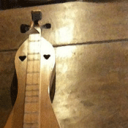
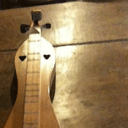
Older types of dulcimers were usually played in the traditional (non-chordal) style, and if the fretboard was in the middle of the top of the instrument, a TALL fretboard made it easier to play with a noter in hand. Rather than a tall fretboard being of solid wood (possibly lessening resonance), making it hollow allowed for more sound vibration and resonance. In effect, a large tall hollow fretboard with its own sound holes was like having a very narrow scheitholt sitting on top of the larger body. In fact, there are some old examples of mtn dulcimers that very much resemble a narrow schietholt built with a larger sound chamber body underneath it. It's one of several possible paths of evolution or 'missing links' in the history of very early dulcimers and zitters in American. More than one of those 'dulicmer evolution' paths may have occurred long ago in different regions.
As modern times approached, people began to play dulcimers more often in chording style, fretting all strings and making chords with the fingers, adding double melody strings- this all encouraged wider fretboards and the need for a tall fretboard that accommodated a noter was much less. Dulcimer bodies became larger and fretboards became wider and less tall...and hollow tall fretboards became less needed for resonance or for noter comfort.
No tricks, it just takes lots of practice. The position of your fretting hand is more across the body and a bit more 'cramped' for lack of a better word. Just keep working at it slowly and you'll be fine.
I have small hands, so I use my thumb a lot to chord on the lower octave frets. When I get up into the "shiny" frets, I don't use my thumb so my wrist is at a better angle.
This is where a "floating bridge" come in handy. Often it's out of tune just a fraction, but sounds more out of tune as you go up the fret board. If it's a little sharp, then move that floating bridge a tiny bit away from the nut...if flat, then go closer to the nut. If you have no floating bridge, then do as Ken Hulme says to do....and to encourage yourself to play more up there.....PLAY your strumming IN THE STRUMING AREA....and your struming won't get that "flap flap flaping" against the fret board. love playing Christmas music now a days.
Often above the 7th fret a regular fretted dulcimer will start to sound discordant. What I usually do, as a Noter & Drone player is to strumm less and less of the drones as I go higher up, until at about fret 10 I'm playing pure melody. Then I add drone as I go down the fretboard.
My JI fretted dulcimer does not seem to suffer from discordance as I go up the FB.
I am in love with playing the bass string on my Wren Feather Dulcimer! Somehow it's easier than on my bigger dulcimer and sounds amazing!!! Still haven't reached upwards of the seventh fret though....
If you're like me, I almost have to force myself to go to the high octave. I have also be practicing playing the melody on the bass string in DAd tuning. No I haven't done much on the high octave bass string. LOL
Thank you, Dan! I don't seem to get much practice on those high notes until I start practicing Christmas music, and honestly I'm always kinda glad of that! LOL!
No tricks, it just takes lots of practice. The position of your fretting hand is more across the body and a bit more 'cramped' for lack of a better word. Just keep working at it slowly and you'll be fine.
Is there a trick to it? Whenever I get above the ninth fret it never sounds so good. Sometimes it even sounds out-of-tune! Do you have any tips for me? TIA!
Terry, please share pics of your ocarina when it arrives! I used to want one very badly, so I will live vicariously through the many vids you will share.... 
I use two holes in my tempered scale dulcimers and three in my Galax style dulcimers. My fingerboards are hollow and holes greatly improve tone. And most of all they look really cool... Robert.
And to add a PHOTO to your own photo section/Galleries, you would follow the same procedure as above:
Go to your profile page.
Click on your Photos TAB there.
Click on the large PLUS sign+ button to add a new photo gallery. If you just want to add a new photo to an existing gallery you created, you'd go to that gallery and add another photo from there:

The Real story is that builders put tiny soundholes in the fretboard just so that people can ask "Why".....
Hi Eileen,
That's very cool! There's a fellow in New Zealand who makes wooden double ocarinas where opne side is a drone note, and they are made with an interval that sounds rather medieval...sounds so pretty! -see the pure white wood one on the middle of this page, with a sound clip: http://www.wood-n-bone.co.nz/musical_instruments.html
I didn't keep up with learning my ocarina. However I did actually learn to play the bones in the end ok (yay), and I'm making progress on penny whistle now...which is sort of vaguely related to ocarina I suppose?...I mean, you blow into both of them at one end and cover the various holes to make music, right? 
I started out checking out the medieval and renaissance music forum on here, and somehow got segued into this double ocarina. Oh dear! They look beautifully made and this one is in F and C with similar fingering to the C and F recorders, with which I'm familiar. Ah temptation yet again! http://hindocarina.com/ocarinas/index.php?l=product_detail&p=84 and
This youtube of a Japanese guy playing got me hooked even further: http://hindocarina.com/ocarinas/index.php?l=product_detail&p=84.Ruth, the oldest dulcimers have come from Virginia, and they had no strum hollow, but they did have soundholes in the fretboard.
And a few had soundholes in the back as well. They were a separate tradition from the Kentucky-style dulcimers that are prevalent now.
They are a form of sound hole, actually fairly common on traditional teardrop/ellipsis-shaped instruments. My Kevin Messenger dulcimer has them. They are not an impediment to finger-style playing at all.
Late in this discussion. I have a dulcimer made by the Walnut Valley Dulcimer Company, the 3rd one made in 1993 by L D Sacks. Mine looks like yours and is noted to be a Wildwood Mountain model. It still sounds good and has held up well all these years. It was my first mountain dulcimer. I saw the company represented at Epcot in 1991 picked up the brochure and ordered in late 1992 with delivery in 1993.
Playing a Galax style dulcimer with those holes was usually done with a noter. This keeps the fingers from getting caught in the holes (grin).
Ken
"The dulcimer sings a sweet song."
Mainly the holes in the fretboard are to allow air to be pumped in and out of the box from the hollowed out area under the fretboard