Need Advice--Buying a New Dulcimer
Instruments- discuss specific features, luthiers, instrument problems & questions
Check out my dulcimers, Light o’ the Moon Dulcimers, at www.dulcimersbymolly.com. I build custom designed dulcimers.
Check out my dulcimers, Light o’ the Moon Dulcimers, at www.dulcimersbymolly.com. I build custom designed dulcimers.
I find it interesting that no year date was put on the label. How did you know it was made in 1980?
Hi Strumelia and thanks for your comments.
The label has the serial number 81480. Initially I thought this was rather high, even if you include the hammered dulcimers that Jim Fyhrie made, then wondered if it was the date in US format (not quite the same way round here in the UK). I managed to track down an email for Jim, now in Arkansas, who kindly responded and confirmed that it was the date for 14th August 1980.
I know my chances of adding to its story are incredibly slim but then again no harm in being optimistic. 
What a nice job you did in cleaning and stringing that, Judith! Looks like it'd be a perfect baritone dulcimer (30"vsl!)
A handsome dulcimer!
I find it interesting that no year date was put on the label. How did you know it was made in 1980?
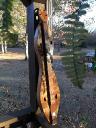
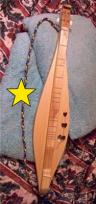
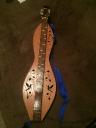
I realise that this a long shot but I wondered if anyone had met my latest dulcimer purchase in its 38 year journey from Laguna, California to a charity ship in Keynsham near Bristol , UK.
I took a chance on what seemed to be a somewhat neglected instrument, as it was for a good cause and it would give me a chance to practice my dulcimer maintenance - applying Dr Duck's Ax Wax and Howards Feed 'n Wax and Citrus Oil (as seen in recommendations here on FOTMD) and restringing as a baritone according to Strothers' string guide (thanks to FOTMD contributors again).
After all this, it has turned out to be a rather lovely instrument:
· mahogany with spruce soundboard
· 30" VSL
· now set up as four equidistant strings (double melody optional)
· no 6+ fret
· IMHO nicely resonant and a joy to play
I know that this one was made by Jim Fyhrie for 'EC Snowden' in August 1980 and it would be lovely to know if anyone here can add any steps to the story of its journey.
With much patience and care -- far more than I have.
For what I want to do, staples look to be a good option, if only a little time consuming at first. Thanks for the quick responses! i was at Ron Ewing's house once, and he had a dulcimer with frets under only the melody string, but it was standard fret wire all the way to the edge. Any idea how he might have done that?
Dan's video is "da bomb". Yes, we use tiny drill bits and sometimes tiny hand drills, but they are readily available and inexpensive. You have to pre-drill the holes for the staple legs, then bend the staples, and finally tap them into place. It is simple, but a somewhat lost art, and does take a little practice to get it perfect.
Staples are what a lot of the old timers used. So do some of the new timers.
Historically, there have been some dulcimers, played with the noter-drone style, which had frets under only the melody string. Many other instruments have such partial frets which do not extend across the whole fret board. My question is, how are these installed? I thought I had read somewhere that it should be simple, but I can't find a simple explanation of how to do it. Online I have found some people saying that you can use really small drill bits or dremel bits, but there should be an easier way, if only because luthiers have been making partial frets for hundreds of years. Any input is appreciated.
Grant
Brian and I generally get pushed off the edges and have to sleep on the cold hard floor. 
Should we start a GOFundMe page for an air mattress for you & Brian? 
Brian and I generally get pushed off the edges and have to sleep on the cold hard floor.
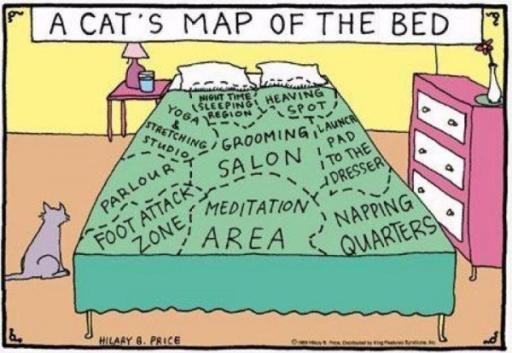
Strumelia, is there really room for a human on that bed? :)
The 1 1/2 fret does not effect your ability to play chords, just ignore it when figuring out where to place the fretting fingers of your left hand. The 1 1/2 fret may increase the number of chords available to you, but it won't change the fretting positions of those chords already known.
Just be sure to think of that fret as the 1 1/2 fret, and don't be tempted to rename it the 2nd fret. You already have a 1st and a 2nd fret, so the one in between fret 1 and fret 2 is logically called the 1 1/2 fret.
If you take Dusty's great suggestion to use a chord chart, the fret numbers (including the 1 1/2 fret when needed) are clearly indicated on the chord charts.
If you decide to use a capo, it will raise the key and change the name of the chord shapes accordingly, but the actual chord shape formed by your left hand remains the same.
Don, you've gotten some good advice here. As Robin has pointed out, the main keys for folk music are C, D, G, and A, and Skip has explained how to figure out the important I, IV, and V chords in those keys. You can use any chord chart, such as those Stephen Seifert makes available , to learn how to play those chords. You should also be aware of how versatile the barre chord is. I assume you can count to 7 and you know the alphabet.  If 000 is a D chord, then 111 is an E chord, 222 is an F (really F#) chord, 333 is a G chord, 444 is an A chord, 555 is a B chord, and 666 is a C chord. Then we start over with D again at 777. Until you learn more chord voicings, those are safe places for you.
Personally, I prefer to approach this by using a capo, which enables me to play in D, G, and A out of a DAd tuning, and then tuning down a step to CGc to play in C. Then I only have to learn the chord positions for one key but they will work in the others. What I mean by that is that 002 is a D chord when tuned DAd, a G chord with the capo at 3, an A chord with the capo at 4, and a C chord when tuned CGc. So I consider that a I chord rather than remembering four different chord names. The same with the 013. That's a G in DAd, but a C with the capo at 3, a D with the capo at 4, and an F when tuned CGc. I could memorize all that or I could just think of it as a IV chord. I could go on, but hopefully you see my point.
I explain this approach in a document I've attached which was written for a different but related question, and also includes a transposition chart for the major keys. And you can see me demonstrating how to use a capo to move to the keys of G and A this video here .
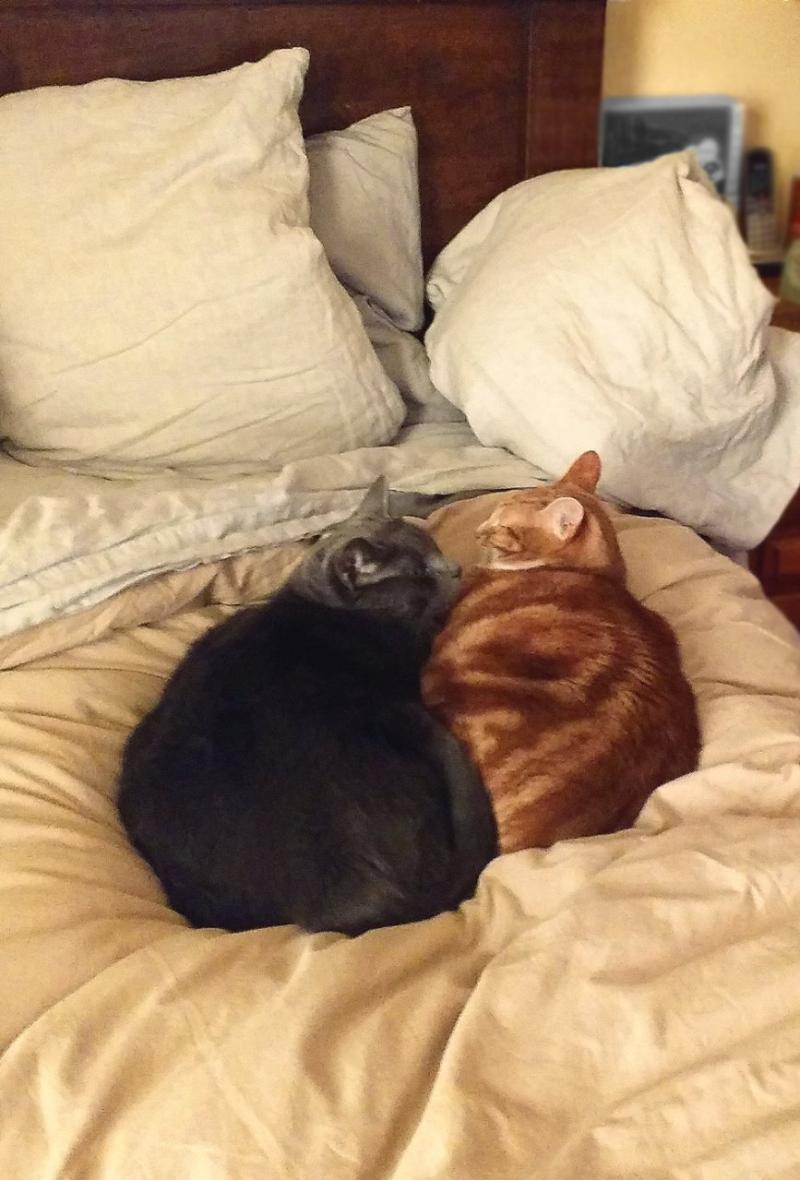
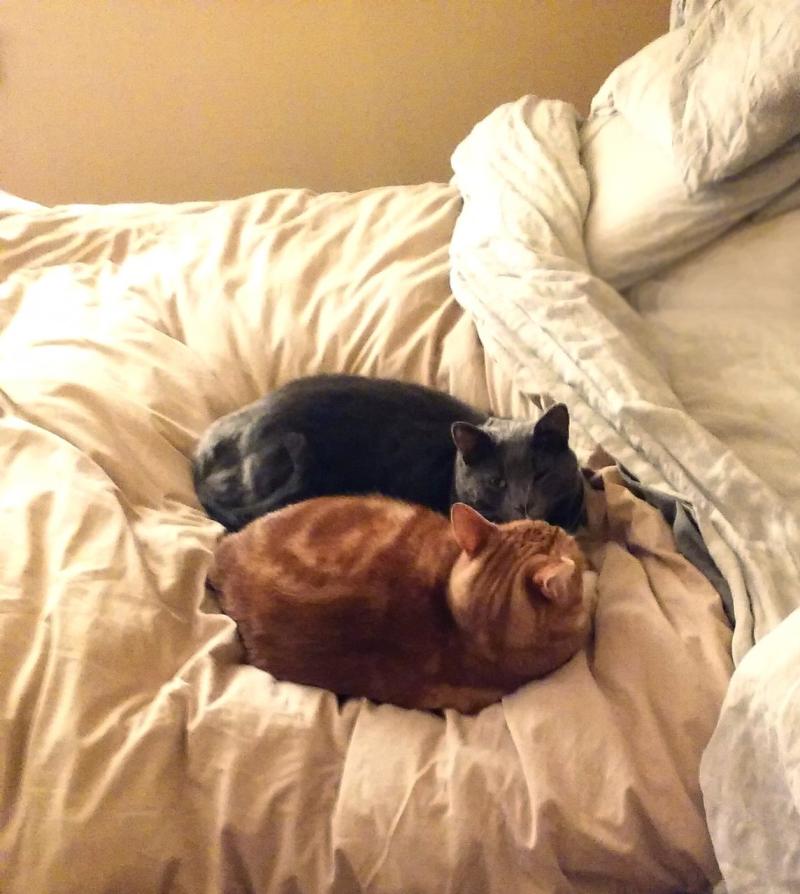
At our house, Wintertime means... cats creating 'impact craters' on our feather bed. Or trying to turn over in the middle of the night but your legs pinned down by a ten ton cat.
Here's what I found the other morning when the sun was shining into our bedroom.
Our two big boys nestled in like Siamese twin pork roasts. Rufus (the red) and Teddy (the grey), who grew up together and are like close brothers even though they're not actually related. When these two are not sleeping or eating, they're tearing around the house while hollering or happily doing body slam wrestling with each other. Boys! 
Don;
You can figure out the chords and the notes to each chord using one hand. Here's how; Looking at your left had, palm up, the thumb = the key note name/I chord name, the ring finger = the IV chord and the little finger = the V chord. To determine the notes to a chord, [you need to know the notes in the scale] ; thumb = base/chord name [root] , middle finger = the 2nd or middle note [Major 3rd] ; the little finger = the 3rd or high note [Perfect 5th] . By the way, the other fingers represent the ii, iii, vi, and vii notes/chords. The real challenge is to find the notes on your MD.
Using a 158 tuning, like DAdd, the basic I [D] chord is 0 fret/open; IV [G] chord is 013/310; V [A] chord is 101. These are the same frets to play the I, IV, and V chords in any key using a 158 tuning. You would have to change the tuning to CGC use this for C or AEA for A, etc. You should go the route of previous posts for a more in depth study.
Don, something which served me well was attending several jams to observe & listen before I ever tried to play in a jam. The skill of jamming-- playing called tunes 'on the fly'-- takes time for some of us to acquire. I know it took me awhile.
Don -- look on the Strothers Chord Finder __ http://strothers.com/chords.html or one of the dozens of dulcimer chord finder charts available to download.
Most of my work starts with 3/4 rough sawn lumber and I work it down from there with a combination of using my surfacer, resawing, and horizontal drum sander, and then hand sanders. Thanks Ken, I'll try to find those ED discussions.
Robert, I still use three thin cross braces but am going to try going to braces that don't go across the entire bottom. Usually my bracing is only for support of the bottom and doesn't touch the top as I rely on the fret board for that support. I do hollow the fretboard to provide more 'open space' inside the instrument; minor addition but I believe every cubic inch helps.
My usual top and bottom thickness is about 1/8", but I try to go thinner than that if I can. As you might have read on this site, or elsewhere, you can get get good sound out of a Tennessee music box even when the top and bottom panels are over 3/8" thick.
Thank you very much, Ken, for the recommendation - I will ask him.
Talk to Jerry Read Smith at Song Of The Wood, in Black Mountain, NC. I understand he has closed the downtown shop, but continues to work out of his home.
I guess I need to add to the description of my "desired" HD that I would like to have the lower half of a 16/15 in order to get the deep tones - with a bottom rail of around 42 '', thickness of around 4'' but only half the height (so only around 8-9 '') - I called this "little" travel one (compared to the complete 16/15) which might be misleading.
If you can find the old ED Discussions by Richard Troughear called An Interesting Dulcimer Experiment, he may have researched and reported on the phenomena. I use 1/8" normally because I can readily get wood already thicknessed to that dimension. Sanding doesn't take off much from that.
I use 1/8" . I tried. 3/16 on my first dulcimers but didn't sound as good. I would love to try 1/16 but then you get into bracing, which might restrain sustain. I think thinner wood would be better if only it were stable... Robert.
I did a search but nada.... so, the question is: What effect does the thickness of the top and bottom of the instrument have on the length of sound sustain? Secondly, what thicknesses do most of you prefer for your tops and bottoms? Right now I am working at 1/8" to 1/10" but mostly 1/8".
I would be interested in a 9/8 hammered dulcimer - but starting with a D3 as the lowest string.
I already have a Dusty strings D45 and a TK O'Brian Travel and would like to have the "advantage" of a little travel one but with the wonderful low tones of a 16/15.
Do you know if there exist these kinds of hammered dulcimers or could you recommend a builder who could build it for a "payable" price?
Hazel's three today. We had a party for her. My grand daughter made her a peanut 
Well, I used a burlap mail sack for a while.

Lass From The Low Countree, by John Jacob Niles, in Aeolian--key of C. I just posted a question about it in the Noter & Drone Group...Maybe I should have posted it here. I'm still learning to navigate the site.
Lady Mary, AKA Palace Grand, is another favorite mournful ballad.
Hi Strumelia,
I believe Cynthia Smith in Orange County area of Los Angeles may be a good contact source for Randy Wilkinson. His arrangements of Elizabethan tunes are still wonderful to play! And his playing was really exceptional. I caught some of his performances at the Summer Solstice Dulcimer Fest in LA in early to mid 1980's. Not aware of what he's now up to.
Best, Peter






 strumming in various keys out of DAd tuning.pdf - 22KB