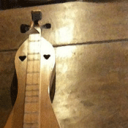
Unknown maker
Instruments- discuss specific features, luthiers, instrument problems & questions
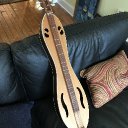
I never noticed they were swans, but they are. It has bracing on the inside, fine tuners and perfluing, too
Fascinating dulcimer! Obviously some care was put into designing it.
I suspect the lower sound holes were originally "f" style sound holes like on violins and cellos. Perhaps the lower parts of the cutout warped out or split off and someone just cut those ears off and neatened up the holes to match. I see that sometimes with sound holes that have curvy cutouts against the grain.
You can see an example of this here:
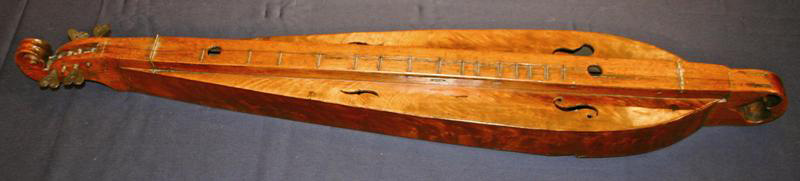
You may be right, Strumelia, but I see swan profiles in the shape of those holes.
I think the fact it's a little asymmetric adds to the charm.
Fascinating dulcimer! Obviously some care was put into designing it.
I suspect the lower sound holes were originally "f" style sound holes like on violins and cellos. Perhaps the lower parts of the cutout warped out or split off and someone just cut those ears off and neatened up the holes to match. I see that sometimes with sound holes that have curvy cutouts against the grain.
You can see an example of this here:
Assuming the dulcimer's "zero fret" was positioned in the correct place, I have to ask- did you cut slots deep enough so that the strings rest on the zero fret? Because if the strings are now higher so that they no longer touch the zero fret, then the intonation might be off on all the frets because you'll have changed the scale but not the fret layout. Sorry, I just had to ask because you can't tell from the photos.
Looks like a decent dulcimer, and the price was certainly right!
Hi Strumelia, thanks for the response -- it took a few tries to get them cut low enough for the zero fret to do its job. If I had to do it again I'd have shaved a bit off the top before slotting. Live and learn!
Assuming the dulcimer's "zero fret" was positioned in the correct place, I have to ask- did you cut slots deep enough so that the strings rest on the zero fret? Because if the strings are now higher so that they no longer touch the zero fret, then the intonation might be off on all the frets because you'll have changed the scale but not the fret layout. Sorry, I just had to ask because you can't tell from the photos.
Looks like a decent dulcimer, and the price was certainly right!
You could try contacting these guys in Roanoke to see if they could steer you in the right direction in case it was locally bought: https://fretmill.com
Good luck!
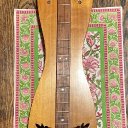
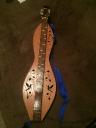
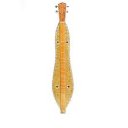
Hi folks, I picked up a damaged mountain dulcimer from a thrift store for $20 before the lockdown and finally got around to cutting and slotting a replacement bone nut and bridge. It lacks a maker mark and suspect it might be a kit build with its zero fret and laminate top, though it's a tad fancy with binding and a rear ornament I might not expect to see on a kit, but I'm no expert. Couldn't find a direct replacement at the length and slot width I had to work with, so I found a bone saddle blank and gave it a shot myself. Not a perfect job but ok for a first-timer, I reckon.
Anyway, it plays pretty well and sounds decent to my inexperienced hands and ear, so I'm having fun with it. Anyone have a clue about its maker or parts source to satisfy my curiosity? Wood guesses also welcome -- thanks!
Wow, that's gorgeous. And from my home town!
Thanks Skip,
I was able to figure out how to balance the dulcimer & overhang on my lap, that took care of the height and distance problem I was having with it on it's stand.
( Maybe a bass, arpeggio & strum across all of the bass strings to finish.) Now that it's on my lap, I was having fun playing around, picking out notes across the fret boards & harp strings
Fun new adventure,
thanks
Sounds good to me, the second piece especially. I think sometime is the better choice. Maybe a bass [one note on each beat?] arpeggio on some of the longer notes, or strum across all of the bass strings to finish. I also feel you will get much better at figuring out what works as you become more familiar with the instrument. You could also switch fretboards [octaves] for repeats or play octaves across 2 fretboards. Instrumental falsetto?
Double Dulcimer Harp:
Thought I would let you hear how I have set up the double dulcimer with the harp strings. there is no pickup, it's all just the dulcimer!
Demo: DAd with 3 drone strings as a Bass - the 3 extra strings - A' below c, D & melody d
Demo (Amazing Grace) : DAA with Baritone - but D instead of E
Reaching over to the far fretboard is throwing me off (seems like I'm digging into the strings as I strum) but gives you an idea of the DAA & baritone tone. Distance is a problem, or just me - At the moment the dulcimer is on a stand and I am standing or with a high stool, I find it difficult to play with height & reach. I have not tried on my lap yet but will and hope that will help.
skip: ( overkill) you maybe right. Seems I need to learn how to play it now, I'm like a beginner - strum the drones - always - sometimes - ?? any suggestions will be helpful
(The Cherub violin mic ) Is a mic the same as a pick up, I have seen several listed as I am also looking to some kind of a way hook a pick up on a dulcimer.
Has anyone hear of a passive piezo pickup for nylon strings - Kremona NG-1. It sits on the tie bar utilizing the tension of the strings, so its seems it could sit behind a dulcimer bridge and under the strings for tension also. They are incase in wood and thin, seems we could just loosen the strings than slip them under.
Any thoughts?
Beautiful dulcimer and I like that the fretboard is cut away. I have one like that and it allows me to put a Seymour Duncan pickup under the strings; so pedals, processors or amp can read the strings - not the vibration.
skip: Interesting (so the string breaks over the slot further back.) I did not know this
Skip thanks - I think I should leave it alone now as it's much improved but thank you re filing the string slot. I had also and hand not mentioned but I put a new bridge on it last night as well as new tuner keys. The bridge by the way is fixed though I know the floating allows some advantages in terms of adjusting on the fly. I'm planning to get another at some point from a builder whose work I like but this Etsy one which has certainly taught me some things already re improving it's playability, for a modest investment is offering a good start with decent woods. Here's a pic.
Jim
If you have a floating bridge it can be re-positioned, which can help some. Another trick is to make the base string VSL a bit longer by modding its slot in the bridge. That's done by refiling i so the string breaks over the slot further back. It may be too late to try this though since you've already lowered the bridge [many times, refilling the slot lowers the string].
Skip thanks. I didn't note and just checked dime and nick again (this time right order as I think I had it backwards earlier) but they are much better in spect. Just barely touching where they weren't and yes got it, re little can do huge and it did albeit positive thusfar. Thanks again folks.
Happy to report that I did 20 sand strokes with 320 (didn't have 400) to nut and saddle and it's notably better. @+/-10 cents where it had been more like 20! I will say I'm learning a lot re my ability to work on an instrument. I have background of few years in other instruments and have danced with bit of work on other instruments but have done the most with this dulcimer which I bought the wrong way, took a chance on etsy but I am bringing it around so cool. Thanks Ken for the lead!
Dime next to the 1st fret, nickel on the 7th fret. If its high on the 7th, then mod the bridge, then check both places. Be careful about modding the nut, a little bit can have drastic results and barely affects the 7th fret. I suggest doing the 7th first, leaving the space a bit high then doing the nut, if needed. If you have a zero fret, all change is done at the bridge since the nut there is basically a locator/separator.
I'm new to the community and latching on to this as I appreciate finding the thread for current needs I'm having. In my case my dulcimer is a bit high at the first fret meaning it's clearing the nickel instead of just touching and sharpening by the third fret. I don't have an exact measurement but it feels high. I realize other factors can be affecting intonation but don't at this time feel I have any warping. I did go over the frets with a rocker finding inconsistencies and did some leveling which helped with some buzzs on bass string and couple spots on the high pair. This dulcimer though new to me was used or been in storage. It was made in 2003 according to it's inner label and appears in good shape but the intonation is few cents sharp in spots which I've been trying to improve so I'm hoping taking Ken's advice and sanding some on the nut in my case and possibly the saddle might avail. Thoughts?
Glad to know Jessica is OK. It's hard to keep up with the disasters these days.
wow, I've been following the fires in the West that I didn't know there was a hurricane SALLY mind you. I thought this was going to be a new tune on the dulcimer. I'm grateful that Jessica made it through. aloha, irene
I got a quick note from Jessica Comeau who endured the storm without having serious damage to her home.
While Pensacola took a major hit, our friend seems to have weathered the brunt of it. Any others of our community who were affected let us know if we can provide some emotional support and encouragement.
Does anyone else hear a tune in their head and have to pick it out on the melody and middle string?
I have so much respect for Dolly and how much she gives back, in so many ways. I hope it brings a lot of $ for the cause. I'll be passing on it though. Kinda puts into perspective the McSpadden Ginger that I have on order. 
No rush, Don. Just enjoy yourself, but feel free to reach out if any questions pop up.
Thanks for the tip, @pmundy. I saw the title to that book but haven't picked it up just yet. The woman who gave me the hammered dulcimer included well over a dozen (mostly older) instructional books. I've been skimming through those and if I can't find exactly what I'm looking for I'll consider Ken's book. I sure enjoy the music he makes with his son, who is perhaps my favorite clawhammer banjo player.
I'm not one for fancy things yet it might be fun to give this one a strum or two. Hope it raises plenty of money for the cause!
Dusty,
Have you looked at Ken Kolodner's HD Theory & Mapping book? It is a great reference for learning the hammered dulcimer.
Sure, Dusty, I'll send you 3 bucks as soon as I find a few herds of deer.
Ken
"The dulcimer sings a sweet song."
If anyone is bidding on that dulcimer, I have a question: "Can you lend me a few bucks?"
Contact me by personal message, Don, if you have more questions on this stuff.
By the way, in explaining things to you, I've made a further change in the tab.
In measure 2, instead of getting the F# on the 2nd fret of the melody string, I will now indicate it as the 5th fret of the middle string. So I would use my ring finger on the 2 at the end of the 1st measure and then slide that finger up to 4 for the second measure, leaving my middle finger ready for the 5 on the middle string. That way the move up happens a little earlier, but it involves the same finger on the same string just sliding up two frets and then the hand is in perfect position for the next two measures.
I'm curious to know if anyone here is planning to bid on this dulcimer.
http://www.cmt.com/news/1824963/take-this-swarovski-crystal-studded-four-string-dulcimer-off-dolly-partons-hands/
It should be a nice addition to anyone's dulcimer collection.
Ken
"The dulcimer sings a sweet song."
Don, I'm not quite sure what you mean by "guideline." A note on the melody string can be found 3 frets higher on the middle string, and a note on the middle string can be found 4 frets higher on the bass string.
If you're looking for guidelines about when you would want to move to another string rather than stay on the string you are on, I think you have to examine the specific notes you are playing and your hand position. In my playing I try to follow a few golden rules: 1) minimize left-hand movement; 2) moving from one chord position to another, try to keep at least one finger on the same string; and 3) keep your left hand in a chord position as much as possible.
If you are not playing chords, some of that won't mean much to you, but you should still understand the principles. Let me address the question of when to shift to another string by looking at the first two lines of a tune I just tabbed out last night for my dulcimer club meeting this weekend.
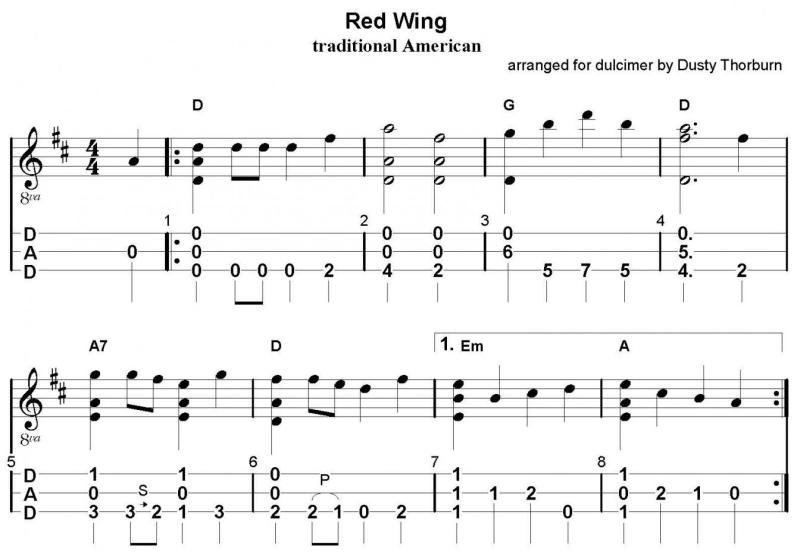
The melody (pick-up note aside) is entirely played on the melody string in the first two measures, but in the 3rd measure I get the melody note of G on the 6th fret of the middle string. Why? That same note is found on the third fret of the melody string. But look at the subsequent melody notes; they are found on frets 5 and 7. So rather than have to jump from 3 to 5 and then to 7, I just move my hand up, catching the 6th fret of the middle string with my middle finger, and then leaving that finger down, my ring finger falls onto the 5th fret of the melody string. Those fingers stay down as I reach with my index finger (or thumb) to 7, then lift it up and hit the 5, where my ring finger can still be found. And then, moving to the 4th measure, that position with my middle finger on the middle string and my ring finger on the melody string just slides down one fret from 0-6-5 to 0-5-4.
So by using the middle string for that one note, I am able to get almost two entire measures with my hand in the same position.
Notice that I said "almost two entire measures." The last note of the first line is an F#, and I indicate it on the melody string at the 2nd fret even though it is the same note as the 5th fret of the middle string, where my finger already is. Truth be told, I probably play that note on the middle string there most of the time when I play this tune. However, the 5th measure obliges us to move all the way down to the 3rd fret for the melody string and then everything that follows is down by the nut. So to facilitate that move, I chose to tab this tune out using the 2nd fret of the melody string rather than the 5th fret of the middle string.
Obviously, there is no hard science to this stuff. You just try to figure out what will work best for you, meaning what will facilitate you finding the melody in the easiest way possible, with the least amount of movement.
GOT IT! Is there a guideline to moving from string to string?
Don, @Strumelia's correct. A lot of people cannot pick out simple melodies on the dulcimer. If you can do that you are ahead of the curve. Just keep working at it.
If you want to challenge yourself, try to pick out melodies going across the strings as well as up and down a single string. If you are tuned DAd, just add 3 to the fret on the melody string and you'll find that same note on the middle string.
Here's a challenge for you: Play "Three Blind Mice." You will begin at the second fret of the melody string. But when you get to "They all ran after the farmer's wife" you will have to move up to 7. However, instead of continuing on down the melody string for the end of that phrase, try to move to the middle string. You will finish the song on the 3rd fret of the middle string instead of the open melody string. See how it works out.
Obviously, drone players will always stay on the melody string. But those of us who include chords in our playing try to minimize our hand movement. Learning to find portions of the melody on the other strings will help you achieve that goal.
Being able to pick out a tune on your instrument is an ability that many folks wish they could develop. Just saying! :)