Embarrassed: just picking out tunes
General mountain dulcimer or music discussions
I seldom progress past my single string play.
No need to be embarrassed. That's how you learn an instrument. I still have trouble playing from tab but generally get a tune in my head and then find it on the fretboard. Sometimes if I have trouble with a spot or two, I'll turn to tablature to see how someone else plays the tune, but then I just go back to the instrument.
I pick it out on the melody string whether I hear the tune in my head or hear it on YouTube or elsewhere. It's how I learn to play any tune. Which means I generally don't consult a tab or sheet music. As I pick out a tune I usually do have to write it down bit by bit.
Does anyone else hear a tune in their head and have to pick it out on the melody and middle string?
Very cool. I have 2 McSpaddens and a Black Mountain 58 deluxe. I still play my Black Mountain a lot. Did you go with the 81 deluxe and a gig bag? Those extra features are great and worth it. Also, the gig bag has a huge pocket that is actually large enough for books!!! My Black Mountain is my go to for my travels.
Ken, that's very funny and also clever..  (bff= best friend forever)
But.. wouldn't they have to be F#'s to equal the same number of steps up from the tonic as in DAA? (correct me if i'm wrong).
Traildad, that walnut and spruce with the slightly larger size will sound very mellow and lovely, I suspect. :D
Congrats on a new BFF! Actually, you could tune it B-F-F and play DAA two steps lower!
Congrats, @traildad! I'm sure you two will make beautiful music together! 
A couple of years ago someone on here suggested The Cherub violin mic as a cheap and reasonably efficient way to hook up a dulcimer. I have found with a decent sound system they do work and are quickly swapped from one instrument to another and most importantly you get to test for the best position for next to no expenditure
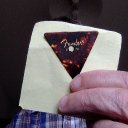
Thank you, Wally! At least I have learned what the shape is called: #355. It could have very well been a home made pick. Ilene
Thank you, John and Susie! I am going to try the D'Andrea that Ken mentioned. Not sure about thickness, though. Thank you for your responses. Much appreciated!
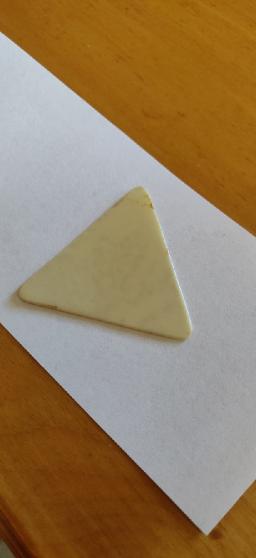
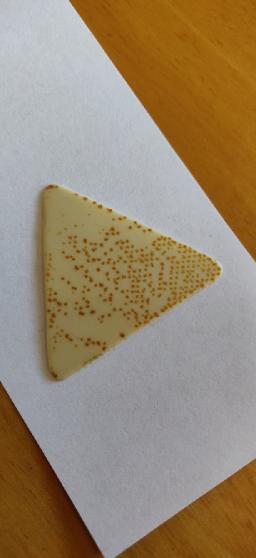
The shape looks like the large triangle pick sold by Fender and D'Andrea.
Pick Punch sells a make-your-own-picks punch in that #355 shape. It is very possible that you have a "home made" pick.
For the punch, see
https://www.pickpunch.com/355-large-triangle-pick-punch-quotdorito-chipq355.html
Pick Punch sells several other shapes. Locally we have a couple of #351 punches. They are good tools.
Just a thought.....
My local music store is Elderly Instruments in Lansing, MI (has been for 47 years). They are great to deal with. They have a huge selection of picks and their website is great for searching/filtering. You could look at their selection, then pick out (pun intended) a bunch of single picks and have them shipped to your home. Picks are usually quite inexpensive and Elderly's shipping rates are very reasonable. I bet for less than $10 (including shipping), you could get a nice selection and try the various shapes, sizes, thicknesses. It can really be enlightening and very helpful.
I can't help with your particular pick, either. But for dulcimer I like big straight-edged triangle picks too. I've settled on thin or medium thickness celluloid picks and drill a hole in the center to help keep them from slithering around or flying out of my hand. Back when I was a wee lad you could find picks with flat pieces. of cork glued to them. "Real musicians" probably never used them, but there were enough beginners like myself to keep them on the market up into the 1970s.
I'm sure you'll get a fine quality instrument. He's made enough of the things to know what he's doing! 
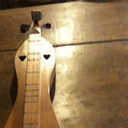
I've ordered my dulcimer! It was really difficult to choose without being able to listen to a lot of instruments. I visited Black Mountain Instruments in Calistoga CA and got to hear a beautiful dulcimer, but I wasn't convinced. My vacation took me to LA so I decided to look around while I was there. I was able to try four McSpadden dulcimers. I still couldn't pull the trigger. The loaner I am playing has a much bigger sound so I was still thinking. Then I remembered that Black Mountain Instruments makes a jumbo dulcimer. The craftsmanship of his dulcimer was excellent so I decided to cross my fingers and order one without playing it first. I should have it in a month or so. Walnut with a spruce top, rosewood fingerboard and a guitar style head. I'll be counting the days.
https://blackmtninstruments.com/buy-dulcimers/model-81-dulcimer/
Thank you for replying, Ken. A friend gave it to me...it was among several picks that were included with a used dulcimer. I like it because it doesn't slip and is big enough to hold onto.
Ilene
I wish I could help you, but I can't. The shape is the Fender 355 shape which is also made by D'Andrea. I am not aware of anyone selling a white triangular pick which has red dots imbedded in it. I can't tell from the photo, but the picks looks to be a thick one. I have some white picks in that shape from Folkcraft when it was in Connecticut, but not with the red dots. I don't think those dots where there when the pick was manufactured.
Ken
"The dulcimer sings a sweet song."
I'm trying to find out what kind of pick this is because I want to buy some more (only have the 1). It is 1.5 inches wide with braille-like specks. The specks are a gold color and are raised for traction.
.
I know, right? 
Have you considered contacting Richard Ash at Folkcraft? He seems always willing to help on questions like this.
Does anyone have experience or knowledge about this subject? I have a 2004 Folkcraft baritone and also a 1993 standard Folkcraft - both for which I am considering to have built-in pick ups installed. Thoughts? Or perhaps someone can recommend a good “stick on” option...but I have never found a good one in all these years!
I recognized you right away, Strumelia! Even the low energy dance would be a workout, if only because of how long the dancing goes on with no breaks.
But COVID has certainly changed our perspectives. Looking at all those people so close together, indoors, breathing heavy, all I can think of is how easy it would be to pass germs.
No, I'm not the guy with the kilt...lol! If you look beyond him, closer to the band. I have a black top, short grey hair, and a black skirt with pink spots on it.
Here's an example of a really bog high energy contra dance- at the Saratoga NY Dance Flurry... I've gone to this dance a few times and danced to this band... they are cool. (btw I am not in this video) It's just the two guys playing instruments, but they keep adding snippets of themselves recording them live right there and looping them on top of each other til it sounds really intense. Watch them work, but then be amazed when at around 1:45 in the video, the camera starts panning out to the dancers in the hall...  That's a major dance.
Just sitting here this evening fondly watching dances and spotting folks I remember in them... :)
Then lastly, here's one more video of the same venue in Saratoga, from this past February... just before Covid-19 came along and RUINED everything. This one has a more traditional fiddle band playing, but you get the idea of how much fun and high energy it can be... 
Because of Covid-19, the last contra dance i attended was Feb 22 2020. Of course all contra dances have been called off until things are safe again, whenever that will be. I sure miss contra dancing a whole lot. I used to go 3 or 4 times a month to various dances in different locations within an hour's drive. 
I just came across a youtube video I didn't see before, of a dance in Sheffield MA back in November 2019, it's one of the dances I used to attend regularly. It's held in a lovely old wooden community center, Dewey Hall. This particular dance tends to have quite a few dancers in their teens. It's a small hall, so we have to be a little careful not to bump into others. Most contra dances are from 8-11pm, with a 20 minute snack break in the middle.
I remember this dance, it was not as high energy compared to some other dances I go to. But it's a great mix of young and old and everyone in between. The boy fiddler Zane in the middle is only around 10 years old, and his father is playing guitar. The caller is a very talented musical young lady in her 20s named Maggie. I know many of the dancers by name. All wonderful folks, and I really look forward to the day the dances start up again... everyone will be soooo happy when the in-person dancing resumes!
You can see me here and there in the video on the right side, mostly at 0:47 and again around 1:58. I have a black top on. 
I'm rootin' for you Sandi! 
Even though I'm quiet I still love getting the e-mails updating this thread! I am a month-and-a-half into eating like a bear (keto, IF 23:1), and I cannot believe the difference already. I couldn't believe the difference in two weeks~though I do still have a very long way to go. I know that I will never view the comment, "That's just water weight," over rapid weight loss the same way again. That was water that meant inflammation, swelling, limited mobility, and needed to come off!
I do have a very long way to go, but I chose this method because of the possible autophagy helping with loose skin. I'm going to have loose skin with all I need to lose, but anything to help, please! LOL! In all honesty, this has been one of the easiest eating plans I've ever tried, and I am so thankful.
Here in South Jersey we've been continually blasted with rain and humidity since June. My and my neighbors vegetable farms are looking poorly. But I still have plenty of food for myself and family. Lately I have been going stir crazy, stir fry crazy that is ☺.
I'm still eager to know of festivals/workshops for other instruments, but if you're interested in creating one this might help. The Story Crossroads blog from Aug. 17, 2020 to Aug. 25 presents a five-part series on "How to Set Up Virtual Events." In blog format, since the most recent appears first, it's best to go all the way back to the first part, working through what you need up to the end. It's written for storytelling events, but is intended to fit other performing arts and virtual events.
Hope it helps replace some events. It gives an interesting choice of times if you want to go global.
My only regret is my other type of event is theater and "You know what you call recorded plays . . . movies."
Today I'll cleanup another area of the veg garden that is kaput for the year- the cucumbers. The tomato plants are mostly brown now, with a few odd stragglers still putting out some plum or cherry tomatoes. But I'll still be planting lettuce and radish seed every couple of weeks 'til mid Oct- they like the cold weather and will usually thrive until early December here in New York. My pepper plants are doing fine too- they seemed pretty frost resistant last year until Thanksgiving or so. I've found it helps to do the Fall veggie garden cleanup a section at a time... easier on me than trying to do it all in a couple of days later on.
I've actually been keeping up with my trampoline/rebounder sessions. It's been over two months now, and I've managed to go from starting out at 5 minute sessions to now 11 minutes, soon to be 12. I think my current goal is to be able to do a 15 minute session at least 5 days a week. That doesn't sound like a lot, but try doing jumping jacks or jumping rope for 15 minutes straight and you'll quickly see what i mean.  It's hard work!
I alternate straight bouncing with jumping jacks and jogging on it. When my 11 min are up, I get off and do some stretches and twists to finish up. So far I'm not avoiding it or feeling bored to death. I like that I don't have to spend a lot of time to feel like I've had a workout. I know it's doing me a lot of good... my legs are definitely stronger. I notice I'm going upstairs much more easily, and it seems easier to tie my shoes and do weeding or vacuuming.
I've lost about 4 pounds in the past two months, but I hesitate to attribute it to anything in particular. But far better than slowly continuing to gain, like i was before.
I have a few instruments in the banjo family.
I play clawhammer and a few other folk styles on my 5-strings.
I have a tenor that is strung with nylon strings that I often play in the Maple Leaf Champions Jug Band.
I also have a few banjoleles that I use Somebody Stole My Gal, Sweet Sue and Walkin' My Baby Back Home.
I used to play bluegrass banjo,but the arthritis in my thumbs has slowed that down a lot.
Wow, this reminds me of how I felt upon my first post-COVID dental visit. They had installed special air cleaners, implemented a number of precautions (including taking my temp and testing my O2) and put quite rigorous/extensive between-patient cleaning into place--and a lot more. My longtime hygienist was clad in all manner of PPE. On the one hand, I felt grateful they were taking so much care to protect me--and their staff. On the other hand, I was heartbroken to see Niki decked out like something out of a sci-fi movie--just do do her job safely. We had to do a socially distant air-hug instead of our usual post-cleaning hug. She had to stay in the room to be sprayed down with a special fog, couldn't even walk/chat with me on the way to the front desk as usual.
I feel the same about your story. On the one hand, I am touched they put so much care into making the wedding safe for all. On the other hand, it breaks my heart that all this is necessary.
On yet another hand...I'm with Strumelia. The Vegas mansion would not have been my cup of tea! :) I'm not a big/loud crowd kind of person...
Hope for more as their registration is only until Monday 3 p.m. CDT. I sent as URGENT FWD to our president & suggested folks prowl online for networking site of their favorite instrument.
Thanks, Dusty! I know you cover a variety of instruments. I'll send that & welcome any others. To paraphrase a popular saying, "A musician is a terrible thing to waste!"
Lois, I don't know of a list such as what you're looking for. The Dulcimer Players News website maintains a list of dulcimer festivals, but nothing beyond that. I did hear recently that the big Walnut Valley Festival is going online this year for two days of "hands-on workshops." The link there is to the list of workshops, which cover guitar, banjo, mandolin, autoharp, ukulele, and more.
Maybe everyone is waiting for someone--perhaps someone with the skills of a resource librarian--to create the list you seek.
Quick Dumb Question: Is there a site for online music festivals beyond exclusively dulcimers? Last night our local folklore society had our 1st gathering since shutting down in March. Thank heavens for Zoom even if not the same as our usual meeting. In talking, before we took turns playing & singing, there was regret over closed festivals. I mentioned attending online & was asked to share a listing of festivals. I know some of the listings at dpnews go beyond dulcimers. I'll gladly share it, but most of our members play guitar, uke, or banjo, so I'm hoping some of our instrumental generalists can name additional sites.
THANKS! (I'm that sure they exist.)