Dulcimer-Guitar Style Options?
Instruments- discuss specific features, luthiers, instrument problems & questions
Perhaps a Seagull Merlin would be appropriate? http://www.seagullguitars.com/en/products/m4
Perhaps a Seagull Merlin would be appropriate? http://www.seagullguitars.com/en/products/m4
I'm just speculating here, but perhaps you should consider a tenor guitar. However, I'm not sure anyone makes one with a diatonic fretboard like a dulcimer.
Like many mountain dulcimers, tenor guitars have four strings. You could always restring one to reflect your favorite dulcimer tuning. The only hangup would be getting used to the chromatic fretboard, which would have both advantages and disadvantages.
As KenH has stated, the more you modify the original design of the traditional dulcimer the more you move away from what would normally be called a dulcimer. The changes suggested above would result in a hybrid instrument that is part dulcimer and part guitar. It's already been done by combining dulcimer and banjo features into a "banjimer" or dulcimer and dobro features into the "dulcibro". There's nothing stopping you from modifying a tenor guitar into a chromatic guitar-like dulcimer. Good luck with your search and let us know what you decide and how it works out. You may be on to something.
Bobby's Cittern has a diatonic fret scheme like the dulcimer. American Cittern is a name that Bobby and I came up with for an instrument that he was designing and building. He doesn't have anything on his site, but I'm sure he still has pictures of what he made. Cittern is the name of an old Renaissance instrument with a diatonic neck that was not a proto-guitar, not a lute or any other instrument. It has a nearly round body a couple inches deep and perhaps 14" in diameter.
The banjo-esque sound comes from the shallow body. If you want a more rounded sound, look for a deeper body. For example, compare the sound of a McSpadden v the sound of a Folkcraft or Blue Lion. When playing an instrument in the underhand "guitar" style, you will find many of the chord/melody riffs of a mountain dulcimer impossible. You simply do not have the same reach as the overhand dulcimer style. Butch Ross gets around this by "playing in the box", similar to a classical guitar player.
Good luck and please post videos when you have settled on an instrument.
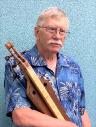
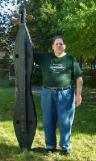
@Butch-Ross sometimes plays the dulcimer like a guitar. He has a special dulcimer that only has half of an upper bout so that he can wrap his hand around the fretboard. Check out this video . I think he had it custom-made, but I'm not sure. He is a member here, so you might ask him. If that design is something you're interested in, you might contact some of the luthiers here and see if they can make you a custom instrument.
I don't think putting heavier strings on a tin-sounding instrument like a strumstick will have more than a negligible effect. If you want a big, warm sound, you would generally need a pretty big box.
Let me add that I think your playing will be limited if you play by wrapping your hands around the fretboard. If nothing else, you eliminate the possibility of using your thumb. Notice in the video of Butch Ross that although he plays standing up for that first tune, which mostly involves strumming chords to accompany his voice, in the next clip, which involves much more elaborate fingering, he is sitting down and playing a regular dulcimer. (You might also compare the 3rd and 4th tunes in the same video for the same contrast.)
ANY dulcimer can be played "stand up". Look at the videos of Robert Force, the grandfather of modern dulcimer playing. He and his partner Albert d'Ossche more or less invented 'stand up' dulcimer.
But if you absolutely need a necked instrument for ergonomic reasons and you want something that is less 'banjo-like' sound, that's a tough one.
A. Because if it has a neck it really is not a dulcimer any more -- it's a diatonically fretted stick thing.
B. Virtually ALL stick things have very little sound box, and it is the internal volume of a larger sound box that gives you the more mellow sound of a dulcimer rather than the tinny sound of a banjo or stick thing.
One possible solution is an American Cittern built by Bobby Ratliff of Slate Creek Dulcimers. It has a relatively large body (much bigger than the run-of-the-mill stick thing) that is a nearly round teardrop shape, with a diatonic fretted neck. Contact Bobby here:
http://slatecreekdulcimers.blogspot.com/
or through his Slate Creek Dulcimer Facebook page. Tell him I sent you, what you're looking for, and see if he's interested. He built a couple of these a few years back.
Yes, the issues of a & b you mentioned - is exactly the obstacles I was running into.
I'm interested in the cittern you mentioned (But I don't see anything on his website about it) - does that have the same type of diatonic fretboard as a dulcimer? I looked at some youtube videos under "citterns" and the frets widths looked different than a dulcimer - so I wasn't sure.
I would love to learn more about this instrument! :) Kate
ANY dulcimer can be played "stand up". Look at the videos of Robert Force, the grandfather of modern dulcimer playing. He and his partner Albert d'Ossche more or less invented 'stand up' dulcimer.
But if you absolutely need a necked instrument for ergonomic reasons and you want something that is less 'banjo-like' sound, that's a tough one.
A. Because if it has a neck it really is not a dulcimer any more -- it's a diatonically fretted stick thing.
B. Virtually ALL stick things have very little sound box, and it is the internal volume of a larger sound box that gives you the more mellow sound of a dulcimer rather than the tinny sound of a banjo or stick thing.
One possible solution is an American Cittern built by Bobby Ratliff of Slate Creek Dulcimers. It has a relatively large body (much bigger than the run-of-the-mill stick thing) that is a nearly round teardrop shape, with a diatonic fretted neck. Contact Bobby here:
http://slatecreekdulcimers.blogspot.com/
or through his Slate Creek Dulcimer Facebook page. Tell him I sent you, what you're looking for, and see if he's interested. He built a couple of these a few years back.
What are the options for a dulcimer that is held like a guitar? So far I've found 1) Stick Dulcimers 2) Dulcitars and 3)Roosebeck Wildwood Dulcimer. But I don't know the 'bigger picture' of what is available. I want to be able to wrap my fingers around the neck (for ergonomic reasons). Any direction you might point me? I prefer a deep rich sound (like a dulcimer) and less like a banjo. If I have to get a banjo-sound, is it possible to put thicker strings on it to make it less tinny? I like to play slow, acoustic fingerpicking songs.
I agree with Dan's suggestions. Sustain comes from a rigid structure and light vibrating components. In my Aaron O'Rourke Fingerstyle dulcimers I use a fairly thick top (up to 0.150) to limit the sustain so the sound doesn't get muddy with fast fingerstyle play. The sides and back are 0.080 thick so they do add the the texture of the sound. On soundboards, I measure the longitudinal and transverse stiffness of the plate and sand until I get the stiffness that I am looking for. The stiffness is a lot more important than the thickness. There is a lot of useful information in the online book "Left Brain Lutherie" if you are inclined to venture into the technical side of instrument making.
A good job on a beautiful dulcimer! Here's to many more!
Very nice instrument, Jack. Thanks for sharing it with us.
Ken
"The dulcimer sings a sweet song."
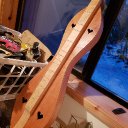
Love the rosy blonde color of that dulcimer, Jack!
Welcome to the site. 
Thank you Robin! Yes, I love that photo, because I know it’s him. My grandmother verified it 30 years ago, and I have another photo of him to verify that it’s the same man. And, his name is on the photo caption, which I cut out of the shot I posted here.
Also, I forgot to add that, the small town I live in here in PA (1300 pop.), still has their own band. The practice hall is half a block from my house, and in the warmer weather, one can here the music because they open the doors. Ah, tonight is their practice night! Maybe I will hear them. I might consider auditioning for them (on clarinet) when I retire.
Ah, the scene where they part after their wedding night! 
Juliet hates that the cursed lark is singing- because it means the break of dawn and Romeo must leave before he is discovered with her...
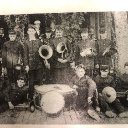
I know music is in my blood, although it skipped a couple generations. This pic shows my paternal great grandfather who was the band leader. He is on the far left in the back row (kind of in the shadows). I don’t know if he played an instrument for sure, but he probably did. If he did, it was probably a cornet. I just noticed something this morning. If you look closely around his belt line, it appears that there might be a bell of some horn there. I never looked at it closely until today. I always thought it was a pocket watch chain. This was a small town band, which, as many of you know, were quite popular during this time period. I am not certain of the date of the photo. If I had to guess, it was around the late 1890s-1910. My great grandfather was a home builder and carpenter by trade.
Glad we could be of help and that you got your issue sorted out so well!
Thanks Dusty! We enjoyed making this episode, glad you liked it.
Very moving episode, Patricia. Thank you.
Very moving episode, Patricia. Thank you.
Thanks Don! We were also touched by the stories.
Hearts of the Dulcimer Podcast - Episode 41
The Healing Dulcimer

We spoke with dulcimer players Lorinda Jones, a professional music therapist, Sally Smith, a hospice music volunteer, and Marian Perdas and Carollyn Robinson, music volunteers for memory care about how they use the mountain dulcimer to help those in need.
Hearts of the Dulcimer Podcast can be found on most podcast apps.
Here's the link to Hearts of the Dulcimer on iTunes: http://bit.ly/hotdpodcast
Don't use a podcast app or iTunes? You can listen to all the podcast episodes directly on our website: http://dulcimuse.com/podcast
We also have a resource page for every episode, where you can find photos, videos, and song lists. Here's the resource page for this episode:http://dulcimuse.com/podcast We also have a resource page for every episode, where you can find photos, videos, and song lists. Here's the resource page for this episode: http://dulcimuse.com/podcast/resource/041.html"> http://dulcimuse.com/podcast/resource/041.html
Ken is right. It sounds to me like the third fret is the bad guy. As instruments age, frets can become uneven because of wear or the finger board drying out.
There are techniques for leveling and re-rounding frets. If you don't feel comfortable working on instruments, a guitar repair person should be able to fix the problem for you.
It's probably not the 2nd fret that's the problem. Check the action height on the 3rd and 4th frets as well. I suspect the 3rd or 4th fret has risen for some reason -- humidity usually. Has the instrument had this buzz even when it was 5 strings?
Contacting Mike is probably your best bet for speedy resolution, unless you have another pet luthier in your back yard!
Your terminology is a bit confusing -- dulcimers have a melody string and two drones - the middle drone and the bass drone. So you've reduced the original 5 strings to equally spaced melody, middle drone and bass drone, correct?
Mike Clemmer Mtn Dulcimer - built in 2002; vsl 28 1/2"; tuned DAdd; strings - .012/.012/.014/.022w; original owner
Basically I'm a neophyte & started taking lessons & studying the dulcimer the last 4 months so an expert I'm not. I changed out the old strings with those listed above & I've tried both larger & smaller middle & base strings but I still have a disturbing buzz on both of those strings when playing on the 2nd fret. Open or any other fret is no problem. The height of both strings at the 1st fret is slightly more than the thickness of a dime & slightly more than a nickel at the 7th. This was a 5 string dulcimer but I've taken off the drone string, moved the base to the drone location & the middle string to the center on the nut & bridge. Space between the melody to middle string and base to middle string is the same. I've not altered the nut, bridge or any of the frets.
Any suggestions are appreciated.
Sharon that's a great question. I guess it's hard to know for sure unless you have little kids or grandkids around to ask!
It's reassuring to read Dusty's reply, that many of the same songs are still taught today in school. 
If that's so, then you might find some good ideas in this old forum thread:
music-discussions/what-songs-were-you-taught-in-kindergarten-grade-school
It's mostly the same tunes, but with updated lyrics. Instead of "If you're happy and you know it clap your hands" you have to sing "If you're happy and you know retweet this meme." 
Seriously, my kid was in kindergarten about a decade ago, and the songs were basically the same as when I was a kid. In fact, you're giving me a good idea for a "Call the Tune" for any songs for kids. We could all share our ideas for good songs for kids.
I don't measure! I "feel of" the wood panel as I'm thickness sanding to the right thickness. Flexing the panel and from experience knowing the right mass I'm looking for for a particular tone. Harder denser woods can be sanded much thinner than a softer less dense piece.
As for sustain? Panel thickness is just one variable factor in a multitude of factors involved. String selection, nut and bridge hardness or softness, nut and bridge placement, over all mass of the piece, wood selection, possibly the finish, intonation, and so on.
If sustain is what you look for, I'd try harder more dense woods sanded to around .090 if you can, harder nut and bridge, and possibly a zero fret?
Some place to start....
@Sharon-Day Great question! I know what songs I've sung to/with a little niece or nephew yet have no clue what songs kindergarteners today know.
I’m going to be teaching mountain dulcimer at our library’s Kids Fair? Do today’s kids still know Aunt Rhody? Twinkle, twinkle? Mary had a Little Lamb? My question is what songs do doday’s Kindergarteners (and beyond) sing? I’d like to teach them to play songs that they know.
Don Grundy...my mind's eye saw 'DAD (as in Daddy, Father) Tuning and I thought to myself (obviously short on morning coffee) "Awww....that's so sweet! His Daddy tunes his dulcimers for him! I wish my Daddy would do that!"

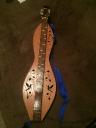
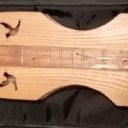
Debbie, thank you. I do not have a website. Building dulcimers is a primarily a hobby for me. What you see is the second of my builds. About half of my builds are donated to local charities such as Habitat for Humanity and Pink Gala. The rest of my builds are commissioned pieces simply generated by word of mouth. Being this is a hobby, and I prefer not to work to deadlines, I don't promise a finish date but usually have them completed within a month or two. It is nice to be able to enjoy retirement at my own pace. Other posts of mine contain photos of some of my other builds; each one is a unique/custom build.