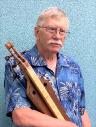
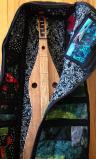
And here's a callus and there's a callus..
General mountain dulcimer or music discussions
Good one Dusty. 
One way to hasten the development of calluses is to soak your fingertips in vinegar or olive brine or something like that. Old school baseball players used to urinate on their hands to toughen up the skin. If you do that, though, please don't play my dulcimers. 
Some people's personalities have similarly marinated in vinegar, which hastens the development of callousness. Certainly no one here at FOTMD, though.
I have to chuckle every time I see this thread.
Callous means "showing or having an insensitive and cruel disregard for others."
Callus means "a thickened and hardened part of the skin or soft tissue, especially in an area that has been subjected to friction."
Occasionally I have been described as callous, but have never developed callus from playing dulcimer
That sounds really interesting john-p
(Any string tuned up from its recommended tension will sound brighter )
Good to know, i do like a mellow sound.
Good luck with all the experiment you will be doing and getting back to building - can't wait to hear how it all goes..
"Jabberwockey" sung to he tune of Annan Waters.
You need to tweak the odd line by using the time honoured folk device of adding an '-o' to the end.
Twas brillig and the slithy toves
Did gyre and gimble in the wabe - o
Good things take time, and come in little boxes. But not too little.
I hope you will share some photos of your finished projects!
Of all the "Amazing Grace/House of the Rising Sun/I'd Like to Teach the World to Sing/Gilligan's Island/Goodnight Irene" mashups my favorite (so far) is Emily Dickinson's poem "Because I Could Not Stop for Death" sung to the tune of "The Yellow Rose of Texas."
Anything goes in 4-line iambic tetrameter. Personally, I like "Amazing Grace" to the tune of "Freebird" but I wouldn't inflict it on the general public.
Oh yes! Rosin. Got to have that. In fact I received instructions inside my pack of synthetic horse hair on how to prime the hair with rosin before doing it the regular way of sliding the bow strings across the rosin bar. Yep, it's necessary for sure. I can see where waxed dental floss could be a problem...maybe not for teeth but for sure as a bowing implement. 
Interesting style. Produces a much quieter sound.
Also, try 1 up, 1 down, like Cuffy does here:
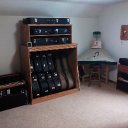
My husband built me an oak "entertainment center" (as I call it) for my instruments. This picture was taken a while ago, and I now have 3 instruments that don't fit. So, this winter he'll be building a second unit for the "overflow". The shelves on top can store 2 instruments each, so the dulcimers all go on the top part. I like to store them in their cases for protection. All the instruments get played quite a bit....takes no time at all to pull one out. The whole music room is humidity controlled (as well as each floor of the house).
K0k0peli, Interesting lyrics. Jimmy Buffett would be proud. Glad you found your avatar. I can almost see you strumming around your house amid your many musical toys, but maybe a little less blue.
Wow, i'm so happy we have a little group of us now here having fun learning to play!
Helen, though the grooves help keep the bones from sliding out of your hand slowing while playing, I think as yuo get better you may find you don't need them. The advantage of not having grooves is that you can more easily change the positions of the bones experimentally, and you will find that this changes the tone and volume more than anything else- more than the type of wood even. I have several different types of wood bones, and any type I can make louder or softer, crisper and ringy or dull and mellow- simply by changing their position in my hands. Try experimenting a lot with that.
Yay!
I use an unwound bass on a couple of mine: a Keith Young hourglass and a John D Tignor large hourglass. Keith Young and the Schillings (Jean & Lee) sold and McSpadden at least sell "squeakless" strings with an unwound phosphor bronze bass string. True, you lose a little sustain, but it is an interesting sound.
I am about to switch to .011 on my melody string, .013 on my middle, and .024 from .012- .014- .024. My VSL is 27, but I will stay with DAd (probably spelled that wrong) as I am playing with so many other players who are in that tuning. These string gauges were recommended to me by a respected instructor at a recent workshop I attended. He played my dulcimer, appeared thoughtful, then told me to try those gauges. He's either a genius, or well, not. We'll see!
For anyone wondering, Wahine (wah-Hee-neh) is my moniker on the Ukulele Underground forum. It's Hawaiian for woman, or female. Seemed appropriate. 
k0k0peli, what is the meaning of your screen name?
No callus on my thumb because I generally don't use it much. Pretty solid calluses on my other four fingers. But I also play guitar, which is how I got them in the first place.
On my Folkcraft I have 0.011s on my melody strings. I have no problem playing in Cgg with this configuration. The Folkcraft has a 27 inch VSL.
Ken
"The dulcimer sings a sweet song."
Sheryl- haha you got me on that one. ;D
One would have to used UNWAXED floss, and any filament or hair would need to be rosined up I think.
Same places as you D, but since recently recruiting my little finger, I am working on building one up on the side of my pinky too.
Strumelia, What about your shortest middle finger? 
K0k0peli, Just joined the UU forum. Beginner Uke player, with lot's to learn. Looks like a great place to do it. Thanks for your recommendation. ~Wahine
I just play with the index finger on the melody string, mostly sliding, and build up a callous on the left hand side of my finger tip.
Must have something to do with how I hold my finger down that gives the lop sided effect.
If I've been playing a lot then it can get to the point where the strings start to catch or dig into the callous, helpful on pull offs but better to file it down some.
Friend of mine has written Florida-specific lyrics to Winter Wonderland. "Walkin' in a winter wonderland" has a whole new meaning on a beach in December
Annie -- you can use the Strothers String Calculator, here http://www.strothers.com/string_choice.htm to find out which strings are appropriate for a given tuning and VSL. For CGc (not CGC which would have two bass strings) and a 27" VSL, you'll want:
C = 22 wound
G = 15 plain
c = 11 plain
C is the C below middle C; c is middle c itself.
k0k0peli, looks like one only needs dental floss or fishing line or ribbon to bow a piano,
Jan, we did that for Christmas a couple of years ago and it turned out kinds neat.
Glad to hear you are making progress on getting your dulcimer repaired.
Ken
"The dulcimer sings sweet song."
Ken, thanks for both answers. I wasn't sure who was a member of either group so hopefully posted in both places. Your suggestion for the Old Town School of Folk Music was great. I'd completely forgotten that. I'm thinking of turning my Blue Lion into a baritone which Janita said could be done. There's only a 1" scale length difference and a 3/4" length difference between what I have and their baritone. 1" width difference & 1/4" body depth difference. Still thinking about it but I've found a baritone suits my voice better. Just called OTS of FM store and got the info I need.
The simple answer is yes. I don't know how close you are to Chicago, but if you are near there, you could call the Old Town School of Folk Music and ask who in your area could do a repair for you.
Ken
"The dulcimer sings a sweet song."