Oddities hanging on your walls
OFF TOPIC discussions
The cross is really lovely, Charles. It's neat you know what the various elements symbolize.
updated by @robin-thompson: 10/27/15 09:18:53AM
The cross is really lovely, Charles. It's neat you know what the various elements symbolize.
I always get my biggest callus right at the tip of my longest middle finger. I laugh because when I recently got into my bones playing frenzy, I actually got a small callus started on the side of one of my fingers where the bones rub against it.
I play with a noter so I don't have to develop any calluses...
Barbara, I gave you an extensive answer in the other place you posted your questions.
I have a Yocky baritone dulcimer that I love but saw two small areas that have come unglued over the the past 5 years. Is there a way to get this fixed? The dulcimer is in perfect shape but I don't know where to begin or who to go to for this. Any suggestions will be greatly appreciated. It's my favorite dulcimer and has the most beautiful 'voice' ever. Thanks again. Barb
This cross was decorated by Huichol Indians with very small beads affixed with a mixture of bees wax and pine sap. The red symbols are scorpions. The story is that if you are stung by a scorpion God is is sending you a message, if you die from the sting God wants to give you the message face to face. The circular symbols at the top are peyote buttons, which the Huichol use in their religious rites. 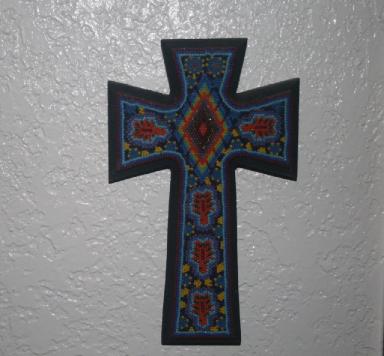
So where have y'all developed your callouses?
My most seasoned callous (much to my surprise) is the side of my thumb. Next in line is the slight side of my middle finger then the side of my ring finger and barely..well, not really on my pointing finger. I have no idea why the callous is to the side. Now I'm going to have to watch my fingers and see what's going on, ha!
In chronological order: piano, violin, cello, guitar, mountain dulcimer (!), autoharp, guitalin [www.guitalin.com], Great Highland Bagpipe, mouthoblown smallpipes, bellows-blown smallpipes, biniou, washboard, harpsichord (!). I can no longer play guitar or violin due to arthritis in the fingers, but other instruments are still doable. I love playing in groups. We have a small family ensemble called "May Milling Company" composed of myself, my husband (on washtub or bodhran), and our nephew on recorder.
Don't ever let anyone tell you you are too old to learn an instrument! I have a good friend whose father played the clarinet all his life. In his 90s he took up the bassoon! Etta Baker was a fine bottleneck guitar player in the Piedmont of North Carolina. We had the pleasure of seeing her at Merlefest back in about 2004. She was in her 90s and had just taken up the banjo.
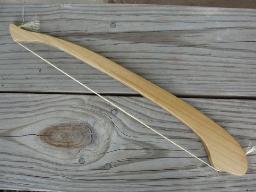
k0k0peli, I looked into using a stick to flex and tie horse hair on it but I wanted to do something special for my neighbors. That's why I decided to make a psaltery bow. When I did research on bows for the violin uke and psaltery I did come across instructions for making a simple bow. ( http://dennishavlena.com/psaltery.htm ) I'm not sure how well a Popsicle stick would work as it is very short and I don't think it would be that easy to put string on it without having to cut slots etc. Just my uneducated opinion. Other than the scroll saw (I already had one) I didn't spend that much money making the bow. I already had tung oil, sand paper, fine steel wool and paste wax from a previous project. I didn't spend much on the synthetic hair, rosin, glue and poplar wood. In fact, I purchased an extra piece of poplar wood just in case I messed up. It wasn't expensive at all.
I would think she could test out the switch before actually buying a left handed dulcimer by flipping the dulcimer around and just going through the motions of making chords and strumming in her opposite hands...without paying attention to any 'wrong' sounds that result in the test. The question would be if she can make and hold down chords with her hand that has tremors. One other thing to keep in mind is that it's a little harder to resell a lefthanded dulcimer than a normal one.
I would think a large flexible pick made from cutting a big triangle out of a stiff plastic deli container- try the side, the bottom, and the lid for different stiffnesses.
I know our wonderful FOTMD member Lexie might be able to give some excellent advice here- i hope she jumps in! 
Thanks so much, Tumbleweed. :)
Wout said:
"My ten years old son just hides my bones, but I have a rather large collection."
That reminds of the joke: "Our parents moved around a lot when we were growing up. But we always found them." lolol
Regarding an unwound bass string - Noter drone players may use an unwound bass string of 18-20 gauge plain steel (guitar, banjo or piano wire). This string is never fretted but used as a drone. And used this way a plain bass string produces the high silvery timbre many noter drone players want from certain instruments in their collections. I use plain gauge bass strings on some of my noter drone specific instruments (usually made from piano wire). If you do intend to fret a thick plain gauge string at a relatively low tension then the intonation will be poor to awful  Thick plain gauge strings also have reduced sustain compared to their wound counterparts - so if you intend to fret the string up the fretboard you'll tend to just get an out of tune 'thud'.
Regarding back fretting noise: A slightly higher action at the nut or using a dampening finger kills this.
Regarding an octave lower bass - You can do this but will need quite a thick string (around 0.054) and higher action, plus wide nut and bridge slots. However, the dulcimer body itself is not capable of producing the fundamental low frequency D2 (or D3 for that matter!!!!) So the string will sound 'boxy' rather than rich.
Basically, the mountain dulcimer, at the body size, shape, VSL and pitch we use today was never designed for playing chords in DAd or CGc. Our modern instruments are based on the size and shape of older instruments that were played in noter drone style with a different set-up, tunings and strings (for which the box size and shape sonically work well). So contemporary chord melody playing is always going to be a compromise. As you say, it is not expensive to play around with string gauges and set-ups so it is well worth you experimenting to find out the set-up that will suit your style of playing the best.
That's the next phase of litigation. We will see what the judge decides.
Ken
"The dulcimer sings a sweet song."
A victory for people and a strike against corporate greed!
I wonder if Warner will be obligated to pay back all those royalties they demanded over the years.
Thanks Ken! And thanks for your advice!
The strings that I use on the Prichard dulcimer and others are , .013 melody and middle and .020 on the bass . These srtings are hand made plain steel piano wire. That's what I sent to Ken also.
Really good job there, Patty. Looks professional. I'm sure your neighbor will enjoy using it.
Ken
"The dulcimer sings a sweet song."
Very nice job Patty, Looks like it will be a fine bow.
I play unwound bass strings. I find they help me get the 'high silvery' old time sound I prefer, rather than the more mellow modern sound. Most of my dulcimers have a 27" VSL and I find that a .018 plain steel string works pretty good for the range of tunings that I use. I you like that mellow 'guitar-like' sound then use a wound bass string, IMHO.
D2-D3-A3-A4 equidistant -- Sure. Why not. I've not seen/heard anyone do it, but don't let that stop you if you're looking for baritone/bass sound. You'll probably want a new nut and bridge set up for 4 strings rather than filing a bunch of notches on the ones you'll have.
re - vibration on the back side of the fret. I'd say that you're not fretting quite hard enough. It could be the low tuning with the strings you have, but it sounds more like not fretting firmly enough. The sort of 'standard' action height is what we call "nickel & dime". That is strings just touching a dime placed next to the first fret, and also just touching a nickel set on top of the 7th fret. You can lower the action more if it suits you, by sanding tiny amounts off of the bottom of the net and bridge.
The string gauge calculator many of us use is at http://www.strothers.com/string_choice.htm It is noticeably light , however, and you can generally go 1-2 gauges heavier.
Just wanted to let you all know I finally finished making a bow (psaltery bow) for my neighbor's violin uke. Here is a picture:
The strings gauges used on the Sweet Woods instruments are for playing in DAdd. There is no reason they can't be used for C - G - C, but will be at lower tension when tuned to pitch. The "ideal" string for the "C" bass would be a 0.023. Wound strings have an inner core that is a smaller gauge. If you tried to tune up a 0.023 to the C bellow middle C you might break it. In the usual DAd tuning the Ds are an octave apart. The high d being a note above middle C and the low D below middle C. Do you want to go an octave below that?
Ken
"The dulcimer sings a sweet song."
Don't forget the alternate lyrics-- my favorite lyrics at one time. I assume these were never copyright protected. :)
Happy birthday to you
You live in the zoo
You look like a monkey
And you act like one, too!
Notice how Happy Birthday doesn't even have a "B part"? ...'cause the candles are melting and so is the ice cream, so hurry it up! 
Hi Rob, I have been doing this song since the 60's, and now do it on the dulcimer. Had their original LP but don't know what happened to it. For those of you who may not know, Richard died in a motorcycle accident just after his book came out. Mimi (Joan Baez's younger sister) died of cancer around 2003.
I play it bagpipe...
0 0 1 0 3 2
0 0 1 0 4 3
0 0 7 5 3 2 1
6 6 5 3 4 3
Could someone email me a tab of that for the dulcimer?
Here's a link to a video you may know about already; I reckon it's the only one of Richard and Mimi playing it. The video and the sound aren't in synch, but you can get the idea from it. I think he's playing in DAd based on his tuning at the beginning and the position of the chopstick he's using as a noter. That being said, I think it sounds good in DAA and John P's notes should be able to get you started.
Neal Hellman's made his "Richard Farina Dulcimer Book" available as a free pdf, but that song's not in it, perhaps because Mimi and Joan's sister Pauline is credited with authorship. Some say she just gave him the title, but he wanted her to have something material from the idea.
http://gourdmusic.blogspot.com/2010/05/liberating-richard.html
Can we do that as a monthly challenge? lol
Well, it's about time! The copyright was no longer benefiting the family, just some corporation.
Well, how about that! Happy Birthday everyone!!
Ken
"The dulcimer sings a sweet song."
http://consumerist.com/2015/09/23/judge-says-happy-birthday-song-no-longer-covered-by-copyright
http://www.nbcnews.com/pop-culture/music/music-company-does-not-own-happy-birthday-song-copyright-judge-n432001
several other sites have posted the information also
Hi joos.
This Richard Farina recording on youtube is done in noter/drone style, and it's not too difficult to pick out the notes by ear.
Pack Up Your Sorrows
What's a bit more difficult is that the tune has a slightly broken strum that may take a bit more work.
If you would like to try picking it out by ear - here's a nudge to get you started.
5 7 5 4 3 8 8 8 10 8 7 6 / 5 5 5 7 7 5 4 ...
Tuning is Ionian DAA (or equiv).
If you would like to use DAd then subtract 3 from the fret order
My ten years old son just hides my bones, but I have a rather large collection.
My upstairs office is directly above Brian's downstairs office. For bones practice, I'm supposed to go in the other upstairs room to cut down on the racket...oops I mean rattle. And 10pm is the bones curfew, which I think is quite reasonable. lolol