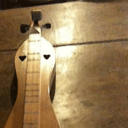
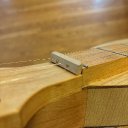
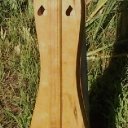
Dulcimer by JR
Instruments- discuss specific features, luthiers, instrument problems & questions
It might be from Dulcimers By JR, 10068 Stonecreek Rd., Newcomerstown, OH 43832
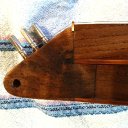
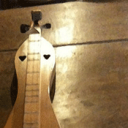
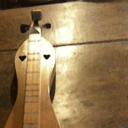
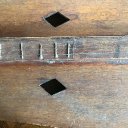
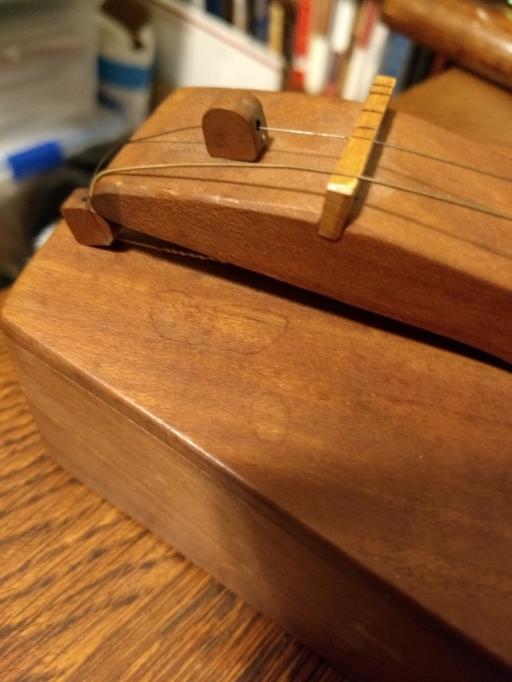
I got this dulcimer aboit 1982. It is a wonderful instrument but I don't know the maker. Inside is a stamp which has "Appalachian and Hammer Dulcimers by JR ( or SR)." It lists a phone number with a Northern Ohio area code. The number is no longer available. I would like to know the builder.
In the Ramblin' piece, it was nice to see how many were in the audience to see Jean Ritchie!
The Ritchie video called Mountain Born is different from the one on the series Ramblin'
I managed to find and stream the show on West Virginia Public Broadcasting's Passport listings last night. My route was a search for "Ritchie" and it was way, way down on the list. I think the actual title may be "Mountain Born," with a 1996 copyright date.
It is well done. A "musical biography," not a concert piece.
I agree with Robin. Can't wait to see the show.
Ken
"The dulcimer sings a sweet song."
THE EXPRESS WAY WITH DULÉ HILL
Appalachia
Will air again:
Wednesday, May 01
01:00 am ET
...will be in a PBS program Tuesday night the 30th.
https://www.pbs.org/video/dule-meets-master-luthier-doug-naselroad-d6qxa3/
Supposedly, so the story goes, Richard Fariña had a luthier install a 6+ fret in a car on the way to a gig so that he could perform a song he had just written, which makes me think he was tuned DAA and/or playing with a noter. Had he been in DAd, he could have gotten the C# on the 9th fret of the middle string instead of the 6+ on the melody. Either way, the story demonstrates that the 6+ fret is useful not only for tuning DAd and playing across the strings.
This was a really cool learning opportunity
Thanks for suggesting this topic
Nate
My question is ... when did the 6 1/2 fret become popular?
I started building dulcimers in 1974; 50 years ago. At that time none one plans I found had a 6 1/2 fret. So, become popular? I guess sometime in the early 1980s or perhaps even the late 1970s.
Precursors of the mountain dulcimer, those built like their European ancestors, sometimes had "odd" fret patterns. These patterns sometimes represented a different starting place for the "do" of the scale. Sometimes they just represented the "bad" ear of the builder.
Ken
"The dulcimer sings a sweet song."
Thanks, Ken!
My question is ... when did the 6 1/2 fret become popular?
I started building dulcimers in 1974; 50 years ago. At that time none one plans I found had a 6 1/2 fret. So, become popular? I guess sometime in the early 1980s or perhaps even the late 1970s.
Precursors of the mountain dulcimer, those built like their European ancestors, sometimes had "odd" fret patterns. These patterns sometimes represented a different starting place for the "do" of the scale. Sometimes they just represented the "bad" ear of the builder.
Ken
"The dulcimer sings a sweet song."
I have a friend who built a fretboard so that the Nut was 4 notes below the normal Open notes of DAA.
I just finished watching-- a real gem!
Thanks, KenL and KenH, for the information which pointed me to where I could watch the program.
Dusty, the link between using the 6.5 fret and also fretting on the middle string is exactly what I was thinking.
Ken, that is cool and informative I had never even considered that other fret layouts could be used.
If you have PBS Passport, the entire Ramblin series is available there. Jean's episode is Season 1 episode 104. I'll be watching it later tonight....
Not sure about staple 6+ and 1+ frets but there certainly were some unusual fret patterns used by some builders, certainly! For example fret patterns to play the Major DAA Scale from the Open fret not the 3rd fret.
1-5-8 is the numeric designation for Mixolydian Mode tunings, so yes, it was used ages before the 6+ fret came along. Those of us without plus frets change tunings from Ionian to Mixolydian to Dorian or Aeolian and the other Modal tunings simply, by changing the open note of the melody string(s). 'Way back, many of the old timers tuned to either 1-8-8 (bagpipe tuning) or 8-8-8 (unison tuning with all strings the same gauge, all tuned to the same note -- a.k.a. Galax tuning.
I doubt it. But that's a good question.
Yes. Absolutely. You cannot play tunes based on the mixolydian mode otherwise. So "Going to Boston" and "Old Joe Clark, " for two common examples, necessitate a 1-5-8 tuning. My guess is that people referred to the tunings by common tunes. So 1-5-8 might have been referred to as "the Old Joe Clark tuning" and 1-5-7 might have been "the Shady Grove tuning."
More generally, I think you are right to connect full-length frets with extra frets. The 6.5 fret allows the 1-5-8 tuning to get the major 7th note of the major scale, but melody notes below the tonic have to be played on the middle string. So the 6.5 fret alone would not necessarily allow a drone player to play in the ionian mode. (Not trying to scare anyone with fancy terms, plagal melodies require using the middle string in 1-5-8 but authentic melodies do not.) My point is merely that only if we are fretting across the strings can we make full use of a 6.5 fret.
Having said that, some drone-style players do indeed make use of extra frets. Don Pedi has both a 1+ and a 6+ on his Modern Mountain Dulcimer dulcimer, although he often uses more traditional dulcimers for demonstrations.
A related question I have is: are there any historical examples of dulcimers with partial/staple frets that also include a 6.5 or 1.5? Also, was 1-5-8 in use before the 6.5 was added?
Jerry, I don't think there is a specific time. It was a slow evolution. According to dulcimer lore, sometime in the late 60s Howie Mitchell and Richard Fariña both independently put 6+ frets on their dulcimers. Slowly over the next 40 years or so, it became more popular and is considered standard today.
I wonder if the same evolution will happen with the 1+ fret (which I use). It is still in the minority now, but some luthiers are offering their standard dulcimers with the 1+ and 6+ frets, and you have to specify if you want a traditional diatonic fretboard.
I once asked Neal Hellman when he started using the 6+ fret and he couldn't even remember. He acknowledged that his first dulcimers were all diatonic and that his later ones all had the 6+ fret, and yet he couldn't remember when he first starting using the fret. Apparently the change for him was no big deal.
I hope this conversation can stay focused on the timing of this change rather than turn into a debate on the merits of different fret systems and styles of play.
Hello friends! Most of the dulcimers in my collection are "traditional" -- that is, without the 6 1/2 fret, and I've never felt shortchanged, because I mostly play noter style, with a little bit of chording (kind of like Richard Fariña). My question is ... when did the 6 1/2 fret become popular?
Here's a song I love to play on my concert uke tuned gCEA .
Walkin' My Baby Back Home
Yes, Richard, it's a little late for me too. Worship starts at 9 a.m., so I might get 5 or 6 hours sleep if I'm lucky.
Ken
"The dulcimer sings a sweet song."
Thanks Ken. A little late for me. Maybe I can find a recording of it later.
We are members of WPSU, a PBS Station in Clearfield, PA associated with Penn State University. Not all PBS stations follow the same schedule, nor do they broadcast the same content, which is why I'll likely be streaming the show.
Ken
"The dulcimer sings a sweet song."
Way cool! We're members of Ohio University's WOUB-- it's located the next county south of where we are here in Perry County OH.
On an unrelated note, though I have never lived in Athens County OH one set of my ancestors married there in 1818.
I received a notice today that WOUB, a PBS TV station) will broadcast a program about Jean Ritchie on Saturday, April 20, at 11 p.m. EDT. It looks like it can be streamed if you are not in their broadcast territory. All I know about this is what is in the link: Jean Ritchie on "Ramblin'"
Ken
"The dulcimer sings a sweet song."
[quote="NateBuildsToys"]
[quote="shanonmilan"]
[/quote] Does it also make it sound better that you use a specially coated string?
[/quote]
Shanon, each material sounds slightly different, but I don't personally think any sound better than any others.Some are magnetic, which is useful for a dulcimer with electric pickups. Some use fancier metals under the premise that they sound better, but I personally like the different sounds of all string types. Maybe a more refined ear would hear more of a difference.
Nate
[/quote]
That's a pretty comprehensive explanation on how stuff works.
Dwain, Don Kawalek is also a vendor at Pocono this year. Although not known as a dulcimer builder he has been making guitars, banjos, and mandolins for many years. He worked for a guitar builder in New Jersey for a while and then went on to become a shop teacher in northern Virginia. I don't know if he does any repair work. I met him when I took a week long banjo making class from him.
Ken
"The dulcimer sings a sweet song."
Ah! I missed seeing Kawalek. I think I met him at last year's Nutmeg Festival, in Milford, CT. Fantastic work, and a very unassuming guy. When I asked him where he hailed from he said "I live in West Virginia, under a rock."
Dwain, Don Kawalek is also a vendor at Pocono this year. Although not known as a dulcimer builder he has been making guitars, banjos, and mandolins for many years. He worked for a guitar builder in New Jersey for a while and then went on to become a shop teacher in northern Virginia. I don't know if he does any repair work. I met him when I took a week long banjo making class from him.
Ken
"The dulcimer sings a sweet song."
Dwain,
Are you talking about the Pocono Dulcimer Festival? It is a full day drive from Michigan, but a workshop where builders talk sounds fascinating.
Have you had these workshops before. Who shows up, what day will it be?
Matt
Yes, the Pocono. I really appreciate your interest and willingness to consider the journey!
I'll be teaching a workshop on how to repair cracks in any surface of the body of a music instrument, including gluing in cleats across the crack, entirely from outside the instrument, using a soundhole for passing in the cleats and interior clamping gear. The workshop is listed as "Laparoscopic Crack Repair." Saturday, 9-10:15
There will be plenty of time to talk with me (unless people bring a lot of cracks to be repaired, extra fret installations and other refit/repair work) and the other builders there and exchange techniques, views on effective design, finishes, etc. Currently, David Fox, Bernd Krause and Gerry Heinrich are the other dulcimer builders registered as vendors. And as Ken mentions, he will be there for this workshop. Looking forward to visiting with you, Ken!
I am signed up for Dwain's workshop. The nice thing about the Pocono festival is that you can sign up for individual workshops rather than for the entire festival. Looking forward to seeing you at the end of the month Dwain.
Ken
"The dulcimer sings a sweet song."
Dwain,
Are you talking about the Pocono Dulcimer Festival? It is a full day drive from Michigan, but a workshop where builders talk sounds fascinating.
Have you had these workshops before. Who shows up, what day will it be?
Matt
Hi Beth loved your exclamation about the D.A.A. disorder. I had a slight out break myself here. I almost bought a beautiful Used Blue Lion Dulcimer. But after adding up the cost of the instrument having it shipped back to Blue Lion to have a pickup installed and retrofit the fretboard with the one and a half fret and having no idea what it sound like, the cost reality hit me. There's an old saying with people with a custom car, paint and Chrome won't get you home. I guess what I'm trying to say is the aesthetic of the instrument got the better of me, then the practicality sunk in. I'll just stick with my FolkRoots and just accept the reality I can only play one instrument at a time. I'm much better now and have managed to shake off the disorder for now. ;o)
G -- GDG Good on a short VSL dulcimer
Beth:
Send in the Music ( https://www.sendinthemusic.com/) is a Free Zoom music jam each Saturday out of Fla. there is a couple
If you don't know them, maybe you could contact them - write to Pat, she could help you out ( pat@sendinthemusic.com )
Quick clarification: "DAA" can refer to either a common tuning for us dulcimer players (with the bass string tuned to a low D, the tonic note played at the third fret of melody string, with the dulcimer played in the key of D) ...OR it can stand for "Dulcimer Acquisition Affliction"... a not uncommon illness whereby one succumbs to buying multiple dulcimers with little or no self control.
Sometimes the DAA illness settles down on its own after the initial raging fever. Other times, symptoms continue until friends or family stage some sort of intervention, or a storage/financial wakeup call occurs. Rehabilitation and/or therapy may be necessary for a return to 'pre-dulcimer discovery' normalcy. 🦠 🚑