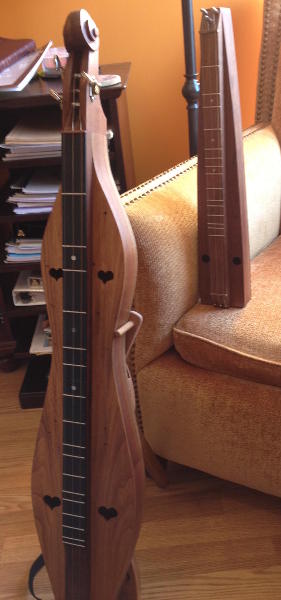
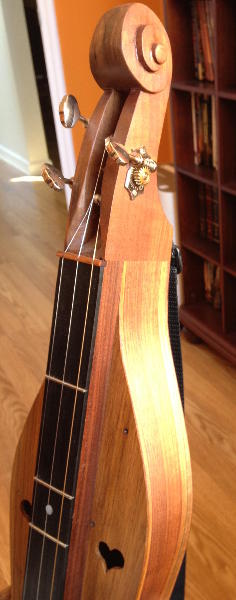
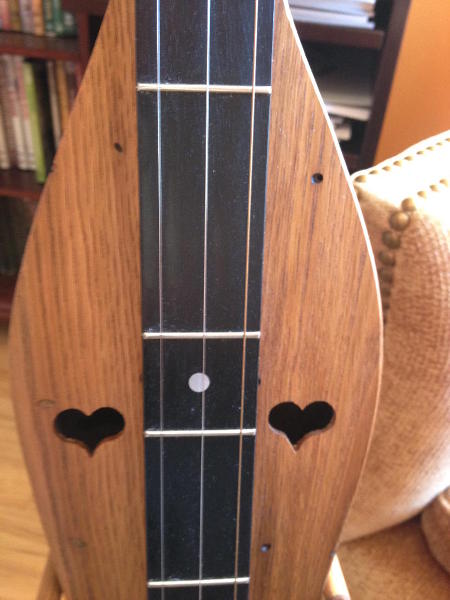
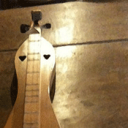
I've stayed away from this conversation because, as those who've taken part in such discussions before can attest, things can get a little testy. Can a dulcimer have "extra" frets? Can you play chords on it? Can you reverse the string order and hang it over your shoulder like a guitar? If I tune my guitar DGDGBD and lay it flat on my lap, is it a guitar or a dulcimer? If a cigar box is used as the sound box, does the fretboard become a neck? Can it still be a dulcimer then?
Rather than asking "what constitutes a dulcimer" which only encourages us to draw a sharpboundary between dulcimers and other similar hybrid instruments, let's askhow to define a traditional mountain dulcimer and traditional mountain dulcimer playing, and then explore what some of the variations of that instrument and those playing traditions are.
Even the analogy of waterfowl species doesn't quite hold up. A goose may not be a duck, but if you see an odd-looking waterfowl that appears to be half goose and half duck, what is it? We define a species as a a group of animals that can produce fertile offspring. There is a species of bullfrog on the east coast whose habitat ranges from Maine to Florida. At each step of the way, the bullfrogs can mate with those around them. But if you take one from Maine and one from Florida, they cannot mate. Or let's try another analogy. Take an ice cube and put it on the counter. It immediately starts to melt. On the outside, therefore, is water, and in the very center is ice. But where is the boundary between those two? As long as it feels wet, it is water, and you can never quite get to the ice because as you get there it begins to melt.
Sometimes there are no clear boundaries and rather than inventing them to make our classification system seem more rational, we should just accept that everything is in flux. Traditions evolve. Let's embrace the old, and the new, the long accepted and the avant guarde. If the music is sweet, it's all good.