Central Fl dulcimer festival, February, 2024
General mountain dulcimer or music discussions
Sadly, I have other commitments that weekend.
Sadly, I have other commitments that weekend.
I'd like to meet some fellow fomd members at the Mt. Dora festival coming up in early Feb. Are any of you planning to attend?
Thank you Jost. I appreciate your posting those links to information about the langleik. That is interesting reading. I especially liked learning about the tuning of the langleik to the key of A. We have a state park not too far from me that is named after Ole Bull. That part of Pennsylvania had many Norwegian immigrants working in the lumber industry. I haven't discovered any references to the langleik among the lumbermen, but there are references to the dulcimer, but in this case it is the hammered dulcimer.
Ken
"The dulcimer sings a sweet song."
Yes, those are excellent books and must reads for folks who want to learn about mountain dulcimer history and context. One part of your question we have not addressed is the use of European predecessors of the mountain dulcimer. Wilfried Ulrich addresses some of this in his book The Story of the Hommel . There are many such instruments in museums in Germany, Belgium, Denmark, Norway, etc.Unfortunately I am not aware of English translations of literature that describes how folks used these instruments. What is clear is that they were "folk" instruments and not considered to be of great value musically. Again, they were mostly played by folks in their own homes for their own enjoyment.
At least Wilfried Ulrichs book is available in English from himself:
http://www.ulrich-instrumente.de/kontakt-links-impress/
https://hogfiddle.blogspot.com/2011/05/wilfried-ulrich-story-of-hummel.html
Some of the information is also available on his website (in German though so you might want to use a translation service like Google Translate, deepl etc).
Now according to Ullrich one of the oldest references of an hommel is the use in a procession (propably with a kind of strap). He also displays a hommel which was built by a carpenter named Adolf Hilke who played it in the local dances until the concertina and accordion took over at the beginning of the 20th century (they were louder than the hommel thus getting more popular soon).
Now my own hommel and galax dulcimers both are quite loud so I guess the actual volume might depend a little bit of the way of building and circumstances.
The norwegian langleik ( https://en.wikipedia.org/wiki/Langeleik ) is interesting as a kind of edge case: It was mainly played by women who tended their livestock on mountain meadows during the summer in their bothys. According to the German wikipedia:
The music played on the Langeleik is divided into dance songs and melodies for listening. The dance songs include the lively and fast dance style halling, named after its home region Hallingdal, the ganger and, in Valdres, Hallingdal and Telemark, the springar, which is played in a strict asymmetrical ¾ time. Several composers adopted the rhythm and melodic forms of springar, including Edvard Grieg in his folk music adaptation Jon Vestafes Springdans Opus 72/2. Grieg was preceded in the popularization of folk music by the violinist Ole Bull (1810-1880) and the composer Ludvig Mathias Lindeman (1812-1887). Lindeman's extensive collection of Norwegian folk songs Ældre og nyere norske Fjeldmelodier ("Older and Newer Norwegian Mountain Melodies") appeared in twelve volumes between 1853 and 1863, with a follow-up volume published in 1867. According to the Norwegian pianist Einar Steen-Nøkleberg, his piano arrangement of the dance piece Springlått contains typical Langeleik tone sequences to be played by the left hand[12] .
Concertante pieces of music belong to the group of klokkeslåtter or huldreslåtter ("Huldrenmelodien", Huldra is a beautiful girl related to the trolls in Scandinavian mythology)[13] .
Here's one I learned from The King Of The 12-String Guitar, Lead Belly. Alabamy Bound
I love playing the call & response.
Here's one I learned from The King Of The 12-String Guitar, Lead Belly. Alabamy Bound
I love playing the call & response.
I love that warm sound 12 string guitars make. Not to mention the additional details it adds to even the simplest chord change.
If you're reading this, and you're a banjo fanatic,
there's a player you should seek out named Kyle Tuttle.
He and I shared a few motorcycle rides, and lived only a couple blocks apart.
A simple google search of his name will bring up a nice overview of his work.
Just yesterday I enjoyed a presentation by Aubrey Atwater at the Dulcimoon Virtual Dulcimer Festival on the playing styles of Jean Ritchie. One important point that emerged was the way Jean accompanied her singing. She neither played the melody on the dulcimer nor strummed chords (obviously), but played a "counter-melody."
Watch her play "Lord Thomas" here , paying attention to what she is doing on the melody string while she sings. She is not playing a harmony in the way we understand it in modern pop music with parallel thirds or fourths that follow the melody, but rather a different melody, one less elaborate than the melody, but a different melody entirely that accompanies (or runs "counter" to) the song's melody. If you keep watching the video to hear "The Cuckoo," you'll hear the same thing.
The counter melody style of play is similar but not identical to our modern use of harmony; it plays a role similar to chord play in hinting at harmonic changes underlying the melody; and it often offers "filler" licks in the interstices of the song's main melody. In other words, the dulcimer is playing three different roles as we define them in modern music.
This is quite a difficult style of play to master, and it has mostly been lost in modern dulcimer playing. When we say that a traditional role of the dulcimer was used to accompany singing, I think it important to point out that it was done in this manner that is strikingly different than the way we use the dulcimer today.
I would also like to point out Jean's right hand. She is picking (mostly with her thumb), sometimes plucking only the melody string, sometimes plucking all the strings one-at-a-time, and sometimes strumming, either all the strings or the two drone strings after having plucked the melody string. This style of play is far more varied than modern playing in which people assume you have to strum all the strings all the time.
We are responding to a thread that is four years old. I'm not sure how popular the Cherub pickup is among mountain dulcimer players as I haven't been to any "live" festivals since the pandemic. Bear in mind that this is a pickup and not a microphone. It responds to vibrations created by the strings and any touch on the instruments surface. It clips on to the top of the dulcimer through a sound hole. It may not fit in narrow or small sound holes. I'd be interested in knowing how it works if anyone here uses one.
Ken
"The dulcimer sings a sweet song."
Age of the instrument doesn't mean thing when it comes to installing an after-market "built-in" mic. Not anything you want to DIY for the first time.
It seems like a Cherub pick-up/mic is really popular among dulcimer player.
Thank you for all of the comments.All pieces of the puzzle.
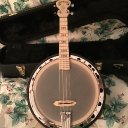
Nate. You have a cool Uncle. That is a nice looking banjo. Last year bought a Deering Goodtime 2 banjo and later bought the Deering Goodtime Banjo/Ukulele. Love it. Easy to play and sounds a lot like a banjo.Steve B.
I am amazed by the wealth of music available to listen to on the website going back 14 odd[whatever]years.Just a fabulous resource,the variety,the playing styles[all so individualistic which seems to be a trait of the mountain dulcimer]...I would feel quite bereft was this website not available anymore,it provides a sense of community and musical inspiration...
I have shipped more with USPS than other shippers mostly out of convenience. I always pay for insurance and I am careful to pack the dulcimer well. Sometimes in a box inside a box.. I use lots of bubble pack. I usually loosen the strings as well. Label the outside of the box fragile--musical instrument. Hope that helps.
I shipped a large Galax dulcimore from the Detroit area to St. Catharines, Ontario, Canada (Niagara Falls area) in a plywood box using Parcel Monkey. I took it to a FedEx office nearby for them to send it with the label I printed for it. Everything went well that time.
I'm wondering which shipping carriers you folks recommend for safely shipping a mountain dulcimer. Prices vary widely, and some do not offer insurance (UPS & FedEx). Your experience and recommendations, friends?
We're proud to "have you on the bus", Nate! You have some amazing ideas. Thanks for sharing them with us.
He was my good friend for many years. I was sadden to hear of his passing, Took the wind out of my sails so to speak. This Feb. 23rd. at the Gardner Winter Music Festival they will be having a memorial for him. I was asked to speak on how Wartz came about. Rob, Kevin Messenger, and myself were the "Three Amigo's" that got it started. But Rob was the backbone and driving force of the group. So caring and a great teacher. He will be missed by all. Rest in peace my friend.
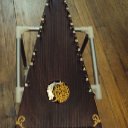
As promised, psaltery arrived today and pix are up.
Maker Richard Krueger (deceased) sure did a bang-up job on this one.
I'm thinking the dark wood is walnut, and the light wood is rock maple.
The inlays are well-done, both wood and mother-of-pearl.
It's a work of art as well as an instrument. I am thrilled ! !
Condition of psaltery and bow appear to have little or no use.
Age is at least 25 years. Included is a songbook compiled by Jean & Lee Schilling.
I've run across their names before. Maybe they have also done some autoharp material.
There's a bit of irony here as the Schillings are in Cosby, TN.
and my girlfriend of 5 years (now ex) is also from there.
Update: Did some reading and find that Jean Schilling actually related to ex-girlfriend...lol
I agree with Dusty. I too started out playing a guitar for nearly 30 years before picking up a dulcimer. Three strings and a diatonic fret board, should be a cinch, right? I'm still working at it. As Dusty mentions, the chord shapes that one may be accustomed to laying anywhere on the finger board for what ever chord needed doesn't work. But for all that, if I wanted to play the guitar, that is what I would grab instead. The fact that it is not the same as a guitar is part of the appeal for me.
With the loss of such a positive support beam in the dulcimer community, it reminds me to express my gratitude to y'all. I am very grateful to have found this community of kind, helpful, non-judgmental, encouraging, and inviting folks who I can share the dulcimer with. You have all had a tremendously positive impact on me, and I'm grateful to be able to interface with all you great folks.
I love you all,
God bless all,
Nate
"It may be true that there are no wrong notes on the dulcimer, but that doesn't mean that all the right ones are there"
Dusty, that deserves a place in the fun sayings about dulcimer chat.
I think of diatonic and chromatic dulcimers as two roads that lead to different kinds of attractions along the way. One will mainly take you to traditional music, both modal and pentatonic, and the other leads you to pop, blues, and jazz. Both can cross over a little bit, but they have different emphases.
Of course, I mainly play a dulcimer with 6+ and 1+ frets, so I've chosen a kind of middle path. I play mostly diatonic music but can occasionally add blue notes or switch keys in ways that would be much more difficult on a truly diatonic instrument.
I would like to caution us all not to assume generalizations hold for everyone. I played the guitar, mandolin, and ukulele before discovering the dulcimer, and the diatonic fretboard did not make the instrument easier to learn. On the contrary, the fact that I could not play so many of the songs in my head was very frustrating. It took about 2 years of playing everyday for me to get a sense of what melodies could be found on the diatonic fretboard and what couldn't. (It may be true that there are no wrong notes on the dulcimer, but that doesn't mean that all the right ones are there!)
And chording on the diatonic fretboard is more complex. On a chromatic fretboard, a chord shape will be the same type of chord as you move up and down the fretboard, but on a diatonic dulcimer, that chord shape changes between major and minor. That fact significantly slows down the development of dulcimer players who wish to play chords.
Never heard it put that way or thought about it that way Nate you're right on the money.
I will miss him. He did a soundtrack for Carrie and me as a spoof of Where O Where Are You Tonight. He did a bit of a rework on Where O Where Has My Little Dog Gone for me as well. He taught us so much. He organized the Wartz gatherings every Spring and Fall. I've got video of him at the Wartz gatherings on my page. Carrie used to say he would make a washboard sound good. He was that good of a musician. He could take any dulcimer and make it sound great. I just found out about this from Jim yesterday. It made me cry. I will be keeping his family and friends in prayer. I surely will miss him. I'm so glad I have two of his cds. I can still hear him play.
https://spicermullikin.com/robert-neil-lackey/?fbclid=IwAR37K4AGHLNxW4nEqm1lxTcoiKd7Z_6M3ymarh7o6_Gmaos5LWHjlzQMfWc
I built my first three dulcimers under the tutelage of a violin maker, so I had good instruction on fitting pegs. While I can describe the process, watching it is probably better. There are some good videos on YouTube that deal with peg fitting. Anyone can check them out if they want to the job. For me the process was watch one, do one with my teacher watching over the process, and do another on my own. Of course, like any task it gets easier with practice. You develop a feel for your tools and the process. It would have been easier for Curt if the original owner kept the original pegs.
Ken
"The dulcimer sings a sweet song."
Peg fitting is indeed a delicate process, and your journey from watching to doing resonates with my own learning on the violin.
Whenever I take up a new instrument, it gives me a fresh perspective on the other instruments I play.
It's funny that you mention this. My experience with chromatic dulcimer is that it enhances my perspective of diatonic dulcimer. The cultural place of chromatic and diatonic dulcimers might be different, but to me, as a self taught dulcimer player, chromatic dulcimer provides me with useful contextual information that I can apply to diatonic.Specifically, hearing the ways that the same chords that I play in diatonic can fit into other keys helps me to think of them with a more open mind.
Nate
A couple of the pads had been damaged over time, and it took QUITE a while to tune up, but the ethereal brightness of the sound is unlike any other instrument I've heard. Such a beautiful sound.
Nate
Autoharp seem to find their way to me, although don't play. I usually either give them away or sell them. My sister has an autoharp which I completely repadded at one time. I've replaced pads on other autoharps as well. Also replaced string, repaired tuning pegs, etc. Partly, this is because I have friends who play and also having been friends with George Orthey and a friend of Greg Schreiber. I also hosted and emcee autoharp concerts for about 20 years, so I know a lot of professional players and builders. I enjoy listening to autoharp music.
Ken
"The dulcimer sings a sweet song."
I got the opportunity to play an autoharp once. It belonged to a family friend who would play it and sing when my father was a kid. A couple of the pads had been damaged over time, and it took QUITE a while to tune up, but the ethereal brightness of the sound is unlike any other instrument I've heard. Such a beautiful sound.
Nate
Whenever I take up a new instrument, it gives me a fresh perspective on the other instruments I play. Somehow, it took me a lifetime to realize that the A minor scale is the same as the C major scale, just starting in a different spot. And it's called "Aeolian Mode". Suddenly I'm a music theory genius! (Many thanks to Strumelia!) The diatonic dulcimer locks in the pattern that opens up all the modes for you. I feel like the chromatic dulcimer promises more but delivers less as a creative tool.
My dulcimer hung on the wall for years and years because of how frustrated I would get with those "dreaded" friction banjo tuners. I committed to replacing them with a set of 5-star planetary tuners as a present to myself last Christmas. They were spendy, and took some modification to install, but what a joy it is to be able to finally play and try different tunings. I don't miss the money at all!
I built my first three dulcimers under the tutelage of a violin maker, so I had good instruction on fitting pegs. While I can describe the process, watching it is probably better. There are some good videos on YouTube that deal with peg fitting. Anyone can check them out if they want to the job. For me the process was watch one, do one with my teacher watching over the process, and do another on my own. Of course, like any task it gets easier with practice. You develop a feel for your tools and the process. It would have been easier for Curt if the original owner kept the original pegs.
Ken
"The dulcimer sings a sweet song."
Curt, you can buy the pegs and install them yourself. Bear in mind that the pegs are tapered and the hole into which they go must be tapered as well. A viola size hole reamer is the tool you will need to do this. Also, if the holes were enlarged for the banjo tuners, they will need to be plugged, drilled, and reamed. It depends upon how much time and money you want to spend. Pegs are inexpensive, reamers are not although since you are only doing this one job you can probably get away with an inexpensive one.
Ken
Ken, if you're certain on giving Curt this advice on setting his own wooden pegs without professional help, please also include how to fine-fit the taper, and how dress the pegs for the proper fit and proper amount of sticking friction to ensure easy and sseure tuning.
You're way beyond me if you can describe that without giving a hands-on lesson.
Ken,
I am pretty sure that the existing holes have not been modified since they held the original pegs. Would not some off-the-shelf pegs fit. If so, what size?
I am more than willing to take the dulcimer to a string shop, if that is needed.
Thanks,
Curt
I don't play autoharps, but i like to hear and watch others play them! Seems to me they are perfect for singing along with. Mike, who first taught you about autoharp when you were a kid?
Curt, you can buy the pegs and install them yourself. Bear in mind that the pegs are tapered and the hole into which they go must be tapered as well. A viola size hole reamer is the tool you will need to do this. Also, if the holes were enlarged for the banjo tuners, they will need to be plugged, drilled, and reamed. It depends upon how much time and money you want to spend. Pegs are inexpensive, reamers are not although since you are only doing this one job you can probably get away with an inexpensive one.
Ken
"The dulcimer sings a sweet song."
The original pegs were rosewood viola pegs, by the way. If you prefer them, the pegs need to be hand-fitted to the peghead. A violin string shop could supply the pegs and fit them properly. If you do not have the fine tuners I can supply them.
That's great to know that the original pegs were rosewood viola pegs, Dwain. And you would have that first-hand knowledge, for sure!
My own experience with Grover Stay-tite tuners is that they cannot hold a high tension very well, especially on a longer scale length dulcimer. My vote is for either wooden viola pegs (well fit by a violin repairperson), or the Wittner or Perfection pegs which are terrific though a bit expensive. Those two also have the benefit of 'looking' just like trad wood pegs, yet you can turn them smooth as butter and they fine-tune too..
Then again, you got that Sunhearth for a bargain price, so maybe you can justify investing in worthy pegs for it!
Thanks to everyone who responded. It appears that the tuners were replacements. I removed them and happily there was no damage done in their installation. So, I will put the dulcimer back to the way it was originally. It was mentioned that the original pegs were viola rosewood pegs, and from all of the illustrations that I have seen, they seem to have been mass produced pegs, although hand-carved pegs were offered as an upgrade.
Any chance that I could fit these myself? It was mentioned that I should take the dulcimer to a string shop and have them fitted there.
Thanks to all,
Curt DeBaun III