Slots for frets loose
Instruments- discuss specific features, luthiers, instrument problems & questions
The picture of my cgb,unfortunately image was a bit downgraded
updated by @shootrj2003: 02/10/23 03:16:04PM
The picture of my cgb,unfortunately image was a bit downgraded
Dwain,
I moved the nut toward the scroll .12" , set the location of the 6 1/2 fret by using the corresponding note on the middle string. The strings are 0.12, 0.12, 0.14, 0.12, and 0.24. Even though the measured locations are not exactly according to the fret calculator, it notes true and checks in tune with harmonics. It is a very easy playing instrument with a bold sound. I do think I will change the middle string to a .016 size, it has a slight twang . That may be caused by slot in the nut or bridge, will check that first.
All I have been able to find out about Davis dulcimers is what seems to be common info on the internet and a little info from a man in London who has at least a few of Bill's dulcimers.
Thanks again for your thoughts and directions. I am a relative newbie to dulcimers, I got my first one about 10 years ago after I retired the second time. I didn't build my first one until I turned 74, am now 81 and have built 131.
Bill R
I recently started playing the pure diatonic Jean-Ritchie-style dulcimer my wife built 50 years ago. No extra fret enhancements (6.5 or 1.5). For modal music, I love it's sound, ease-of-play, and slide-ability (something not possible on a chromatic). To expand its capabilities beyond noter-style playing, I've set it up with four-equidistant strings.
Exploring this instrument's capabilities, and developing proficiency and style in playing it, could last a lifetime. Musical genres that I like on this instrument are Appalachian, old hymns, traditional music of the Brittish Isles, Medieval, and Renaissance.
However, there are musical styles that sound good on the dulcimer but require more than hard-wired modal scales. For me, these are Jazz, Blues, Classical, Eastern European, and Klesmer.
Because I don't want to alter the beauty of my wife's pure-diatonic instrument by going down the slippery slope of adding extra frets whenever I encounter missing notes, I've ordered a chromatic dulcimer. But, for me, it won't replace my diatonic instrument for being able to capture the unique beauty of modal music.
I learned of this when I received my magazine yesterday. Ashley said she would keep the website up, and the festival and club directories.
I'd like to see some sort of blog or continued articles online if not in print. That's my wish anyway. I feel like the dulcimer community has done amazingly on embarking on the new online adventure. We still need a way to stay connected with the community as a whole. I do, anyway.
My first dulcimer was a Backyard Music cardboard kit. The fretboard (mercifully) already had the frets on, and it was easy to assemble. The tone was shockingly good. It's a nice little dulcimer, although it led to other things--a walnut kit from Cedar Creek (fretboard was pre-slotted, and I did not do a great job on putting on the frets, TBH), then my McSpadden, which is the only dulcimer I play now. And that cardboard dulcimer led to first a steel string acoustic, then a Stratocaster, then a nylon/classical acoustic, and now 3 Native Flutes from Highspirits.
That cardboard dulcimer was expensive, LOL. But yes, they make a nice kit, the frets are very well done, and it sounds amazing. They offer with and without a 6+, I didn't know enough to go ahead and get that and regretted that pretty fast. I knew nothing about dulcimers at the time, bought it more as an art kit that I could maybe play sometimes.
Thanks for the advice-3 strings for melody playing,making harmonies with 2 fingers,etc.
I'm glad you finished it and can enjoy playing it. Have fun.
Ken
"The dulcimer sings a sweet song."
…I guess you learn something every day wether you want to or not!…
I saw a poster once with a cat hanging from a clothes-line. The caption was priceless:
"Experience is what you get when you don't get what you wanted."
Happy building!
@davisjames and @robert-schuler , I won't try to change your approaches to playing, but I invite you to consider other aspects of the dulcimer that also make it beautiful and unique.
For example, with only 3 strings, it's easy to use two fingers to play a two-note chord while playing a melody on your remaining string, or to smooth out your next chord change. Much easier to do that with 3 strings than with 6.
It lives,and sounds good now if I can only learn to sound good!
DavisJames, the drones and tuning in modes is what makes a dulcimer such a unique and beautiful sounding instrument...Robert
…Several of us are interested in playing different dulcimers and are looking into purchasing inexpensive cardboard dulcimers to try out chromatic, or 4 equal distant, or baritone tuned dulcimers.….
What are your recommendations? Ideas?
I forgot to respond to your note in the matter of baritone dulcimers. Any dulcimer can be strung for baritone tuning.
You can outfit any dulcimer for baritone playing. The matter of getting the right strings to do that is easy to do. The effects of the baritone strings, especially the bass strings, might take a bit more work.
First you have to find the tension at which the current strings are operating at when tuned to pitch. Knowing that, it is possible to choose strings which are that same (or similar) tension when tuned to your desired baritone pitch. I have an Excel spreadsheet for doing that.
Let me know if you'd like me to run it for your dulcimer. I'll need:
If the action of your dulcimer is low, the results will be more satisfying, as the intonation and compensation may not change. But you may find the bass string buzzing on some frets, as the vibrational excursion (how much the string travels up and down) may be greater. (Plucking and picking it from side to side rather than pulling up on strings will improve that, though).
If your dulcimer has a floating saddle (not set in a groove), you can re-adjust it to proper intonation (the saddle set-back needed to compensate for the increased pitch caused by fretting the strings) and compensation (the saddle slant needed to compensate for the difference in plain strings, and wound strings, of different diameters). If your dulcimer's saddle is set in a slot it will need attention from a dulcimer builder (Don't send a dulcimer in good condition to a guitar repair shop for such work unless you now the repair folks understand an respect the instrument. So many mountain dulcimers have been ruined by misbegotten notions of guitar repair people).
And the action can be adjusted by putting a thin shim under the saddle (a business card is good, but a stiff shim of wood or plastic is better). Let me know if you need help on how adjust the action for best playing and how to adjust the intonation. Instructions are also available at my website, under the menu item Dulcimer Building>Setup>. From there, look for the sub-items "Setting action" and "Intonation."
These matters all sounds complex if you've never dived into your dulcimer that far, but the problems and methods for dealing with them are easily explained. Most (probably all) of the builders here can explain them further.
True. Good point. But that only displaces the question. Folkcraft doesn't specify what wood the fretboard is made of, but I would guess poplar. I am not sure it could hold up to heavy strings on a permanent basis.
I have a lovely Tom Yockie chromatic.My second dulcimer.However I'm glad that my first dulcimer was a standard mountain dulcimer with a 6+1/2 fret[Folkroots].I find the drones plus re-tuning strings to play in different modes is such a big part of dulcimer playing...I would have been confused by a chromatic and perhaps missed the dulcimer's biggest virtue-the drone and the[resonant] harmonies you can make.Easy for me to say,I grew up with guitar and fiddle so I don't have to turn anywhere for chromaticism.I wouldn't advise anyone to begin their dulcimer playing on a chromatic..wait,then mix the instruments and techniques.
Dusty -- the strings are only attached to the fretboard not the body, so the body would not have stress on it from baritone tunings.
Hi Kay. I hope you're doing well.
I was amazed when I played one of the Folkcraft cardboard dulcimers. They don't have much volume, but the tone is much better than I expected. I don't see it on the website now, but my memory is that Folkcraft used to have an option to buy them pre-assembled. Even if they don't do that now, as @ken-hulme explains, the fretboard comes pre-slotted and the fretwire pre-cut, so it's pretty idiot-proof. You wouldn't have to worry about intonation.
However, I am not sure the cardboard could handle the heavier gauges of baritone strings. You would have to ask about that. And they only have three strings.
If you look at your current dulcimers, I bet the nuts and bridges have extra slots in them that would allow you to play 4-string equidistant. You might not need a special purchase to try that out.
Thanks Ken Hume, Ken Longfield and Dwain Wilder for your responses. All helpful!
You might talk with Richard Ash at Folkcraft to see if he would make custom kits for you. Folkcraft does make a chromatic dulcimer kit, but all the kits are three stringed. So if you would want to experiment with 4 equidistant strings, he would need to provide different fret boards. Otherwise all your other requirements are possible with the two types of 3 string dulcimer kits from Folkcraft.
Ken
"The dulcimer sings a sweet song."
Oh I used a small wood clam p for the press ,a hammer being uneccesary I will haveto rub in some more Tru oil on the fret board and despite checking several times I ended up with two lefts and a right tuner instead of two rights and a left and they changed after the holes were drilled( dang poltergiests!) so one is backwards till I get another to match(.but nobody knows but us!) again thanks everybody
Well,I managed to fret and worked out well after all,the frets tang is smaller than I thought with the “ teeth “ .010 I’m measuring them right now so I guess it’s not my saws fault,I guess I assumed they would be sized about .030 ,I looked at another brand,a popular brand on Stew Mac they were sized for tang thickness at.037,not all of them have that dimension the tangs were also longer ,I guess you learn something every day wether you want to or not! Between glue and some fine scrap from my tables saw I got the job done and it seems strong.I also got the piezo installed ,a floating bridge,finished,the nut cut and finished and the tuners installed ,only thing left is strings, the piezo controls and Jack port holes and the tailpiece put back on,then I’ll hear what it sounds like,I’m still resizing the pics then I’ll put them up,all I can say right now is it’s a real purty piece of woodwork!thanks for your help guys
As a follow-up on Ken's note, if you intend to cut slots for frets, talk to the maker of your kit about which fret-wire to use, as there is a wide variety. The kit-maker may be able to supply enough fret-wire for all the frets you'll need, for a fee.
Regarding installing frets, I agree with Ken's advice. Make sure the ends are the same width as the fretboard. If you cut them yourself to size, make sure the ends of the fret are rounded so their corners don't snag (and maybe cut) your fingertips as you play.
One additional trick I've developed for installing frets on an assembled dulcimer is to get the fret started with a few gentle taps. Then pick the dulcimer up, just clear of the workbench, by grasping the fretboard by the edges while finally tapping it home. That ensures that the rest of the dulcimer doesn't become a 'hammered dulcimer,' possibly causing cracks in the top.
All of the cardboard dulcimers I've seen have very precise fret spacing. With Folkcraft kits you don't have to cut the fret slots yourself (the critical part), just tap the included frets into place the pre-cut slots.
None of the cardboard dulcimers are available with chromatic frets, you would have to calculate, mark, slot and install the extra frets yourself. To make a 4 equidistant string dulcimer all you need is a jewelers small triangular file and file a shallow Vs at equidistant marks on the existing nut and bridge. Baritone dulcimers are all about buying the right strings and tuning correctly to a baritone tuning; nothing else.
We are a group of 8 seniors playing dulcimers together. Several of us are interested in playing different dulcimers and are looking into purchasing inexpensive cardboard dulcimers to try out chromatic, or 4 equal distant, or baritone tuned dulcimers. I see several makers of cardboard dulcimers, Folkcraft, Backyard Music, Fireside Harps (are they still in business? I'm only seeing on Etsy), and Mountain Dulcimers for Children.
I'm not crazy about the idea of having to cut and install the frets ourselves as it seems Folkcraft kits require, but I'm interested in all your ideas and comparisons. Personally I care a lot about intonation, so want frets to be accurately distanced.
What are your recommendations? Ideas?
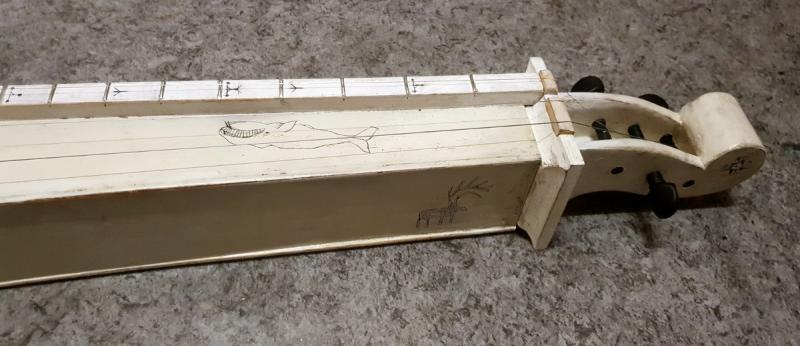
I cut my fret slots the saw cuts .031-.032 the frets I have are just about .030 so there is grab but they can be lifted out easy,will super glue gel hold them or should I use another glue like epoxy ,my first fret job ,I put in a couple with super glue gel and they held while filing and fitting which can be stressful my concern is will it keep holding or shrink later,the right thing is a wider tang fret or a crimper but I am attempting to do with what I have .Wider tang frets are about .037 maybe enough for more grab.appreciate any help. Thank you
Is your measurement of .031-.032 including the width of the barb tips? If you want a nice press fit, check the width of the tang, not the extent of the barbs. And the best width of the slot will depend on the fingerboard wood. For instance, I use fretwire with a tang width of .023 and barb width of .030.
I cut fret slots in black walnut (which is one of the softest hardwoods) using a .020" saw, and the tang pushes easily and firmly into those slots. But when slotting an ebony fingerboard I need a .023" saw, as that ebony isn't going to move over for nobody!
As I've written elsewhere, it helps a lot when sawing slots to fit the tang, to dress the edges with a small 45° chamfer, just a bit wider than the tang's barbs. This helps seat the frets vertically while inserting and also avoids grain pull-up and break-out when the frets need to be pulled.
One tip I learned for successfully using superglue to seat problem frets is to first apply a sizing coat to the slot walls. Easily done by putting a small bead of glue on an edge of a business card and drawing it through the slot. Let it dry, and it will keep the next coat, also delivered with another edge of that card, from wicking into the wood, creating a much better bond.
My own preference for inserting frets is a manual press. I made one out if scrap and fitted a shop-made swivel foot. By luck I chose just the right dimensions so I can actually feel when the fret is biting into the wood and when it has gotten flush down on the surface of the fingerboard. You can find a photo of it here: Using the Fret Press
And I follow that up with a check on fret leveling by using a collection of trusted straight-edges (the blades of machinist squares, in my case). The process is to start with the first three frets with a blade long enough to span them. If there is any rocking (I check both ends and the middle), I take that middle fret back the the fret press and give it a little more pressure, re-checking as I go so I don't over do it (which would make the next fret too high). Then I progress up the fretboard, checking each triad of frets for rocking on the middle one. I never have to dress frets with a file, using this technique.
Sorry, I may have written much of this before. My memory of what I've said before is lousy.
I was sadden to learn that DPN was shutting down the publication at the end of 2024. Ashley is doing the right thing by honoring those who have a subscription to the end of 2024. The publication was such a part of my life for many many years and I believe was the glue that held the community together. DPN will be missed by many.
As Ken sez, a little ordinary or thin superglue will work just fine. Ideally you'll find a fretwire source with a given tang width and buy a fretsaw with an appropriately thin blade. Before I switched to staple frets I often used a jigsaw with an appropriate blade.
Using super glue makes the frets a little harder to remove if you ever need to do that, but not impossible. I've used super glue, the thin kind, after seating the fret and wicking a little under the fret. I haven't had one come loose yet. I do use it sparingly.
Ken
"The dulcimer sings a sweet song."
I cut my fret slots the saw cuts .031-.032 the frets I have are just about .030 so there is grab but they can be lifted out easy,will super glue gel hold them or should I use another glue like epoxy ,my first fret job ,I put in a couple with super glue gel and they held while filing and fitting which can be stressful my concern is will it keep holding or shrink later,the right thing is a wider tang fret or a crimper but I am attempting to do with what I have .Wider tang frets are about .037 maybe enough for more grab.appreciate any help. Thank you
I am stunned to learn of this. I have been thus far a one-time contributor with an article that I wrote on Dulcimer Association of Albany's yearly festival Mountain Dulcimer Music Festival. I had written another article but that has yet to see the light of day from DPN. I've enjoyed what interactions I've had with Ashley and realize that this decision doesn't come easy. I was actually hoping to get to a point where I would travel around the country a bit and take in other festivals and maybe write on those. I do wish Ashley the best. If I were younger (and perhaps had a bit more money) I might have thought about taking this venture over; but at my current age (68) I'm trying not to tie myself down too much. This is sad news as since when I first learned of DPN in the mid 90s I have treasured receiving my quarterly copy of this fine magazine.
This is sad news indeed. DPN served an obvious need for several decades. But since we can now interact, share, teach, and learn online in real time and asynchronously, the role of a quarterly print magazine seems minimal. It would be nice to think it could still exist in digital form, as Acoustic Guitar Magazine does, but that wouldn't minimize the amount of work involved. I don't blame Ashley for deciding it's run it's course.
Well stated Ken.
Wishing all the best for the folks involved. Times have really changed profoundly. Sad to see this worthy magazine come to an end. What a noble run it had though!
Ashley is a wonderful person and I wish her all the best as finishes out her tenure at the helm of DPN!
On Facebook today, 01 February 2023, Ashley Ernst announced that DPN will cease publication in 2024. She did not give a volume or issue number, but I suspect the last issue will be the first one that comes out in 2024. Again, that is just speculation on my part.
Having been a columnist and contributor to DPN over the years, I will miss the magazine. I understand why Ashley made this difficult decision. Many print publications are ending that aspect of life and shifting to electronic (online) editions. There was no mention of this as a possibility for DPN.
In the early days of DPN it seemed the "newsletter" worked to create a community of dulcimer enthusiasts. It helped people share ideas, arrange meetings (festivals), and find places to buy instruments. It also kept us posted on what we were all doing. While these things continued over the life of the magazine, over the last 10 or 15 years the emphasis seemed to shift to teaching techniques or songs. In a sense it became a quarterly lesson for mountain or hammered dulcimer. The connection of getting to know "dulcimer people" seemed to have been lost. We knew contributors were good players and provided excellent lessons without learning what brought them to play the dulcimer, desire to teach, etc. I know that much of that community building happens at festivals, but with so many festivals going virtual what we are experiencing is group video lessons and little real community (but that is a whole other discussion).
I offer my thanks to Ashley, Dan, Maddie, and Phil for their hard work and dedication to DPN and the dulcimer community it created. Without them who knows where we would all be. So to those five folks and all who contributed to the magazine over the years, "So long, and thanks for the all the fish."
Ken
"The dulcimer sings a sweet song."
Well, @Tim-Amburgey deserves an award for patience!
Oh my, what a wonderful tale! And how truly kind is @John-Gribble for making a dream come true.
What a great story and wonderful ending. Enjoy your granduncle's handiwork.
Ken
"The dulcimer sings a sweet song."
Awesome. Glad you finally connected and now have the dulcimer in hand. Thanks for sharing your success.
Many thanks to this forum and specifically John Gribble. Nearly three years ago right at the beginning of Covid I posted a "in search of a Jethro Amburgey dulcimer" on FOTMD and was connected to John. Jethro is my ggranduncle and I had been on the lookout for one of his dulcimers. Almost immediately I was contacted by John. John was more than happy to put the dulcimer in the hands of a family member. The problem was that John, and the dulcimer was in Japan. We stayed in touch periodically waiting for the opportunity make the 'exchange". After a series of attempts John made it to the States two weeks ago, and last week I was able to hold a beautiful instrument built by the hands of a relative 83 years ago.
Once again thank you John and those that put me in touch with him many months ago.
I always made those ebony fine tuners for Walt, and still do. Message me if you need them. I also make cases that fit Sunhearths, but the are expensive and hard to find materials for. None on hand.
This is good to know Dwain.
Ken
"The dulcimer sings a sweet song."