International Appalachian Dulcimer Day
General mountain dulcimer or music discussions
Indeed, we did-- what a bunch of troublemakers we are! 
Indeed, we did-- what a bunch of troublemakers we are!
We started something bigger than we knew..we’re hysterical eh, I mean Historical.
@steve-c Just goes to show the power of a #! 
Boy does AI exaggerate much? I search “mountain dulcimer first festival” and this came up. “The first recorded mountain dulcimer festival was the International Appalachian Dulcimer Day (IADD), which is always the last Saturday in March, and this year it falls on March 29, 2025.“
It's hard to differentiate the concept of a dulcimer from its fretboard and string layout. A three course instrument with a paired melody course and two accompanying courses in the same key is such a powerful concept that it gets applied to all kinds of different resonators.
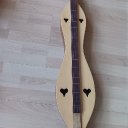
On the topic of lutes and zithers, I am wondering how this system reconciles something like a discontinuous fingerboard which terminates before the bridge, or a dulcimer with a fingerboard that extends beyond the box. Is the following photo a lute or zither?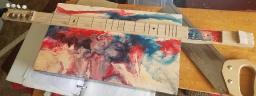
Thank you Strumelia. I will try that.
Strumelia,
Key of D
Well OK, so lute might be the genus, but we still need a species name. 



I agree, Dusty. The main problem is that there are so many styles from Martin's Backpacker Guitar (because it has 6 strings) and McNally's Strumstick® (3 strings) to the Merlin and homemade instruments with three or more strings. An additional category might include fret patterns. So, do we put our collective minds together and start working on this?
Ken
"The dulcimer sings a sweet song."
Marsha, what key do you want to be playing in? Then we can tell you what tuning to use if you want to be playing with that 'medieval sounding' aeolian mode... either with or without using a capo.
Thank you all for the interesting feedback. I may be wrong but am thinking that watching other videos from that guy I saw that besides using the capo on fret 1, he also had a slightly different tuning from DAD (I can’t remember, but maybe one of the D’s was one step different?)
I guess I will just stick to relying on using that E minor to get a more medieval sound. I was talking to my husband Mike about it and suggested that the next time he gets the urge to build another dulcimer for me (he has built 7 so far experimenting on different woods and designs) that he do a pear-shape that looks like a lute just for fun.
Well OK, so lute might be the genus, but we still need a species name.
In the lexicon of stringed instruments the lute is characterized not by the number of strings but by having a sound box (often pear shaped) and a neck over which the strings extend. As Strumelia points out I should have be more precise by saying "lute family" rather than just lute. And the ukulele is a member of the lute family. You are correct about the Seagull instruments not having a 6 fret as they are intended to be play in a 1- 5 - 8 tuning.
Ken
"The dulcimer sings a sweet song."
There might be some confusion here between referring to "a lute" and referring to a member of the lute category of instruments... being a sound box with an attached neck and strings going over the length of both. Guitars and mandolins are in the lute family. And the zither family being a usually flat sound box without a neck, and strings going the length of the sound box. The mountain dulcimer and the hammered dulcimer are both in the zither family. (according to the Hornbostel–Sachs instrument classification system)
It may not be a dulcimer, but it isn't a lute either. A lute usually has 11 or more strings. I believe a Renaissance lute has 15 strings, and some courses are not fretted but only used for bass notes. The instrument in the video is more like a diatonic ukulele than a diatonic lute.
@ken-longfield is on the right track referring to it as what is often called a stick or walkabout dulcimer. The odd thing about Seagull's Merlin is that it has a 6+ fret but no 6 fret.
As Strumelia so graciously pointed out, that is not a dulcimer. It is a lute with a diatonic fret board. Seagull makes an instrument similar to the one in the video. At one time it was called a Merlin. Looking a Musicians Friend, I see they are called Seagull dulcimer. Do a search there and you will find several models. There is a used one for under $100. They should be easy to build. Michael J. King has a book, Stick Making Dulcimer Book, available on his website: michaeljking.com . He is in Great Britain. I think he also has plans you can download.
Ken
"The dulcimer sings a sweet song."
A really great guy with a big heart! He is missed by so many!
In that video, he is simply putting a capo on fret 1, which changes you to Aeolian mode. Aeolian mode sounds minor and gives you that 'ancient' sound that you are liking as a medieval type sound. But you can put a capo on fret 1 on any mountain dulcimer and get the same thing and play the same music he is playing in the video.... did you know that?
Unless what you are wanting is the lute-like SHAPE of his instrument, including the neck and the bowl-like body shape. In that case there are several makers of 'stick dulcimers' (dulcimers with necks, technically making them be part of the lute family, rather than the usual zither family of instruments). Stick dulcimers can be found that are not very expensive- try searching for 'stick dulcimer' instead of 'lute dulcimer' and you may find some makers that meet your taste and your budget.
Have any of you ever played or built a Lute Dulcimer? I saw a YouTube video that fascinated me as I love playing Celtic and medieval tunes. I would love to buy one but they all look way too expensive. My husband built my mountain dulcimer and I am looking for maybe some plans and instructions for him to build me one.
If you want to check out the video: https://youtu.be/u814RNCqxEQ?si=kICcja0RAcyLi68K
I hope you know, @lilley-pad, that the filmmakers responsible for the Hearts of the Dulcimer documentary are FOTMD members @Patricia Delich and @Wayne Jiang .
And some of the folks responsible for the Santa Cruz dulcimer renaissance back in the day are still active, most notably Neal Hellman and Howard Rugg. Neal organizes the Redwood Dulcimer Day festival every year (mid-August) and Howard has started making dulcimers again, resurrecting Capritaurus.
No that " groovy Strumelia". SMILE 
Adding to what Dusty said, tone can also be greatly effected by the wood thickness... not simply by the size of the sound box and its scale length.
@Dan ...what note and what string gauge do you use for a 36" scale? Surely not the usual high d note... you must be tuning to lower keys/notes?
Perhaps simply comparing the sound/tone of a shorter 23 5/16" scale McSpadden Ginger to a regular 29" scale McSpadden would answer TonyG's question. However, the Ginger is described as being tuned to the key of G, several steps higher than the standard DAA or DAd.
So, Tony asks if a different scale will effect the tone or sound... I guess part of the answer would also depend on whether you specify tuning both scales to the same notes or keys.
I have two pieces, the hourglass loosely based on the I.D. is a four string using .009, .009, .016 and a wound .022 long neck banjo strings. To get that unique tonal quality you slack the regular baritone ADD down about a full note and a half. My other is a Virginia style three string using music wire @ .016, .016 and a .020 tuned around DAA. Sorry it took so long to respond, I kept forgetting to bring my dial calipers in from the wood shop.
Unfortunately, since I live in Southern Oregon, my local library has been ruined by the anti homeless measures, and will probably never recover. Most of the libraries in my area have been totally stripped of funding and local support in order to make the area more hostile to homeless people.
Northern California has a terrific dulcimer community, with plentiful old hippies who love the instrument. I especially loved the section on "counterculture."
Hi kids for anyone that's interested and hasn't seen it you may want to check out a DVD from your library called Hearts of the Dulcimer. a documentary basically of the dulcimer movement in California. I had no idea there was such a following in the Santa Cruz mountains at that time. It is a very interesting DVD. I had no idea that it took place in my backyard. Of course back then in the late sixties and early seventies the only time we ever went to Santa Cruz was to go surfing and hang out at the boardwalk, hoping to meet women. Up here in the San Francisco Bay Area at that time period the folk music scene was kind of being phased out, it was still a little bit popular but for the most part was moving into rock.
We were more interested in going to the Fillmore West sitting in the back on the couch smoking a joint and listening to Fleetwood Mac and Jethro Tull. Driving home across the bay bridge in the rain in a car with no windshield wipers we would have a string tied to the wiper arm and the driver would pull in One Direction and the passenger would pull in the other direction. Okay I'm rambling on again sorry about that. Anyhow check out the video If you haven't seen it yet you may find it interesting. You should be able to get it from your local library
Hello world!
I’m Gareth, living just outside Edinburgh here in Scotland. I’ve played mandolin off/on for around 20 years (doesn’t make me good though!) and I drifted toward the Seagull Merlin family of instruments having noted them in a local music shop, along with mountain dulcimers. Exposure to traditional folk from the US got me interested in the dulcimer.
Presently I have two mandolins, a ‘project’ bouzouki and a Merlin which I bought gently used a few weeks ago. I’m finding the relative freedom of the Merlin to be really amazing and drawn to pick it up whenever I can. Usually while dinner is cooking or between meetings at work (when I’m working at home).
In the past I’ve played in a few groups with friends, then as part of a mandolin and guitar orchestra, but now mainly music-making is for my own amusement and general sanity.
Dulcimore Dan is an I.D. Stamper fan! I.D. used those long, jangly, low-pitched strings on his dulcimers.
Wow there are some pretty skilled musicians showcasing those instruments
I think that any effort to directly compare different VSLs would be a compromise of all kinds of other features that probably affect tone far more than VSL. While the original question specifically asked about scale length, there is also the broader question of how tone, volume, and sustain are affected by a physically larger instrument. I think in general dulcimers with long VSLs tend to often have larger soundboards, are often taller, are often sturdier and can handle more tension, and are often tuned lower. The many other factors that come along with a long VSL can affect the tone more than the VSL itself.
When I bought my Terry McCafferty dulcimer, he was offering 3 VSLs from which to choose: 25", 25.8", and 27", though I could be wrong on that last one. The boxes are all identical, with the difference just being the length of the fingerboard and the placement of the saddle. So his instruments would be good ones to choose from to gauge the difference VSL makes.
I am convinced that there is little-to-no difference in tone, although the differences in VSL in these cases are minimal.
However, I believe the 25.8" has a bit more sustain than the 25", and the difference is less than an inch! (I opted for the 25" model anyway, just for the comfort of my chording hand.)
(If you visit Terry's website, click the "Cool Stuff" page. You might see someone you know playing a tune or two!)
Yeah, to actually measure the difference, we would need to hold all the other variables constant. We would need the same builder to make identical instruments with the exception of the VSL. Same box, same bracing, same wood types, same wood thickness, same amount of glue, etc. And even then we would have to decide what string gauges to use. Would you choose the gauges most appropriate for the longer VSL or the shorter? Would you cut the difference in half to measure? Either way, you are not really hearing the way at least one of the dulcimers would normally sound.
Adding to what Dusty said, tone can also be greatly effected by the wood thickness... not simply by the size of the sound box and its scale length.
Does a longer instrument simply have more tension because the players choose to use higher tension strings?
When I string up longer dulcimers, I use smaller gauge strings or lower pitch tunings to compensate. Similarly, when I string up shorter dulcimer, I use thicker strings or higher tunings to compensate. I prefer the tactile experience of having thinner strings, and I also notice a difference in sustain with longer strings, even when they are not at a higher tension.
I am selling my dulcimer that I have had for more than 30 years as I have never given it my full attention. The instrument is in excellent condition.
Here are the details:
Rugg and Jackel Fok Roots Dulcimer
D-50 S 726881 (dated July 26, 1988)
Spruce top
Black walnut back, sides and headstock
Approximate measurements are:
Length: 37”
Height: 3”
Width at widest point: 7¾”
Cost: £125 plus any shipping costs. Or collection in person from London UK
Perhaps over simplification, but if the only variable is the strings, Longer and thicker gauges [and therefore higher tensions] will vibrate longer on any given length for the same tuning. As an example a .024 tuned to D3 on a 22 inch VSL [about 12.5 pounds of tension] will not vibrate as long as the same string used on a 36 inch VSL with the same tuning [39.2 pounds].
In the proverbial nutshell, longer dulcimer strings [VSL] usually mean a longer "sustain" of each note played. You can coax a bit more out of a shorter scale by going thicker on the strings , but only to a point. Finger comfort and tension on the instrument can get excessive.
Yeah, to actually measure the difference, we would need to hold all the other variables constant. We would need the same builder to make identical instruments with the exception of the VSL. Same box, same bracing, same wood types, same wood thickness, same amount of glue, etc. And even then we would have to decide what string gauges to use. Would you choose the gauges most appropriate for the longer VSL or the shorter? Would you cut the difference in half to measure? Either way, you are not really hearing the way at least one of the dulcimers would normally sound.
I guess what I'm saying is that we could never measure this accurately. But the good news is we'll be able to discuss it forever!
Adding to what Dusty said, tone can also be greatly effected by the wood thickness... not simply by the size of the sound box and its scale length.
@Dan ...what note and what string gauge do you use for a 36" scale? Surely not the usual high d note... you must be tuning to lower keys/notes?
Perhaps simply comparing the sound/tone of a shorter 23 5/16" scale McSpadden Ginger to a regular 29" scale McSpadden would answer TonyG's question. However, the Ginger is described as being tuned to the key of G, several steps higher than the standard DAA or DAd.
So, Tony asks if a different scale will effect the tone or sound... I guess part of the answer would also depend on whether you specify tuning both scales to the same notes or keys.
Sustain. I think longer VSLs have more sustain than shorter ones.
Remember that modern instruments often have much larger boxes than do traditional instruments, so some of the generalizations here may not accurately describe the difference between a traditional instrument with a long VSL and a modern instrument with a shorter one.
Dulcimore Dan is an I.D. Stamper fan! I.D. used those long, jangly, low-pitched strings on his dulcimers.
If you tune a 26 inch and 29 inch Dulcimore the same, the longer scale will have more tension and usually have a little better "punch" to it. I also prefer the longer scales, 36 inch is my favorite!
One thing to note is that a longer scale length/VSL usually means a physically larger instrument, which can affect tone and volume.
This is just an observation and I might be wrong about this, but to me, when tuned to the same note with the same tension, thinner longer strings seem to have a fuller tone than thicker, shorter strings.