Cantilevered Tail/Bridge
General mountain dulcimer or music discussions
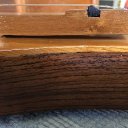
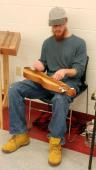
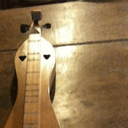
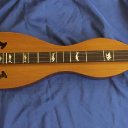
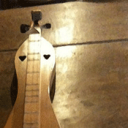
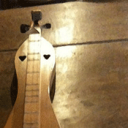
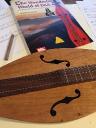
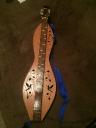
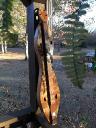
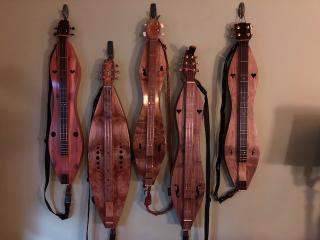
Here is a photo of the cantilevered fret board on the first dulcimer I built. I only made two like this.
Ken
"The dulcimer sings a sweet song."
Here is a photo of the cantilevered fret board on the first dulcimer I built. I only made two like this.
Ken
"The dulcimer sings a sweet song."
A similar idea, but no, the one I'm looking for is definitely "October is a Gypsy Lass". I've found it in a couple spots online, but no one ever says who wrote it...either the words or the music.
Hi Jan,
Did you ever find any more info on October is a Gypsy Lass? I'm very curious about it also. I know it only by these words (and did not know it was even a song - I thought it was "just" a poem):
October is a gypsy lass
Who dances through our town
Scarlet is her flying scarf
Many-hued her gown
On her dusky hair she wears
A crown of bittersweet
Maples spread a golden carpet
For her dancing feet
Thanks for the responses. I might have to give it a try.
I was just thinking of our FOTMD member Oliver Ogden who passed away a while back.
It was nice to look over his fotmd photos and see him happily playing with his FOTMD friends.
Ok, we are now officially sick and tired of fresh tomatoes for the year. 
The first dulcimer I built (back in 1974) has a cantilevered fretboard. I used plans made by Joseph Wallo who worked at Weaver's Violin Shop in Washington, D.C. I made the fretboard from three pieces of wood and after 44 years of constant tension the on the strings (mostly in DAA tuning) there is no curling of the fretboard. Although this is not the largest dulcimer I own, it is the loudest. The top vibrates as well as the back but not as much as the back. I thought I had some photos I could easily find, but I don't. I'll try to take a few and post them for you.
Ken
"The dulcimer sings a sweet song."
Hi @Webb. You might find David Beede's demonstration of his "decoupled" tailpiece to be interesting. I am not a builder myself, but I find the difference in tone that he gets to be truly dramatic.
I am interested in luthiers and players a like opinions/experience with cantilevered fretboards tail/bridge
( made popular/exercised by Howie Mitchell and Keith Young ) compared to tail/bridge being in direct contact with the tail block.
The Lover's Ghost (Child 248) as sung by Barbara Dickson, New Celeste or Pauline Scanlon
This is an absolute no brainer for me............"The Unquiet Grave" by Jean Ritchie..............you can hear her sing it here:
https://blogs.loc.gov/folklife/2017/10/ghost-stories-in-song-for-halloween/
It is such an easy tune to play.......btw, there are a few others by other artists there as well...........enjoy!
Not having any photos to refer to, I am guessing that Don O is right. Now, if they used Floating Bridges, it wouldn't be an issue (just pandemonium).
It IS the bridge, not the string set. When they set up the bridge on their short scale instruments for DAd, they tilt it slightly for intonation compensation.
This is a very significant move on their part, and an a knowlegement that DAd is the “new” standard. “New”, even though it’s been around since the 70’s!
Here’s two sad ones that, given the right mood, brings me to tears:
the Irish American song Maggie
A tree in the Meadow as sung by Margaret Whiting
A good solution emerged. A luthier who I've bought a couple of guitars from offered to be the go-between with Ameritage so I could get his dealer discount. With the shipping the case will come in around $400 ...still a bit more than I wanted to pay but I own a few cases by Ameritage and they're very good. I sent along a tracing and the padding will be form fitted to the dulcimer. My Edsel Martin is as much a piece of folk art as it is a musical instrument so I'm happy to have a case on the way that will give it the protection it deserves.
Thanks for the well-intended suggestions.
Aw, I'm glad you got the snake out unharmed, @salt-springs !
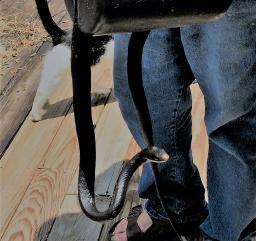
Don't you get a kick out of getting up in the morning and walking into the kitchen and finding the latest creature that the cat has brought in for your inspection? A beautiful creature but one that can deliver a nasty bite if so inclined. I took him/her out to the edge of the deck and let it go, it was not injured but not really happy either.

I recently made a set 9" that I really enjoy. I upped the length from 8" . The longer hammers add a bit more bounce. Different woods, lengths, weights. There's no end to finding the prefect hammer. But its fun... Robert
A good "ballpark" length is something between 20 - 22 centimeters. You alter the mass of the hammer by altering the thickness and width of the handles, heads and grips.
Could somebody tell me what the total length of a standard hammer is please including handle and head? I know they vary but an about figure would be great, thanks Nige
Regarding learning by ear vs. sheet music: This is a complex issue and both sides have their purpose.
I think that if you look at the oral tradition vs. printed books, you can see a parallel to learning music orally or by written sheet music.
The oral tradition although it could be epic in length, used repeated rhythm and rhyming patterns to help people learn the story/poem/legend/etc. Written words allowed authors to break away from those patterns to produce more complex written styles. Although not impossible, it would be hard to memorize a novel by Tolstoy or James Joyce.
I play in a symphonic orchestra, and cannot even imagine trying to learn a symphony by ear. Yes, it could be done, but it is much easier to read the music. When you have lots of different instruments and complex arrangements, sheet music allows competent musicians to play together without even having heard the music before.
A good classical musician will hear the written notes in their head while reading music. It's very internalized after years of practice. I've been playing my secondary instrument (euphonium) a lot at home the past year, but I noticed how my body doesn't react as instinctively as when playing trombone. With trombone I see the note, my arm moves without much conscious thought, my lips buzz the pitch and the sound comes out. With euphonium, my fingers aren't as automatic as my slide arm. So although my lips are ready with the pitch, my fingers can get tripped up or delayed. LOL. The same should be with dulcimer playing, although dulcimer has the added complication of different modal tunings, so the brain and body need to learn them all.
When you look at the folks tales and folk songs versus books and classically written music. You see where the the author/composer's intent has little with the former, and each reteller/resinger creates a new version but within the tradition. The stories are songs are truly the people's. With books and symphonies, etc., you can interpret what the author meant or how the composer wished the music to be played. Even if readers and musicians can create their own interpretation of the works, the creator of the original is very much at the heart of the work.
Learning folk music should lean more heavily on the oral tradition (with the help of sheet music and recorded music for those that need it in the beginning), just as classical music should lean more heavily on the written tradition (with help from a good ear and hearing other musicians playing the piece).
When my first child was born here in Sweden, I started looking for American folk songs to sing to him. There were no American folk singers around in Örebro to learn from, so I ordered a book from the Internet, played the melodies on the piano and sang along. Then I started hunting the Internet (then via Napster LOL) for recorded versions of all the songs. I started singing without the sheet music (hard hold a music book while also holding a crying baby), using my ear to create my own version of the songs, mixing the various versions of lyrics and playing around with embellishments. So it was a mixture of sheet music at first for the new songs (or to refresh my memory for songs I heard/sang as a child) and then a healthy dose of playing by ear and experimentation.
So neither side should look down upon the other. Great musicians can come from either tradition.
No, I haven't. I don't have a way to record anything right now, but hope to organize something before long.
Thanks Don! We take a lot of care in creating the podcast as well as the resource page for each episode, so we're happy you appreciate it!
Awesome! Howard is a very dear man as well as a great builder.
Have you recorded yourself playing V'la le bon vent (chanson québécoise) on your dulcimer?
Hi Patricia,
I am listening to that one now - thank you!
Tricia
Hi Patricia,
I am listening to that one now - thank you!
Tricia
Hi Tricia,
So glad you found the podcast! You might be interested in hearing the episode with Howard Rugg, one of the co-founders of FolkRoots and CapriTaurus: http://dulcimuse.com/podcast/resource/010.html
Those old FolkRoots dulcimers sound great ... you're lucky to have one!
Thanks for listening,
Patricia
I am seeing this some 2+ years later, but I'm delighted to find your podcasts are still available for listening. Thank you so much - this is wonderful ! I got my Folk Roots dulcimer from Elderly Instruments in Lansing, MI in 1986, and love it to this day. I'm really looking forward to listening to more of the podcasts over the next while.
I am seeing this some 2+ years later, but I'm delighted to find your podcasts are still available for listening. Thank you so much - this is wonderful ! I got my Folk Roots dulcimer from Elderly Instruments in Lansing, MI in 1986, and love it to this day. I'm really looking forward to listening to more of the podcasts over the next while.
Hearts of the Dulcimer Podcast - Episode 37
Golden Ring: A Gathering of Friends for Making Music
The 1964 LP Golden Ring: A Gathering of Friends for Making Music became one of the most popular recordings of the early folk music revival. In this episode, find out why Golden Ring was a groundbreaking album for the mountain dulcimer.
Hearts of the Dulcimer Podcast can be found on most podcast apps.
Here's the link to Hearts of the Dulcimer on iTunes: http://bit.ly/hotdpodcast
Don't use a podcast app or iTunes? You can listen to all the podcast episodes directly on our website: http://dulcimuse.com/podcast
We also have a resource page for every episode, where you can find photos, videos, and song lists. Here's the resource page for this episode: http://dulcimuse.com/podcast/resource/037.html
Thanks for listening! :-)
They are the kindest people I've ever met at the Dulcimer Shoppe. Jim takes such great effort in everything he does, and goes out of the way to meet needs and wishes. I'm looking for a 3rd dulcimer to add to my dulcimer family, and had thought about changing makers, just for variety, but I most likely will end up getting one from Jim again, just because I love not only their product, but their attention to detail and customer happiness. Maybe the notice of the standard policy change was with us frequent flyers in mind that know his instruments are generally in DAA (GDG for Gingers) unless otherwise requested.
Perhaps the concern is more about letting the dulcimer community know and hoping it understands than anything internal to their production practices.
It's not even the bridge, Dusty; I don't believe they really intonate for one tuning over the other. It might be the string set, if anything. Personally I don't see an issue, or what all the fuss is about. I know how to use the tuners to tune the strings to anything I want within the properties of the strings
Interesting, but no surprise, I suppose.
I am curious why Jim Woods states the change has not gone smoothly. Isn't the only difference which bridge they use? You would think they would have a bunch for DAA and a bunch for DAd, and they just have to switch which pile they grab from. I must be missing something here.
Interesting, in that in another topic we have a discussion about 'tradition'. Yes, some traditions never change and some do over time. ⌛️