Thanks for the responses!
updated by @markstarcrashes: 07/20/18 04:05:34PM
The one I'm playing, the other one, the black one, the one Bobby made, the one Til made, the Gross replica...
saras
custom designs, beautiful & so personal
Here is mine I designed them
...but I like to play and I find that different instruments make me think differently. On guitar, mandolin, or dulcimer, I come up with different things. The modal nature of the dulcimer, in particular, forces me away from my natural tendency toward chromaticism.
Hey Craig good to meet you!
Wow - a Capritaurus AND a D-00. What a great pair.
I played guitar for many years before I started the dulcimer. The main draw for me was exactly as you say: diatonic forced me to rethink composing and experimenting with different tuning and string configurations.
As a result, I've now gone back to playing guitar again and started noodling in CGCFCD - what an amazing find courtesy of Martin Simpson!
Hi, I'm Craig and I'm new around here. I discovered the site the other day while searching for info about my dulcimers.
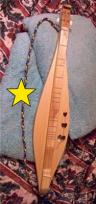
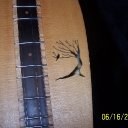
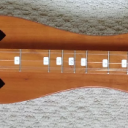
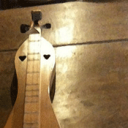
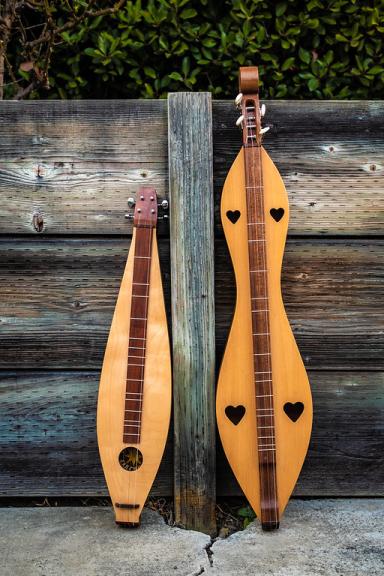
I first got interested in the mountain dulcimer in the 1980s; I forget why, exactly, but Dave Cousins' use of the instrument on "Witchwood" by the Strawbs may have had something to do with it. I was already a guitar player at that point who could also find his way around a piano. I bought a Rugg & Jackel (the teardrop-shaped one in the photo) along with an LP by Michael Rugg ( Rugg's Celtic Collection for Dulcimer -- charming album) and a couple of instructional books and started playing. The D-00 is quite small (22" VSL), so it's easy to play, though the tone is a bit boxy. More recently, I bought a vintage 1973 Capritaurus (the hourglass-shaped one), which at 29" VSL is the opposite -- great tone, but kind of hard to reach chords, and easier to play when tuned down to C. I may have to split the difference and buy a 26" model...
I'm not really a great dulcimer player; I'm better at guitar, but I like to play and I find that different instruments make me think differently. On guitar, mandolin, or dulcimer, I come up with different things. The modal nature of the dulcimer, in particular, forces me away from my natural tendency toward chromaticism.
That is a nice looking dulcimer. How does it sound?
Well, 3 minuts with Google tells me that he lives in Claremont, NC, apparently does not have a website or blog, and sells through Ebay and a couple of NC dulcimer shops.
Newest addition to the collection! It is all cherry, so I couldn't resist... Any info on the builder would be appreciated! Thank you in advance!
Our last cat (of the four we adopted 20 years ago) sleeps quite peacefully on our bed most days, but when I tune up, she yells to beat the band and gets up. She is a sweet girl, but at over 100 in human years, a bit of a crank...
Hi MarkStarCrashes! As you can see from my post below, I own two of David's dulcimers. Love them both! My post below was 3 years ago and still stands. Mine are both natural in color...one big standard form and one curvy (Tater). Lovely, light, great sound. He seemed to slip into the dark staining a while back, but I like the natural looks better. Will have to go see what he is offering now. I have a bunch of dulcimers...sighhhh… Like tater chips! Also, you can't go wrong with Folkcraft (have 3). Just finished restoring an old cherry that had more dents and dings than my hay truck and a mouse eaten 'f' hole. It turned out wonderfully, gorgeous sound! I doubt you would go wrong with a Honea dulcimer for $190. I looked at his Ebay offerings and liked liked #678 with Western Cedar top and Walnut back. Might be louder, rounder sound with Cedar. #691 semi hour glass with Cherry top and back might be a crisper, brighter sound with hard wood cherry. Enjoy your choice and let us know your pick!
Wow, you have very wide-ranging music genre interests! You seem to be a fairly experienced player.
So, it seems that most of the accidentals you are running into are in the most modern types of music you play- modern film scores, which can be especially daunting since movie music tends to change moods mid-song, often not following the usual expected structure of a song. I would think a chromatic dulcimer might be your best bet in the long run if you intend to pursue playing a lot of that kind of music. And certainly the modern chording style of playing would be the way to go as well for that.
Now you've got a whole bunch of great ideas and options from the good folks here in terms of methods and tools to use to get those elusive notes when they pop up.  Go forth and create many happy accident(al)s ! lolol
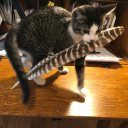
We have a writing desk with a writing space that drops down, it is next to a table that our 'puter is on. For the last week or so on the desk I had a primary turkey feather that I put there waiting to get around to doing something noter/droninsh with.
The other night, my wife had already some to bed, while I was taking care of business on the 'puter, Sally snuck up behind me on the chair I was in and stealthily got on the writing desk to my left, and quick as a wink snatched the turkey feather and went dashing off with her prize.
I let her think she got one over on me, figuring I'd later find the turkey feather with her stash of kitty toys, wadded up paper, and other treasures she's collected.
When I finally went to bed I found that turkey feather laying on top my sleeping wife.
OH MY GOSH I LOVE Y'ALL!!! Our phone/internet was out a few weeks after a storm, and I come back to see how amazing y'all are! I LOVE IT!!!! And I kinda wanna hear it all, too....
If I am not mistaken, the original post here was written in verse. My guess is that the formatting got lost when we moved from the old site to the new one. It would be wonderful if Linda could edit that post so that we can see her original poetic intent more clearly.
I just saw this post Terry. GOOD STUFF! 
@yeahsureok, you've gotten great advice so far, and I'm going to do my best not to repeat it. I just have two points to add.
First, bending strings is very difficult if not impossible with a double string. There is a reason guitarists bend strings all the time and mandolin players almost never do. You might consider playing with a single melody string. It makes bending strings as well as hammer-ons and pull-offs much easier. And I think you get a cleaner sound all around.
But keep in mind that you don't always have to play the string as you are bending it. As you improve your touch, you can bend a string and then pluck it, so you don't hear that bend up but merely the note you are trying to get. That technique takes some practice, but you can get good enough that no one would know you are bending a string to get a particular accidental.
Second, accidentals are not, . . . uh, . . . accidental. That is, they are notes purposely included in a melody. Not all music is diatonic. If you can retune to get a song, then the song might still be diatonic but in a different mode. In that case, we are not talking about accidentals at all. But some music does indeed have more than the seven notes of the diatonic scale. If there are only one or two chromatic notes that appear occasionally in a song, you can employ the techniques others have laid out here. But if there are a lot of accidentals, perhaps that song is not really good for the dulcimer. I tried to learn a tune from a Carolina Chocolate Drops album a while back and realized that there were 4 half tones in a row in an important part of the melody. That was my clue that my dulcimer efforts were better spent on a different piece. Right now I am arranging tunes for a tab book on lullabies of the world. I found a few tunes from Israel and Russia that I really wanted to include, but there were too many accidentals, so I just left them out. In another case, a tune had a single accidental, which I get by bending the melody string at the 4th fret. That one I included, with a note that the melody works fine with the straight 4th fret, but adding that bend gets closer to the original melody. So a little extra effort might be worth it, but if a tune is defined by too many chromatic notes, perhaps its better to leave that one for chromatic instruments.
Having said all that, let me add that I now use dulcimers with the 1+ and 6+ frets, and I find that with those two extra frets, I can get almost all the tunes I want to play. It took some time to get used to the 1+ fret, but I wouldn't want to go without it now.
With a noter, the slant thing like John said.
Without a noter, I pinch the string between my thumb and forefinger in the place where I wish I had a fret. This works well if you've got fingernails that are neither too long nor too short (experiment).
As Ken said, you can skip the note or substitute another. Try a note that harmonizes with the missing accidental -- often two frets up or down. Whatever sounds good is good.
When in doubt, strum the chord and sing. Your voice is chromatic :-)
If your dulcimer has high-enough action, get a metal or glass slide and play without letting the strings touch the frets -- now it doesn't matter how many frets you've got!
If you can set your dulcimer up with 4 equi-distant strings, you can try a chromatic tuning. I use D-A-d-c#. This works like a piano: the white keys are on the "d" string and the black keys on the "c#." The disadvantage is you can no longer simply strum across all the strings. My solution is to make the chromatic string the one closest to me, so I can mute it with the heel of my thumb while fretting the other strings. Or fingerpick without touching the chromatic string except on the accidentals. I have done this successfully, but it is a bother and my preferred solution is...
Play a chromatically-fretted dulcimer. Not the cheapest option and maybe not possible for you right now, but long-term it SOLVES the problem while all these other techniques are just work-arounds. If your favorite music includes a lot of accidentals, it makes sense to use the right tool for the job.
If you're playing noter style and the chromatic note passes pretty quickly, you can use the noter like a guitar slide. You can get the "in-between" note this way.
Leave the tip of the noter on the fretboard. Lift the noter on a slant, tipping it downward so that the string is off the fret, but still making contact with the noter. You want to have the noter where the chromatic fret would be. The tone isn't the same as a fretted note, but most people won't notice. It is a little tricky with a doubled melody string, though. That can get buzzy.
Temporary frets are another option. Fret wire is around .040 high [crown height]. Tape them in place, tape between the strings. These could be partials, just under select strings.
Hi Yep,
Folks who play mostly chord/melody style like yourself can often find the accidentals on another string- usually the middle string. Try that first.
There's also a way of slanting your noter so the tip touches the wood fingerboard in the place where your missing fret would be- giving you the half note accidental. Others could maybe point you to videos and discussions here on FOTMD that describe this technique.
Retuning into a different mode (but staying in the same key) can solve the missing accidental in most cases, but not all.
Some tunes can be altered just a bit in order to skip or avoid the accidental. Not everyone can figure out how to do that but if you can, then great! It can make for a more 'personalized' tune version.
If you find that in your playing, if you frequently need a particular accidental or note that always seems to be on a particular 'missing' fret location, then in my opinion there's no reason not to have the new fret added there if it enables you to play more enjoyably. As to extra fret 'acceptance'- you're not playing dulcimer in order to gain approval from others . My mtn dulcimers have the 6.5 and the 1.5 frets added- and I've never regretted it. I have an epinette with only the diatonic frets and I would never add extra frets to it- i love that it was built strictly traditionally, and playing it without extra frets is very enjoyable. If you decide you want a chromatic dulcimer, you can save for it and then look for a used one to buy- you can always resell it later if you decide it's not for you.
You don't mention the KIND of music you typically play that has accidentals. Certain genres of music have more accidentals than others. Interestingly, I find that both Modern music and very early Renaissance/Medieval music seem to present the most accidentals to me- which is amusing since they are at complete opposite ends of the spectrum in terms of time periods. Traditional and rural folk music from 1830-1940 or so presents me with the fewest accidentals... and (not coincidentally) the American mountain dulcimer was developed around playing that kind of music.
I enjoy several genres of simple music to play at home on a few different instruments. The medieval type music seems to have enough accidentals in it to make it problematic for a non-professional musician to play on a non-chromatic fretted dulcimer or instrument. I will be getting a langspil with chromatic fretting in order to have a traditional instrument that enables accidentals and mode changes easily, 'on the fly'. 
Some folks do find that adding one or two extra frets is confusing... but the confusion will fade if they stick with it. After all, most dulcimers have the 6.5 fret and nobody finds that extra fret terribly confusing. ;) Going from a 'normal' mtn dulcimer to a chromatic has its own learning curve as well. My banjos are split between totally fretless banjos and chromatically fretted... if I play them all fairly regularly, the differences only take about 30 seconds to get used to when I switch from one to another.
I don't buy new instruments that often, but when I do there's usually a very specific function I'm looking for.
Handling Accidentals
1. Skip them entirely with sustain of the previous note occupying the measure. Or play either the note before, or the note after, for the same measure as the 'missing' note. Most of the time, if the audience knows the song, they will 'hear' the missing accidental. If they don't know the song it doesn't matter. This was a very common traditional approach, as many players seem to have used an Octave tuning (Ddd, Ccc, etc) rather than Modal tunings like Ionian (DAA), Mixolydian (DAd), Dorian (DAG) or Aeolian (DAC)
2. Re-tune -- it's only one string and should take less than a minute while you're introducing the next number! Create sets of tunes in each tuning that you use; rather than playing one song in this tuning, the next in something different. It's easy find half a dozen songs in each of the common Modal Tunings.
3. Bend the melody string. Try removing (permanently or temporarily) one of the doubled melody strings until you learn to bend a pair.
As a 99.5% N&D or Fingerdance traditional player, numbers 1 & 2 are my options of choice, and my choice depends on the missing note(s) in which tuning
I was wondering, some of the songs I like to play have accidentals in them, and I was wondering what different peoples approaches to getting around that.
I am familiar with different modes of tuning to get the specific notes you want. I have tried a few that have served me well, but I'm not a big fan of retuning my dulcimer so often for different songs.
I have also experimented with string bending, which I really enjoy and I love the twangy sound effect it can make. It is more difficult on the melody string, being double coursed, but I'm working on it. Anyway, I'm just curious about other people's approaches.
I like the idea of buying a fully chromatic instrument, but it isn't in my budget at the moment.....and many people condemn them, which I don't understand. I have read some people say they tried one but the extra frets caused problems. So.....?
Also, if it's useful info, my playing style is about 25% noter drone and 75% chord melody. I also just started trying out fingerstyle.
Richard, what lovely instrument. I love the snowflakes and love your description. Maybe one day we will get treated to a little demo from you playing it. 
It's a wonderful thing to own an instrument that is a joy when we strum it. 
Thanks for the great explanation, Dusty!
JP, I'm just curious- did you not look over the other threads in this Site Questions forum to see if the solution to your problem had already been asked about and answered? I hope you now understand why you were not seeing the whole discussion.
Dusty mentions the main site links along the TOP navigation bar on every page of FOTMD (Home, Forums, Photos, Videos, etc). When one is very confused about how the site is laid out, it really does help to click those links to gain a better understanding of the areas of main function and content. Not everything is immediately accessible from the Main Page... or else it would have to be five miles long.
I'm glad you were able to post a new thread here in the Site Questions forum in order to ask your new question, though! I'm going to edit this thread's title to be more descriptive of the thread subject now- in order to help others in the future looking for answers to similar questions as yours. :)
Richard, I'm glad you are happy with the sound of your June Apple model dulcimer. Mine is similar to the one you have with the following exceptions: Mine has traditional heart-shaped soundholes and only three planetary pegs at my request. Carl and his staff are great. They are very accommodating in meeting requests for minor changes like number of strings and soundhole design. I haven't checked the website lately, but their prices are a bargain compared to many new dulcimers out there.