making Shakuhachi
Adventures with 'other' instruments...
Tambourines were very common in the minstrel era, along with banjos and rhythm bones. I kinda play my banjo a little like a tambourine sometimes anyway, rappin' on the head... so fun . 
Tambourines were very common in the minstrel era, along with banjos and rhythm bones. I kinda play my banjo a little like a tambourine sometimes anyway, rappin' on the head... so fun .
Hi Strumelia
I loved the jpg of your banjo with the carving of the Pigs head in the head stock. What a wonderful idea. I've been dreaming about making a tambourine banjo and carving some kind of minstrel era neck for it.
Hi Erin
It's great to have a real master Shakuhachi player to take some lessons from. For the Shakuhachi I've had to go it alone. I bought one of Perry Yungs introduction books and it has the right to left notation the Japanese use in it. From that I'm trying to read and write with that system since it has a notation system for some of the head shakes, occilations and breath attacks. I've got the rest of my time alive to study it. I live in an area where there are few Shakuhachi players or even Mountain Dulcimer players.One of myDulcimer studentsstarted a Dulcimer club here a while back and I got one newsletter from them and then they disapeared when she moved. You might check the Dulcimer player news mag for groups in your vicinity as well. There's a lot of great music in the northwest there, but like here you probably have to really search for it to find it.
Erin said:
Hey David, how wonderful to find another shakuhachi player, and maker at that!, here in the dulcimer group! I admire your ability to play so many instruments.
I have only been playing the shakuhachi for three years now and am constantly amazed at how slow my progress is! That said, I like the meditative aspects of the flute dearly and have a wonderful group of friends to share shakuhachi music with here in Vancouver. I am a student of Michael Gould and take a lesson from him once a month or so. I too prefer honkyoku and am also a big fan of Watazumi.
As for dulcimer, I only started playing it in the summer time. It is delightfully fun and feels so effortless compared to the flute. I haven't found a local community of dulimer players yet but will try to get down to join the group in nearby Bellingham some time soon.
Penny whistles are great as well. It only took just a little nudge to get me started collecting and making world flutes since they tend to be less expensive than a lot of instruments. Though some Shaks can get prices like rare violins. I have a chest of drawers at home that is nearly given over to flutes of all kinds.
Beth Hansen-Buth said:
That is a really beautiful shakuhachi David. I love hearing people's musical stories. I haven't ever tried the bamboo flute, I currently have some penny whistles that I pick up and toot on once in a while.
That is a really beautiful shakuhachi David. I love hearing people's musical stories. I haven't ever tried the bamboo flute, I currently have some penny whistles that I pick up and toot on once in a while.
Hi Erin
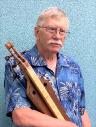
The Mountain Dulcimer came first along with the Guitar. I played Guitar for groups in our area for many years and always had the dulcimer along as a side instrument. At some point twenty years ago I met my wife and we put together our band to play our own music and I mostly played the Dulcimer and Irish Flute. We hired a guitar player friend. I started with a Black Mountain Dulcimer that my youngest boy owns and later got a McSpadden and for the last six or seven years have teardrop made by Gila Mountain. It fit well with the festivals and venues we play from Renfairs and Celtic to Old Time stuff. Along the way I picked up a Dutch Schietholtz and a French Epinette. The Irish Flute playing got me into world flutes of all kinds and having met some of the flute makers at the Zion Flute Festival got me started making flutes. The Bamboo flute making works for me since I have a small carving studio and not a lot of large table saws and the like. I use mostly hand tools. I'm mostly interested in the Honkyoku style of Shakuhachi playing since it is the most free form. I absolutly fell in love with the instruments ability to make unusual articulations from the large bladed surface on the instrument. Recordings I like are by Watazumi doso roshi and many of the current players I admire are followers of his.
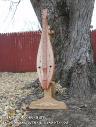
I've been making Shakuhachi for several years now and have reached a point where I think they are sounding good and have a nice appearance. Lately I've added more wood burning decoration with wood dyes and bleaches. My past production has been to use a tung oil finish for the inside of the barrel and walnut oil mixed with a little linseed for the exterior. Walnut oil is used to occasionaly oil the barrel and clean and oil the outside. With this lates project I've wanted to try something different, maybe a beeswax and walnut oil finish buffed out. The Japanese would coat everything, including the binding with Urushi laquer. Many of my local instrument making friends would just spray it with a commercial laquer of somekind. I've wanted to try to be a little more on the green side and use less harmful substances for my sake, keeping in mind that the flute goes in or near my mouth as well as using a filter mask that doesn't entirely keep out vapourized laquers etc.
I should add the sound of playing Shakuhachi for me is extremely relaxing and theraputic. Buddist priests have used them for many centuries to meditate to by listening to the sound they play.
Dave Sharp
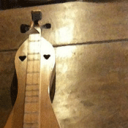
http://fotmd.com/david-s-sharp/gallery/2639/shakuhachi-close-up
Well, mine are made by my brother, Dave Lynch, who is known here and on ED as Harpmaker. You could contact him at Sweet Woods Instruments. His email is harpmaker at sweetwoodsinstruments dot com or at area code 660 then 747 -- 8618.
If you want he can add strap buttons to the corners of the possum board for greater security, but I've never had them installed on mine.
Vanessa, If you want more volume from your instrument you can get it by using a possum board. A possum board lifts the instrument off your lap and allows the bottom of the sound box to fully vibrate rather than being muffled in the lap.
Here's a photo of two of mine that my brother made for me. They both have a none slip rubber glued to the bottom of the board which allows for a great flexibility in placement on my lap. The one with the extra leg means that I can really stretch my legs out for greater comfort as I play. You don't have to strum as hard to increase the sound when the instrument is lifted.
Vanessa Lorentzen said:
Thanks for the reply Ken. After considering your comment and Beth's about playing slower and analyzing a bit, I believe I have been too aggressive, a combination of excessive force and pulling up as I do some alternate picking (as I have seen my husband do on the guitar.) WELL...it doesn't get the same results. I was proud that I could do it though! Funny thing is that I appreciate the soft sound of the dulcimer, but as I play more I want more volume and I think it's getting me into trouble. I guess I better call the guy who sold me the dulcimer to find out the gauge...you're right, I need a spare set!
Fingerpicking doesn't mean picking the string up from the slot. More like fingering them individually sideways. BTW, it's always a good idea to know what gauge strings you are using. You will break one (or need to replace them anyway in a couple months), and will need to know what gauge to buy to replace it with...
I've only been playing for 6 months, and am just trying fingerpicking on a couple of songs right now. It's tricky business, but the sound is so lovely that I'm practicing on my technique. My teacher said to think more of brushing the strings with my fingertips rather than plucking them. That's helped, but it's taking some practice time. 
Vanessa Lorentzen said:
Without a doubt...you have a good point here and I have noticed that fretting close to the fret is the way to get an excellent tone. Thanks for your input!
Beth Hansen-Buth said:Is it only buzzing on the strings you are fretting? I get a little buzzing now and then, especially on my base string, but I think it's mainly poor fretting skills on my part. What I do is go back and replay things more slowly to figure out where it's happening and play with how I'm fretting until it sounds a little cleaner.
You mentioned strumming with too much authority, do the strings buzz only when you strum forcefully or all the time? Some times strings will buzz if the finger or pick lifts the string upwards from the fret board rather than moving side to side. This upward pull lets the string snap back down against the frets and can create a buzz. You need to adjust your angle of attack on the strings to a cross motion eliminating the lifting motion if this is the problem.
Is it only buzzing on the strings you are fretting? I get a little buzzing now and then, especially on my base string, but I think it's mainly poor fretting skills on my part. What I do is go back and replay things more slowly to figure out where it's happening and play with how I'm fretting until it sounds a little cleaner.
i agree with this ! i have one myself and love it.
Leslie, Do you have any Scotch tape? preferably the gift wrap type. After reading about your mom I applied scotch tape to a nickel harmonica cover and the tape in no way hindered my ability to play the instrument. My lips never touched the metal and the tape is invisible. I think its a workable idea. Yes there are chrome harmonicas as an option but if you still have any nickel harmonicas I would go with the tape... Bob.
Bob I love this little story. I wish you could take a photo of your old box full of harmonicas and show it to us!
I have a couple of my harmonicas from 20 years ago, but sadly I think i lost my original two harmonicas I had as a teenagers, which would have been over 40 yrs old now. I always liked fooling around with harmonicas, but never got very good at it.
But I agree, it's always good to keep a little harmonica in your pocket- like carrying around a microscopic church organ!
I keep a set of rhythm bones and a limberjack in my instrument case when I go to music gatherings- like a harmonica they are very portable, and sometimes it's just the thing!
That is a really gorgeous instrument, I loved watching you play! You look like you are having a blast with your new dulcimer, which is as it should be. Congrats on your new friend.
Hey Mary,
That's an increadible instrument - it sounds like a whole band
Great playing 
I just love it too! Here it is under the Meyer's lemon tree. The rumble is the wind--it is breezy and wonderful outside today. :)
Hi Whit,
From D,A,A simply raise the bass D to an E - giving E,A,A I use a reverse capo on some of my dulcimers which I just slide under the bass string next to the first fret. On other dulcimers, where I have a slightly lower gauge bass string my bass string will tune up the tone from D to E. E,A,A gives you all those mixolidian fiddle tunes (OJC, June Apple etc) and any ionian ones (Buffalo Gals, Cripple Creek) if you either have a 6+ or simply avoid using the 7th of the scale.
From D,A,d I again raise the bass D to an E (either re-tuning or with a reverse capo) giving E,A,d and can then play the A dorian tunes (Shady Grove, Elzic's Farewell, Cluck Old Hen, Cuckcoo, Frosty Morning etc). With a 6+ you can also work all the ionian and mixolidian tunes around this tuning aswell. So on 90% of modern standard dulcimers E,A,d will cover off everything the fiddlers play when they re-tune to A,E,A,E
I also use A,a,a and A,a,d depending on the sound I want.
If you want to play chord/melody then a quick way to get to the key of A is to put a capo on fret 4. As long as your dulcimer has a 6+ fret then this will give you the A scale and the chord shapes you are used to from D,A,d. Additionally, by using the 6 rather than the 6+, you can play many Am fiddle tunes in this position.
Tuning your D,A,d 1-5-8 dulcimer to the key of A - keeping the same 1-5-8 string ratio - is a little more awkward. As Ken says, you will probably need to change your string gauges.
You can play in the key of A from D,A,d using 1-0-1 as your root chord A, open strings as the D chord and 1-1-1 as the E chord (3-3-3 for G on mixolidian tunes).It is a little awkward as it is the mixolidian scale that's under your fingers. But tunes like Old Joe Clark and June Apple that are usually played in the key of A mixolidian at old time sessions can be played using this approach.
If you play melody/drone or noter/drone then your options for getting to the key of A with a standard string set are greater than with chord/melody. I regularly (make that daily!!!!) play in the key of A because the list of fiddle tunes played in that key is endless! If you can't play in A major, A minor and A mixolidian then you will never cut it at any old time sessions!!!!!!!
Thanks, Stephen, for the info. It is such a pretty, haunting song. I have the "Song Catcher" DVD and just happened to watch it again a few days ago. I have been doing the song for some time using the dulcimer. I use a different, less clunky rythm than is heard in the movie.
Stephen Addison said:
The songwriter( of When the Mountains cry) has posted a lead sheet on his web page, its fairly easy to play from it - I've used this for banjo and dulcimer versions as well as guitar versions. Here is a link to David Mansfield's lead sheet. You can make it sound just like the movie - it's also easy to make it too pretty.
Ellen Rice said:
Any chance of the TAB being posted some place ?
The songwriter( of When the Mountains cry) has posted a lead sheet on his web page, its fairly easy to play from it - I've used this for banjo and dulcimer versions as well as guitar versions. Here is a link to David Mansfield's lead sheet. You can make it sound just like the movie - it's also easy to make it too pretty.
Ellen Rice said:
Any chance of the TAB being posted some place ?
That's FOTMD member Michael Futreal of Twang Darkly (we share Shreveport, LA as home base). Great stuff!
Brian G. said:
I wouldn't call You are My Sunshine a bright and cheery song at all, especially when you consider the verses. This verse, for example, has a more melancholy feel:
"The other night, dear, as I lay sleeping
I dreamt I held you in my arms
When I awoke, dear, I was mistaken
So I hung my head, and I cried"This one seems vaguely menacing:
"I'll always love you and make you happy
If you will only say the same
But if you leave me to love another,
You'll regret it all one day"And this one is definitely sad:
"You told me once, dear
You really loved me
That no one else could come between.
But now you've left me
And love another,
You have shattered all my dreams."Aura Waters said:
I wouldn't call You are My Sunshine a bright and cheery song at all, especially when you consider the verses. This verse, for example, has a more melancholy feel:
"The other night, dear, as I lay sleeping
I dreamt I held you in my arms
When I awoke, dear, I was mistaken
So I hung my head, and I cried"
This one seems vaguely menacing:
"I'll always love you and make you happy
If you will only say the same
But if you leave me to love another,
You'll regret it all one day"
And this one is definitely sad:
"You told me once, dear
You really loved me
That no one else could come between.
But now you've left me
And love another,
You have shattered all my dreams."
Aura Waters said:
Oh, so pretty!
Guy Babusek said:
Any chance of the TAB being posted some place ?
The funeral song from the movie "The Song Catcher" (When the Mountains Cry). It is one of the most simple, haunting songs I have ever heard. I sing and play a version of the it on the dulcimer.
Under "plaintive" more than the other choices: two hymns (I think both are from the shaped-note tradition) chorded in B minor in DAA tuning: "Wayfaring Stranger" and "What Wondrous Love Is This."
Minor keys have an unfinished quality about them, with something in them begging to be resolved. This is a perfect match to "Wayfaring Stranger," a story of a spiritual pilgrim waiting for his unsatisfying and unfinished life to be resolved by entrance into the heavenly Kingdom. "Wondrous Love," likewise, presents an unfinished story. It is a Lenten hymn which reflects upon what Christ's love for us cost Him, while awaiting the not-yet-achieved joy of Easter. These two songs, with their anxious, "not-quite-yet" quality, illustrate why people started composing in minor keys in the first place.
I really love this thread.
This might be a good place to mention "Creepalachian" music. It's contemporary, alternative Appalachian music, typically dark, moody and minor. Tom House's "Someone's Digging in the Underground" is a good dulcimable example. Except for the electric rhythm guitar, it could be something Alan Lomax recorded.
There's a badly recorded version HERE or get the studio track from Amazon for a buck.Scroll way down for the lyrics HERE .
I think of Tom House as reporting from Appalachian darkside in the amphetamine age. It ain't sweet, spiritual stuff, be advised.
See also Freakwater, another group in this genre.
I've always thought that 'My Dearest Dear' was very sad. I'ts one of those songs that won't go away and I have several tunes to it now.