worldwide Play Music on the Porch Day
General mountain dulcimer or music discussions
David, I watched your movie on YT yesterday-- well done!
David, I watched your movie on YT yesterday-- well done!
Something useful might be found on the CBGitty website. They have 3- and 4-pole pickups and flat humbuckers as well.
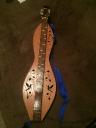
A friend came and played with me for Play on the porch day
I have two dulcimers with built in piezo under saddle pickups. I think both do a very good job of reproducing the acoustic sound of the instruments. I used stick-on piezo pickups for a long time, but they not only amplified the sound of the strings, but also amplified pick noise and any touching of the dulcimer. Using a microphone can be tricky in that you need to find the proper placement for it. One reason I stopped using a microphone is a sound tech at a festival I was playing at insisted that the mic be suspended over the dulcimer. Well, when the mic slipped out of the holder and fell on top of the dulcimer, that was it for me. I went to direct plug-in.
As to magnetic pickups, I have no experience with them on a dulcimer. I know Folkcraft is now offering them on some models. I am not aware of anyone selling magnetic pickups for dulcimers, but maybe you do.
Ken
"The dulcimer sings a sweet song."
That's right, it's more about the doing of it, not the recording of it.
You did good playing for your friend, Irene. 
@irene, in my book, you did play for PMOTPD! The fact that you don't have a good recording is just a little thing.
Since no one has yet answered, I'll give my 2 centavos. I use a Schatten Dualie stick-on piezo I've had for at least 20 years. I bought it to amplify nylon string guitars to get that "Willie" sound. That being said, I also run it through a Boss GE-7 equalizer which has a small preamp built in. Like with the guitar, I run it into whatever amp I have available. I was given a Roland Microcube this year and I love it. I was using the Squire version of a Frontman 15, which for what it is, a cheap amp, isn't bad at all. For larger gigs I have a Fender Acoustisonic 150. I haven't yet used a magnetic pickup on a dulcimer, however I'm thinking about building a strictly electric instrument with both a piezo and a magnetic. If you want some input on magnetic pickups, contact Jerry Rockwell. He also has a unique mounting system he invented to move magnetic pickups from dulcimer to dulcimer. Think the old Rickenbacker horseshoe in reverse.
Been finishing up dulcimer #48 and at the end of the day, remembered. Grabbed my dulcimer and headed into Nauvoo to play for my friend that is going into a big cancer operation and we're all praying that he makes it. I called and said he could stay inside and I play on his porch. So I started my phone to record it, and handed it to his wife that was outside to take a photo. hrumph. All I got on the phone was a 2 second record playing that I was on......repeat. ha ha ha. but my friend and his wife enjoyed me playing for them. A perfect day here as the sun went down on the porch. Maybe NEXT YEAR, I'll be able to get my whole act together and have someone else record it. or at least take one photo.....I'm grateful I got to do this for my friend. He requested old 60's songs and yeah, I know those too. aloha, irene
@don-grundy I'm sorry you got rained out! You'll get to play a make up game now. :)
@gordon-hardy I watched your video yesterday and enjoyed it!
Worldwide PMOTPD had so many participants this year-- more than ever, I imagine. Thanks to all who participated and to all who watched videos!
@don-grundy, did you get to play on your porch?
Any friends want to tell about your adventures with music on PMOTPD? (We had a tech problem of some kind and it took well over an hour to upload our little film to YT.)
Also note that many dulcimers are sold in craft shops (not music stores) to and by people who do not play them. Exotic woods, fancy grains, etc. can play an important role in that process.
Lovely playing and singing! Thank you!
Keep in mind being a 'luthier' can be a hobby or a business. If a hobby, the luthier can do what (s)he wants and can afford, In business, money and customer satisfaction is king.

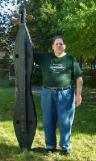
World Wide Play Music On The Porch Day!! Here is my submission
Today is the day!!! Excited. Looks like it will be nice weather here, planning to take out the dulcimer and the acoustic guitar later today and have at it!!!
Capitals and accent marks indicate the octaves. The first letter of a tuning name is usually the bass string, then the Middle Drone, lastly the Melody string(s). CGG/CGc and DAA/DAd are the most common tunings.
C D E F G A B c d e f g a b
The Bass string is usually C or D. The Middle Drone is then G or A. If you are tuning to CGG or DAA, the melody string(s) ae the same as the Middle Drone. If you are tuning CGc or DAd, the Melody string(s) are an octave higher in pitch -- as indicated by the lower case letters c or d. If you refer to the line of letters above, and count 8 letters to the right of C or D, you will find c or d.
The system goes both higher and lower than shown here, with accent marks indicating other octaves.
Here Traildad: http://www.strothers.com/string_choice.html
(Make sure you are calculating in the right octave.)
Not necessarily "one size down". The Strothers string gauge calculator shows that for a 29" VSL tuned DAA/DAd or CGG/CGc, you want .010 for the two Melody strings, a .012 for the Middle Drone, and a .020 wound string.
,
Keep in mind being a 'luthier' can be a hobby or a business. If a hobby, the luthier can do what (s)he wants and can afford, In business, money and customer satisfaction is king.
Ken's point is I think: "one size down.. from what?"- because there are all kinds of different gauge sets for dulcimers that people use, and it also depends on the tunings you want to use.
All that said, a .022 for the wound bass and a .014 for the middle string would likely work fine too. But I'd hesitate to put .012 on the melody string and tune it up to high D on a 29" VSL... it would probably be ok, but it'd be pretty tight and therefore not as comfy to play. .010s would be perfect for melody strings on a 29"er. :)
Randy is "da bomb" when it comes to fretless dulcimers. I don' think you can call the sound "sweeter"... just different.
Not necessarily "one size down". The Strothers string gauge calculator shows that for a 29" VSL tuned DAA/DAd or CGG/CGc, you want .010 for the two Melody strings, a .012 for the Middle Drone, and a .020 wound string.
,
I'm partial to this tune from Randy :)
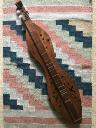
It looks totally great! It has the 6.5 extra fret, btw. I think you'll find that comes in handy. Don't put too heavy a set of strings on it, considering it's a 29" VSL (vibrating string length). Maybe .010 for the melody course.
It looks totally great! It has the 6.5 extra fret, btw. I think you'll find that comes in handy. Don't put too heavy a set of strings on it, considering it's a 29" VSL (vibrating string length). Maybe .010 for the melody course.
I'll second Strumelia's post. Randy Adams is a national dulcimer treasure and I'm happy to own an instrument he made which uses toothpicks for frets.
Ken
"The dulcimer sings a sweet song."
People tend to forget that for a good long time McSpadden dulcimers were made from laminated wood. It was used primarily in the back and sides. The reason the David Schnaufer model was discontinued is that the laminated cherry wood that he specified for the back and sides was no longer available. An advantage of laminated wood is that it is more stable than solid wood. A disadvantage is that it can be heavier than the same amount of solid wood depending upon variations in thickness.
I sometimes build a dulcimer with a spruce or cedar top, not for reasons of sound, but because I like the contrast in the woods; a light top and and a dark bottom.
Over the years I've made some very nice sounding instruments for low quality wood and some real clunkers from very nice wood.
Ken
"The dulcimer sings a sweet song."
Nate, check out our member @Randy-Adams. He is well known for building and playing fretless dulcimers . Most of the dulcimers he's made are rectangular boxes, some from cigar boxes.
He has his own unique playing style. Note that some of his videos include playing on fretted dulcimers too... but particularly check out the fretless videos- they're pretty amazing.
Looks like a good place for you to start!
Let me second what Ken said. Building any musical instrument is the product of hundreds of little decisions made by luthier as the instrument is constructed. An experienced builder makes many of these decision almost subconsciously. Many builders also understand that the buyer needs something to justify whatever price they paid, expensive wood = expensive instrument = quality instrument?
1. Yes -- as far as we can hear, the prejudice against plywood is that it is "dirt cheap" and therefore not good. FALSE
2. Spruce/redwood for dulcimer tops, IMHO is not worth the expense. In guitars, yes. But dulcimers do not create sound the same way, and the "good" that spruce does in a guitar is negated in a dulcimer because the top is so small and further, is muted by the fretboad.
3. Body wood choice is just one of close to a hundred factors which affect the sound of a dulcimer and is overshadowed by the other 99 factors.
Again, IMHO, dulcimer buyers have been sold "a bill of goods" about the importance of exotic, expensive, sexy-looking woods in making dulcimers. As you said, extremely common woods like poplar make absolutely beautiful sounding instruments.
You asked "Is it a matter of the best luthiers choosing the woods that make the subtly best differences, thereby choice of wood could imply a level of craftsmanship?"
My answer is NO. Almost no dulcimer builders have done any reliable, repeatable quantitatively measured experiments to prove "beyond a shadow of doubt" that any woods make any subtle or not so subtle differences in dulcimer sound.
They would like you to think that because they use sexy, expensive woods that that implies "a certain high level of craftsmanship". But it does not. A high level of craftsmanship is found only in those dulcimer builders who can make any woods, or even materials like cardboard or Legos sound good.
[donning asbestos suit to weather incipient firestorm]
Hello all! With lockdown finally dialing back I have been offered a gig at an antique mall, a barber shop, and a juice bar. Given that I build my own dulcimers I have been faced with the decision of how to amplify my sound so that it can span these venues.
It would be ideal to be able to street perform and make a living off dulcimer in the future, so I'd like to build one that has a beautiful tone that translates well when amplified with a speaker.
For starters a pickup seems to not be affected very much by the tone of the dulcimer itself, as electric dulcimers have much less dynamic tonality than acoustic dulcimers I have heard.
I have been told that the only difference among magnetic pickup dulcimers comes from the pickup chosen (I would appreciate input on which pickups are good for dulcimers) and how much the 'soundboard that the pickup is anchored to' is vibrating matters very little.
I have been told that piezos limit the fidelity of the audio and will leave the instrument sounding duller than if it were an acoustic performance
I have noticed that the vast majority of stage performances with a dulcimer rely on electric pickups to convey the sound, whereas coffee shop performances with a physical microphone pointed at the dulcimer seem to provide much more expression of the instrument itself.
How does it all fit together? For gigging at small venues what is ideal?
In guitar communities, cigar box guitar forums I participate in, as well as dulcimer forums there seems to be a lot of status attached to some types of wood, for example koa or basswood, in California it's redwood, or in Arkansas, pignut hickory.
I started off using craftboard for my dulcimers when i was first beginning to learn. Due to the reliable access I switched to red oak, and noticed right away the sound was consistently much brighter and twangier. Eventually I built the one in my profile picture which has a soundboard made from softwood teaboxes coated in poly for some extra durability. I got a couple of huge pieces of 1/8th inch plywood which i have built several dulcimers out of. They all sounded great.
This begs the question, how much does any of it really matter? Since joining a local dulcimer group several people have asked me after hearing my instrument what type of wood it is, only to be totally shocked when I say plywood with veneer. It seems that they have an expectation that plywood should not be able to sound good, but where does this idea come from? Is it just the knowledge that plywood is dirtcheap that makes them assume it should "sound cheap?"
Is it a matter of the best luthiers choosing the woods that make the subtly best differences, thereby choice of wood could imply a level of craftsmanship?
Maybe my ears are too unrefined to be able to tell the difference but others can?
I'm sure there will be opinions all over the place, given that some woods seem to be EXTREMELY common, whereas National champ Grant Olson played for so long (maybe still does) on a styrofoam dulcimer, so I'd love to hear everyone's thoughts.
Cheers!
-Nate
Is it accurate to say that you can make generalizations about an instruments tone based on materials, depth, and bridge placement?
For example it has always been my experience that a harder wood without any large knots will sound brighter than a softer wood of the same thickness which also does not have any large knots.
Also, dulcimers with taller sides seem to give more bass response than shallower ones.
Finally a bridge placed near the very edge of the soundbox to me sounds twangier than a bridge that is more centered over the box.
These generalizations have seemed consistently accurate to me. What do you guys think?
I have noticed that every dulcimer has a different tone and you never really know for sure what it will sound like til you hear it, but maybe at the very least one can identify characteristics that will ensure their dulcimer's tone is not too terribly far from what one desires.
I'd love input from others as I am still very much a beginner!
-Nate
A topic I have heard several times among both players and builders is the pros and cons of various temperaments, with no consensus ever being reached. It does occur to me that a fretless instrument such as a violin avoids this problem entirely since the fretting hand determines how flat or sharp the note is by it's placement. Are there dulcimers made fretless, in order to achieve any microtonality the player might desire? Obviously it would be MUCH harder to play and also take a lot of knowledge to use correctly, but if it gives a sweeter sound, why not?
Stay well!