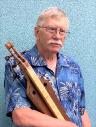
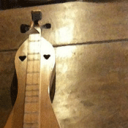
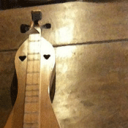
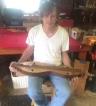
John Molineux uses a striker on a mountain dulcimer
General mountain dulcimer or music discussions
The player is not John Renbourn (who is the one with the guitar, on right at the beginning of the video) but the great John Molineux
I do not know what was being used as a striker in the video yet I've used a chopstick when I've tried the technique.
Irene showed us how to do this @ the Berea Gathering!
I was fascinated with the striker, too. Wonder what he was using as the striker?
Chopstick?
I was fascinated with the striker, too. Wonder what he was using as the striker?
His playing and singing are good enough (you gotta love the little smile as he sings the slightly bawdy lines) but the rhythms he gets with that striker are just amazing. I'm in awe.
That was a really neat video. Loved the song and the music. Thanks for sharing.
Though it doesn't come until near the end of the video, I was fascinated with seeing how Mr Molineux used the striker.
Hello from northern VT! Even though I really am not much of a traveler at all, I am considering a road (or air) trip to the Smokey Mountains - there, I have said it and maybe that will help me to follow through with it. Any suggestions or advice from anyone out there in MD land?
The Crescent PA Turkeys have just dropped by (first time this year!) to wish you a Happy Thanksgiving! Best wishes to you all.
Barb, Blackdogbess
Its amazing how things have changed. I wrote the original post that starts this thread when I was just starting out on the dulcimer and knew no one who plays. Now I have students who work with me weekly, a monthly gathering, and a couple of annual festivals. And through that entire evolution, I've relied on all the friends here at FOTMD to share our musical passion. Without all of you to share my interest in things dulcimer, my life would be genuinely impoverished. Thank you all.
I wish you all a peaceful Thanksgiving.
Thank you, Strumelia!
Wishing everyone here a meaningful Thanksgiving!
Nice to once again look over this thread of giving thanks. I feel blessed to be here and privileged to have so many online friends through our shared love of music. I feel a positive connection to you good folk who participate here on FOTMD currently, and to our friends who have been here in the past.
May you all have a wonderful day tomorrow, hopefully experiencing (or even creating) something meaningful to you.
Not old, not a kit. But I can't tell you right off which of several companies
built it.
You can certainly play in DAd tuning on that instrument, but you cannot play both in DAd (called Mixolydian Mode, with the 7th note of the scale flatted) and play in DAA the Major Scale (called Ionian Mode). Greg is correct that you will find it easier to play in DAA, which is actually used for about 95% of the folk and pre-20th century popular music in the world.
Thank you. You confirmed my suspicions it is diatonic. I just ordered some new strings 12-12-22 and will restring in a few days. In the meantime I'm going to start cleaning it up. Have a good Thanksgiving!
@susie I came-by the instrument used yet it has been used very little. I've not contacted the builder, Paul Conrad, to ask him just what variety of instrument he called it. It has a very deep voice with which I am smitten.
From your picture, it looks like you have traditional diatonic fretting on your dulcimer. In practical terms, that pretty much eliminates D-A-d tuning for playing a "D" major scale. To play a major scale in D-A-d tuning, you would need a 6 1/2 fret (an extra fret not available on your dulcimer). If you had that fret and tuned to D-A-d, the "D" major scale would begin on the melody string at the nut and go up the fretboard one fret at a time skipping the 6th fret and using the 6 1/2 fret instead.
Your diatonic fretboard will work best with D-A-A tuning. In D-A-A tuning the "D" major scale would begin on the melody string at the 3rd fret and proceed up the fretboard to the 10th fret. No extra frets are needed in this tuning.
D-A-d tuning could be used on your dulcimer to play in the Mixolydian mode, but as a beginner you are better off staying away from modes until you can play several tunes on the dulcimer that you have. Modes can be somewhat confusing for beginners. When you are ready to try out D-A-d and other alternative tunings, you can have a luthier install a 6 1/2 fret on your dulcimer, if you like.
I hope this helps. I'm having trouble receiving the photos I sent to my computer, so maybe this one will help.
Photos, Robin! Photos!! Overall, close ups of head and tail. General descriptions are no real help in identifying a dulcimer. Look inside the sound holes and see if there is a Maker's Label. Overall length and depth of the box are meaningless measurements. Round soundholes and good birch ply do not mean a kit.
What do you mean by "The frets are really small"??? Length? Diameter? Height above the fretboard?
The string gauges you choose depend on what "open" tuning you will be using -- most folks use DAA or DAd. Go to the Strothers String Calculator and plug in the VSL and desired open notes, and it will tell you what you need: http://www.strothers.com/string_choice.html
Thanks for your helpful response. I just checked Hulme's article for new players. My action is too low on the middle and bass strings at the first fret. The melody string action is okay at the first fret. There is plenty of room at the left of the second fret (using a nickel). I assume that lowering the nut slots on the bridge for the middle and bass strings will help. Is that going to increase the space between the string and the fret? I will have to get new strings first, for sure. As to what tuning to use, what is the tonal difference between DAA and DAd?
The strings will depend quite a bit on the tuning you intend to use. Most dulcimer players play in the Key of "D". The two most common tunings used are D-A-A and D-A-d. For D-A-A tuning you will need a bass string with a gauge somewhere between .020 and .024, a middle string with a gauge of approximately .012 to .016, and a melody string with a gauge of approximately .012 to .014. There are several brands of dulcimer strings that are sold in sets in these standard gauges.
I tune in D-A-A for most of my playing and prefer .022, .012, and .012 gauge strings. If I were going to tune in D-A-d tuning, I'd probably go with a .010 or .011 for the melody string, but the .012 will work fine on most dulcimers.
Before buying your strings, take a look at how they attach to the tail-end of the dulcimer. Some dulcimers require ball-end strings. Other dulcimers require loop-end strings. And just to complicate things, some dulcimers can use either ball-end or loop-end strings. If you aren't sure take your dulcimer with you when you go to the music store to buy your strings. If you are buying your strings online or through the mail, just be sure to order the strings that attach to the dulcimer in the same way as those currently on the dulcimer.
Other than that, welcome to our friendly forum. You will find many helpful and friendly people ready to assist you. When you have a question, someone will normally have the answer for you.
I'm a total newbie who was given what appears to be an older 3 string elliptical dulcimer. I'd like some help identifying what I've got and what strings to use. It's 30" overall, 1-3/4" deep in the box, has a metal staple style nut and I think a plastic bridge and open gear tuners. I think this may be a kit build, because the sound holes are two simple circles and it may be laminate. The strings are attached to posts on the top of the fretboard beyond the bridge. I can't identify the wood, but it has a nice resonance and volume.
The frets are really small, which is why I think it may be an older instrument. The VSL is 24". What strings should I use on this? The ones that came on it are totally grungy.
Thanks for any help you can provide. If I can get my phone to send me a photo of it, I'll post a picture.
Thanks, @don-grundy!
Indeed, it is, @dusty-turtle. I have been fiddling with the bridge to get the intonation set and am not there yet, yet I really love its deep voice.
Is that the dulcimer with the deep voice that you used on your recent audio recording, @Robin-Thompson? It sounds wonderful!
A new-to-me Timbre Hill mountain dulcimer. :)
Don, it just occurred to me that if you were indeed trying to get the note of a 1/2 fret, you could do it by bending a lower string. So if you wanted an A#, you could bend your D string at the 4th fret. Or if you wanted a D#, you could bend the A string at the 3rd fret.
Don, I'm not sure what you mean by "at 1/2." If you bend a note at the first fret, you are actually moving toward the note you would get at the 1-1/2 fret. There is no way to bend an open string, so you cannot bend a string to get the note you would get with a 1/2 fret.
Bending notes at the first fret is harder than elsewhere. I generally push in on the melody string and pull back on the bass and middle strings. It also helps to use more than one finger, so you might fret and bend a string with three fingers until you build up the strength to do it with just one.
Thanks, Lisa. I have a McSpadden and my melody strings are closed together, too. There are times when I am quickly sliding my thumb while anchoring the other strings in chord playing where the bottom two strings separate some. I might see if I can try out someone’s dulcimer in my group. That is a great idea.
Well, the second-easiest way to find out is take one of the melody strings off your dulcimer and see how you like it. You can always put the string back (or use this as a opportunity to replace all the strings, which is usually a good idea). See if you can loosen the string that's closest to you and drop it down off the side of the fretboard. Some dulcimers have a tiny nail where you can tuck the string to keep it out of the way -- then you don't have to remove the string entirely and you can switch between 3 and 4 strings whenever you like.
The most-lazy way (and therefore my favorite!) is next time you're at a group meeting ask someone with a 3-string setup if you can borrow their dulcimer for a song or two. Try to borrow a dulcimer that's similar to your own so it's a fair comparison.
My own preference is double-melody for drone-style in DAA or DAG tuning. I don't have a problem with hammer-ons or pull-offs because my McSpadden's melody strings are placed very close together, the action is not ridiculously low nor too high, and the string tension is fairly tight. Floppy strings or strings that are far apart can be a problem. I have met some ducimers that are not good with double-melody strings and I don't blame the strings, I blame the dulcimer.
I prefer a single-melody string for chords, fingerpicking and tunings like DAD that often require melody notes on the middle string. In these situations I don't want the melody string(s) to sound vastly different from the other strings.
But that's just me. Try it and see what works for you. As you continue to explore the dulcimer, you'll want to try a lot of different setups (try 4-equidistant next!) Strings are (relatively) cheap and easy ways to experiment.
Thanks, Dusty, I appreciate it. I played rhythm guitar on an acoustic in the past and didn’t want to give up the extra string either. I just went to my first dulcimer festival and one of my teachers suggested I remove the string. I am a chord player and want to improve on hammer on’s and pull offs, etc... I think I should try it.
I tune my dulcimer to DAD. Sometimes other tunings.