$10 Dulcimer Stand Conversion Project
General mountain dulcimer or music discussions
Thanks Ken, I appreciate it. I wanted to post so others might benefit by the project. A very inexpensive way to get a dulcimer stand.
Thanks Ken, I appreciate it. I wanted to post so others might benefit by the project. A very inexpensive way to get a dulcimer stand.
Very nice Susie. You and your husband did a fine job on the conversion. Thanks for sharing your handiwork.
Ken
"The dulcimer sings a sweet song."
Yeah, it does kind of favor a Galax, although all the Galax I've seen do not have a strum hollow. That's an interesting peg head design. I guess the builder was making sure he/she had enough space for six pegs.
Ken
"The dulcimer sings a sweet song."
Sure makes for a great conversation piece, ye guys!
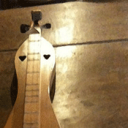
I don't think those are machine heads; I think they're just pegs stuck in the top of the headstock. There are a couple pics in one of Ralph Lee Smith's books of that style peg. I'll try to find them and see if any of them are similar. It's a wide body, like a Galax. So it may be (at least) a 1st cousin to one. LOL. I notice the Fender bag/cover behind it. Is there a lot of musical stuff there?
Thanks for listening Lexie! I couldn't do this podcast by myself ... my husband Wayne Jiang and I partner together to produce it.
If you're willing, we'd love it if you write a review on our iTunes page. Just go to the iTunes app and search for Hearts of the Dulcimer in the iTunes Store. You'll find us in the podcast section. If you have any questions, just let me know.
Machine heads? Those look like violin tuning pegs set from the top rather than the back... Can't remember seeing that configuration of head and tuners for a six-string before. It's certainly an Elliptical shape but doesn't appeer to be as deep as most Galax style dulcimers (3" or more). As Rob says, -- can't tell much from one photo.
It looks like 6 strings, maybe, because there are 6 machine heads. It looks like Galax to me, and there is a noter under the strings at the top. Also no 6+ fret. It's at an estate sale this weekend, so I don't know what they are asking, but it does sure look interesting. The people are moving to the beach, taking very little, and apparently not in love with the dulcimer, or never learned to play it...
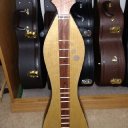
And another picture, with the dulcimer - front.
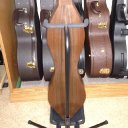
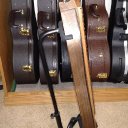
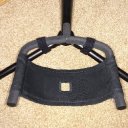
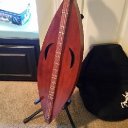
I had a $10 guitar stand that I thought would make a great project to convert to a nice dulcimer stand. I have sewing skills and my husband has a welding torch. So, here's what we did. The bottom support (normally for the lower bout of a guitar) was converted by adding a "sling" (this is where my sewing skills came into play) to support the bottom of the dulcimer. I also sewed a hole for the strap button to rest through. This also serves the purpose of not letting the dulcimer slide off the sling. I also put some one wrap velcro on the bottom support to keep it stable from rotating (which is how they are made for guitars). Then, the top support (normally for the neck of the guitar) was converted by using the welding torch to reshape it to accomodate the wider area needed for the dulcimer. The steel is "hardened", so we couldn't just bend it by hand. Wa-la......a dulcimer stand is born. I'm really happy with how it turned out. And it is still adjustable to accomodate the height of all my dulcimers. Here are some pictures.
How many strings does that thing have? I don't think I've ever seen anything quite like that. Without looking at it and playing it, I'd be hard pressed to give a figure on what I'd give for it. Sure does look interesting though.
Patricia, I truly enjoy your pod-casts, how you introduce people and their creative ways of enjoying our magical dulcimer and the variety of music it brings us.
Thank you for your strong support of the mountain dulcimer.
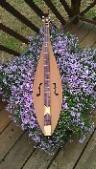
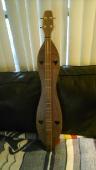
Does anyone recognize this dulcimer, and if so, what’s a fair asking price?

We had fun talking with Rick, who is a dulcimer player, storyteller, actor, and singer songwriter. Rick has been playing the dulcimer for more than four decades and has received several awards and honors for his work with children’s music. This episode has lots of great music as well as entertaining stories about being a dulcimer player.
If you listened to our episode about Joni Mitchell, you heard Rick tell his story about getting picked up by Joni while hitchhiking in Canada in the 1970s.
Listen to the Hearts of the Dulcimer Podcast on your favorite podcast app, in iTunes, or on our website. And be sure to check out the episode resource page on http://dulcimuse.com/podcast/resource/006.html for lots more!
I have a retail store where I ship items daily. In the past 6 months, UPS and the USPS have become brutal in their treatment of packages. It took me a while and a lot of broken glass, to figure out what the problem is. No matter what kind of stickers or fragile messages you put on the outside of the box, a lot of weight is often piled on top of the box. Your box needs to be able to withstand hundreds of pounds of weight in order to arrive safely. Hard dulcimer cases, would be of great help. Lots of vertical cardboard would help in preventing the dulcimer from being crushed.
I double and sometimes triple box items that I send.
Hi James,
Here's some sheet music for C Major, so no sharps or flats. This should make it easy to work out for yourself (the first note is on the open string).
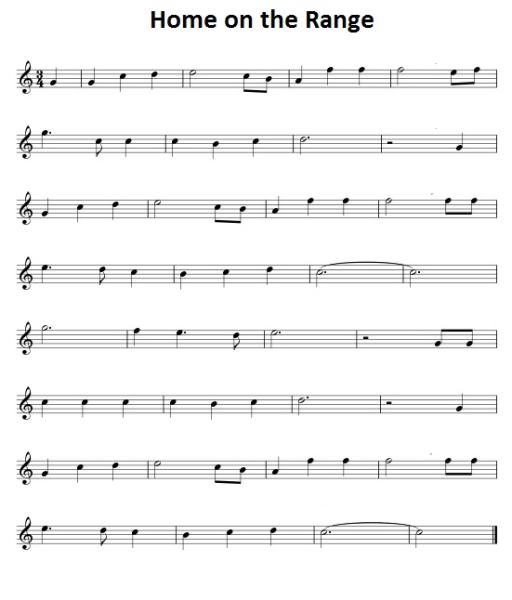
I play it both Daa and Ddd. Sounds great both ways... Robert
Beating the straws, beaters, fiddlesticks, ....it's an old fiddle percussion technique. No need to associate it with anything negative, any more so than beating a drum. Here's a great thread on fotmd about it:
http://fotmd.com/forums/forum/general-mountain-dulcimer-or-music-discussions/4572/fiddlesticks
Dusty...you ain't right lol! Robin, rumor has it that you just may be correct.  Jan, that sound like about the coolest trip ever!
I saw, maybe I should have clarified Ionian tuning, so I will print out one of these tabs and add 3 save for the jump to the middle string parts.
John Keane, that dredges up quite a few memories from almost 50 years ago: 30+ teenagers on a 3-week bus trip through 2 countries, stopping at a World's Fair, 2 capitals, seeing the ocean, getting lost on the NYC subway, visiting the major cities of the northeast coast and every historic site we could cram in--with multiple verses to this tune added every day, including verses about every person on the bus. I remember my verse was about me and a particular boy on the trip with whom I had fallen madly in love...I married him 5 years later!
James, as you can see, Frank linked to two versions of the song, both in DAd. The melody goes down (in fact starts on) the middle A string. So if you want to play melody drone, you will need to tune DAA and adjust the tab accordingly.
http://www.gulfweb.net/rlwalker/dogwood/alltunes/Home%20On%20The%20Range%20(D).pdf"> http://www.gulfweb.net/rlwalker/dogwood/alltunes/Home%20On%20The%20Range%20(D).pdf
or
http://www.threeriversdulcimersociety.net/Music/Home%20on%20the%20Range%20092911.pdf
I have a song request for a tab that I don't have in a book, or have scene on ED, Home on the Range. If someone has a melody line tab that they could send me, I would greatly appreciate it.
John, I'm thinking our own Ken Bloom did studio work on Monkees' music back in the day. . .
It was just there (and cheap). I held my enthusiasm in check until we paid and left lol. 
Hand me that hickory wife beater, Rob, I think it'll make MacLaren's March sound just right!
Ken, for some reason I figured you'd get the reference.  I still think beater is the best name for it, although I have heard it called a hammer.
Seems to work well on Old Joe Clark. I vote for Sticks for the name.
Being a non native speaker has some advantage, so is being naive 
Oh I got the reference! I've always called them Strikers or Hammers. I've used the technique for years, but IMHO there aren't many songs where the technique is appropriate -- Little Drummer Boy, and some of the Irish march tunes of the 1916 rebellion come to mind...
That was really interesting. I'm too old to have much hope of reaching that level but maybe my kids could approach it with a lot of practice.
In this day and age when people are easily offended knockers,  . Stick would be about as bland and non-offensive as you could get and somebody would still probably be offended.
Oh my! I can hear me doing a workshop on this technique and saying, "Ok, now, knockers up."
Anyone get the reference  Think 60s.
One of my wall hanging oddities (flea market find).