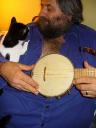
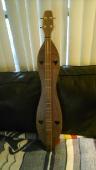
The Cardboard dulcimers are perfect for youngsters. cost between $5-75. Your 8 year old can decorate it, even help to 'make' it by folding things together. They play perfectly well - it's the fretboard that matters, and the fretboards are true sounding.
Forum Activity for @ken-hulme
Breanna, I would highly recommend the student dulcimer that Sweet Woods has. I have several dulcimers, and this one, though it has a birch body, has a mighty great sound to it, and is easy to play. And if your 8 year old sticks to it, Dave Lynch does have a trade-in policy with the student model, but not a lot of people have traded them in as they love them a lot.
Need some help with this song
Playing and jamming difficulties...HELP ME!
If you want to play with drones, from DAD you almost have to use a capo. Either standard capo at the first, or a reverse capo under the drone strings at the first fret. It can be done without a capo, but you have to fret a lot of chords. The DA drones will clash with all the Em phrases. An alternative would be to not strum the drone strings at all, and just play the melody. That's what a fiddler does, though most modern fiddlers embellish the daylights out of tunes. You don't need to do everything a fiddler does. The whole melody can be located between the the nut and the 3rd fret, if you start on the bass string. Perfect for walkabout dulcimers. Another alternative is to raise the bass string to E, and the middle to B. This eliminates the capo, and gives you the correct drones for this song. You will then be tuned to EBD, and play all the melody notes on the melody string. More than one way to skin a cat. But beware of the ladies- As I understand it,the annual Faire in Lisdoonvarna was a place ladies went to find a husband! You could come home married!
Paul
Need some help with this song
Playing and jamming difficulties...HELP ME!
Hey you old dusty turtle...hehehee
Thanks.. yeah.. I can pick. (need to get some ideas and forms down).. my fingers are bent and locked up a bit, so I can not stretch and curve to form chords..(Hence why I am diggin' the dulcimer).. So if I can pick up a few pickin' techniques then your right.. I can probably make the song come alive.
Some one did start a ren fair thread I thought.. I will search it and see. They just recommended books.
I will zip over the help me with this song and see what happens.
Thanks again.
Need some help with this song
Playing and jamming difficulties...HELP ME!
Hi Bradford. You might consider joining the group I created a while back called Help Me Learn This Song, Please . You can start a new discussion with Road to Lisdoonvarna--or any other tune you needhelp with--as the title.
Quick thought: It might be easier to use a capo on the first fret for this one.
Quick question: You describe your difficulty with chords; what about with your picking hand? If you can pick individual strings rather than strum across all of them, you will indeed be able to play this song without too much difficulty. If you have trouble holding a pick, you might consider a thumb pick.
Quick suggestion: You might consider starting a discussion asking for ideas for songs to play at a Ren Fair in a droning style. I bet Ken H. and folkfan alone could give you dozens of good ideas.
Need some help with this song
Playing and jamming difficulties...HELP ME!
Especially for Renn Faire things, I'd keep it simple, one strum per note -- no fancy back and forth strums, bum ditties, filling in the blank spaces with extra strums -- those sorts of things. IIRC early instrument frets were relatively fragile, especially frets tied on or made of wood and glued on; so I suspect that playing was, relatively speaking, calm.
Need some help with this song
Playing and jamming difficulties...HELP ME!
Thank you... that was very helpful.
The other thing I need a little help on is strumming technique. Any good videos or material giving ideas or how-to's.
Need some help with this song
Playing and jamming difficulties...HELP ME!
Here's a link to a discussion on ED, where you'll find a link to Mark Gilston's version, which you should be able to play just on the melody string with drones, tuned DAd. Yes it has a few 3 finger chords, but ignore those and just play the melody line notes at those places.
http://everythingdulcimer.com/discuss/viewtopic.php?t=25813
Here's a link to Gary Gallier's version, also in DAd, again mostly melody line:
http://dulcimercentral.com/wp-content/uploads/2008/08/the-road-to-lisdoonvarna-key.pdf
Need some help with this song
Playing and jamming difficulties...HELP ME!
Hi all,
I am getting close to the next renaissance faire and want to take my stick dulcimer with me to play as I walk around. There was a good discussion on Ren music on another link so I got the books that where brought up. I found this one song that I really like:
The Road To Lisdoonvarna
I don't read sheet music that well, but it is a 6/8 beat. The notes are for guitar and it has the chords listed as well.
I found it on you tube and listened to multiple ways to play it. (sounded great on a lap dulcimer). but no real instructional videos. I can play it "okay" with the dulci on my lap.
Here is my issue: I have damaged fingers from arthritis, so I can not form chords while holding the dulci stick like a guitar.. in order to play this while walking around, I need it to be in the guitar position.
So any of you really talented music folks out there that might be able to look at this song and come up with a way to play it by droning? Or at list a simple finger pluck of some sort..
Any help would be greatly appreciated.
Thanks so much
updated by @bradford-jennings: 02/25/19 02:24:36AM
Beginner? Intermediate? Expert?
General mountain dulcimer or music discussions
Labels, Shmabels. I don't like them. You can be many different kinds of players. Advanced at one skill and intermediate or beginning at another skill. You are what you think you are. If you think you're advanced, then you are, if you think that you're intermediate, then you are, if you think you're a beginner, then you are. The key words here are YOU THINK! I think that it's important to use your best judgement when choosing classes and skills that are best for you. I take classes that interest me regardless of the class description. Sometimes they are a bit too easy, but as Rob pointed out, these are always good to review fundamentals. Sometimes, they are too hard, but I have noticed that you always improve your playing, when you are around players that play better than you. If you pay attention, you can always learn something new at any level class. Sometimes, just the way someone says something different, will gets those brain dendrites circulating and make connections in a new direction. Anyway, that's my take on this discussion.
Beginner? Intermediate? Expert?
General mountain dulcimer or music discussions
Patty, I really think you've hit the nail on the head. Having an accurate and detailed description of what a workshop entails is infinitely more valuable to deciding on whether to take a class than a simple general labeling of classes as beginner, intermediate or advanced students. Especially since it's difficult to really decide what those labels should encompass.
My preference for a workshop description is one that gives details as to playing style that the class will use as to both left and right hand, the tuning that the class will start out in, if a capo will be needed, what tunes will be used and if tab will be available or is the class a strictly "play by ear". Having such information gives the individual enough knowledge to decide whether the workshop will be at his or her level of performance, an interesting challenge, or way over head (as in sinking from the moment the instructor starts speaking.) Personally, I've been in the way over my head type of situation
and spent sometime figuring out how to apologize to the instructor and get out of the room with as much dignity as I could.
Beginner? Intermediate? Expert?
General mountain dulcimer or music discussions
Having descriptions for workshop classes is helpful especially if classes that you want to take are at the same time. It helps with making decisions. When I attended Shenandoah U. I took the beginner classes. I did know some of the basics already but it doesn't hurt to review them. I agree Rob!!! Anne Lough encouraged me to challenge myself and take a class that is above my level. I had trouble with some elements but I learned a lot and enjoyed it. As always, I'm learning a lot from members here. Thank you John Keane and Robin Clark for your how to videos!
I guess I'll always be a beginner for some aspect of the MD. It is such a versatile instrument. Thank you Lisa for this web site. It's the best!!!
Wayne, I didn't realize you no longer have pennies. When you come to my neck of the woods I'll give you some, LOL,
Beginner? Intermediate? Expert?
General mountain dulcimer or music discussions
Beginner - someone who needs help learning a tune.
Intermediate - someone who doesn't need help learning a tune.
Advanced - someone who needs help finding tunes to play.
Expert - guitar boy.
john
Beginner? Intermediate? Expert?
General mountain dulcimer or music discussions
I'm barely starting and hoping to make it to intermediate. However, I hope I never get to the point that I would consider myself an expert. There should always be more to learn, more to look forward to. Aw heck, no one has reached perfection yet so I guess there are no experts.
Beginner? Intermediate? Expert?
General mountain dulcimer or music discussions
Thanks, Robin, but if you noticed Dusty said we were both nuts.
And thanks, Dusty, for your assessment of my real level. I do think though that I would rank as a beginner when it comes to playing ability. Realistically, on a good day, I can only manage to play in the most basic manner with either right or left hand. On bad days, now, I don't play at all.
Lisa, Have you ever heard the Oysterband's version of the False Knight On The Road? The knight was a nut for thinking he could get around the child. That little boy knew to stand fast and face evil.
Beginner? Intermediate? Expert?
General mountain dulcimer or music discussions
Ed, I like that ! And, there is always someone who plays worse then us, and someone who plays better than us.
Ken, you make some great points. But one problem I have with your definitions criteria is that it calls for everyone to be able to play in more than one style in order to be classified as an intermediate or advanced player. Some folks are very advanced players in their chosen style of playing, -why should they have to be able to play in multiple styles in order to be considered anything other than a beginner? This is definitely not true in the banjo community for example- imagine if all clawhammer players were classified as beginners unless they could play banjo in bluegrass style as well...!
I also feel that 'performing' should not necessarily be a requirement for evaluating players. Some folks don't want to perform for one reason or another, but I feel some of them are highly skilled players regardless of that.
P.S. Dusty, Robin, FF,.... isn't there an old Anglo ballad by the name of "False Nut on the Road" ...?
Beginner? Intermediate? Expert?
General mountain dulcimer or music discussions
I'll always be a beginnerat the next level whatever that may be.
Beginner? Intermediate? Expert?
General mountain dulcimer or music discussions
Dan said "I met with one of the members of a local dulcimer society, he began with telling me all the things I have to have. My noter and quill was not mentioned. No way I can play chords with first string staple frets....I imagine I too am destined to always being a beginner."
Dan, I know exactly how you feel. For more years than I want to count, every time I met a dulcimer player or group that was the same reaction I received --- you can't do that, you have to play this way, we only play DAd, et cetera ad nauseum .
There is still far too much of that sort of prejudice going on in the dulcimer world today. Unfortunately most of those folks don't read FOTMD or ED, either, to see how the wider world works.
After being insulted, put down and shunned by people and groups like that, I wasn't about to cower in the corner and shut my trap. That's just not me
Is it any wonder that I have become such a vocal champion of "playing your way" as well as preserving the more traditional styles -- in particular Noter & Drone. My mission, as such, is to prove to those blatantly wrong self-righteous folks that the dulcimer does not have to be, and never was intended to be, played only DAd tuning and chords and fingerpicking and all that other modern nonsense.
The good thing that's happened over the past few years, and in particular here at FOTMD, is what I've taken to calling the Second Dulcimer Revival -- a.k.a. Dulcimer Revival Part Deux, the Return of Traditional Playing
Dan, you're welcome to share my semi-official moniker: Uncontrite Modal Folker.
Beginner? Intermediate? Expert?
General mountain dulcimer or music discussions
Dusty, who you calling nuts? Folkfan is perfectly sane! :)
Dusty Turtle said:
Robin, your noter technique is definitely advanced. And hey, no beginner could use a false nut so effectively.
Folkfan, no beginner could talk modes and tunings as clearly and confidently as you do.
I love you both, but y'all are nuts.
Beginner? Intermediate? Expert?
General mountain dulcimer or music discussions
I think almost everyone in the dulcimer community is humble about their playing abilities. I take a lot of beginner's workshops for several different reasons. 1) Fundamentals, fundamentals, fundamentals. In music, like in sports, having the best grasp possible of the fundamentals of technique is necessitous. 2) How material is presented. If, someday, I ever teach a workshop or two, I like to see how players/instructors I respect present their material to get ideas I can borrow for myself. 3) Learn a new tune, simply, so I can add my own "take" to it later.
Intermediate workshops are for the challenge. I took one last year just for that reason. Wasn't sure about the tune, but I wanted to push the envelope a little (maybe a lot) and get out of my "comfort zone."
An "expert/advanced" workshop, to me, would be a master class where the student and instructor (usually a pro) work on one piece to make it the "best it can be." These are quite common in the classical music world and I've been pleased to see them starting to catch on in our musical world as well.
So, if there's a problem, it could be with people's perceptions of their own abilities and their desire to stay in their comfort zones rather than the terminology regarding the workshop.
My 2 centavos
Beginner? Intermediate? Expert?
General mountain dulcimer or music discussions
Ken, thanks for breaking this down. It is good to hear from someone with your experience as to the level of players you may expect to find in the different classifications. John, thanks for the Pep talk giving us the courage to push the envelope and ignore the classifications. Knowing what you may be getting yourself into makes exploring new horizons less daunting.
Beginner? Intermediate? Expert?
General mountain dulcimer or music discussions
Robin, your noter technique is definitely advanced. And hey, no beginner could use a false nut so effectively.
Folkfan, no beginner could talk modes and tunings as clearly and confidently as you do.
I love you both, but y'all are nuts.
Beginner? Intermediate? Expert?
General mountain dulcimer or music discussions
Sooooooo sad. I'm always a beginner. But I enjoy playing the dang thing my way and for me, myself and I so I guess it doesn't really matter. heheheheee
Beginner? Intermediate? Expert?
General mountain dulcimer or music discussions
I'm happy being, in many ways, an advanced beginner so am too lazy to learn enough to be able to write/speak knowledgeably using music terminology. :)
Beginner? Intermediate? Expert?
General mountain dulcimer or music discussions
I dunno...I'm not much for labels. If there's a class with a subject matter of interest to the participant, then take it. Even if it is above or below a particular perceived ability level, there is valuable information to be gained when there is a genuine interest in the material covered. I also feel that personal improvement can be delayed if one consistently stays with classes within their "comfort zone" so to speak. It's refreshing to see folks just step through the door in search of a new challenge. The journey becomes much less mysterious if there is a knowledge of the road ahead. For me personally, I'm too dumb to realize that there is stuff out there that I can't eventually do with a reasonable amount of practice and desire. I say keep it fun, keep it forward, but don't keep it a secret! Share this wonderful instrument with others!
Beginner? Intermediate? Expert?
General mountain dulcimer or music discussions
Brian and I host an old-time music camp-out every year, and we get about 250 fiddlers, banjo players, etc.
We host workshops in Fiddle, Guitar, and Banjo, with different respected players teaching every year.
One thing I notice is that the workshops are always full of beginner and intermediate players. But all the 'advanced' players are seldom there- they are out in the campgrounds, just playing music, not taking workshops.
So I too would be interested in seeing who goes to a class aimed at advanced/expert players. Wouldn't they all just be the teachers, playing together?
Beginner? Intermediate? Expert?
General mountain dulcimer or music discussions
Most often when a workshop is listed as beginner/intermediate or intermediate/advanced the idea is not that a new, in-between category is created but that the workshop would be appropriate for players of both levels.
Yes, Ken, it appears people don't like the word "expert." But if you change the name to "advanced" we'll find something else to complain about.
Beginner? Intermediate? Expert?
General mountain dulcimer or music discussions
So what I'm hearing here is that more people are objecting to my use of the word Expert rather than something else... And not objecting so much to the actual definitions??
Helen - I think if you break things down too far the distinctions begin to blur too much. What distinguishes Beginner from Advanced Beginner? Knowing what VSL stand for? Being able to play two tunes but not three? See what I mean?
Beginner? Intermediate? Expert?
General mountain dulcimer or music discussions
Ex = former
Spurt = a drip under pressure
OK... Novice, Intermediate, Advanced then...
Lisa: I know that you know at least 6 tunes from memory! And, except for maybe not up to leaping tall buildings, you surely do meet Expert, not just Intermediate.
I see what you mean, Dusty. But an expert blues or classical guitarist doesn't normally start out studying strictly blues or classical guitar, either. They get a firm foundation in general guitar playing before they start specializing in blues or whatever. I guess my point is that most dulcimer players do not get a firm foundation in the totality that is the dulcimer. And more's the pity...
My definition of a 'professional' dulcimer player is one who makes significant or primary income from teaching, performing, making & selling CDs/DVDs, etc. When I said an expert 'regularly plays solo in public', I didn't mean to imply stage performances, but rather a level of comfort playing in front of others (besides your immediate family and pets). I mean being comfortable enough with one's skills to play for strangers - not in a jam setting, but in a park, at a nursing home, farmer's market, etc. - and not be scared witless.
Beginner? Intermediate? Expert?
General mountain dulcimer or music discussions
Well that certainly lets me out...I'll never be an expert!
Heck, I honestly don't even think I meet all the criteria to be an Intermediate!
Hey, I thought an expert was "Someone who knows more and more about less and less until finally they know everything about nothing".
Beginner? Intermediate? Expert?
General mountain dulcimer or music discussions
Ken, it would indeed be nice if everyone could adopt a common set of definitions of these terms. If this discussion begins the process whereby such an agreement could be made, you have done the dulcimer world a great service.
Let me complicate things a bit.
There are at least two other terms commonly used in this context: novice and advanced. In fact, I think "advanced" is much more commonly used than "expert." One might still be a student and be "advanced," but your definition of "expert" is what most of us would call a professional. I doubt you will see a workshop advertised for the "expert" level,but you might see it for the "advanced" level.
One reason this issue is complicated and confusing is that although some people come to the dulcimer with no prior experience on any musical instrument, others come as advanced players on other instruments. I was able to tune and change strings before ever holding a dulcimer because I had beenplaying guitars, mandolins,ukuleles and the like for decades. And I could probably play six tunes from memory within a couple of hours of getting my first dulcimer. That ability was not due to some natural gift I have, for believe me, I am not naturally gifted, but simply that I had been playing so many other stringed instruments that I was already familiar with how to play. And the fact that I had read (perhaps a dozen times) your essay"I Just got a Mountain Dulcimer, Now What?" over on ED meant that I was familiar with MD terminology even though I had never held one before. About a month after getting my first dulcimer I attended a festival thinking I was a beginner but was told by people at my first workshop that I was at least intermediate and perhaps even advanced. They were wrong, of course. My knowledge of the fretboard was still in its infancy, for example. But they based that opinion on my comfort fretting, strumming and picking notes and chords. I guess my only point is that any serious definition of these terms for "levels" of playing has to account for those whose technique might be advanced but whose understanding of the instrument is still at a beginner level. In fact, after almost four years I probablystill fit that description. (Maybe the term "novice" could be defined in such a way as to include those new to the dulcimer but familiar with other fretted instruments.)
My only real quarrel with your definition of terms, though, is the insistence that one must be equally familiar with all styles of dulcimer play. Is it not possible for someone to be an expert noter/drone player who knows nothing about chords? Is it not possible to be an expert modern chord player who knows nothing about noter technique? One would not demand that an expert blues guitarist also know how to play classical guitar or that the double bass player in an orchestra also know how to play bluegrass bass.
Beginner? Intermediate? Expert?
General mountain dulcimer or music discussions
In various times and places (noticeably when reading festival class descriptions) we have all pondered the meaning of the words Beginner, Intermediate and Expert. In the interest of developing and promoting a Fabianist discussion of the topic, I thought I would post here my own descriptions of those playing distinctions.
Beginner
Someone who cannot tune and re-tune their dulcimer in less than five minutes. Someone who has never changed a string, does not know what kinds and gauges of strings are on their dulcimer, and does not know how to determine what kinds and gauges are necessary. Someone who does not understand common dulcimer terminology. Someone who has begun learning one style of left-hand and right-hand play in one tuning. Someone who cannot play at least three tunes completely through from memory.
Intermediate
Completely at home changing both keys and tunings (DAd to CGG for example) in less than five minutes, and understands the nomenclature of tunings (1-5-8 vs Dorian vs DAC). Can change strings quickly and correctly, and has changed all the strings on their instrument at least twice. Understands and uses common dulcimer terminology. Can demonstrate at least two styles of left-hand and right-hand play, and play at least one tune completely through in each style. Can read tab or SMN, or learn by ear, and plays at least 6 tunes completely through from memory using at least one style of play.
Expert
Someone who has experienced all three major styles of left-hand play, at least two styles of right-hand play, and regularly uses elements of those in his/her personal style and repertoire. Changes and re-tunes naturally. Regularly (at least 6 times a year) performs solo in public. Can play at least twelve tunes completely through from memory using at least two styles of play. More powerful than a locomotive. Able to leap tall buildings at a single bound.
Let the fur fly!
updated by @ken-hulme: 02/09/25 09:59:58PM
When I got my 1st instrument in Dec 1986, there were quite a few books available. I had Jean Ritchie's Dulcimer Book , and a few others. I knew of no others on the Eastern Shore of Maryland or in lower Delaware who played, so I was on my own. Like Ken, I listened to records of players I liked and players I didn't like. I took something from all. I had one afternoon workshop with Leo Kretzner right after I got my dulcimer. That was all the instruction I'd had 'til 18 months ago. I laid the instrument down for several years, playing maybe once or twice a year at most. I have been playing seriously now for about 18 months. Were I able to go back I would buy the one book I specifically rejected because it didn't have songs in it: In Search of the Wild Dulcimer by Robert Force and Al D'ossche. This is now available from www.robertforce.com as a free download along with its companion: The Wild Dulcimer Songbook . Reading it after I bought a copy at a thrift shop on Mercer Island, Washington, made me want to play the dulcimer again. So I have, and I've increased my instrument collection and, most importantly, I've increased my friends.
Welcome!!
I'm a self-taught traditional noter & drone player. When I started nearly 40 years ago there was only Jean Ritchie's Dulcimer Book , and a few cassettes and records (!!) to listen to. Today you've got a zillion YouTube videos and teaching CDs, some of them by folks here an other well known players and quite good, others not so much.
Lois Hornbostel is a trained teacher, unlike 95% of the other dulcimer teachers out there, and her Classroom Dulcimer book is extremely well written and developed, and I can't recommend it highly enough if you want a good teach-yourself book. www.loishornbostel.com
In the meantime you might want to read the article I wrote here called I Just Got A Dulcimer, Now What? It's an illustrated glossary of dulcimer terms and answers to many beginner questions about tuning, playing, modes, care and feeding of your new best Friend. It's here:
http://mountaindulcimer.ning.com/profiles/blogs/i-just-got-a-dulcimer-now-what
updated by @ken-hulme: 02/16/16 10:03:18PM
As you can see this shows a single setting, but can be translated in to the diatonic world in 3(or 4) different ways. DAD, DAA, DAG,( DAC) and thats without any transposing.
One reason I try not to talk in modes when it is more accurate to talk of gapped scales.
John P - I can understand that. The fact that many, many tunes are 'gapped' (Cripple Creek, Angeline the Baker, Shady Grove, Cluck Old Hen, Buffalo Gals etc etc) is a godsend at old time sessions as it saves a lot of re-tuning. I can play most of the 'standards' in more than one position on the freboard.
But I don't think it is more accurate to talk about gapped scales rather than modes as these aren't really cross modal tunes. They are just tunes that don't use all the notes from their 'home' mode and so you can cheat by moving them around the fretboard. For example, if you start to improvise on Cripple Creek or Angeline the Baker you very quickly realise that their 'home' mode is ionian even though the tunesthemselvescan be played on the mixolidian scale. I've not come across a tune yet that will truely work in more than one mode, when you start to harmonise or improvise they all have their 'home' mode. It is good though to know that you can get away with playing lots of tunes from different start points on the diatonic scale.
Sorry if you found that overkill John, to me everything you need to know is contained in that one table, you can dump anything else you've dragged in from the chromatic world.
Are you sure you understand how to tune a dulcimer, and not just learnt a couple of rules of thumb ?
It's a two stage process, first you tune the melody string, then you tune the drones accordingly, why are you expecting the keynote to turn up on the drones(although it usually does), it's the melody string you tune.
SMN is not a precise system by any means, it purports to be a 'one size fits al' but it's not.
Here's the SMN for Pretty Saro :
as you can see this shows a single setting, but can be translated in to the diatonic world in 3(or 4) different ways. DAD, DAA, DAG,( DAC) and thats without any transposing.
One reason I try not to talk in modes when it is more accurate to talk of gapped scales.
john