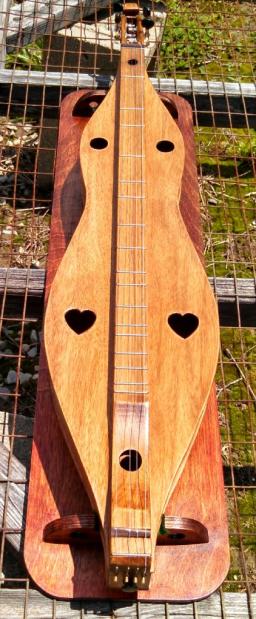
I've used a variation on Janita's tuning: D-A-d-A#. Also D-A-d-c#. I can mute the near string with the heel of my hand. That means I'm playing D-A-d (that's easy and I can strum!) with an extra string I can play only when I need it.
Another chromatic tuning is D-F#-A. See this site: http://www.mountaindulcimer-1-3-5.com/
With 4 equidistant strings, try D-F#-A-D.
You can substitute a "power chord" when you can't get a major or minor chord. A power chord contains only the root and 5th notes. It's the 3rd note that determines whether the chord is major or minor. When you play an open DAd you're playing a D power chord, which can substitute for either D-major or D-minor as needed. Not the same sound, but it works in a pinch, especially when playing with other instruments that will supply the missing 3rd.
When dulcimer tab shows a barred 1st fret as an "E-minor" chord, it's actually an E power chord. It's the kind of workaround that dulcimer players use all the time, but a guitarist won't know about.
I think it's great that you've found a guitar teacher who's willing to explore dulcimer with you. However, he may need an occasional gentle reminder that a dulcimer is not a guitar. The typical lesson plan for beginning guitarists is not well suited for dulcimer. The dulcimer is NOT designed to play in multiple keys from the same tuning. Nor to play chromatic runs. That doesn't mean it's impossible -- but it ain't easy and it's very uncommon for anyone to attempt it. The addition of a 1-1/2 fret doesn't really change things -- it makes a few more chords and scales possible, but it does not mean you can take the normal scale boxes and movable chords that you'd learn on guitar and translate them directly to the dulcimer.
If you're hunting for a Gb, G and G# in the same song, then you're playing a song -- or an arrangement -- that might be easy on guitar, but on dulcimer it's crazy advanced. If your heart's set on that style of music, your life will be much easier with a full-chromatic fretboard.