Show Us Your Pets!
OFF TOPIC discussions
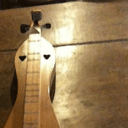
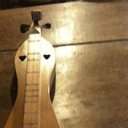
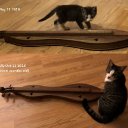
Sally at 2 months and 7 months checking out my 1931 Uncle Ed Thomas reproduction made by Kevin Messenger
Sally at 2 months and 7 months checking out my 1931 Uncle Ed Thomas reproduction made by Kevin Messenger
Thanks to everyone for your input. I've made some notes. I realize there are variables, but even guidelines given are helpful. I broke a couple of 9 gauge strings a few months ago but, alas, I can't recall what I was attempting to tune to at the time.
On a 28 or 28.5" scale, I would think .009 and .010 strings would tend to more often break if you try tuning any higher than a high e (for melody strings). That's just my own experience.
Too many variables to say definitively. New strings, a week old, six months old, more? Never tuned above C or regularly tuned up and down? Never been tuned above DAA, or regularly tuned up and down? String vibrating as you tune it, or static? Tuner gear ratio (high ratios like 1:18 easier on strings than 1:4)?
I have one customer who plays a 27.5" VSL dulcimer with 0.024, 0.012, 2 x 0.010 string gauges up at F,C,f,f above D,A,d,d on stage and when recording.
https://www.threeleggdmare.com/
There's definitely a balance between pitch, string gauge and scale length. For a given VSL there will be a physical top pitch and bottom pitch you could reach irrespective of the string gauges you try. This is because every string has an optimum tension at which it will vibrate the best. A good way to get an indication of this is to look at other instruments VSLs, such as mandolin or guitar, and compare where their standard string gauges and pitches lay against your dulcimer's VSL.
This does not directly answer your question, but the highest standard tuning that I generally see is EBee. If you are just playing around, I would purchase multiple sets. (If you have a guitar center, ask at accessory counter for individual strings at about $1 each.) Then just keep tuning until..."POP!"
I have strings in gauges 9, 10, 12, & 22 and dulcimers with 28 1/2" & 28" VSLs. What is the highest note (i.e. g4) that I can tune EACH of these gauges to without the string being likely to break? Info appreciated!
I don't think I could have made my fingers move fast enough!
On the way to Texas! Thank you.
Salt Springs!
That's it!!!!
I know coming here was a wise move! Do you know where I can find it to buy?
I've searched The Steam Powered Preservation Society, not there. Amazon is not looking good either.
Thank you!!!
Just by chance several weeks ago, before my friend sent me the link to this dulcimer sale, I had started gathering information on A.W. Jeffreys for my Today In Mountain Dulcimer History posts but never completed it. This got me jump started. In fact today I traded several emails with Jeffreys' daughter, Jan. I'm still tweaking this but this is what I have so far:
A.W. (Alois Waldo) Jeffreys, Jr. was born in 1923 in South Hill, Virginia to a tobacco farmer/auctioneer.
A.W. Jeffreys was a Naval pilot during WWII. In 1946 he was in the naval pilot's group that was the fore-runner to today's Blue Angels, then known as the Flight Exhibition Team.
After his Naval career he was a clinical psychologist. He was Chief Psychologist at Western State Hospital at Staunton, Virginia for 33 years.
According to his daughter Jeffreys became interested in dulcimers after observing local folk playing them in the mountains of Virginia where he lived. He made his first dulcimer in 1956.
About 1960 he started the Appalachian Dulcimer Company in Staunton, it was a family business. His wife ran the business side and she and the kids, Jay and Jan, helped A.W. with various aspects of the business and building dulcimers.
Jeffreys built both 3 string and 4 string instruments, but preferred 3 strings, in walnut, cherry or butternut with either heart or diamond shaped sound holes. With each dulcimer came an instruction book, which he wrote, a cloth bag, a hand cut pick, and an optional LP record made by his friend, Paul Clayton.
In the mid-1970s A.W. and his wife took over all the work when Jay and Jan left home. The business wound down sometime in the late 1980's. It is estimated that over 3000 dulcimers were made. Sometime in the 1980's Jeffreys donated much of his dulcimer collection to the Smithsonian Institute.
Jan told me her dad played the dulcimer very little as he was more of a vocalist. But the song she remembers the most was "Go tell Aunt Rhody".
A.W. Jeffreys died 29 January 1992.
Not much without permanent alterations. A leather strip will help. A thin bent metal or hard plastic plate tucked under the strings would last longer.
Most of us just sort of accept that the round-over of the fretboard is going to notch if the builder did not install a piece of fretwire (like your aluminum rod) at the break-over. Your aluminum rod will notch under the pressure of steel strings.
Generally the cutting-in goes 'so far and no farther'. I have dulcimers that are decades old, and the cutting-in has not continued much more than the depth of the string diameter.
New dulcimers going out of tune after a day or so is quite common, and not just caused by the string cutting it. New strings take a day or two to stretch into the root tuning that you use.
Hello all,
I picked up my first dulcimer several months back and found that it would go out of tune after a day or so. After further investigation, I noticed that the middle and melody strings had cut in to the tail and were going deeper with each tuning.
Since I hadn't paid much for the instrument, I decided to solve the problem by cutting the tail at the top end and placing a bit of aluminum rod for the strings to rest on... This dulcimer hasn't gone out of tune since.
I have since acquired a number of dulcimers and am having the same problem with two others but don't want to modify them, as they are much nicer and were quite a bit more expensive.
Does anyone have any suggestions on how I can stop this without permanent alterations?
Hi Irene. I have several Mirlitons -- one almost identical to the one Peter is playing, made by the same Austrian builder. Very spendy…
I've also started making them myself. Not as pretty perhaps but they play just as well. I've made three so far from bamboo that is 3/4" but not 1" in diameter, with lengths from 5" to 10". The covers are made from joint ends of larger culms. I'll post some photos later. I have one crummy vid on my YouTube. Having trouble finding a way to make vids that aren't 50-80 Mb. The membrane is a 2x2 square of plastic grocery bag tied/glued over the ends and trimmed.
Tut Taylor did a dulcimer album for the Bicentennial and the first song on side two was called, "Mountains and Woodsmoke".
Here is a link, it starts at about 2.22 on the video.
I'm the craigslist seller. Funny, but I didn't even think about posting it here.
I actually have two of these (including the one for sale), numbered #2517 and #2782. They're almost identical twins, except the fretboard on the earlier one is 3/4" thick and the latter is more like a 1/2" thick. And #2517 is initialed AWJ and #2782 is initialed JCJ.
The one I'm playing is tuned to CGC/CGG, and I like the sound of it there.
Here is fotmd's own Peter W. playing onion flute with mountain dulcimer:
Ken, I'd never heard of an "Onion flute" and went on youtube to see it played. how fun is that!!! Where did you get your onion flute? aloha, irene
I play a bit of pennywhistle, but mostly Mirliton. The Mirliton or Onion flute isn't really a wind instrument, it's a membranophone -- an ancestral kazoo more or less (but not as raucous or metallic sounding) from the 15th-17th century. Sounds good with the dulcimer actually.
Ever since getting my teeth replaced with an upper plate, I more or less lost the ability to whistle well; which I used to enjoy doing along with a friend's band. The Mirliton lets me do almost all the complicated trills of whistling again.
Welcome Atilwi! Glad you found us. You're in for a fabulous experience! Always ask questions -- we're here to help. There are no stupid or inappropriate questions, just ones that don't get answered.
I've attached an article I wrote a few years back called I Just Got A Dulcimer, Now What?. It's an illustrated glossary of dulcimer terms, so we all speak the same lingo when asking and answering questions. Plus it has answers to many beginner questions about tuning, playing, care and feeding of your new friend.
Hello!
I teach elementary music in Kansas and just ordered my first Dulcimer. Found this place when I was researching what to look for so I could choose a good one!
Same, John, in that, having a music education degree, I can supposedly play all of the band wind instruments, buuuuut.... I'm really a flute player. If I had access to the instrument and practice time, I have the foundational knowledge to pick any of them up.
I also do a little on soprano, alto, and sopranino recorder (mine are all plastic Yamahas, acquired for the purpose of teaching elementary children). Would love to learn pennywhistle, but haven't bought one yet.
A friend saw this AW Jeffreys dulcimer on Craigslist. Looks like the seller is about 3 minutes from my house. Too bad I'm not collecting, seems like a good price.
https://huntsville.craigslist.org/msg/d/vintage-w-jeffreys-dulcimer/6708546706.html

That's one beautiful instrument. All but one of mine have wooden tuning pegs. I don't find them hard to work at all -- just 'different' from mechanical pegs. I gave you ideas for strings on your FB post.
Posted this on the Everything Dulcimer FB page, and it was suggested I ask here (probably should have asked here first!).
I recently acquired a beautiful mountain dulcimer made in July 1975 by John Kleske of Binghamton NY, and wondered if anyone else has and plays one of his instruments. Mine is #82, and I suspect it has the original strings from 1975. All I know about him is what I found in his 2011 obituary (plus a piece about a ukelin orchestra he and John Thomson of Seneca Moon String Band put together!). Sadly, it appears that the Cranberry Dulcimer Gathering he founded in 1976 ended with the one in 2016. Any information about him or his instruments would be most welcome. I'd also appreciate any tips on what kind of strings to use; these ancient oxidized ones feel like playing a cheese slicer. Do wooden peg dulcimers require anything different than ones with geared tuners?
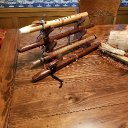
Here is my collection so far. HighSpirits, Erik the Flutemaker, Stellar kit and recently purchased from Joe Loftin.
The Wilsons are somewhat legendary in Michigan, having built dulcimers and exhibited them at festivals. As I understand it, Richard built the dulcimers and Denise provided the inlay work, and maybe the soundholes. They do (did?) excellent work.
That inlay on the back looks really cool, John!
Here is my collection so far. HighSpirits, Erik the Flutemaker, Stellar kit and recently purchased from Joe Loftin.
There is also a McSpadden "Sweet Song" dulcimer kit listed on the site.
I just found this listed on shopgoodwill.com! A very pretty, high-quality dulcimer with beautiful heart and flying geese soundholes. Flying geese inlay on the back. Item #58634975.
Blondie - FYI - you can see the stand in my video - "Crippled Creek Osceola Aug 2012
Oh my goodness, this is just awesome! Thank you so much for sharing!
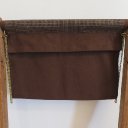
You are VERY welcome! Let me know if I can help you any more! Like I said, it wasn't perfect, but is light-weight, folds up, and adjustable. I did have a little trouble stitching the shelf liner onto the fabric, but it is helpful so you don't get the instruments slipping and sliding.
Oh my goodness, this is just awesome! Thank you so much for sharing!
Hi Blondie!
Ok - for my stand (which is a double-wide) I used the following:
(4) - 1"x2"x40" - for the legs
(3) - 3/4"x20" - dowel (for the outside leg and center)
(2) - 3/4"x18 1/2" - dowel (for the inside leg)
(2) - 26" lengths of chain (this makes the stand height adjustable)
(4) - hooks to attach chains to
Fabric, shelf liner and stain
While it isn't perfect, it certainly has served me well! I made it double-wide so I could keep 2 instruments on it, and switch them easily, especially if playing out. Let me know if you have questions.
Thanks!







 cheers!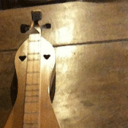

![IMG_20181013_173729921[3129].jpg](https://fotmd.com/forum/image/forum_file/32564/icon/crop=auto/_v=4cfce1539472099)



 I Just Got A.pdf - 1MB