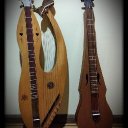
"New" harp dulcimer and Gallier A-frame prototype...
Instruments- discuss specific features, luthiers, instrument problems & questions
Wow, Brian, I've never before seen a harp dulcimer-- way cool! Your Gallier's a beauty, too!
Wow, Brian, I've never before seen a harp dulcimer-- way cool! Your Gallier's a beauty, too!
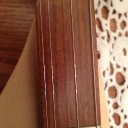
I just added a couple of very special instruments to the collection and thought I'd share. The one on the left is a walnut, purpleheart and spruce harp dulcimer built by Bob Schepis. According to correspondence I have, it is the only harp dulcimer he ever built (it's the 86th instrument overall that he built). I found it interesting that next to his signature he wrote Psalm 150:3-4 ("Praise him with trumpet sound; praise him with lute and harp! Praise him with tambourine and dance; praise him with strings and Pipe!")
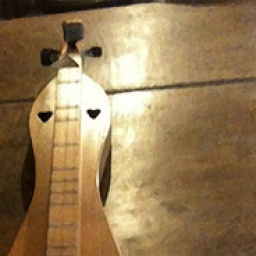
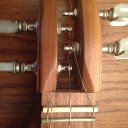
The instrument on the right is a prototype by Gary Gallier , of the Gallier A-frame dulcimer. It's mahogany and redwood, serial number A-1, built in Oct. 2005.
Both of these instruments look and sound great and I'm pretty happy to have them. Thanks for having a look. :)
Hmm...the only thing i can offer is that it's a known thing that 'mystery' buzzes appear most often when the seasons change to dry Autumn and indoor heat. When you played it on vacation last year and it sounded fine- were you in a humid climate on vacation?
Dusty outlined the method well. 
One little detail though- if you are typing in "@" or hyphens when typing in their name, you should not do that- just start typing their user name without a @. Don't put hyphens in either. For example, for Dusty Turtle, I'd just start typing Dusty...and he would pop up as one of the choices of members who have "Dusty" in their profile name...and I could select him probably before I even get to the "ty" of Dusty. I would not start typing @dusty-turtle, I'd start typing Dusty.
Steve, in order to send a private message, first hover your cursor over your name in the upper right-hand corner and choose "Private Messages" from the drop-down menu.
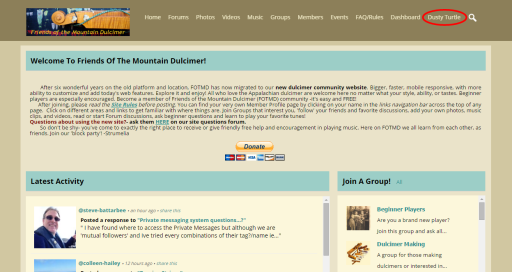
Then choose "New Message."

When you get the message box, put the beginning or part of the person's username in the search box, and all the members that have those same characters will show up in a drop-down menu. Click on the name of the person you want to contact.
Once the recipient's name has been automatically loaded into the recipient field, you can go ahead and 1) give a name or title to your message; 2) add the actual text of the message; and 3) click "send.
I hope that helps.
I have found where to access the Private Messages but Ive tried every combinations of their tag?/name ie @their-name I keep getting an 'invlaid' message
Is there an issue or is it just me doing it wrong?
Thanks
It's been kept in the same room as my other dulcimers. Same tuning as last year and same old strings. It was really out of tune after being unplayed for a year, so I did retune it.
A couple of quick questions first Colleen-
Where was it being stored?- in a location that has different temperatures and humidity than your normal living areas? If so, has it had time to adjust for a day or two?
Also, have you changed the tuning from what you were using a year ago? Or have you put on new strings since last time you were playing it?
New question to an old thread! I have a little travel dulcimer that I bought last year. I took it on vacation and it worked and sounded fine. Fast forward a year and I'm heading off to Christmas vacation again in a week or so. So I hauled it out and tuned it up and I noticed buzzing. I haven't narrowed down which string/fret is causing it. I haven't played it since last December, but it did work ok when I first got it, so I'm not sure what has happened in the meantime. Is there some obvious-but-not-to-me fix for this? Could my fingering be causing buzzing because I am used to playing a regular sized dulcimer?
http://www.everythingdulcimer.com/discuss/viewtopic.php?f=3&t=31460&p=367608&hilit=just+intonation#p367608
This is from April?
The answer is a resounding YES! Most folks, I think, tune a banjimer like the dulcimer that it is. But there's no reason you couldn't string and tune it as a banjo -- except all the conventional banjo chords would be 'backwards' more or less.
So, I came into another rescue, will require some work like the Blue Lion I recently acquired, it was worth the effort.
My question is, it's the first equidistant strung dulcimer I own, a June Apple Banjomer, I have another banjo dulcimer but it is strung as regular dulcimer, so it gets tuned in standard tunings, does anyone know if this should be tuned with the matching drone strings, or should it be tuned to banjo tuning?
Thanks everyone.
The 'bright' sound is probably not caused by the strings, but by the simple fact that you have a very short VSL instrument which may be tuned to a higher pitch than a standard dulcimer.
What is your current tuning? Try tuning down one notch. If you're tuned GDD or GDg, try FEE or FEf; If you're tuned DAA or DAd, try CGG or Cgc. Be aware that the short VSL Ginger dulcimers often "sing" best when tuned up and bright.
Is your Ginger set up for G or D? If you're set up for G, swap your strings (one at a time) for a the standard McSpad Ginger D strings -- .012 plain steel melody strings, .016 plain steel middle drone, and .026 bass string.
You can certainly buy loose (individual) strings .02" larger than your existing strings without bothering things too much.
"All the sites"?
The For Sale section is here:
If you click on Forums at the top of the page, then scroll down, you'll see it also.
Hey, Unclekb! Welcome to FOTMD! Here are some of my thoughts on "used dulcimers":
Hope some of these suggestions are helpful!
Jan (who is thinking about starting to reduce her collection!)
that's a true statement!!
So far I think it's okay now....I'll have to see as I play it and tune it.
Thanks for the tip too
Maria
If it ain't broke now, don't fix it. However, if you find the outermost (closest to you) melody string breaking often, try reversing the peg attachment for the melody strings. That way the outermost string will be attached to the farther peg, making it bend less.
Hey folks, it wasn't my intention to derail this discussion by offering my fictional version of a dulcimer discovery. I really enjoy hearing about everyone's first instrument and hope people continue to post.
well I guess I could do all that but honestly if I spent the money for a new instrument then I don't want to have to fix mistakes. plus now I already bought my "new" old one and I don't think at the moment I need both. In fact the skinnier neck would now mess me up so I'm happy learning on the Walnut Valley one.
but thanks for the suggestions
Maria
well so far with changing the strings a bit and fooling with that screw I've gotten it tuned to dadd and it seems to be holding!! But thanks for the advice and compliments on it!
Maria
Dusty, you had me going. What great story. 
Both versions of your story are excellent.
You should try playing with one melody string using the tuner that works best. The dulcimer is really a three string instrument after all. Looks like you have the old friction ukulele type tuners. If they continue to slip you might lower your tuning to Cgc. Looks like a pretty dulcimer.,. Good luck... Robert
Oh wow.....thanks so much!! it's prettier than the pics on ebay show and for that I'm glad!!
Maria
Okay that's good news!!
Thanks so much
Maria
The strings should go over the top of the peg as you tighten them, not underneath, otherwise the won't stay tight. The picture from the tuning head end seems to show them winding around correctly. With that sort of tuning head it's quite common for the melody strings to cross each other, at it does not usually cause a problem. The inner melody string rightfully goes to the tuner at the far end, and the outer melody string goes to the closest tuner.
You can set those string spacings any way you want, by adding new string slots. The melody string couplet should be about 1/8" apart. The non-middle string is an easy fix with a fine saw like a jewelers' saw or even a V section needle file. The grooves don't have to be deep, but they should be deeper towards the respective end of the instrument.
Dusty, was you possessor of any of the early John Fahey albums?
Thanks Dusty, glad you liked the video. Yes, that is a mic that you see. :-) And thanks for listening to the podcast!
I was watching that one on Ebay. So glad that it went to a good home.
Haha Dusty. That's how we all wish we had found our first dulcimer. Even better than winning the lottery and buying up a whole music store...
I don't know why the above repsonse is on the side but if you could read it and look at picture that would be great
thanks
Maria
>
Okay so I unloosened both of the melody and then somehow popped the one that was closer to the middle which mean the peg was the further away from the fretboard so I had to reverse the strings and I was able to get them both back on. BUT I may have screwed up the direction and does it matter?
Right now the bottom bass d and the middle string a get tighter as I twist the peg UP, and the ones I just put back the two top melody strings get tighter when I twist the pegs down. IS that wrong? or maybe I'm right now and had it wrong before......also here's a new pic and no matter how I try the strings do cross each other but it seems like it's a bit better. what do you think?
Maria
AHHHH the lightbulb goes on lol...Thanks then I don't risk popping the strings too...thank you thank you thank you!!
Maria
Thanks Dusty...
I already did send them the picture I will post here so you will see what I mean and no matter where you fit it (meaning their are extra grooves in the nut) the spacing is not correct. the two dd strings are too close together and the a string is not in the middle it's closer to the bass d string.
I sent them this picture and one of a mcspadden that I got off the internet to show that. I will have to wait now and see what they come back with and then if they give me more trouble I will do the "intonation" check. Even If I lose money I'm getting rid of it and sticking with my old new Walnut Valley..Thanks again
Maria
Well, during the infamous "Blizzard of '78" I had had enough of the New England cold. At the age of 13 I sold my record collection to get enough money for a train ticket to the west coast. I traveled with nothing to eat but a jar of peanut butter and a couple of apples. But I had an old Marine Band harmonica to keep me entertained. The train across the country seemed to take weeks, but it was my first time leaving my native land, so I was entranced watching the scenery roll by. The train dropped me in Los Angeles, but Union Station did not look like California to me. Somehow I found some local buses to get me to Santa Monica, which looked just like the movies: bikini girls playing volleyball, muscle men roller skating, you get the point. I still had no place to sleep and no food to eat, but I was adopted by a group of evangelical surfers. Yes, these folks claimed that G-d spoke to them through the ocean waves. I never learned to surf with these folks, but they did feed me and offered me a ride up north. We drove up the California coast, and on the drive I got to practice my harmonica, for when they weren't surfing, these kooks were smoking weed and singing a mixture of gospel tunes and Hawaiian surfing songs. Indeed, I smoked my first joint with these kind folks, but also ate my first tofu and seaweed soup. I have to admit that I learned more about music and food than I did about the Bible.
We eventually got to Santa Cruz, but that's where they left me. One day we were hanging on the beach and I fell asleep while they surfed the waves. But when I woke up, they were gone. I figured I'd check some of the church soup kitchens, which they frequented, but while I lay there on the beach I saw a small dark object in the ocean. I couldn't tell what it was, but in the haze of the sunshine I kept watching it as it slowly moved to shore. It must have taken a couple of hours, but when it was just beyond the break in the waves, I waded out there and found this soggy, weather-beaten wooden canoe paddle. At least that's what I thought it was at first. After it dried out I could make out a label on the inside that said "Capritaurus Dulcimers." I knew nothing about astrology, but I had heard of a dulcimer before. I traded my harmonica for a hamburger and a set of guitar strings, strung that thing up, and began playing. I just sat cross-legged on the Santa Cruz boardwalk and started picking out simple tunes. And what would you know? People started giving me change! Yes I was busking on an instrument I didn't know how to play. But people saw this 13-year-old kid playing a weird instrument and dropped money and sometimes food in my lap. I don't know whether those surfing hippie Christians led me to this instrument or whether it was astrological fate, but I knew at that moment that my life would only have meaning because of the dulcimer.
Oh, you know the rest. I was discovered by Ry Cooder, given a recording contract with Atlantic Records, hired as VP of folk music at Mel Bay Publishing, appointed by the President to be Curator and Artist-in-Residence at the Smithsonian, yadda, yadda, yadda.
OK. None of that is true at all, but it's better than my telling the truth: A middle-aged, balding man living in the suburbs and driving a mid-sized sedan, I saw a dulcimer on YouTube and then bought one for myself.
I'm nervous because when I tune it now it feels like if I tune it differently (like I want to change it to daa for a music book my son gave me ) then it will pop those two double strings.
I'm guessing you are currently tuned to DAd, in which case you need to tune the melody strings down to A, not up.